
 한국어
한국어

Let’s be honest about the water treatment business: selling the wrong system to a commercial client or a high-volume residential distributor is an expensive mistake. I’ve seen seasoned procurement managers mix up water softeners and reverse osmosis (RO) setups, assuming they both just “clean the water.” They don’t. If you install an RO system where a simple softener was needed, you’ll choke the flow rate and bankrupt the client on membrane replacements. If you put a softener where pure ingredient water is required, your client’s commercial boilers or beverage lines will scale up and fail within six months.
Executive Summary
- Water softeners act as Point-of-Entry (POE) utility protectors, exchanging calcium and magnesium ions for sodium at high flow rates (8 to 20 GPM) to prevent scale buildup.
- Reverse Osmosis (RO) systems serve as Point-of-Use (POU) or localized purification units, removing up to 99% of all dissolved solids (TDS) through semi-permeable membranes.
- Sourcing decisions must align with regional water hardness metrics, local environmental discharge regulations, and the specific application—whether safeguarding plumbing infrastructure or producing ultra-pure drinking water.
We are seeing global water quality deteriorate in highly specific ways. In the United States, over 85% of geographic areas have hard water, with regions like Indianapolis and San Antonio regularly registering hardness levels well over 15 grains per gallon (GPG), or roughly 250 milligrams per liter (mg/L). Meanwhile, European distributors face strict local discharge regulations regarding brine waste from traditional salt-based softeners. Navigating these regional quirks requires a clear-eyed understanding of what each technology actually does, how they operate under real-world pressure, and how to structure your bulk sourcing pipeline to maximize margin without sacrificing field reliability.
The Fundamental Engineering Divide
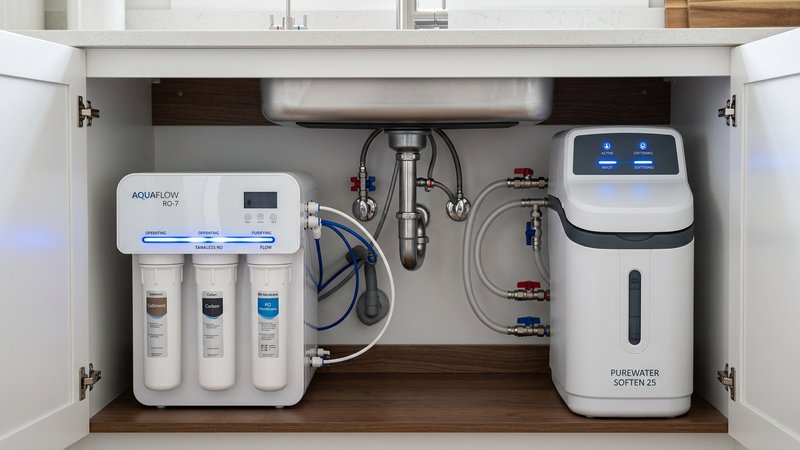
To understand why these systems cannot be swapped, we have to look at what they are physically doing to the water chemistry. A water softener is a single-trick pony, but it performs that trick incredibly well. It targets hardness ions—specifically Calcium (Ca2+) and Magnesium (Mg2+)—and swaps them for Sodium (Na+) or Potassium (K+) ions through a process called ion exchange. The water remains filled with dissolved solids; they are simply different, non-scaling solids. This is why softened water still registers a high Total Dissolved Solids (TDS) reading on a handheld meter. The minerals are still there; they just won’t stick to the pipes anymore.
Reverse osmosis is a completely different beast. Instead of swapping ions, an RO system uses sheer mechanical pressure to force water through a semi-permeable membrane with pores as small as 0.0001 microns. This pressure overcomes natural osmotic pressure, pushing pure water molecules through while leaving behind up to 99% of all dissolved inorganic solids, heavy metals, fluoride, microplastics, and organic contaminants. It is a purification process, not a conditioning process.
Here is a counter-intuitive finding that catches many B2B buyers off guard: highly purified RO water is actually corrosive to standard metal plumbing. Because RO water is stripped of all minerals, its pH often drops below 7.0, and it actively seeks to leach minerals from its surroundings. If you route pure RO water through copper pipes in a commercial building, the pipes will pinhole and leak within a couple of years. Softened water, on the other hand, preserves the natural pH and bicarbonate buffering of the source water, making it much safer for standard copper or brass distribution networks.
ONEMI engineers often point out that pairing these two technologies in a multi-stage configuration is the gold standard for high-TDS regions, as feeding unsoftened hard water directly into an RO system will scale up the expensive RO membrane almost instantly, cutting its operational lifespan from three years down to three months.
| Technical Parameter | Ion Exchange Water Softener | Reverse Osmosis (RO) System |
|---|---|---|
| Primary Target | Calcium, Magnesium (Hardness ions) | TDS, Heavy Metals, Fluoride, Bacteria, Organics |
| Operating Flow Rate | High (8 to 20+ GPM for residential/commercial) | Low (0.03 to 0.5 GPM per membrane element) |
| System Pressure Req. | Standard line pressure (30 to 50 PSI) | High pressure required (50 to 100+ PSI) |
| Waste Stream | Brine discharge during regeneration cycles | Continuous concentrate (wastewater) stream |
| Installation Footprint | Point-of-Entry (POE) main water line | Point-of-Use (POU) or localized commercial skids |
How Ion Exchange Softeners Work Under the Hood
Let’s look at the mechanical sequence of a standard commercial water softener. The heart of the system is the mineral tank, filled with thousands of tiny, negatively charged polystyrene resin beads. These beads are pre-loaded with sodium ions (Na+), which carry a single positive charge (+1). Calcium and magnesium ions carry a double positive charge (+2). As hard water flows down through the resin bed, the stronger (+2) charge of the calcium and magnesium physically pulls them closer to the resin, kicking the weaker (+1) sodium ions off the beads and into the water stream.
Eventually, every single resin bead is saturated with calcium and magnesium. The system can no longer soften water. This is where the regeneration cycle comes in, controlled by an electronic control valve on top of the tank. The valve initiates a backwash to loosen the dirt, then draws a highly concentrated brine solution (sodium chloride dissolved in water) from the adjacent brine tank. This massive concentration of sodium ions forces the resin beads to release the calcium and magnesium, flushing them down the drain, and re-loading the beads with sodium. Once rinsed with fresh water, the system goes back online.
But here is a practical gotcha that every B2B importer must account for: brine discharge regulations are tightening globally. In places like California (specifically the Central Valley) and parts of Texas, local municipalities have outright banned or heavily restricted salt-based water softeners because the chloride-rich discharge damages agricultural soil and complicates municipal wastewater recycling. If you are importing for these markets, you must source alternative solutions, such as template-assisted crystallization (TAC) systems, or specify potassium chloride (KCl) as the regenerant, which is more environmentally friendly but costs up to three times more than standard sodium chloride salt.
The Multi-Stage Mechanics of Reverse Osmosis
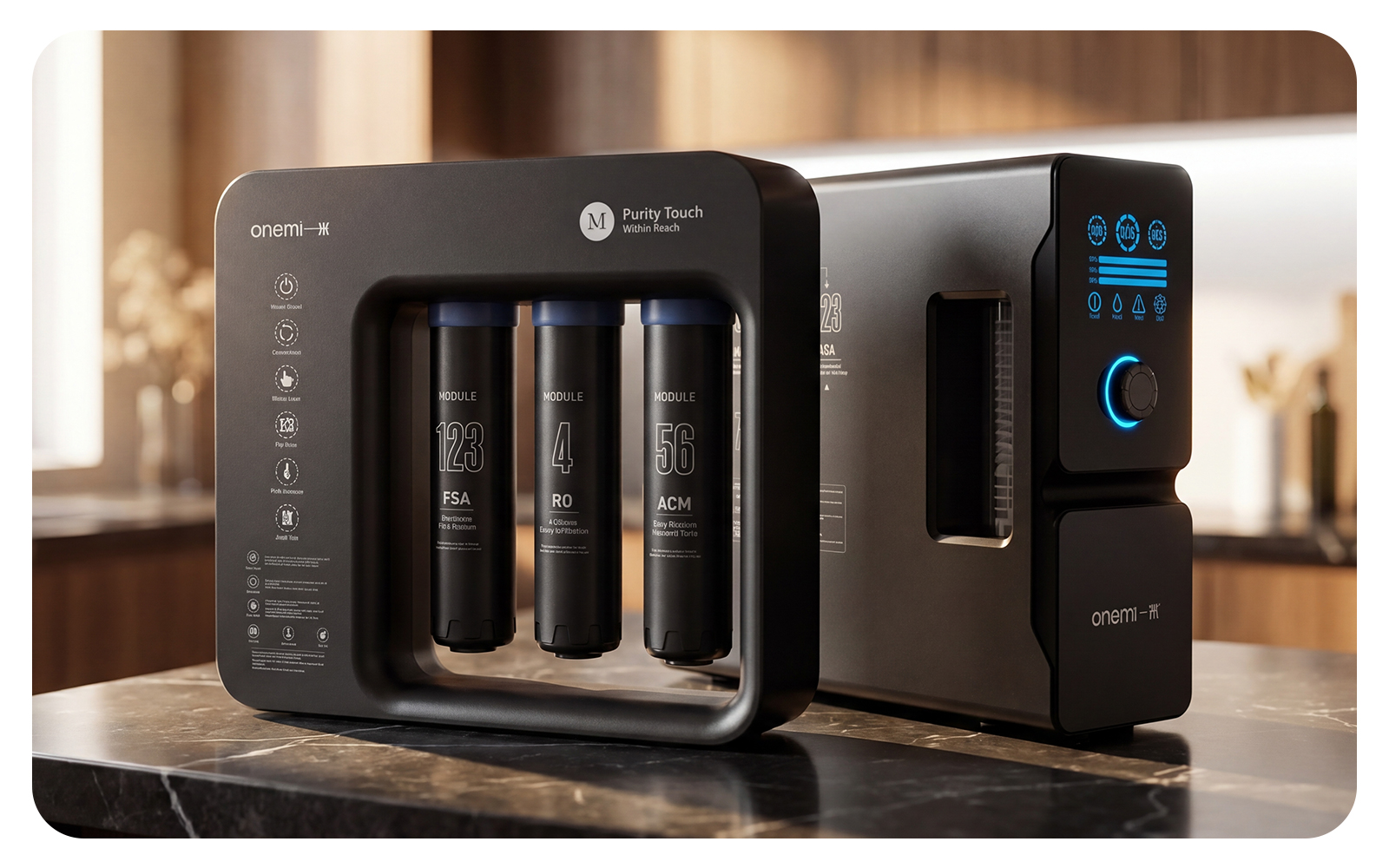
An RO system is never just a membrane. If you feed raw tap water directly into an RO membrane, it will foul within days. A commercial-grade RO system is a carefully engineered sequence of filtration stages designed to protect that delicate 0.0001-micron polyamide thin-film composite (TFC) membrane.
First comes the sediment pre-filter, typically a 5-micron spun polypropylene cartridge, to catch sand, rust, and suspended silt. Next is the activated carbon block filter. This stage is absolutely critical because municipal water contains chlorine or chloramines used for disinfection, and chlorine will chemically burn holes through a polyamide RO membrane, destroying its rejection capabilities. The carbon block adsorbs this chlorine, protecting the membrane downstream.
Only after these pre-treatment stages does the water reach the RO membrane itself. Under high pressure, water is forced through the spiral-wound membrane sheets. The purified water (permeate) flows down a central perforated tube, while the concentrated contaminants (reject or concentrate) are continuously washed off the membrane surface and routed to the drain. This continuous self-cleaning action is what allows the membrane to function for years without clogging, but it also means RO systems inherently produce wastewater. A standard residential RO system might waste 3 to 4 gallons of water for every gallon of pure water produced, though high-efficiency commercial systems with recovery loops can bring this ratio down to 1:1 or even 1:0.5.
How do you ensure consistent performance across varying water pressures? Many regions suffer from low municipal water pressure, dropping below the 50 PSI threshold required for efficient RO operation. In these scenarios, B2B distributors must source systems equipped with integrated electric booster pumps. These pumps artificially raise the inlet pressure to 80 or 100 PSI, which dramatically improves the system’s recovery rate, lowers the wastewater ratio, and ensures the TDS rejection rate remains above 95%.
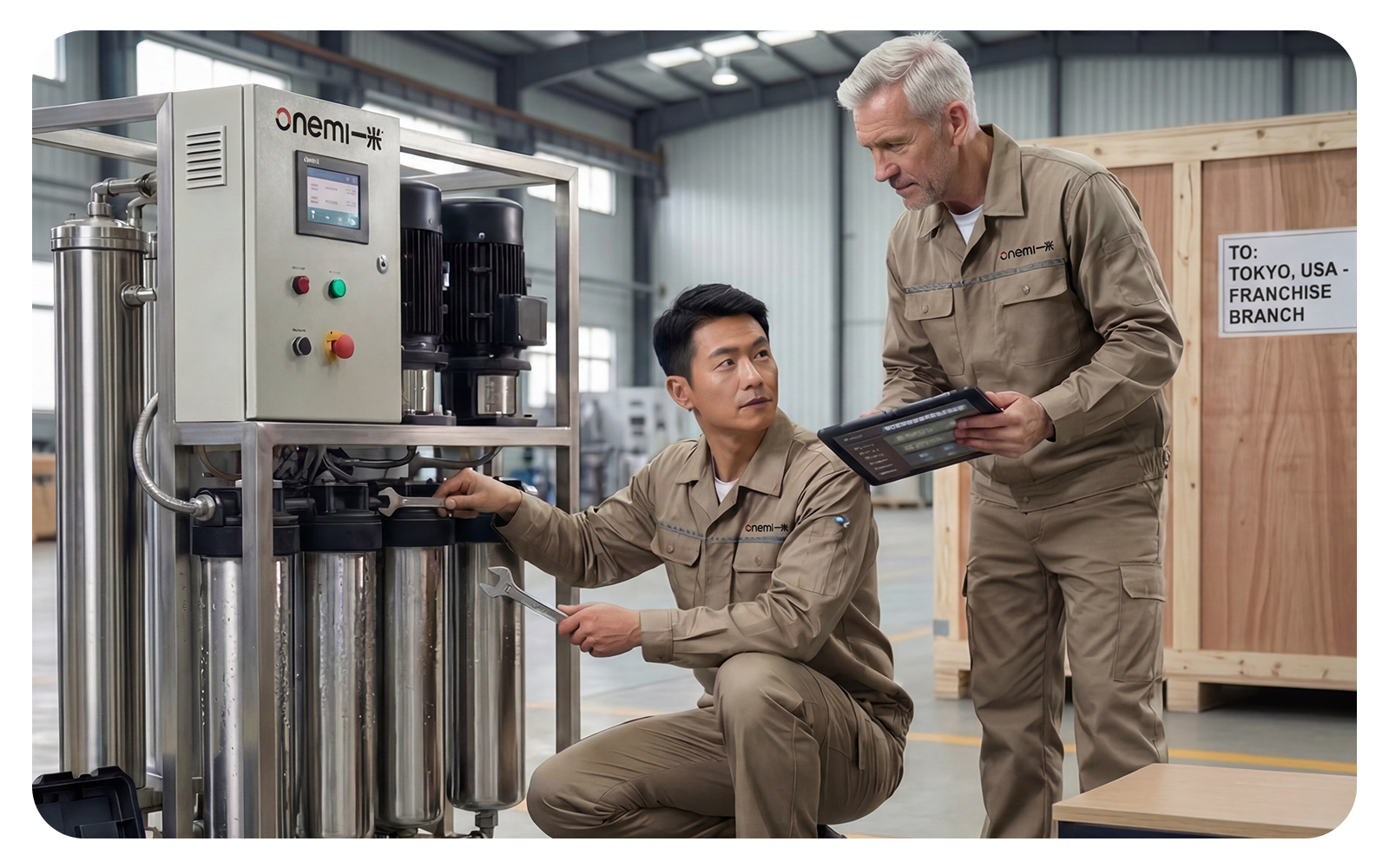
ONEMI designs its commercial RO lineups with integrated booster pumps and smart auto-flush valves as standard configurations to mitigate these field pressure fluctuations.
Real-World Sourcing Implications for Global Distributors
When you are sourcing water treatment equipment at scale, you aren’t just buying hardware; you are buying a solution to a specific regional water problem. Let’s look at how local water profiles dictate your procurement inventory. If your primary distribution network is in the UK or Northern Europe, you are dealing with ancient limestone aquifers. The water hardness in London, for instance, averages around 280 to 300 mg/L of calcium carbonate. Here, your primary inventory driver must be high-capacity POE water softeners. Your commercial clients—hotels, laundromats, and restaurants—need these systems to protect their commercial dishwashers, water heaters, and laundry equipment from catastrophic scale buildup.
Conversely, if you are distributing to coastal regions in the Middle East or areas in the US Southwest with high brackish groundwater tap profiles, TDS levels can exceed 1,500 mg/L. In these markets, a water softener is practically useless on its own. The water might be soft, but it will still taste metallic, salty, and fail to meet basic drinking water standards. Here, your inventory must skew heavily toward multi-stage RO systems, both under-sink residential units and light commercial skids. The market demands pure, bottled-quality drinking water straight from the tap.
Let’s look at a concrete case in point: a commercial laundry facility in Munich, Germany, was experiencing heater element failures every 9 months due to heavy scale accumulation. The local distributor initially recommended a budget-grade imported RO system, thinking “pure water” would solve everything. However, the RO system couldn’t keep up with the facility’s peak demand of 45 GPM without a massive, cost-prohibitive holding tank setup. The solution was actually a duplex alternating water softener. By swapping the hardness ions at high flow rates, the scale stopped forming, the laundry equipment maintained its thermal efficiency, and the capital expenditure was 60% lower than the proposed RO installation. This is the kind of practical application knowledge that saves B2B relationships.
When selecting a manufacturing partner for global sourcing, look closely at their component certification. For the North American market, NSF/ANSI 44 is the gold standard certification for water softeners, verifying structural integrity and barium/radium reduction. For RO systems, look for NSF/ANSI 58 for residential systems and NSF/ANSI 61 for material safety across all drinking water components. Sourcing certified systems ensures your shipments won’t get held up at customs or rejected by commercial mechanical engineers during project submittals.
Are your current product lines optimized for these regional regulatory shifts? As municipal infrastructure ages and chemical contaminants like PFAS and microplastics dominate global news cycles, the consumer demand for point-of-use purification is skyrocketing. Keeping a balanced inventory of high-flow softeners for infrastructure protection and high-rejection RO systems for drinking water safety is no longer just a good strategy—it’s the baseline for staying competitive in the modern water treatment market. Working with an agile OEM partner like ONEMI allows global distributors to customize system configurations, from custom resin volumes to advanced membrane arrays, ensuring a perfect fit for localized water challenges.