
 한국어
한국어

A few months ago, a commercial client walked into our office with a classic dilemma. They had spent thousands of dollars on marketing a premium alkaline water brand in Southern California, only to receive a wave of customer complaints about a “flat, chalky” taste and white scaling inside their brand-new glass dispensers. The culprit wasn’t their branding; it was a fundamental mismatch between their imported ceramic filter media and the local tap water chemistry, which already had a high baseline of calcium carbonate.
Executive Summary
- The global alkaline water market is projected to approach $12 billion by 2026, driven by a shift toward functional, mineral-rich hydration.
- Successful OEM/ODM scaling requires balancing pH stability with local water hardness to avoid taste issues and scaling.
- Choosing the right technology—whether passive mineral ceramic media or electronic electrolysis—determines your regulatory pathway and margin structure.
This is where many ambitious water brands stumble. They treat alkaline water filtration as a plug-and-play commodity, ignoring the fact that municipal water profiles vary wildly from Munich to Miami. To build a product that survives the journey from a warehouse to a consumer’s kitchen countertop, you must understand what happens inside the cartridge at a molecular level.
The Chemistry of Alkaline Water Filtration

To the average consumer, “alkaline” simply means a pH level above 7.0. To an engineer, it represents a complex balancing act of dissolved ions, electrical potential, and mineral solubility. When designing an OEM water filtration system, we generally look at two primary pathways to achieve alkalinity: passive mineral reconstitution and active electrolysis.
Passive mineral reconstitution relies on sacrificial media. As water flows through the cartridge, it contacts highly pure magnesium, calcium, and potassium minerals. These minerals slowly dissolve, releasing hydroxyl ions (OH-) and increasing the pH. This process mimics how natural spring water gathers minerals as it trickles over underground rock formations. The challenge lies in controlling the dissolution rate. If the water sits in the filter housing for twelve hours overnight, the first glass poured in the morning might have an unpleasantly high pH of 9.5 and a bitter taste, while the fifth consecutive glass might drop back down to 7.2 because the contact time was too short.
Active electrolysis, or ionization, takes a completely different route. It uses platinum-coated titanium plates to split the water molecules electrically. This process separates the acidic and alkaline streams, delivering a highly stable, adjustable pH without adding physical minerals to the source water. However, this technology requires a robust power supply, electronic control boards, and a higher upfront manufacturing budget. It also demands a baseline level of dissolved solids in the incoming water to conduct the electrical current, making it less effective in regions with extremely soft water unless a remineralization stage is installed upstream.
Why does this distinction matter for your brand? Because your target market’s local water quality dictates your product architecture. If you are launching a counter-top system in a region with hard water, adding more calcium through a passive filter will inevitably lead to scaling and consumer complaints. Conversely, if your target market has soft, acidic water, an ionizer alone will struggle to function without an integrated mineral pre-filter.
Comparing Alkaline Filtration Technologies
Choosing the right technology for your product line involves balancing performance, cost, and regulatory compliance. The table below outlines the three most common manufacturing approaches for alkaline water systems.
| Technology | Average pH Output | Key Advantages | Primary Limitations | Target Applications |
|---|---|---|---|---|
| Mineral Ceramic Media | 8.0 – 9.5 | Low cost, no electricity needed, adds essential minerals | pH decay over time, potential for scaling in hard water | Gravity pitchers, inline RO post-filters, portable bottles |
| Electronic Electrolysis | 8.5 – 10.0+ | Adjustable pH levels, high hydrogen potential (ORP) | High manufacturing cost, requires power source | Premium countertop appliances, clinical installations |
| Hybrid RO + Remineralization | 7.5 – 8.5 | Removes all contaminants first, highly consistent taste | Complex multi-stage housing, water waste from RO membrane | Under-sink residential systems, light commercial use |
For brands targeting the residential market, the hybrid RO system has become the gold standard. By stripping the water down to its pure H2O state before introducing a controlled blend of minerals, you eliminate the unpredictable variables of local municipal water. This ensures that whether your customer is in London or Tokyo, the water coming out of your system tastes exactly the same.
The Engineering Gotchas of Mineral Media
If you decide to go the mineral media route—which remains highly popular due to its excellent profit margins—you must prepare for the physical reality of mineral dissolution. Many off-the-shelf mineral balls use low-grade binders that degrade quickly when exposed to continuous water flow. Over a few months, these binders can break down, releasing fine white sediment into the storage tank or clogging downstream flow restrictors.
Another common engineering oversight is the management of Oxidation-Reduction Potential (ORP). A negative ORP is highly desirable in alkaline water because it indicates antioxidant properties. To achieve a negative ORP, filter media often incorporates pure magnesium metal chips. While highly effective, magnesium reacting with water produces hydrogen gas. If your system design does not include a venting mechanism or a pressure-relief valve, this gas can build up inside sealed filter housings, causing a sputtering flow or, in extreme cases, hairline cracks in plastic housings.
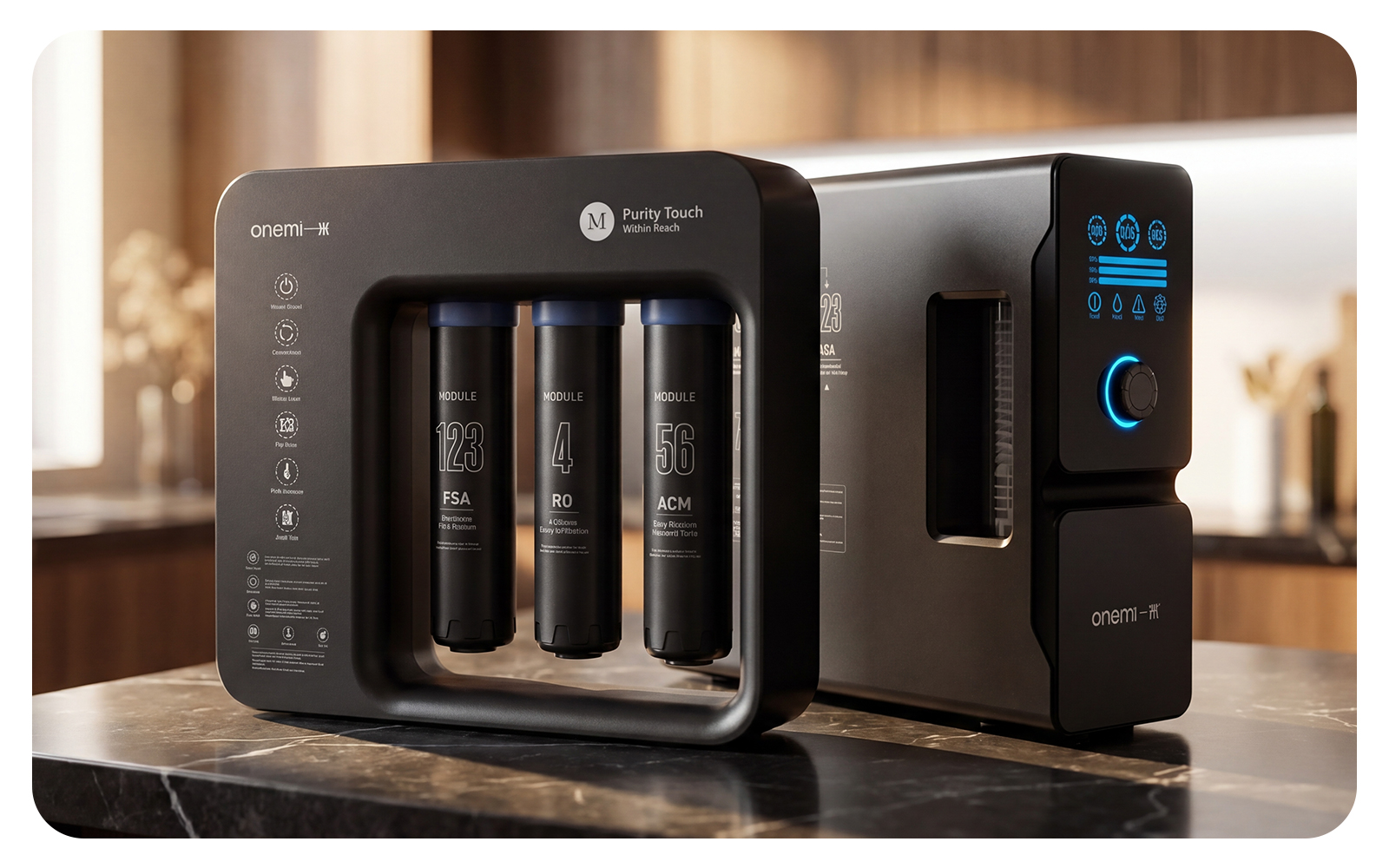
How do we solve this? At ONEMI, we utilize a proprietary sintering process for our ceramic media, baking the mineral blends at precise temperatures to ensure structural integrity over a 12-month lifecycle while maintaining a controlled, steady release of hydrogen ions without excessive gas buildup.
Navigating Global Regulatory Standards
You cannot scale a global water filtration brand without hitting a wall of certifications. The regulatory landscape for water contact materials is incredibly strict, and failure to secure the right stamps of approval can result in customs seizures or costly product recalls.
In North America, NSF/ANSI Standard 42 (for aesthetic effects) and Standard 53 (for health effects) are the benchmarks. If your alkaline filter is positioned as a post-filter for a Reverse Osmosis system, you also need to look at NSF/ANSI Standard 58. These certifications verify that the materials used in your housings, O-rings, and media do not leach harmful chemicals into the water. In Europe, the regulatory path is more fragmented, requiring compliance with the German LFGB, the French ACS, or the UK’s WRAS regulations depending on your primary target markets.
Crucially, if your system uses electronic components for electrolysis, you must also clear electrical safety and electromagnetic compatibility standards such as CE, FCC, and UL. This dual-track certification process—covering both water safety and electrical safety—is why many start-up brands partner with established ODM manufacturers who already hold these certifications for their base platforms, allowing the brand to launch with a customized outer shell while piggybacking on existing regulatory approvals.
How to Choose Your Manufacturing Partner
When evaluating potential OEM/ODM partners for your alkaline water line, look beyond their unit prices. A cheap filter cartridge is no bargain if it leaks in ten percent of your customers’ homes or fails to deliver the promised pH levels after two weeks of use. Ask prospective manufacturers about their testing protocols: Do they test their filters with simulated real-world water profiles, or do they only use distilled water in their laboratory testing? Do they perform pressure impulse testing to ensure their housings can withstand the water hammer effect common in high-rise apartment buildings?
A reliable manufacturing partner should offer comprehensive support, from initial CAD drawings and rapid prototyping to packaging design and international logistics. They should have a deep understanding of food-grade plastics, ultrasonic welding techniques, and automated assembly lines that keep production defects to a absolute minimum. By focusing on engineering quality and regulatory compliance from day one, you can build an alkaline water brand that delivers not just healthy hydration, but long-term business growth.