
 한국어
한국어

You are looking at a specification sheet for a 2,000 GPD whole house reverse osmosis system. The FOB price from a Chinese manufacturer says $350. On a retail site in Texas, a system with seemingly identical specs is listed for $4,500. This massive price gap is where most water treatment distributors, real estate developers, and sourcing managers get tripped up.
Executive Summary
- True FOB costs for commercial-grade whole house RO systems range from $180 to over $1,200 depending on membrane quality, pump selection, and structural frame materials.
- Hidden costs like shipping logistics, customs duties, pre-treatment filtration, and pressurized storage tanks frequently triple the initial hardware acquisition price.
- Partnering with a specialized OEM manufacturer in China typically reduces per-unit production costs by 40% while allowing custom engineering for regional water profiles.
Sourcing water purification hardware on a global scale is not just about comparing line-item prices on a spreadsheet. If you do not understand the engineering decisions behind that $350 quote, you will likely pay for it three times over in warranty claims, premature membrane fouling, and plumbing failures on the ground.
The Real Breakdown of Factory Floor Costs
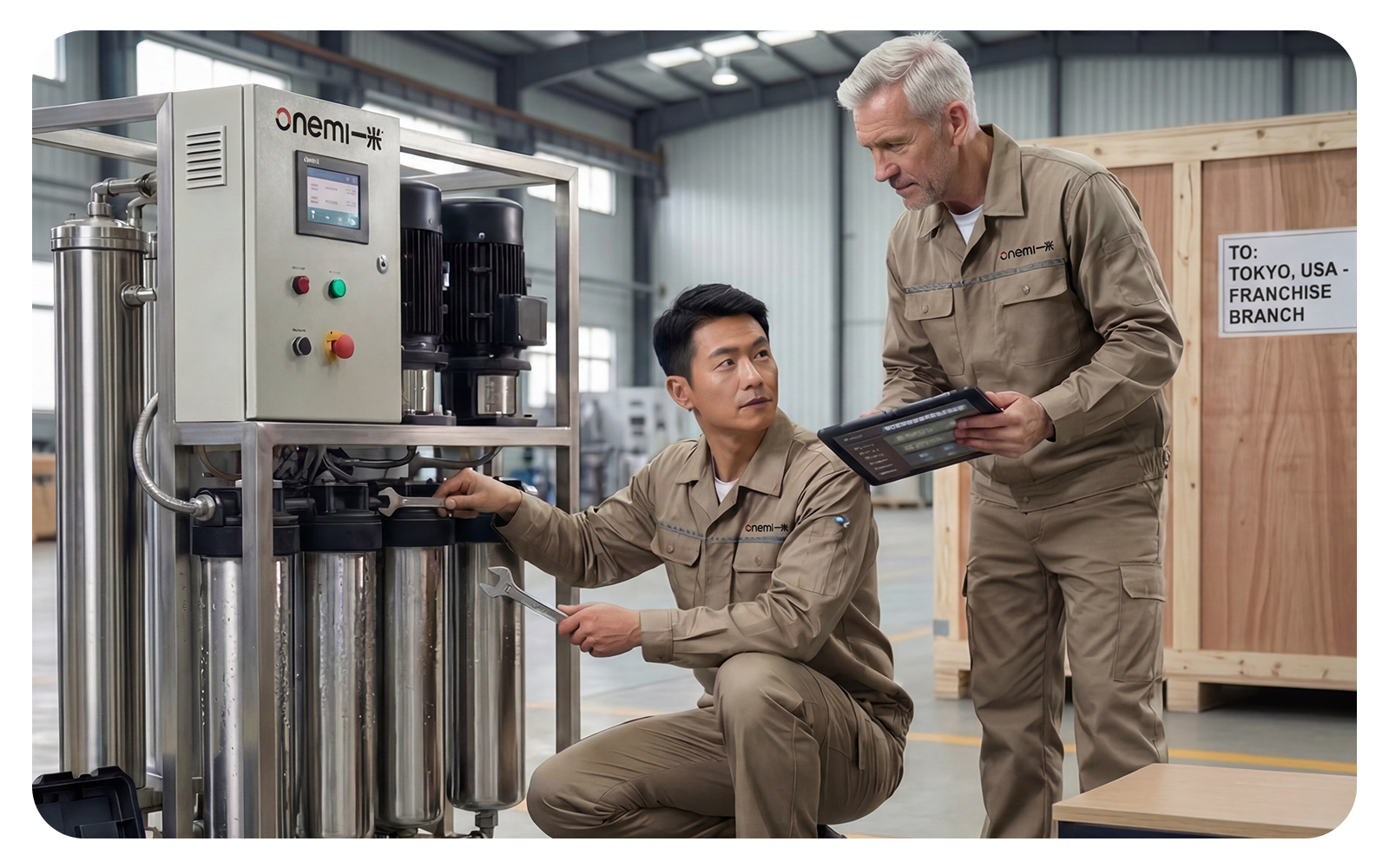
Let us peel back the metal casing of a standard whole house RO unit. When a factory in Ningbo or Wenzhou builds a system, their bill of materials determines the baseline reliability. A cheap system uses generic rotary vane pumps and unbranded low-pressure membranes. A premium system uses multi-stage centrifugal pumps, Dow Filmtec or Toray membranes, and integrated PLC control panels.
Most commercial buyers do not realize that the frame material itself can alter the FOB price by up to $150. In high-humidity coastal regions of Florida or Spain, a painted carbon steel frame will show rust spots within six months. Upgrading to 304 or 316 stainless steel is not a luxury; it is a baseline survival requirement for the machine.
ONEMI engineers often point out that the cost of electrical components is another area where factories quietly cut corners. Using non-UL or non-CE certified contactors and microprocessors saves a few dollars upfront but guarantees compliance failures when importing into North America or the European Union.
| System Component | Low-Tier Sourcing ($180-$350 FOB) | Mid-Tier Sourcing ($350-$750 FOB) | High-Tier Sourcing ($750-$1,200+ FOB) |
|---|---|---|---|
| RO Membranes | Generic Chinese domestic brands | Vontron / CSM high-rejection | DuPont Filmtec / Hydranautics |
| High-Pressure Pump | Local brass rotary vane pump | Shimge or Nanfang (CNP) Stainless | Grundfos / Procon premium |
| Frame & Plumbing | Painted carbon steel / PVC | 304 Stainless Steel / UPVC | 316 Stainless Steel / Food-grade SUS |
| Control System | Manual analog valves | Digital microcomputer board | Siemens PLC / Touchscreen HMI |
Do not buy the cheapest option unless you plan to rebuild it yourself.
The Hidden Infrastructure Costs Beyond the Skid
An RO system is not a plug-and-play appliance like a microwave. It is a highly sensitive chemical processing plant scaled down for residential or light commercial use. If you feed raw tap water directly into a reverse osmosis membrane without pre-treatment, the system will self-destruct.
Consider a real-world scenario from a boutique resort development in Los Cabos, Mexico. The local groundwater has a total dissolved solids (TDS) level of approximately 1,200 ppm and a hardness level exceeding 15 grains per gallon. The developer purchased ten 3,000 GPD RO units directly from an online trading platform. Within three weeks of installation, the product water flow dropped by 70% due to calcium carbonate scaling on the membrane surfaces. The membranes were completely ruined.
To make a whole house RO system work reliably, you must purchase and install a complete pre-treatment train. This includes a multi-media sediment filter to remove suspended solids, an active carbon block to neutralize chlorine which eats polyamide membranes, and a water softener or anti-scalant dosing system to handle hardness minerals. This pre-treatment hardware often costs just as much as the RO unit itself.
You also need to store the water. Reverse osmosis systems produce water slowly, drop by drop, storing it in a non-pressurized atmospheric tank. You then need a secondary delivery pump and a pressure tank to push that clean water from the storage tank into the home’s plumbing system. Suddenly, your $500 RO unit requires $1,500 of auxiliary equipment to actually deliver a glass of water to the kitchen sink.
Navigating the Logistics and Import Minefield
When importing container loads of water purification equipment, the FOB price is merely the starting line. Freight costs have stabilized somewhat since the extreme volatility of recent years, but shipping heavy, bulky steel skids across the ocean remains a major cost driver.
Customs duties and local regulatory certifications can completely destroy your profit margins if you do not plan for them. For example, importing water treatment equipment into the United States often subjects the goods to Section 301 tariffs if sourced from China, adding an extra 25% to the declared value. Furthermore, municipal inspectors in many Western markets require NSF/ANSI 61 certification for any component touching drinking water. If your imported system uses uncertified plastics or brass fittings that leach trace lead, you cannot legally connect it to a public water supply.
Why do major regional brands still source from China if these hurdles exist? Because the manufacturing ecosystem in regions like Zhejiang province is unmatched in its efficiency. The key is working with an OEM partner who understands these international regulatory frameworks and can build systems using certified components while keeping the core manufacturing labor costs low.
How to Optimize Your Sourcing Strategy
If you want to reduce your procurement costs without sacrificing the structural integrity of your water systems, you must change how you negotiate with factories. Stop asking for the lowest price. Instead, ask for a detailed component breakdown sheet.
Specify the exact brands of critical wear items. Demand genuine DOW Filmtec or high-grade Vontron membranes. Insist on stainless steel multi-stage pumps with thermal overload protection. If the factory balks at these specifications, they are likely relying on sub-par components to inflate their margins.
Another counter-intuitive finding from high-volume sourcing projects is that over-specifying system capacity can actually save money over a five-year operating window. Running a smaller 1,000 GPD system at 90% capacity to meet daily demand wears out pumps and fouls membranes rapidly. Sourcing a 2,000 GPD system and running it at 45% capacity extends the lifespan of your consumables by years, drastically reducing truck rolls and field maintenance labor costs.
Ultimately, successful sourcing is about finding the sweet spot where engineering reality meets import economics. By understanding the true component costs, planning for necessary pre-treatment infrastructure, and selecting an OEM partner capable of meeting strict international standards, you can deploy highly reliable whole house reverse osmosis systems that deliver clean water without draining your operating budget.