


 한국어
한국어

- Food-grade material is the first compliance gate: wetted parts carry NSF/ANSI 61 and NSF/ANSI 372 obligations, with lead capped at 0.25% weighted average.
- A valve-core tolerance of ±0.01 mm and a surface finish of Ra≤0.8 μm are what separate a fitting that seals from one that drips under line pressure.
- Audit batch consistency, not the sample. A flawless sample and a drifting production line are both common in low-cost parts sourcing.
A water purifier is a chain of parts under pressure. The RO membrane gets the marketing budget, but the leak that ruins a distributor’s quarter is almost always a ten-cent quick-connect fitting or a faucet stem that drifted a few hundredths of a millimetre off spec. For importers and assembly lines, the parts catalog is where margin is won or lost long after the unit ships.
Materials Are the First Gate
Every wetted part, from the filter housing to the faucet body, has to be food-grade. That usually means polyoxymethylene, better known as POM, for quick-connect fittings and valve bodies; 304 or 316L stainless for faucet stems and housings; PEEK where the part sits in hot or aggressive water. Cheap regrind plastic is the common shortcut, and it shows up as stress cracking, taste pickup, and failed audits.
In the US market, material compliance is governed by NSF/ANSI 61 for health effects and NSF/ANSI 372 for lead content. NSF/ANSI 372 caps lead at 0.25 percent weighted average across wetted components. A fitting that meets the dimensional spec but was molded from unlisted resin will still fail the certification file, and that failure lands on the importer, not the molder. ONEMI’s parts line is built around food-grade resin and stainless, with the material certifications supplied per batch. See the full certification scope on the certifications page.
Tolerances and Surface Finish Decide Whether It Leaks
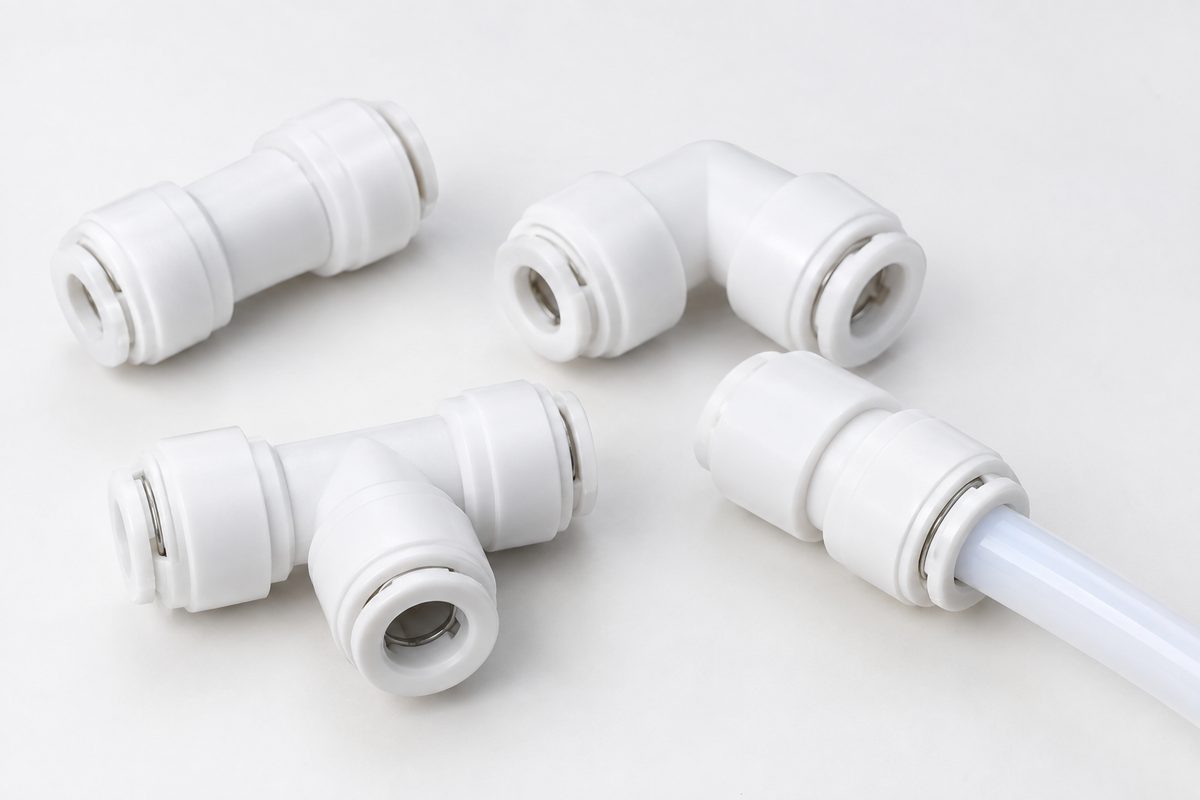
A push-fit fitting looks simple. It is not. The grip ring, the O-ring seat, and the release collar all have to hold dimension across temperature cycles and line pressure. On valve cores, a tolerance of plus or minus 0.01 millimetres is the difference between a clean seal and a slow drip. Surface finish matters just as much: a rough bore above Ra 0.8 micrometres traps scale, wears the O-ring, and turns a two-year part into a six-month one.
Threaded parts are a separate discipline. NPT or metric sealed threads have to be cut, not just tapped, or the joint leaks under the 50 to 80 psi a typical RO system runs. Stainless parts should be passivated after machining to build the passive oxide layer that resists corrosion in water service. These are process details that never appear on a price list and always show up in a warranty claim.
The Parts Catalog, Part by Part
| Part | Common spec | What goes wrong when it’s cheap |
|---|---|---|
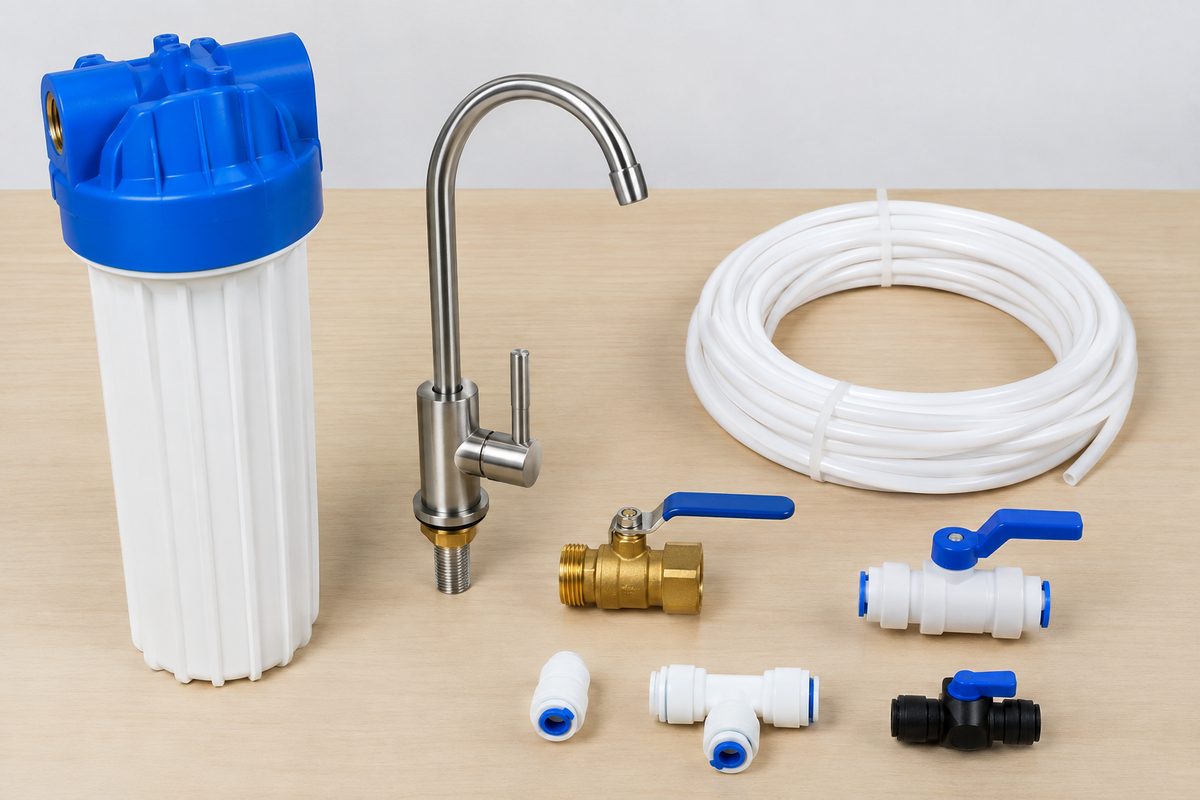
| Quick-connect fittings | 1/4″ and 3/8″ OD, food-grade POM | Grip ring slips, O-ring seat leaks under pressure |
| Filter housings | Polypropylene or stainless, NSF/ANSI 61 | Stress cracks, poor thread seal on the cap |
| Faucets | 304/316L stainless, ceramic or brass internals | Stem wear, lead in the alloy, drip after months |
| Ball valves and tees | POM or brass, sealed threads | Seized handles, cross-threaded ports |
| Tubing | PE, food-grade, consistent wall thickness | Pinch points, burst under pressure spikes |
Assemblers don’t buy one of these. They buy them by the container, and the repeatability across thousands of units is the actual deliverable. A parts supplier that sends a perfect sample and then drifts on production is a common failure mode, which is why serious buyers audit batch records, not showpieces.
Compliance Is a Stack, Not a Sticker
North American buyers usually need three layers: NSF/ANSI 61 and 372 for the wetted materials, plus California Proposition 65 if the product ships into that state. Prop 65 is a labeling law, not a product standard, but it has teeth: wetted components must control lead, cadmium, and phthalates, and the short-form warning label now names the specific chemical. For stainless and POM parts sourced from a disciplined factory, this is routine paperwork. For a low-cost vendor, it is where deals quietly die.
The practical question for an importer is whether the parts supplier can produce the certification file for the exact resin and alloy in the production batch, not a lookalike from the catalog photo. That is the difference between a line that clears customs and one that gets flagged.
Sourcing Strategy: Audit the Line, Not the Sample
Three things separate a reliable parts supplier from a one-off vendor. First, material traceability: the resin lot and the stainless heat number should be recoverable from the finished part. Second, process discipline: passivation on stainless, low-speed machining on PEEK and POM so the material doesn’t warp, and a dimensional inspection at the line rather than a final sort. Third, minimum order reality: precision parts carry tooling and setup cost, so a MOQ that is too low usually means the vendor is amortizing it somewhere else, often in material quality.
For importers and assembly lines, the right approach is to start with a specification document that names the material, the tolerance, the surface finish, and the certification file, then hold the supplier to that document, not to the sample. ONEMI manufactures the parts alongside the systems they go into, so the fitting and the housing were designed to meet each other. The parts catalog and OEM/ODM factory pages list the specifics.
The Spec Sheet Is the Contract
A water purifier that leaks costs a distributor more than any invoice. The parts that hold it together, the fittings, housings, faucets, and valves, are where that risk concentrates. Sourcing them on material, tolerance, and traceability rather than on price is not extra diligence; it is the difference between a product line that scales and one that drowns in warranty claims.