

 한국어
한국어

- The global portable water filter market is projected to exceed $2.8 billion by 2030, with RV and camping segments driving 22% of demand growth since 2024.
- Chinese manufacturers now offer NSF/ANSI 42 and 53 certified portable filtration at per-unit costs 40-60% below US/EU counterparts, with MOQs starting at 500 units for OEM orders.
- Three filter technologies dominate the RV aftermarket — granular activated carbon (GAC) inline filters, hollow-fiber UF straws, and gravity-fed multi-stage systems — each with distinct sourcing economics and margin profiles.
The RV Water Filter Market Is No Longer a Niche
RV ownership in the United States hit 11.2 million households in 2025, according to the RV Industry Association. That is not a rounding error. Every one of those rigs connects to campground water hookups of wildly variable quality — from municipal treated supplies in Florida state parks to well water in Arizona desert campsites with TDS readings pushing 1,200 ppm. The result is a replacement-parts market that turns over roughly every three to six months per active RV household, creating a recurring revenue stream that importers and distributors are only beginning to map out systematically.
What changed in 2025-2026 is the convergence of three forces. First, the post-pandemic outdoor recreation boom did not fade — it stabilized at a permanently higher baseline. Second, the EPA’s 2024 PFAS National Primary Drinking Water Regulation, even with its compliance timeline extended to 2031, fundamentally shifted consumer awareness: campers now ask about contaminant removal specs, not just “does it make the water taste better.” Third, Amazon’s RV accessories category grew 34% year-over-year in 2025, creating a distribution channel that did not exist at this scale five years ago. For B2B buyers sourcing from China, this is a structural shift, not a trend.
What Buyers Actually Stock: Three Product Categories That Move
Walk through any RV parts distributor’s inventory and the portable filtration segment breaks cleanly into three buckets. Each has different manufacturing requirements, different margin structures, and different supply chain considerations.
1. Inline Hose-Mounted GAC Filters
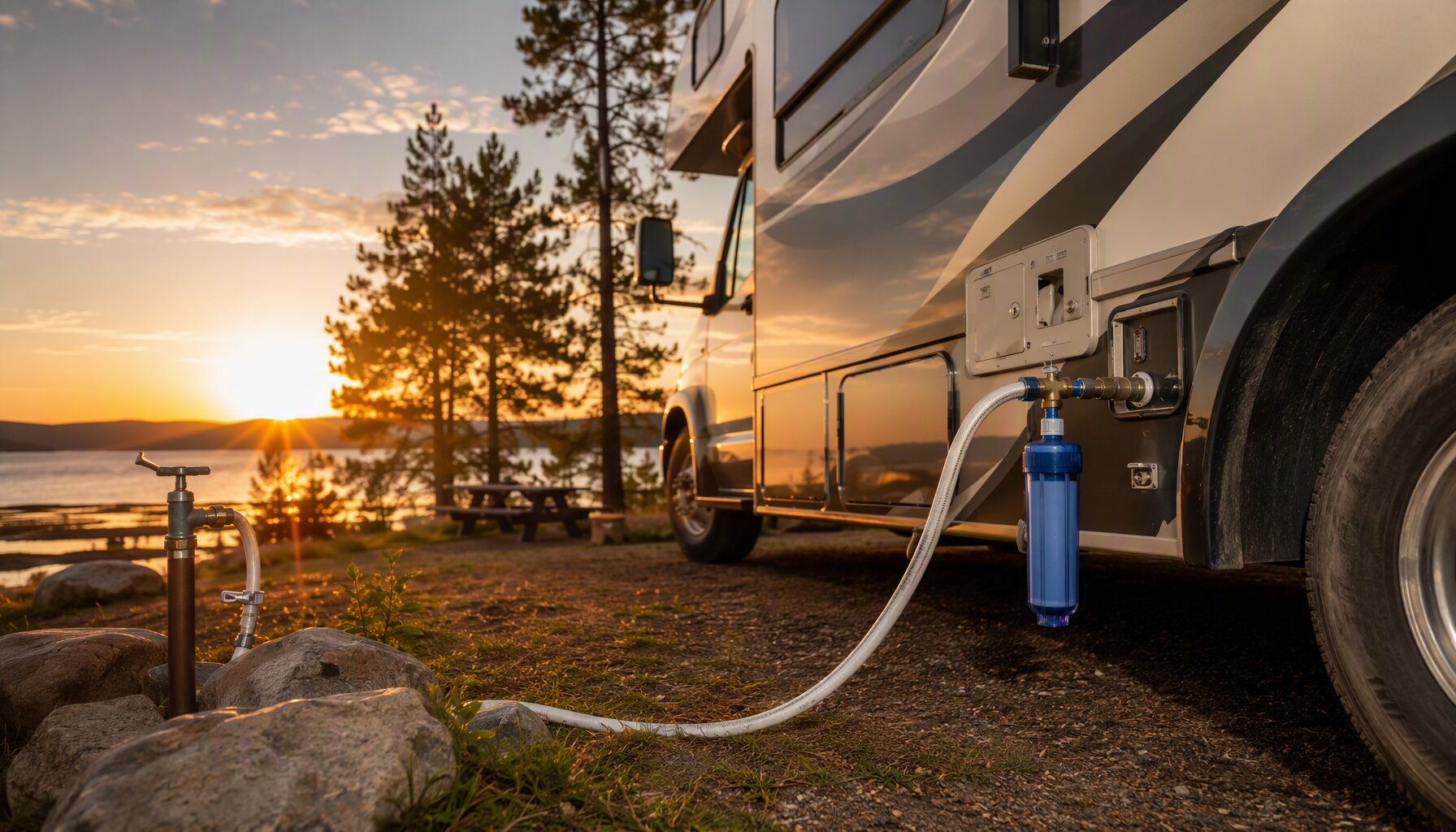
This is the volume play. These are the cylindrical cartridges that screw onto the water hose between the campground spigot and the RV inlet. Typical specs: 20-micron sediment pre-filter layer wrapped around granular activated carbon, sometimes with a KDF (kinetic degradation fluxion) media layer for chlorine and heavy metal reduction. Housing material is food-grade polypropylene, weight around 450 grams, service life roughly 3 months or 1,500 gallons.
The dominant SKU on Amazon — Camco’s TastePURE model — retails at $18-22 per unit and holds NSF/ANSI 42 (aesthetic effects: chlorine taste/odor) and NSF/ANSI 53 (health effects: lead, VOCs) certifications. The manufacturing cost from a Guangdong factory for an equivalent unit with comparable certification runs $3.20-4.80 per unit at 5,000-piece MOQ, landed. That gives importers a 65-72% gross margin at wholesale and still leaves room for the distributor and retailer.
The key sourcing decision here is whether to pursue NSF certification. Getting a product through NSF/ANSI 42 testing at a WQA-accredited lab costs roughly $8,000-15,000 in testing fees and takes 3-5 months. For a private-label brand launching on Amazon, the ROI calculation is straightforward: working with an experienced OEM water filter manufacturer reduces sampling-to-production lead time to 45-60 days: NSF-certified SKUs consistently rank in the top five organic search results for “rv water filter” and command a 30-50% price premium over uncertified alternatives. For distributors supplying brick-and-mortar RV dealerships, NSF certification is usually non-negotiable — the dealership’s insurer typically requires it. ONEMI maintains current NSF/ANSI 42 and 53 certifications with test reports available for buyer review.
2. Hollow-Fiber UF Straw Filters
If inline GAC filters are the volume play, UF straws are the margin play. These are the personal filtration devices — roughly the size of a thick marker pen — that backpackers, campers, and emergency preparedness buyers purchase individually or in multi-packs. Filtration media: 0.01-0.1 micron hollow-fiber ultrafiltration membrane, typically PES (polyethersulfone) or PVDF. Flow rate: 300-500 ml/minute by suction. Rated capacity: 1,500-3,000 liters per unit before replacement.
The category leader LifeStraw retails its personal filter at $19.95. But here is what matters for B2B buyers: the ex-factory price from a Shenzhen or Xiamen UF membrane specialist for a functionally equivalent unit — 0.01 micron pore size, 1,500L rated capacity, food-grade ABS housing — is $1.80-2.60 at 1,000-unit MOQ. Even after adding custom retail packaging ($0.30-0.50/unit), Amazon FBA fees ($3.50-4.50/unit), and 15% referral fee, a private-label seller can price at $14.99 and still net 40% margin.
The catch is quality consistency. Hollow-fiber membranes are sensitive to manufacturing defects — a microscopic tear in a single fiber and the entire unit leaks unfiltered water. Reputable Chinese factories in this space maintain membrane integrity testing stations on every production line, typically using air-pressure decay testing on 100% of units. Importers should require factory audit reports showing this testing protocol. The difference between a factory that tests every unit and one that does batch sampling is roughly $0.40/unit in cost — and the difference between a 0.2% and 3% defect rate in the field.
3. Gravity-Fed Multi-Stage Systems
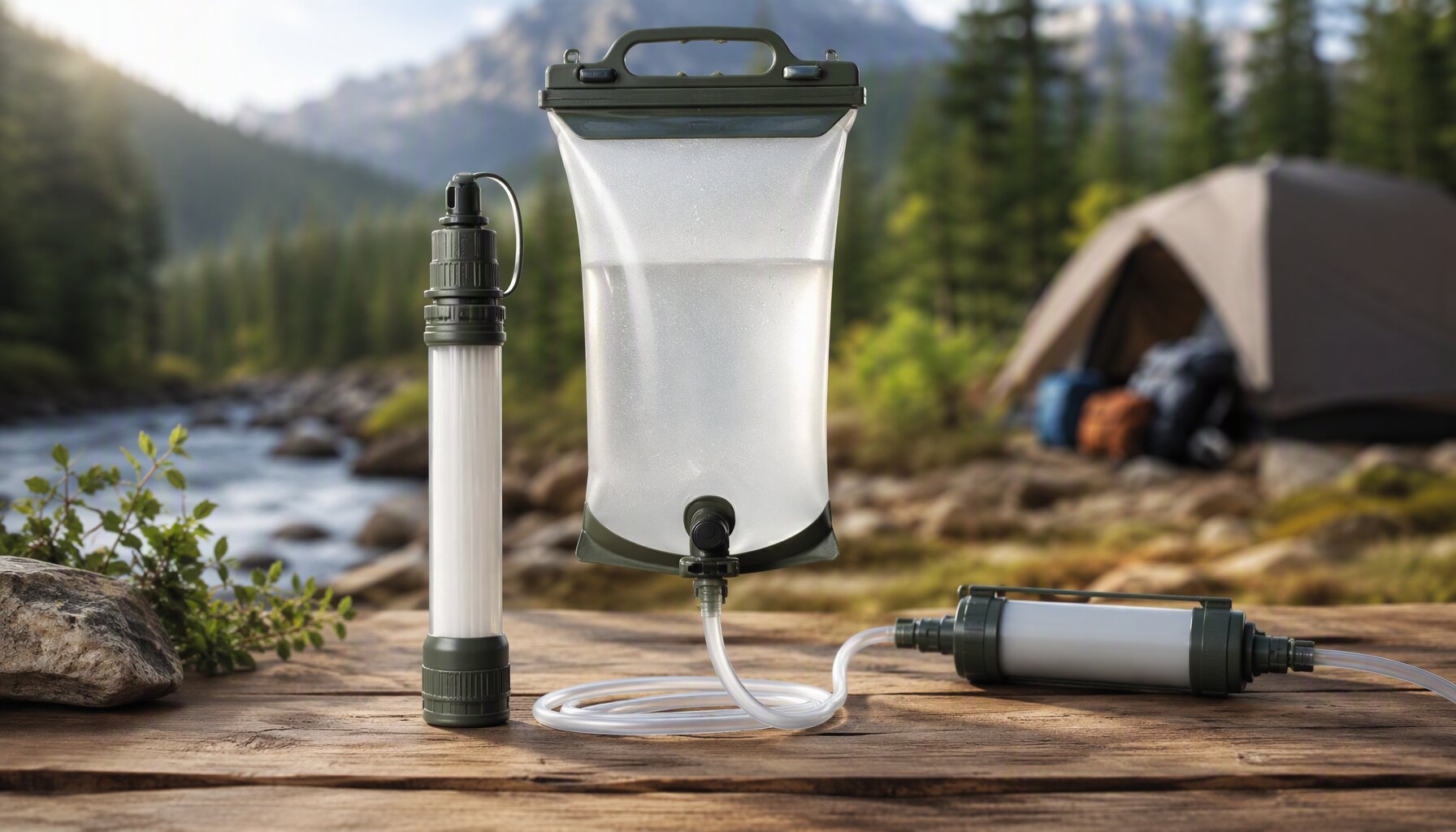
This is the premium segment for base-camp and group-use scenarios. These systems consist of an upper raw-water reservoir (typically 4-10 liters, TPU or food-grade PE), a filter element mounted between chambers, and a lower clean-water reservoir with a dispensing spigot. The filter element usually combines a ceramic pre-filter shell with an activated carbon core, delivering 0.2-micron filtration at 1-2 liters per hour under gravity alone — no pumping, no electricity, no moving parts.
Unit cost from Chinese factories: $18-35 depending on reservoir capacity, filter element type, and material grade. Retail price in the US RV and camping market: $79-149. This is where B2B margins get genuinely interesting because the filter element itself is a consumable with a 6-12 month replacement cycle, creating a razor-and-blade recurring revenue model for distributors who stock both the system and replacement elements.
One structural advantage for Chinese manufacturers in this category: the ceramic filter element production process — diatomaceous earth mixed with colloidal silver, pressed, and kiln-fired — is labor-intensive in ways that resist automation. Chinese factories in the Fujian ceramics cluster have optimized this process over decades of water filter production, achieving yields that European competitors struggle to match at comparable unit costs.
Certification: What RV and Camping Buyers Actually Check
Different distribution channels impose different certification requirements, and understanding this mapping is the difference between a SKU that sells and one that sits in a warehouse.
| Channel | Required Certification | Nice-to-Have | Typical Audit Frequency |
|---|---|---|---|
| Amazon US (RV Accessories) | None legally required, but NSF/ANSI 42 strongly recommended for ranking | NSF/ANSI 53, 372 (lead-free) | Amazon may request test reports for listing approval |
| RV Dealerships (Camping World, etc.) | NSF/ANSI 42 minimum; many require 53 | WQA Gold Seal | Annual supplier audit typical |
| Big-box Retail (Walmart, Target) | NSF/ANSI 42 + 53 + 372 | Factory social compliance audit (BSCI/SMETA) | Quarterly quality audits; annual social compliance |
| EU Camping Retail | CE marking; materials compliant with EU 1935/2004 (food contact) | WRAS (UK), ACS (France), DVGW (Germany) | Varies by retailer |
| Government/Disaster Relief Procurement | NSF/ANSI 53 minimum; often requires EPA-compliant test data | ISO 17025 accredited lab reports | Per-contract specifications |
ONEMI’s portable filtration product line carries NSF/ANSI 42 certification for filter cartridges, with testing conducted at ISO 17025 accredited laboratories in Guangdong. For B2B buyers developing private-label RV filter products, ONEMI provides the full compliance documentation package required for Amazon listing approval and US retail distribution — including material safety data sheets, third-party lab reports, and factory audit certificates.
Sourcing Economics: A Worked Example
Let us walk through the unit economics for a hypothetical US-based importer launching a private-label inline RV water filter on Amazon in 2026.
| Cost Component | Per Unit (USD) | Notes |
|---|---|---|
| Ex-factory cost (NSF 42 certified, GAC+KDF, 5,000 units) | $4.20 | Guangdong factory, PP housing, retail-ready packaging included |
| Sea freight + insurance (LCL, Shenzhen to LA) | $0.35 | Based on 2026 Q2 spot rates, 20ft container share |
| US customs duty (HTS 8421.21.0000, water filtering machinery) | $0.00 | Currently duty-free; verify with broker — tariffs subject to change |
| Amazon FBA fulfillment fee (standard-size, under 1 lb) | $3.89 | 2026 FBA rate card, non-peak |
| Amazon referral fee (15% of $19.99 selling price) | $3.00 | Home & Kitchen category |
| Total landed + fulfillment cost | $11.44 | |
| Net margin per unit at $19.99 retail | $8.55 | 42.8% net margin |
At 5,000 units sold per year — a realistic volume for a well-optimized Amazon listing in the RV accessories subcategory — that is $42,750 in net profit from a single SKU. Scale to three SKUs (inline filter, replacement 2-pack, and a UF straw) and annual net profit crosses $100,000 without requiring a warehouse, employees, or US-based operations beyond an Amazon Seller Central account.
The numbers work because Chinese manufacturing costs for water filtration products have remained relatively stable even as US retail prices for outdoor gear have risen 12-18% since 2023, according to Bureau of Labor Statistics CPI data for sporting goods. This margin expansion — stable input costs against rising output prices — is the structural opportunity for importers in the current market.
What Separates Reliable Chinese Portable Filter Factories from the Rest
Alibaba lists over 2,100 suppliers for “portable water filter” as of mid-2026. Most are trading companies that never touch the product. The ones that matter are manufacturers with actual production lines, and they share a set of observable characteristics.
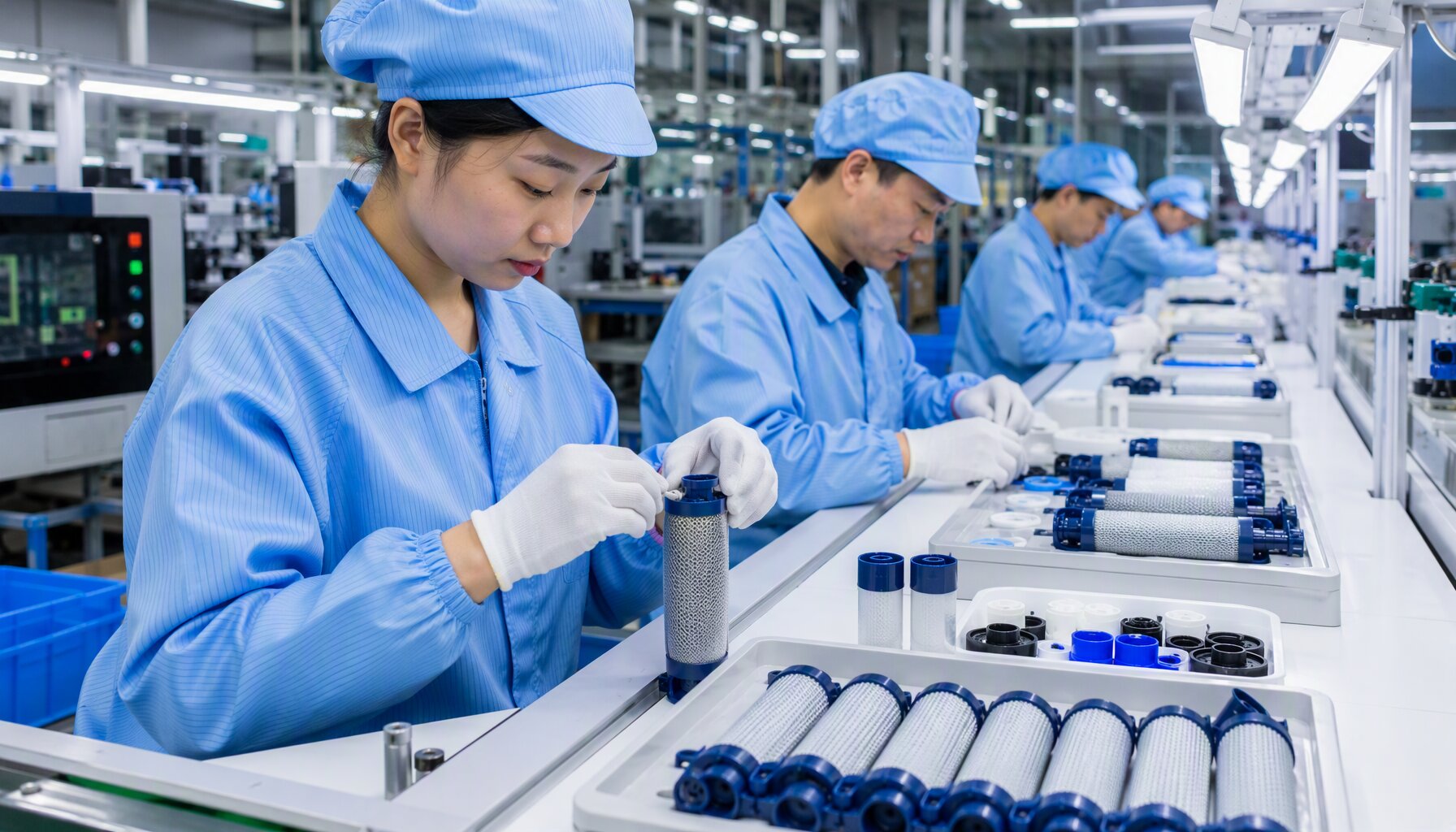
In-house membrane production capability. This is the single most important differentiator. Factories that extrude their own hollow-fiber UF membranes or compound their own activated carbon blocks control the two most critical quality variables in portable filtration: pore size consistency and adsorption capacity. A factory that purchases pre-made membrane from a third-party supplier has no way to guarantee batch-to-batch consistency beyond incoming inspection — and by the time a bad batch is caught, 5,000 defective units may already be assembled.
Pressure-decay testing on 100% of UF-based products. As mentioned earlier, this is not optional for products that claim bacterial removal. The test protocol: each assembled UF filter unit is pressurized with air to 0.1 MPa and monitored for 30 seconds. Any pressure drop beyond the calibrated threshold triggers rejection. The testing station itself costs under $2,000 to build — factories that skip this are not saving money; they are externalizing quality risk onto the buyer.
Material traceability for food-contact components. Under EU Regulation 1935/2004 and FDA 21 CFR, every component that touches drinking water must be traceable to its raw material batch. Reputable factories maintain lot-number tracking from raw resin pellets through injection molding to finished housing assembly. For B2B buyers supplying the European market, this traceability documentation is not optional — it is a legal requirement enforceable at the border.
ONEMI‘s Dongguan facility operates under ISO 9001:2015 quality management with full batch traceability on all food-contact components. The factory’s portable filtration line includes automated UF membrane integrity testing, GAC iodine number verification per ASTM D4607, and finished-product pressure-cycle testing to simulate six months of field use in a 72-hour accelerated protocol. Buyers considering private-label portable filter programs can request the full quality control manual and recent batch-test reports during the sampling phase.
Product Development Trends That Affect Sourcing Decisions
Several technology shifts in the portable filtration space are worth factoring into OEM product planning for 2026-2027.
UV-C LED integration is moving from premium to mid-range. Two years ago, integrating a UV-C LED sterilization stage into a portable filter added $12-18 to the BOM cost. Advances in UVC LED chip manufacturing — specifically, the shift from 4-inch to 6-inch sapphire substrate wafers at major LED foundries in China — have driven the per-unit cost of a 275nm UVC LED module (sufficient for 99.9% bacterial inactivation at 2L/min flow) down to $3.50-5.00 in 2026. This makes UV+UF combination portable filters viable at the $29-39 retail price point, opening a new mid-tier segment between the basic $15 inline GAC filter and the $80+ gravity system.
PFAS-specific filter media is becoming a purchasing criterion. The EPA’s 2024 PFAS regulation, even with its extended compliance timeline, has permanently changed the conversation. Campers drawing water from lakes and streams in areas with known PFAS contamination — which, per U.S. Geological Survey testing published in 2025, includes approximately 45% of US tap water sources — are increasingly looking for filters that explicitly claim PFAS reduction. The media of choice is powdered activated carbon (PAC) with a high iodine number (>1,000 mg/g) in a compacted carbon block format, which can achieve >95% PFOA/PFOS reduction at flow rates under 0.5 L/min. Adding this capability to a portable filter increases the filter element cost by roughly $0.80-1.20 per unit at manufacturing scale.
The smart-filter concept is arriving, slowly. Several Kickstarter campaigns in 2025-2026 have introduced portable filters with Bluetooth-connected flow meters that track cumulative volume and estimate remaining filter life via a smartphone app. The BOM cost adder is modest — a $2.50 Bluetooth Low Energy module and a $1.20 hall-effect flow sensor — but the reliability challenge is real: flow sensors in portable devices accumulate drift over time, and Bluetooth pairing in wet outdoor environments is unreliable. For B2B buyers, the prudent approach is to monitor this trend but not commit significant inventory to smart-filter SKUs until the second-generation hardware proves itself in the field.
Packaging and Presentation: What Moves Product Off the Shelf
In the RV and camping retail environment — whether physical shelf or Amazon search results page — packaging is not an afterthought. It is the primary sales tool when no salesperson is present.
Window-box packaging with a filter cutaway. A retail package that physically shows the filter media cross-section converts at a measurably higher rate than a closed box with a printed diagram. The manufacturing cost difference is $0.25-0.40 per unit for a die-cut window with PET blister insert versus a standard printed box. For a product retailing at $19.99, that is a 1.25-2.0% cost increase for what retailers report as a 15-25% lift in shelf conversion.
Hang-tab design for pegboard display. RV parts retailers overwhelmingly use pegboard merchandising. A reinforced hang-tab — Euro slot with tear-resistant reinforcement tape — is essential. The specification is simple (a 40mm x 8mm slot, 5mm from the top edge, centered) but the execution matters: die-cut slots without reinforcement tear during stocking and create a messy shelf appearance that retailers penalize with reduced facings.
Multi-language packaging for North American distribution. The US RV market includes a significant Spanish-speaking consumer base (approximately 13% of RV owners per RVIA demographic data), and Canadian distribution often requires bilingual English/French packaging per Quebec provincial regulations. A single SKU with tri-lingual packaging (English/Spanish/French) covers the entire North American market without the inventory complexity of language-specific SKUs.
Logistics: Getting Product from Guangdong to a US Warehouse
For B2B importers sourcing portable water filters from China, the logistics equation has shifted meaningfully in 2026.
Sea freight rates have stabilized. After the extreme volatility of 2021-2024, container shipping rates on the Shenzhen-LA route settled into a $2,800-3,500 per 40ft container range through the first half of 2026. For portable water filters — which are lightweight and compact — a 40ft container can hold approximately 35,000-45,000 inline filter units or 80,000-100,000 UF straws. The per-unit freight cost is negligible at these densities: roughly $0.07-0.10 per inline filter unit.
Amazon AGL (Amazon Global Logistics) is worth considering. For sellers shipping directly to Amazon FBA, using Amazon’s own freight forwarding service eliminates the complexity of coordinating a separate freight forwarder, customs broker, and FBA inbound shipment. The trade-off is slightly higher per-unit shipping cost (roughly 15-20% above negotiating directly with a forwarder) against significantly reduced administrative overhead and faster FBA check-in times — typically 3-5 days versus 7-14 days for third-party forwarder shipments.
Warehouse strategy for multi-channel distribution. Importers selling through both Amazon FBA and wholesale to RV dealerships need a bifurcated logistics plan. The efficient structure: ship container to a 3PL warehouse in southern California (Inland Empire or Ontario, CA, where warehouse space runs $0.65-0.85/sq ft/month for class B space in 2026), split the shipment into FBA-bound pallets and wholesale-bound inventory, and use the 3PL for both FBA replenishment and dealer order fulfillment. The additional warehousing cost is offset by avoiding FBA long-term storage fees on slow-moving inventory and maintaining the ability to fulfill wholesale orders within 48 hours.
Risk Management: What Goes Wrong and How to Prevent It
Every product category has its failure modes. For portable water filters, the risks cluster around three areas.
Filter media degradation in storage. Activated carbon adsorbs volatile organic compounds from ambient air. A GAC filter stored in a non-hermetic package for 12 months in a warehouse that also stores solvents, paints, or cleaning chemicals will arrive at the customer partially exhausted before first use. The preventive measure is specification-level: require aluminum-foil-laminate inner packaging with heat-sealed edges for any GAC-based filter product. The cost adder is $0.08-0.12 per unit and it eliminates the single most common cause of negative reviews for inline RV filters: “didn’t improve taste at all.”
Housing stress cracking from freeze-thaw cycles. An RV stored in Minnesota over winter will see its water filter housing experience temperatures well below freezing. Residual water inside the filter expands by approximately 9% upon freezing, exerting pressure that can micro-crack polypropylene housings. The specification fix is specifying impact-modified PP copolymer (with 5-10% ethylene content) rather than standard PP homopolymer for filter housings destined for cold-climate markets. The material cost difference is approximately $0.15/unit. The alternative — a warranty claim rate above 3% — costs far more in returns, refunds, and brand damage.
Regulatory risk from evolving PFAS standards. As of August 2026, the EPA’s PFAS regulation remains in legal flux — the 2025 proposal to remove four of the six regulated PFAS compounds from the federal MCL list has not been finalized, and several states (California, New Jersey, Michigan) have enacted their own stricter standards in the interim. For B2B buyers, the practical implication is that any marketing claim about “PFAS reduction” should be backed by ISO 17025 accredited lab testing for the specific PFAS compounds claimed, with test reports less than 12 months old. Vague claims like “reduces contaminants including PFAS” without specifying which compounds and at what reduction rate are an enforcement risk under FTC Green Guides and state consumer protection laws.
Building a Private-Label RV Filter Brand: The 90-Day Launch Timeline
For importers who want to move beyond reselling and build their own brand in the RV filtration space, here is a realistic timeline based on ONEMI’s OEM project experience with North American and European buyers.
Days 1-14: Product specification and sampling. Define the target product: inline GAC filter, UF straw, or gravity system. Specify housing material, filter media grade, flow rate, rated capacity, and certification requirements. Request 5-10 pre-production samples from the factory for evaluation. Ship via air freight (3-5 days) to begin hands-on testing immediately.
Days 15-30: Lab testing and packaging design. Submit samples to an ISO 17025 accredited lab for NSF/ANSI 42 and/or 53 testing. In parallel, finalize retail packaging design — including UPC barcode registration, Amazon FNSKU labeling requirements, and any mandatory regulatory markings (California Prop 65 warning if applicable). The lab testing and packaging design run in parallel because they have no sequential dependency.
Days 31-60: Production and quality inspection. Upon lab test approval, place the production order. For a first production run, 2,000-5,000 units is typical — enough to validate market demand without overcommitting inventory. Engage a third-party inspection service (SGS, Bureau Veritas, or TÜV) to conduct an AQL 2.5 Level II pre-shipment inspection. The inspection cost ($300-500) is negligible compared to the cost of receiving 5,000 defective units.
Days 61-75: Ocean freight and customs clearance. The container departs Shenzhen/Yantian port. Transit time to LA/Long Beach is 14-18 days. Customs clearance adds 2-4 days if all documentation (commercial invoice, packing list, bill of lading, FDA prior notice for food-contact articles) is in order. Engage a customs broker with experience in water filtration products — the HTS classification for portable water filters can be ambiguous (8421.21 vs 8421.99) and an experienced broker avoids classification disputes that delay clearance.
Days 76-90: Amazon listing optimization and dealer outreach. Create the Amazon listing with A+ Content including comparison charts, NSF certification badges, and lifestyle photography. Simultaneously, send samples with wholesale pricing sheets to RV parts distributors identified during the product development phase. The first reorder from a distributor who tested the sample typically arrives 30-45 days after the sample shipment.
Why the RV Filter Category Rewards First Movers
The portable water filtration category for RV and camping applications sits at an unusual intersection of market forces in 2026. On one side, the installed base of RVs and the annual camping participation rate (58.3 million US households camped at least once in 2025, per Kampgrounds of America’s annual report) create a large and growing replacement market. On the other side, the Amazon search results for “rv water filter” remain dominated by a handful of legacy brands — Camco, Culligan, and a rotating cast of generic Chinese imports with thin reviews and no brand equity.
The gap between a dominant incumbent and a generic drop-shipped alternative is exactly where private-label brands built on quality Chinese manufacturing can establish themselves. The unit economics work at small scale. The certification moat — while not insurmountable — filters out the least committed competitors. And the recurring-replacement nature of the product category means customer acquisition cost amortizes over multiple purchases, not just the first sale.
For distributors and importers evaluating whether to enter this category in 2026, the question is not whether the demand exists — the RVIA and KOA data answer that definitively. The question is whether to enter now, while the Amazon category is still consolidating, or to wait until the window for building a defensible brand position has narrowed. History in adjacent categories — portable power stations, camping cookware, rooftop tents — suggests the consolidation window is roughly 18-24 months from the point at which the category crosses $100 million in annual Amazon GMV. The RV water filter category crossed that threshold in late 2025.