




 한국어
한국어

- The global water purifier market reached roughly $37.7 billion in 2025 and is forecast to exceed $72 billion by 2034, at a 7.6% CAGR (Fortune Business Insights, 2025)
- Market share is split between brand owners and the OEM/ODM manufacturing cluster that actually builds the hardware, concentrated in China’s Guangdong and Zhejiang provinces
- Buyers who source well evaluate four things: certification depth (NSF/ANSI, CE), real MOQ and lead time, production QC discipline, and filter-cartridge recurring revenue economics
The water purifier business looks like a branded-products industry from the outside. From the inside, it is a two-tier structure: a small set of brand owners who control shelf space and marketing, and a much larger manufacturing base that produces the machines those brands sell. Understanding where the capacity sits is the fastest way for an importer to stop overpaying and start sourcing well.
Two tiers of the market: brands and the factories behind them
The global water purifier market was worth about $37.7 billion in 2025 and is projected to pass $72 billion by 2034, growing at a 7.6% compound rate, according to Fortune Business Insights. That growth is not distributed evenly. North America alone accounts for roughly $8.9 billion in 2025, while the commercial segment is expanding even faster, with some estimates putting its CAGR near 15% through the early 2030s.
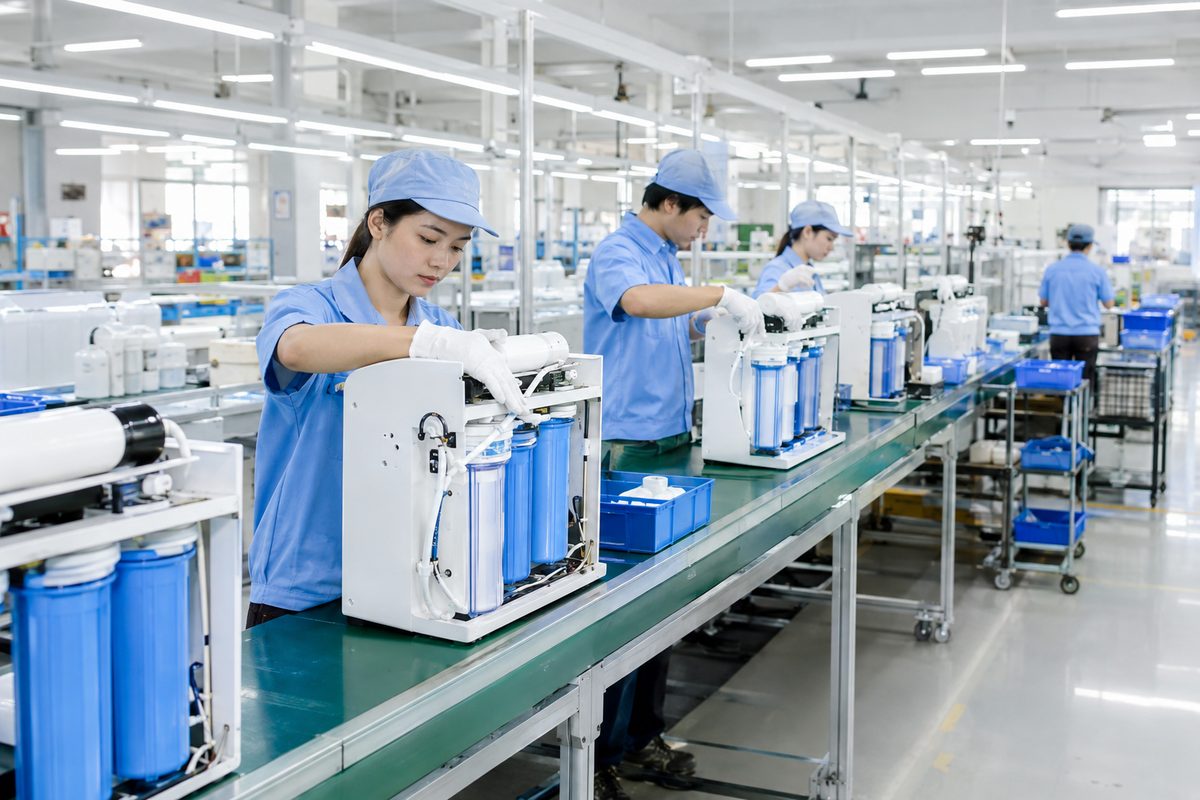
Behind the brand names, the production side is heavily consolidated in a handful of industrial clusters. A large share of the world’s reverse osmosis systems, under-sink units, and filter cartridges are manufactured by OEM and ODM factories in China, primarily in Guangdong and Zhejiang. These factories build to a brand’s specification, apply the brand’s logo, and ship container loads to distributors across North America, Europe, the Middle East, and Southeast Asia.
Where the capacity actually sits
Guangdong is the center of gravity for finished water purification equipment, particularly around Dongguan and the Pearl River Delta, where the component supply chain for pumps, membranes, filter housings, and electronic controls is dense enough to keep lead times short. Zhejiang, especially the Ningbo and Cixi area, is strong in lower-cost, high-volume filtration hardware. This geographic concentration is why a single factory can often supply a complete private-label program: the membrane, the housing, the pump, the faucet, and the control board are all sourced within a short radius.
The practical consequence for a buyer is straightforward. When you buy from a factory inside these clusters, you are buying from the same supply chain that feeds most of the brands on the market. The difference in final price comes down to who owns the brand layer, not who made the machine.
What is actually driving market share
Three forces are reshaping share more than any marketing campaign. The first is regulation. The U.S. EPA’s 2024 PFAS drinking water rule set enforceable limits of 4 parts per trillion for PFOA and PFOS, which pushed reverse osmosis and high-performance carbon filtration to the front of the product mix, since RO is one of the few point-of-use technologies that can reliably meet those levels. NSF/ANSI 53 and 58 certifications became table stakes for any system claiming PFAS or lead reduction.
The second is the shift to tankless, high-flow RO. The market has moved decisively away from storage-tank systems toward direct-flow designs in the 400 to 1200 gallons-per-day range. These units command higher prices and higher filter-cartridge attach rates, which is exactly what distributors and brands want for recurring revenue. The third is the commercial segment, which is growing at roughly double the rate of the residential market, driven by offices, food service, and light industrial demand.
What a serious buyer actually evaluates
Price is the wrong first filter. A serious sourcing decision rests on four legs:
- Certification depth: NSF/ANSI 42, 53, and 58 for the U.S. market, CE and RoHS for Europe, plus material-level compliance such as NSF/ANSI 372 for lead-free components. A factory that holds these certificates has already absorbed the audit and testing cost.
- Real MOQ and lead time: quoted MOQs under a few hundred units are common, but the lead time that matters is the one under a rush order, when a factory’s component depth in Guangdong decides whether you ship in 30 days or 90.
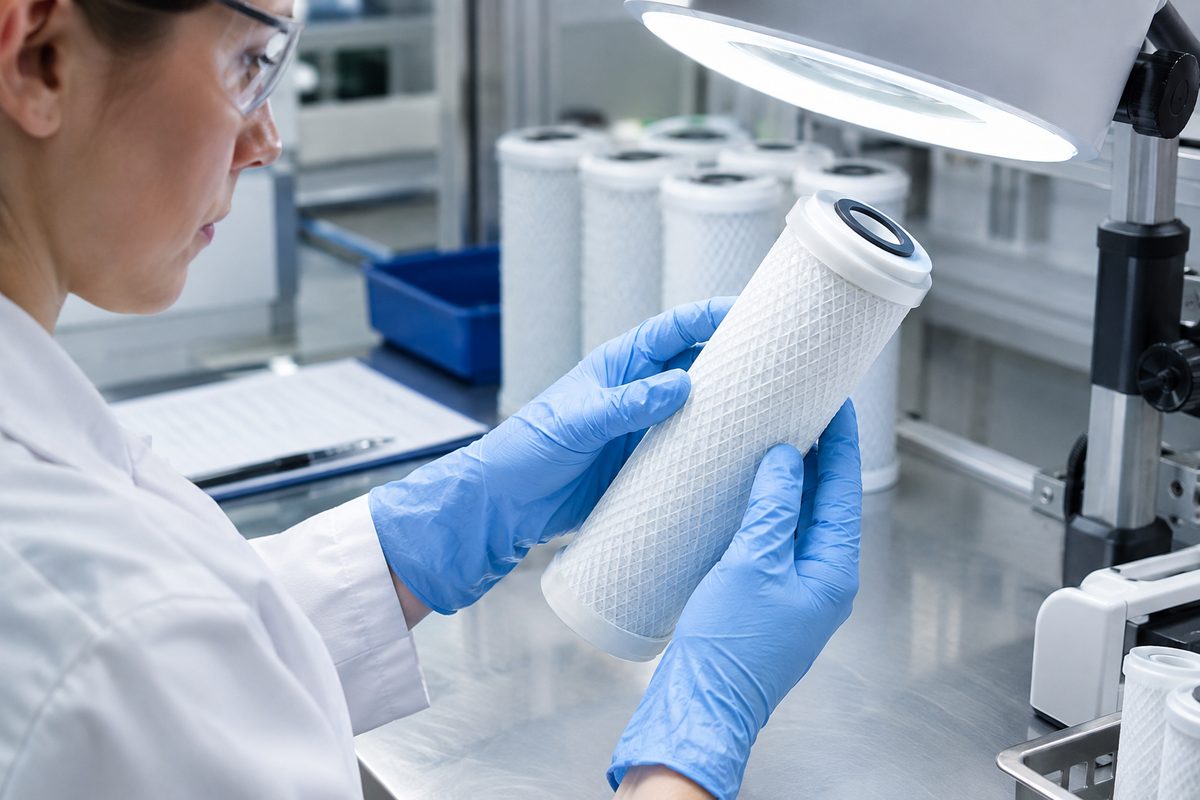
- Production QC discipline: incoming material inspection, in-line testing of every unit, and a documented defect rate. Factories that test each unit before packing rarely talk about it; those that do not, hide behind a warranty.
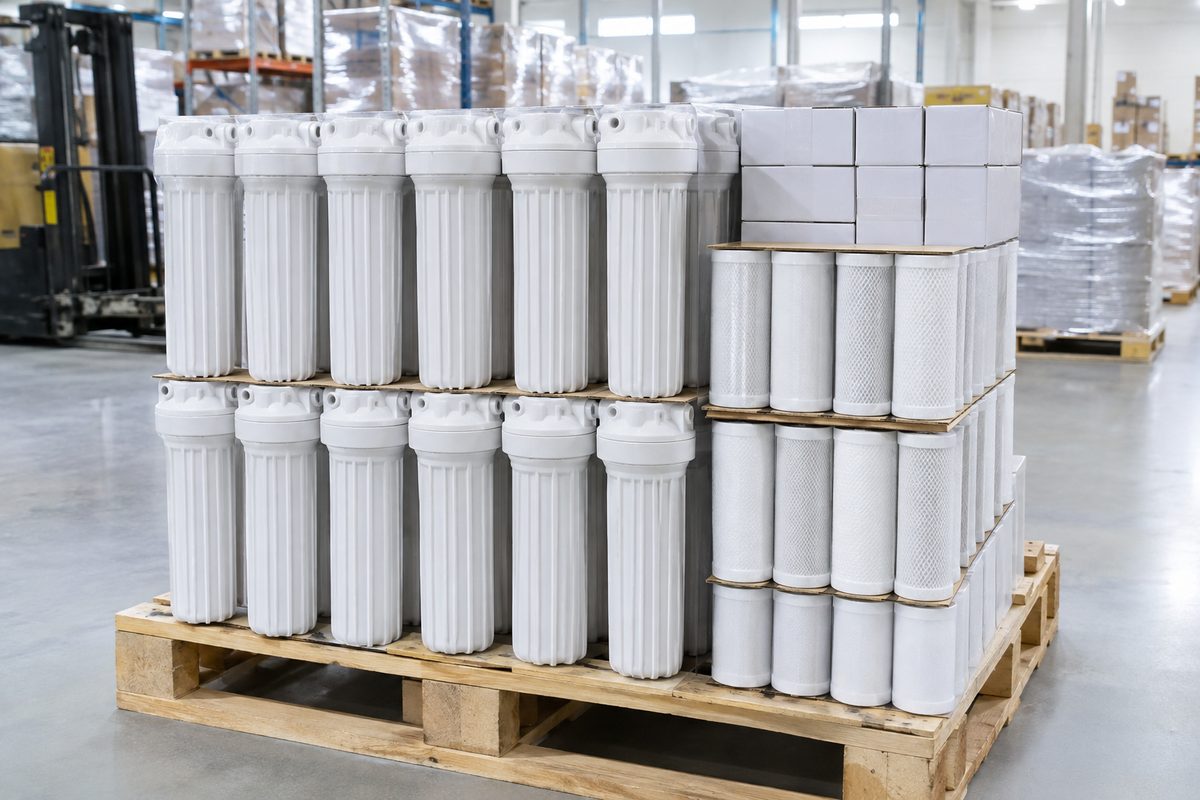
- Filter-cartridge economics: the cartridge is the recurring revenue. A buyer who locks in a proprietary or bayonet cartridge format with a reliable factory secures years of repeat orders.
How the certification landscape separates factories
| Standard | Scope | Relevance to buyers |
|---|---|---|
| NSF/ANSI 42 | Aesthetic effects: chlorine, taste, particles | Baseline for U.S. point-of-use units |
| NSF/ANSI 53 | Health effects: lead, arsenic, VOCs, PFAS, cysts | Required for any health-claim system |
| NSF/ANSI 58 | Reverse osmosis systems | Required for RO systems, TDS reduction ≥75% |
| NSF/ANSI 372 | Lead content in wetted components | Lead-free compliance, weighted average ≤0.25% |
| CE / RoHS | European safety and restricted substances | Market entry for the EU |
The certifications a factory holds are a reasonable proxy for its export maturity. A factory that has already passed NSF or CE audits has solved the materials, documentation, and traceability problems that a first-time exporter is still wrestling with.
The OEM/ODM economics, in plain terms
Why do brands outsource manufacturing at all? Because the capital and compliance burden of owning a membrane line, an injection-molding operation, and a certification portfolio is enormous relative to the margin a single brand can capture. By buying from an established OEM, a brand converts fixed cost into variable cost and gets to market in months instead of years. The trade-off is that the factory’s other customers are running the same machines. The brand that wins is the one that pairs a distinctive cartridge format, a strong warranty, and local distribution with a factory that can deliver consistent quality at container scale.
How ONEMI fits into this landscape
ONEMI is a Guangdong-based water purification equipment manufacturer, operating from Dongguan, inside the cluster where most of the world’s RO hardware is built. The company’s position is that of an OEM and ODM supplier: it builds under-sink reverse osmosis systems, tankless high-flow RO units, and the filter cartridges that go with them, for brands and distributors who want the manufacturing layer handled without owning a factory.
For a buyer, the value proposition is the combination of cluster-level supply chain access, certification support across NSF/ANSI, CE, and RoHS, and the ability to run a private-label program from a single source. The relevant pages are the OEM factory overview, the certification summary, and the product range that anchors a sourcing conversation. If you are weighing a tankless RO line, the 400G smart RO system is a concrete reference point for what the current generation of direct-flow hardware looks like.
The water purifier market is not hard to read once you separate the brand layer from the manufacturing layer. The growth is real, the certification bar is rising, and the capacity is concentrated. The buyers who do best are the ones who stop shopping on sticker price and start evaluating factories on certification, QC, and cartridge economics.