

 한국어
한국어

The Changing Landscape of Commercial Water Infrastructure
Commercial water infrastructure is undergoing its most significant regulatory and operational shift in three decades. Across North America and Europe, municipal feed water quality is degrading due to aging distribution networks and the emergence of persistent chemical contaminants. For enterprise buyers, facility managers, and process engineers, treating water is no longer just about protecting downstream equipment from scale buildup. It has become a critical compliance and operational risk management priority.
Executive Summary
- Commercial water systems must handle high-volume demands ranging from 500 to over 50,000 gallons per day (GPD) while maintaining strict effluent consistency.
- Stricter environmental regulations, including EPA limits of 4.0 parts per trillion (ppt) on specific PFAS compounds, are forcing facilities to upgrade their filtration technology.
- Successful B2B procurement requires balancing initial capital expenditure (CapEx) against long-term operational costs (OpEx), focusing on membrane life, salt consumption, and energy use.
The scale of commercial water treatment is vastly different from residential filtration. While a standard household system might produce 50 to 75 gallons of purified water per day, commercial installations regularly process between 500 and 55,000+ GPD. These systems must run continuously under high operating pressures, often 150 to 400 PSI, depending on the feed water’s Total Dissolved Solids (TDS) levels. They must also withstand fluctuating inlet pressures, thermal shocks, and varying chemical compositions without interrupting production or service delivery.
Regulatory frameworks are tightening rapidly. In the United States, the EPA has established legally enforceable Maximum Contaminant Levels (MCLs) for several per- and polyfluoroalkyl substances (PFAS), setting the limit at just 4.0 ppt for individual compounds like PFOA and PFOS. In Europe, the recast Drinking Water Directive (Directive 2020/2184) introduces stricter thresholds for endocrine disruptors, lead, and microplastics. For businesses operating in food and beverage production, pharmaceuticals, hospitality, or light manufacturing, non-compliance is not an option. It can lead to severe fines, forced operational shutdowns, and permanent brand damage.
Consider the daily operational reality of a commercial facility. A single commercial boiler system operating with untreated, hard water can accumulate up to 0.25 inches of scale within a year. This scale buildup reduces heat transfer efficiency by up to 40%, driving up energy utility bills by thousands of dollars every month. This is where professional-grade water treatment becomes an investment with a clear, measurable payback period rather than a simple overhead cost.
How clean does your process water actually need to be?
The Three-Stage Architecture of Commercial Water Treatment
To design or purchase an effective commercial water treatment system, you must understand its core physical and chemical components. No single technology can safely and efficiently transform raw municipal or well water into high-purity process water. Instead, modern systems rely on a multi-stage architecture designed to protect downstream components and systematically remove target contaminants.
The diagram below outlines the standard flow of a comprehensive B2B water treatment system, moving from raw feed water to the final point of use:
| Treatment Stage | Primary Technology | Target Contaminants Removed | Typical Operating Range |
|---|---|---|---|
| Pre-Treatment | Multi-Media Filtration & Softening | Sediment, Chlorine, Calcium, Magnesium | 5 to 25 Microns (filtration) |
| Core Membrane Separation | Reverse Osmosis (RO) / Nanofiltration | Dissolved Salts, Heavy Metals, PFAS, Bacteria | 0.0001 to 0.001 Microns |
| Post-Treatment & Polishing | UV Sterilization, Deionization, Ozone | Residual Viruses, Trace Ions, TOCs | Log 4 to Log 6 Pathogen Reduction |
Pre-treatment is the foundation of any commercial water system. Raw water first passes through multi-media filters containing layers of anthracite, silica sand, and garnet. This media removes suspended solids down to 10-15 microns, protecting downstream equipment from clogging. Next, active carbon filters remove free chlorine and chloramines, which are highly corrosive to reverse osmosis membranes. Finally, water softeners use ion-exchange resins to swap scale-forming calcium and magnesium ions with sodium ions. Skip this step, and your expensive reverse osmosis membranes will scale up and fail within weeks.
The core of modern commercial purification is membrane separation, dominated by Reverse Osmosis (RO). High-pressure pumps force pre-treated water through semi-permeable membranes. This process separates pure water molecules from dissolved solids, organics, and microbiological contaminants. Depending on system design and feed water temperature, RO systems operate at recovery rates between 50% and 82%. The remaining water, known as concentrate or reject water, carries away the separated contaminants.
Post-treatment and polishing customize the water for specific industrial uses. For example, commercial kitchens and steam generation facilities might feed RO permeate directly to their equipment. In contrast, microelectronics facilities and pharmaceutical labs require ultra-pure water. These operations route the water through mixed-bed deionization (DI) tanks or electrodeionization (EDI) systems to achieve electrical resistivity levels up to 18.2 Megohm-cm. At the same time, ultraviolet (UV) sterilizers operating at a 254 nm wavelength destroy any remaining microbial DNA, ensuring biological purity.
The Hidden Gotchas of Commercial Water System Engineering
When selecting a commercial water treatment system, many procurement teams fall into the trap of looking only at the nominal GPD rating on the spec sheet. This simple oversight often leads to under-designed systems that fail to meet peak demand, or over-designed systems that run inefficiently and waste capital. Understanding the physical and chemical limits of these systems is crucial for making an informed purchasing decision.
Here is a practical checklist for sizing and specifying your system:
- Calculate Peak vs. Average Demand: Do not buy a system based on your average daily water use. A hotel might use 15,000 gallons of water per day, but 40% of that demand occurs during a three-hour morning peak. Your system must either have a high instantaneous flow rate or use a large atmospheric storage tank with a high-delivery repressurization pump system.
- Temperature Derating: Water viscosity changes with temperature. A commercial RO system rated for 10,000 GPD at a standard reference temperature of 77°F (25°C) will see its output drop by up to 50% if the incoming winter feed water temperature plummets to 41°F (5°C). Always size your system using the lowest expected winter water temperature.
- Water Waste and Recovery Ratios: No RO system runs at 100% recovery. Standard commercial systems operate at a 50% to 75% recovery rate, meaning that for every 1,000 gallons of purified water produced, another 333 to 1,000 gallons are sent down the drain as waste. High-recovery systems, which can reach up to 85% recovery, require specialized anti-scalants and precise dosing pumps to prevent membrane fouling.
- Feed Water Chemistry: A basic TDS test is not enough. You must conduct a complete water chemistry analysis that measures silica, iron, manganese, barium, strontium, and Total Organic Carbon (TOC). High silica levels (above 15 mg/L), for example, will polymerize on membrane surfaces, creating a glassy scale that cannot be cleaned off with standard acid or alkaline washes.
Let us look at a real-world engineering challenge in a commercial laundry facility located in San Antonio, Texas. The municipal water there has a high hardness level of 20 grains per gallon (approximately 340 mg/L as CaCO3). The facility installed a standard 15,000 GPD commercial RO system without a properly sized water softener, assuming the RO membranes could handle the hardness directly. Within 45 days, the operating pressure of the RO system spiked from 160 PSI to over 240 PSI while water production dropped by 35%. The membranes were completely fouled with calcium sulfate scale. Replacing the membranes cost the facility $4,200, plus two days of unplanned operational downtime. This expensive mistake highlights why proper pre-treatment is non-negotiable.
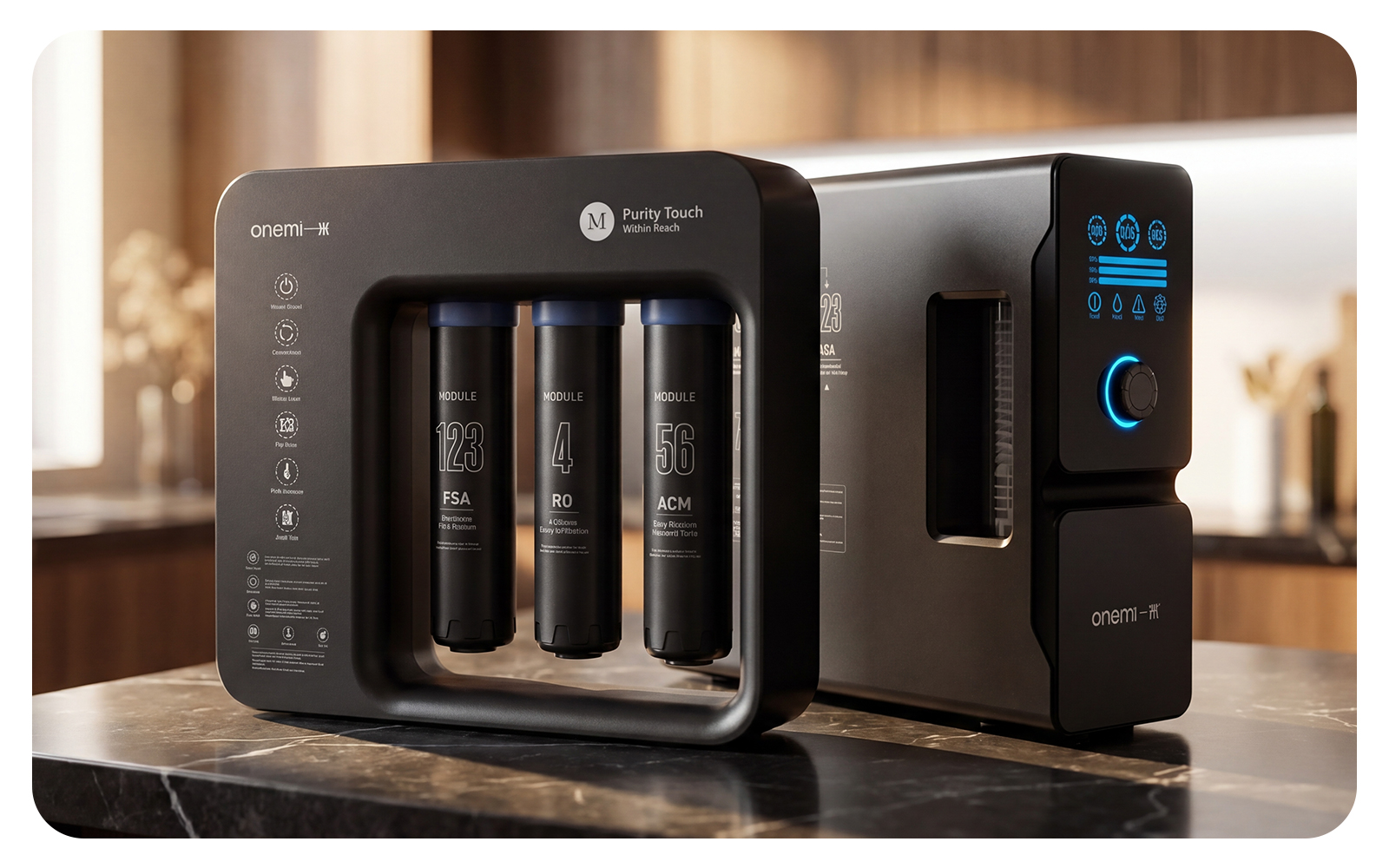
ONEMI water purifiers and heavy-duty industrial filtration units are engineered to prevent these exact failure modes by integrating smart monitoring sensors that track pressure drops and flow rates in real-time.
To avoid these issues, your engineering team must work closely with system manufacturers to review the raw water chemistry profile before finalizing the system design. This ensures that every pre-treatment filter, softener, and membrane element is matched to the specific chemical makeup of your local water supply.
Evaluating Total Cost of Ownership: CapEx vs. OpEx
A commercial water treatment system is a long-term asset with an operational lifespan of 10 to 15 years, provided it is maintained correctly. When evaluating competing bids, procurement officers must look beyond the initial purchase price (Capital Expenditure) and calculate the total cost of ownership (Operational Expenditure) over the system’s life.
The true cost of operating a water treatment system is spread across several key areas:
- Consumable Replacements: This includes sediment pre-filters, carbon blocks, and RO membranes. High-quality RO membranes should last between 3 and 5 years if the pre-treatment system is working correctly. If you have to replace membranes every 12 months, your pre-treatment system is failing or incorrectly sized.
- Chemical Consumables: Water softeners require regular salt replenishment for resin regeneration. Industrial systems may also require continuous dosing of anti-scalants, sodium bisulfite to neutralize chlorine, or pH-adjusting chemicals like sodium hydroxide. These chemical costs add up quickly over years of continuous operation.
- Energy Consumption: Running high-pressure multi-stage centrifugal pumps is energy-intensive. Modern commercial systems utilize variable frequency drive (VFD) pumps and energy recovery devices (ERDs) to cut power consumption by up to 30% compared to older, fixed-speed systems.
- Maintenance and Labor: Systems require regular monitoring, sanitization cycles, membrane Clean-In-Place (CIP) procedures, and sensor calibrations. If your facility does not have dedicated utility technicians, you will need to budget for a preventative maintenance service contract with a local water treatment firm.
A common mistake in B2B procurement is buying a cheaper system that uses non-standard, proprietary filter cartridges. This locks your business into buying expensive replacement consumables from a single vendor for the lifetime of the system. Choosing systems designed around industry-standard 2.5-inch or 4.5-inch double open-ended (DOE) filter housings allows you to source high-quality replacement filters from multiple competitive suppliers, keeping your long-term maintenance costs low.
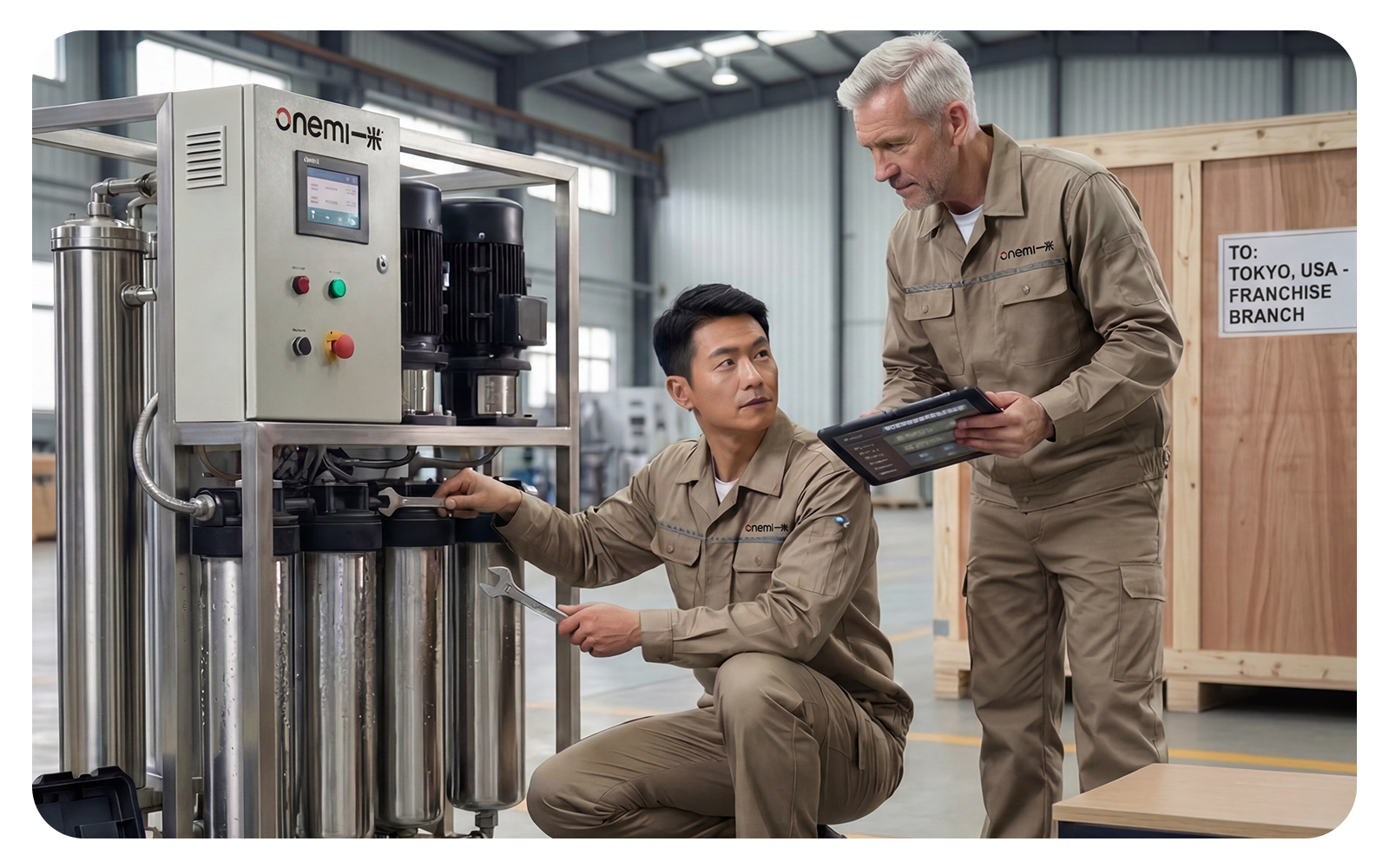
Additionally, modern systems like those developed by ONEMI incorporate automated self-cleaning cycles and digital telemetry. These features allow off-site engineers to monitor system performance, pressure differentials, and water quality metrics via a cloud-based dashboard, reducing the need for costly on-site diagnostic visits.
Investing in higher-quality materials upfront also pays off. Choosing 316L stainless steel high-pressure piping over cheaper PVC or 304 stainless steel prevents corrosion, especially in systems handling high-salinity feed water or corrosive RO permeate. It also ensures the system can withstand aggressive chemical sanitization cycles without degrading.
Procurement and Implementation Roadmap
Successfully deploying a commercial water treatment system requires a structured, phase-based approach. Skipping steps in the planning and commissioning phases is the leading cause of post-installation performance issues and expensive retrofits.
The following step-by-step roadmap outlines the path from initial water testing to final system commissioning:
Phase 1: Water Analysis and Feasibility Study
Before looking at equipment catalogs, collect multiple water samples at different times of the week to capture variations in municipal dosing or well water quality. Send these samples to an accredited third-party laboratory for a complete chemical, physical, and microbiological analysis. Use this data to define your target water quality standards based on your specific application, whether that is NSF/ANSI compliance for food service or ASTM Type I water standards for laboratory use.
Phase 2: System Design and Specification
Work with water treatment engineers to build a detailed process flow diagram (PFD). Select the appropriate pre-treatment, core membrane, and polishing technologies based on your water analysis. At this stage, determine physical space requirements, floor load capacities, electrical power availability (such as 208V, 230V, or 460V three-phase power), drain capacity for waste streams, and ventilation needs for chemical storage areas.
Phase 3: Vendor Evaluation and Procurement
Issue a detailed Request for Proposal (RFP) to qualified water treatment system manufacturers. Evaluate bids not only on price, but also on component quality, warranty terms, and the manufacturer’s technical support capabilities. Ensure the selected vendor provides complete engineering submittals, including electrical schematics, piping and instrumentation diagrams (P&ID), and comprehensive operation and maintenance manuals.
Phase 4: Installation and Commissioning
Ensure the physical installation is completed by licensed mechanical and plumbing contractors who have experience with commercial water systems. Once installed, the system must undergo a rigorous commissioning process. This includes pressure testing all piping, sanitizing the entire system, calibrating online sensors (such as conductivity, pH, and temperature meters), and verifying that all safety interlocks and automatic shutdown systems function correctly under simulated fault conditions.
During commissioning, it is critical to train your facility’s maintenance staff. Operators must know how to perform routine tasks, read system gauges, recognize early signs of membrane fouling, and safely execute a Clean-In-Place (CIP) cycle. Taking the time to properly train your team during this phase protects your investment and ensures your water treatment system operates reliably for years to come.
For organizations looking to simplify this process, partnering with established manufacturers like ONEMI provides access to end-to-end engineering support. This support spans from initial water analysis to final commissioning, ensuring your system is designed and installed to meet your exact operational requirements.