


 한국어
한국어

Executive Summary
- The global transition to tankless reverse osmosis technology is driving a 35% to 50% reduction in warehousing and shipping volumes for water purification distributors.
- Modern tankless engineering achieves wastewater-to-pure-water ratios ranging from 2:1 to 3:1, significantly outperforming legacy 1:3 systems and meeting strict environmental mandates.
- Procurement decisions must balance high-flow membrane performance against local water quality challenges like TDS spikes and premature scaling.
A major European appliance distributor recently slashed its annual logistics spend by 42% while simultaneously cutting customer warranty claims for water stagnation to absolute zero. This operational leap was not achieved through complex supply chain restructuring or aggressive price negotiations with carriers. Instead, it was the direct result of purging bulky, 4-gallon pressurized storage tanks from their inventory and replacing them with high-capacity, direct-flow filtration systems.
The traditional tank-based reverse osmosis system, long considered the standard for residential and light commercial water purification, has become an expensive liability. Shipping air inside empty steel expansion tanks is a margin-killer in modern logistics.
By eliminating the reservoir, distributors are packing up to twice as many units onto a single shipping pallet, immediately altering the economics of sea freight and last-mile delivery.
The Hidden Financial Toll of Stored Water
When you calculate the total cost of ownership for water filtration inventory, physical volume is only the first metric that demands scrutiny. Legacy systems rely on a pressurized bladder tank to store purified water because their membranes produce water at a slow, agonizing trickle of 50 to 75 gallons per day (GPD). These tanks present a massive physical footprint, typically measuring anywhere from 11 to 15 inches in diameter and up to 17 inches in height.
This translates to a shipping volume of approximately 1.5 to 2.2 cubic feet per complete system kit. In contrast, a modern tankless system occupies a mere 0.5 to 0.8 cubic feet of space.
Let us look at the raw container utilization data for a standard 40-foot High Cube (HC) shipping container:
| System Architecture | Average Unit Volume (m³) | Max Units per 40ft HC Container | Average Ocean Freight Cost per Unit ($) | Warehouse Pallet Capacity (Units) |
|---|---|---|---|---|
| Legacy Tank-Based (75 GPD) | 0.062 – 0.075 | 900 – 1,100 | $4.50 – $6.00 | 16 – 20 |
| Tankless Slimline (600 GPD) | 0.028 – 0.035 | 2,000 – 2,400 | $2.00 – $2.90 | 40 – 48 |
| High-Flow Tankless (1000 GPD+) | 0.032 – 0.040 | 1,700 – 2,100 | $2.30 – $3.30 | 36 – 44 |
The math is clear: switching to tankless designs allows importers to double their container capacity, effectively cutting ocean freight costs per unit in half.
Beyond shipping, the secondary financial drain is the post-installation support cycle. In a tank-based system, water sits stagnant in a dark, warm butyl rubber bladder for hours, days, or even weeks. This environment is highly susceptible to biofilm formation and bacterial regrowth, particularly heterotrophic bacteria. When a consumer detects an off-flavor or odor due to this stagnation, the service call-out costs are borne by the local distributor or retailer. Tankless units eliminate this entire risk vector by producing fresh, on-demand water that has had no contact with a storage bladder.
Have you ever calculated the hours your technicians spend troubleshooting air charge pressure in leaking steel tanks?
The Mechanics of High-Flow Filtration
To understand how a tankless system operates without a storage reservoir, we must look at the physics of the reverse osmosis membrane. A standard 75 GPD membrane has an active surface area of roughly 4 to 5 square feet. Under typical municipal water pressures of 50 to 60 PSI, water passes through this tight polymer matrix at a rate of only 0.2 liters per minute. To make a tankless system viable for a consumer waiting at a kitchen sink, the flow rate must be increased to at least 1.5 to 2.6 liters per minute.
This requires an entirely different engineering blueprint. First, the membrane surface area must be scaled up drastically. A 1000 GPD membrane features up to 25 to 30 square feet of wound polyamide thin-film composite (TFC) sheets. This massive increase in surface area allows more water molecules to pass through simultaneously at any given pressure.
Second, because municipal water pressure is rarely sufficient to push water through such a dense, high-capacity membrane at a functional speed, tankless systems must integrate an internal booster pump. This pump artificially elevates the operating pressure inside the membrane housing to a consistent range of 80 to 110 PSI.
This mechanical pressurization introduces a technical trade-off: noise and vibration. While a tank-based system is completely silent during operation (relying solely on line pressure), a tankless system emits a hum during filtration. Top-tier manufacturers like ONEMI address this by utilizing brushless DC (BLDC) booster pumps coupled with rubber dampening mounts, reducing operational noise levels from a harsh 60 decibels down to a whisper-quiet 43 to 48 decibels. This level of acoustic engineering is crucial for high-end residential deployments where consumers expect premium, silent appliance performance.
The booster pump also changes the electrical profile of the system. While tank-based systems require no electrical connection (unless they feature a UV stage), tankless systems require a dedicated under-sink power outlet to run the pump and the integrated smart control board. For older homes in markets like the United Kingdom or older metropolitan areas in the northeastern United States, the lack of an under-sink power source remains a common installation bottleneck that installers must resolve.
Water Scarcity and the Regulatory Squeeze
Environmental regulations are rapidly making low-efficiency water systems obsolete. Historically, traditional RO systems were notoriously wasteful, often discharging 3 to 4 gallons of wastewater down the drain for every single gallon of purified water produced. This is represented as a 1:3 or 1:4 pure-to-waste ratio. In regions facing severe drought and water stress, such waste is no longer legally or socially acceptable.
Consider the regulatory shifts across major global markets:
- United States: The EPA WaterSense program and strict state-level building codes in California (Title 20) and Texas are pushing for higher efficiency standards, penalizing systems that fail to meet minimum recovery rates.
- China: The national standard GB 34914-2020 (Minimum Allowable Values of Water Efficiency and Water Efficiency Grades for Water Purifiers) mandates that water purifiers must achieve a water efficiency of at least 45% (Grade 3) to be sold, with Grade 1 requiring a recovery rate of 65% or higher.
- European Union: The Ecodesign Directive continues to tighten requirements on energy and resource efficiency for water-using appliances, steering the market toward smart, low-waste technologies.
Modern tankless systems solve this efficiency crisis through intelligent wastewater recycling loops. By utilizing high-pressure booster pumps and advanced membrane chemistry, premium tankless systems can achieve pure-to-waste ratios of 2:1, 3:1, or even a highly efficient 4:1 under optimal conditions.
Let us look at a real-world scenario. In a suburban development in Arizona, USA, where municipal water TDS (Total Dissolved Solids) averages 450 to 600 PPM, a traditional RO system wasting 75% of its feed water contributes heavily to local water scarcity. A high-efficiency ONEMI tankless unit operating at a 3:1 ratio reduces wastewater volume by up to 90% compared to those legacy models. This not only appeals to eco-conscious consumers but also ensures long-term compliance with municipal water conservation ordinances.
However, there is a counter-intuitive catch that B2B buyers must understand: higher efficiency ratios increase the risk of membrane scaling. When you push more pure water through the membrane and discharge less wastewater, the concentration of calcium, magnesium, and silica ions in the remaining waste stream rises exponentially. If the local feed water is exceptionally hard (above 15 grains per gallon), these minerals will precipitate out of solution and form a hard scale on the membrane surface, rapidly clogging the system and reducing its lifespan from two years to mere months.
To prevent this, high-quality tankless systems must incorporate an automatic flush valve. This valve opens for 15 to 30 seconds every time the system starts up, or at set hourly intervals, flushing the concentrated brine away from the membrane surface with a high-velocity burst of raw water. This simple engineering detail is what separates commercial-grade, reliable tankless systems from cheap, problematic alternatives.
The Real-World Procurement Checklist
For B2B buyers, sourcing the right tankless RO system requires looking past surface-level marketing specifications. A high GPD rating is meaningless if the system fails prematurely due to poor component quality or high local TDS levels.
When evaluating potential manufacturing partners, procurement managers should focus on three critical technical pillars.
1. Membrane Material and Sourcing
The heart of any RO system is the membrane sheet itself. The industry standard is Polyamide Thin-Film Composite. However, the quality of the casting and the consistency of the pore size vary wildly. Leading systems utilize membranes sourced from top-tier global chemical manufacturers like DuPont FilmTec or Toray. These premium membranes offer superior chemical resistance, higher salt rejection rates (typically 96% to 99%), and a more robust physical structure that can withstand the constant pressure cycling of a tankless booster pump.
2. Smart Control and Leak Protection
Because tankless systems are active electrical appliances, they should feature integrated microcontrollers. Look for systems that offer real-time TDS monitoring with an external LED display on the faucet. This builds immediate consumer trust by showing the exact purification performance of the system in real time.
Furthermore, because a leak from a pressurized, high-flow system can cause catastrophic water damage to a home, an integrated physical leak detector with an automatic shut-off valve is a non-negotiable safety feature for any professional importer. ONEMI systems, for instance, integrate multi-point sensor arrays that cut off power and water supply the instant internal moisture is detected.
3. Cartridge Replacement Mechanics
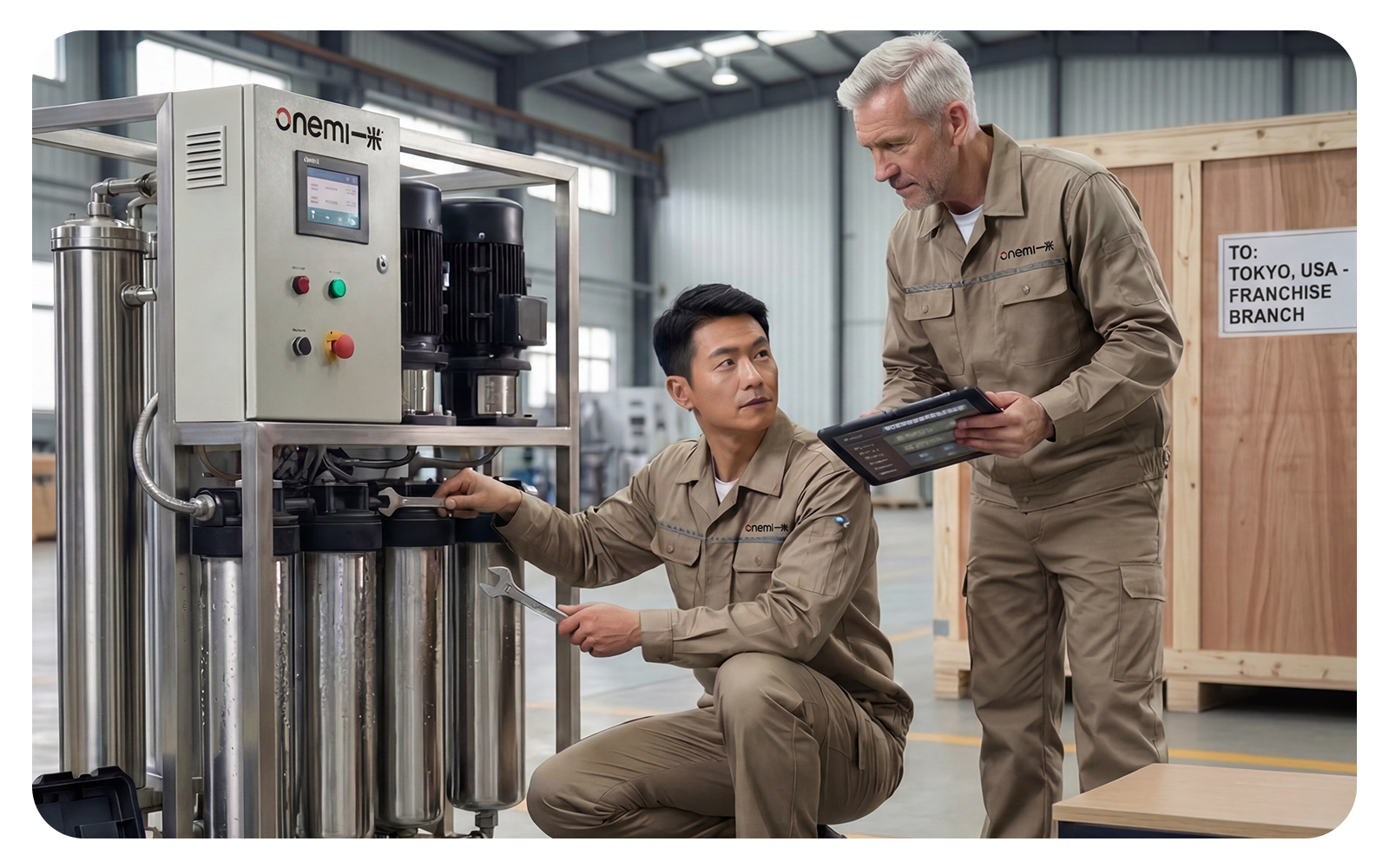
The post-sale business model of water purification relies entirely on replacement filter cartridges. Traditional systems require dedicated service tools, wrenching, and a messy cleanup process to change out vertical filter housings.
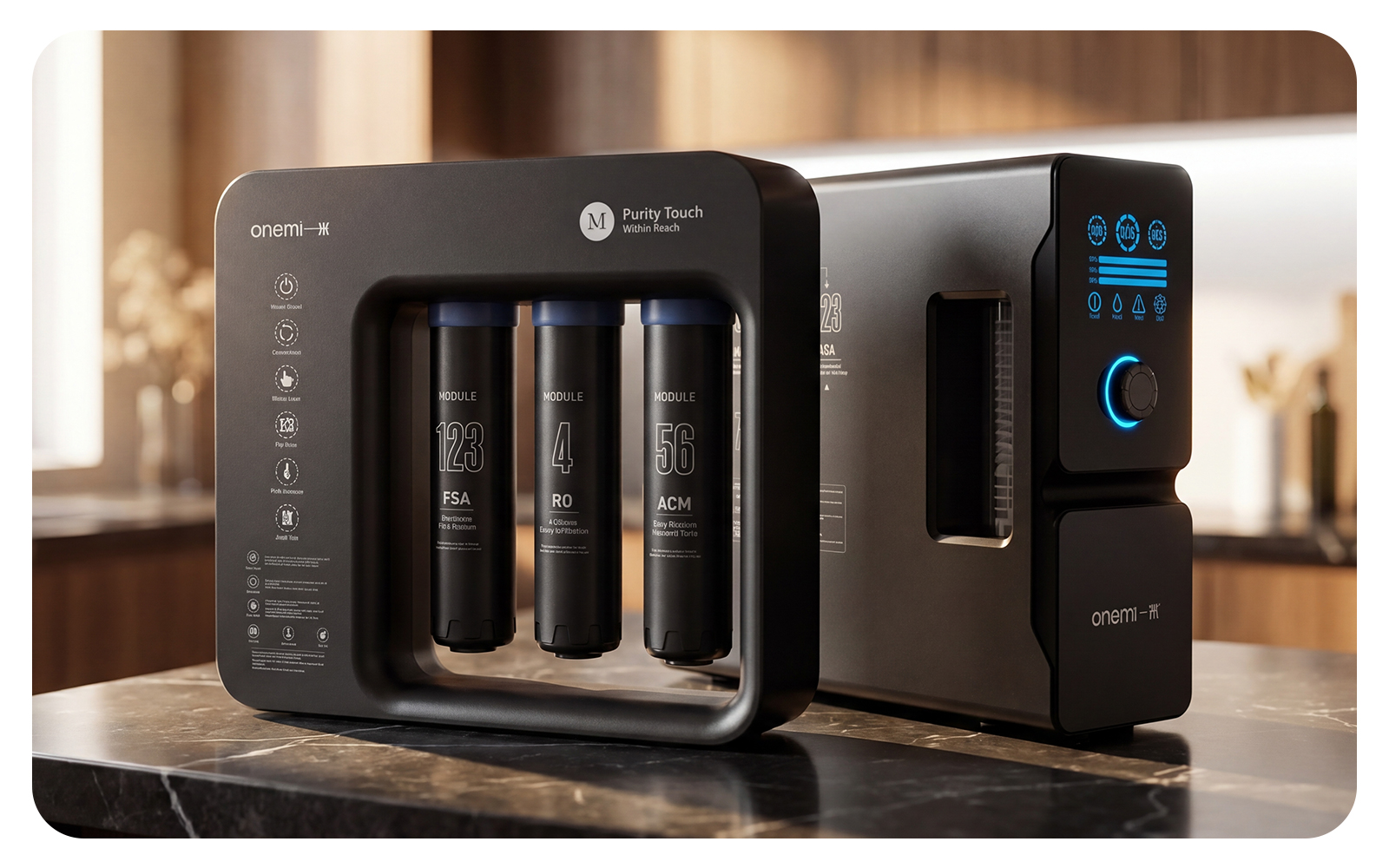
Modern tankless designs have transitioned to quick-twist, dry-change cartridges. These allow the end-user to replace a filter in under three seconds with a simple 90-degree turn, eliminating the need for professional service visits. This user-friendly design reduces the barrier to replacement, resulting in higher cartridge repurchase rates and a more predictable, recurring revenue stream for distributors.
Ultimately, the transition to tankless RO technology is not merely a design trend; it is a fundamental shift in the economics of the water purification industry. By reducing shipping volumes, minimizing post-installation service liabilities, and meeting the world’s most stringent environmental standards, tankless systems represent the future of global water treatment distribution.