
 한국어
한국어

We recently watched a high-end commercial wellness center in Southern California rip out a brand-new, ten-thousand-dollar electrolysis water system just twenty-four weeks after installation. The pH levels had plummeted from a crisp 9.2 down to a sluggish, acidic 6.8, and the customers were starting to complain about a metallic, bitter taste in their morning hydration flights. Everyone blamed the manufacturer, but the real culprit was a silent, slow-motion chemistry battle happening inside the pipes that most B2B buyers completely ignore until it is too late.
Executive Summary
- The global alkaline water market is expanding at a compound annual growth rate of 7.8% to 8.9%, shifting commercial demand from simple filtration to highly precise, mineral-balanced hydration systems.
- B2B buyers must navigate three core technologies—mineral remineralization, electrolysis (ionization), and surface-modified media—each presenting distinct operational trade-offs regarding flow rate, scale accumulation, and long-term pH stability.
- Successful commercial deployment requires matching filtration technology to regional water chemistry profiles while strictly adhering to local municipal standards and EPA secondary drinking water guidelines.
What happened to that California wellness center wasn’t an isolated hardware glitch.
It was a classic case of system-water mismatch. The local municipal water supply had a high temporary hardness profile—specifically calcium bicarbonate levels hovering between 180 and 220 parts per million (ppm). When the electrolysis plates ran their electrical currents to split the water molecules, they didn’t just raise the pH; they acted as a magnet for calcium ions. Within ninety days, a microscopic, rock-hard layer of calcium carbonate scale had coated the platinum-titanium electrodes, insulating the plates and stopping the ionization process dead in its tracks. The system was still consuming electricity, but the water passing through was completely untouched.
The Chemistry Behind the pH Swing

To understand why this happens, we have to look at what alkaline water actually is from a commercial engineering perspective. It is not just about pushing a number past 7.0 on a digital meter. True, stable alkalinity requires dissolved alkaline minerals—mainly calcium, magnesium, and potassium—along with dissolved hydrogen gas and a negative Oxidation-Reduction Potential (ORP) ranging from -150mV to -400mV.
When you are sourcing equipment for a commercial facility, a corporate office, or a hospitality brand, you are buying a chemical processing plant in miniature. If your incoming municipal water is too soft—say, under 30 ppm of total dissolved solids (TDS)—electrolysis systems have nothing to work with. The machine spins its wheels, runs hot, and fails to shift the pH because there are no mineral ions to carry the current. Conversely, if the water is too hard, you get the scale disaster we saw in California. This is why the global market, which is growing at a steady clip of 7.8% to 8.9% annually, is moving away from raw, unmonitored ionization and shifting toward highly controlled, multi-stage mineral bed infusion systems that guarantee a stable pH output regardless of what is coming out of the city main.
Let’s look at the actual numbers behind the three primary technologies dominating the B2B space today.
| Technology Type | pH Output Range | ORP Range (mV) | Maintenance Interval | Best Use Case |
|---|---|---|---|---|
| Mineral Bed Remineralization | 8.0 – 9.0 | -50 to -150 | 6 – 12 Months | High-volume offices, food service, pre-treatment loops |
| Continuous Flow Electrolysis | 8.5 – 9.5 | -200 to -600 | 3 – 6 Months (Acid Wash) | Low-volume wellness clinics, specialized gyms |
| Surface-Modified Media (SMM) | 8.2 – 9.2 | -100 to -300 | 9 – 18 Months | Centralized building filtration, premium residential complexes |
The Hidden Operational Gotcha: Flow Velocity vs. Contact Time
Here is a piece of engineering reality that sales brochures love to gloss over: mineral-based alkaline filters are completely at the mercy of contact time.
If you run water through a sacrificial mineral cartridge containing magnesium oxide and calcium carbonate at a rate of five gallons per minute, the water doesn’t spend enough time touching the media to actually dissolve the minerals. Your pH might climb by a measly 0.2 units. But if that same system sits idle overnight, the water resting inside the filter housing has hours of contact time. The next morning, the first cup of water drawn from the tap will be a highly concentrated, chalky, super-alkaline shot with a pH of 10.2 and a TDS spike that tastes like liquid drywall.
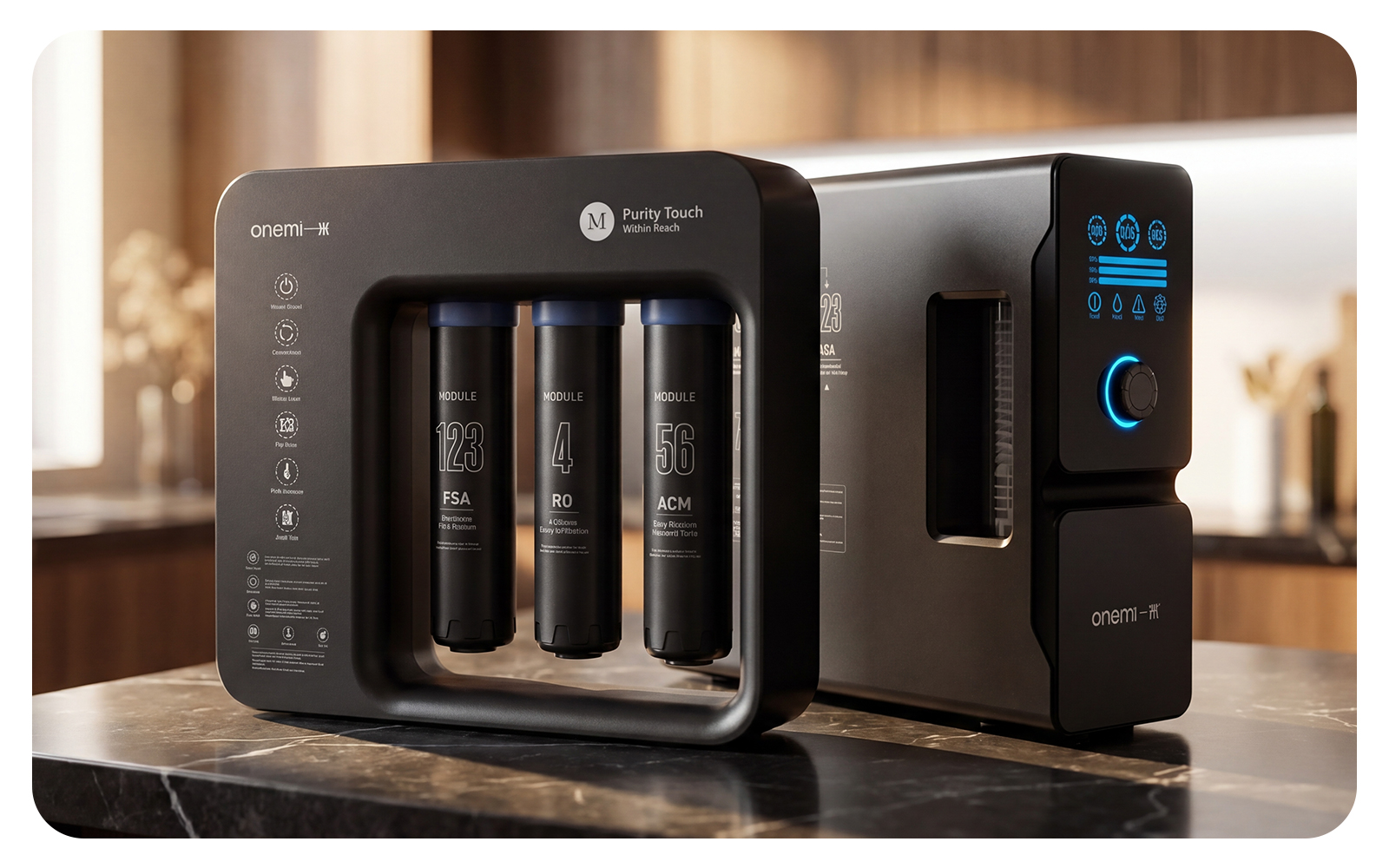
To prevent this extreme fluctuation, commercial systems must utilize bypass loops, flow-restrictive orifices, or recirculation pumps that keep the water moving at a constant, predictable velocity across the media bed. Brands like ONEMI design their commercial filtration setups with integrated flow-regulation manifolds to ensure that whether a machine is dispensing its first cup at 8:00 AM or its five-hundredth cup at 2:00 PM, the mineral saturation curve remains perfectly flat.
Without this mechanical compensation, you are going to get wild taste swings that drive users crazy.
Navigating the Regulatory Maze
You cannot talk about commercial water treatment without talking about local plumbing codes and environmental regulations. In the United States, municipal water systems are governed by the EPA’s National Secondary Drinking Water Regulations, which set a non-enforceable guideline for pH between 6.5 and 8.5. When a commercial business installs an alkaline system that intentionally pushes the pH to 9.5 or higher, they are technically operating outside the standard municipal aesthetic parameters.
In regions like the UK and the European Union, the rules are even tighter. The European Drinking Water Directive (Directive 2020/2184) sets strict maximum limits on sodium, potassium, and electrical conductivity. If your alkaline system uses a low-grade sacrificial media that dumps excessive amounts of sodium or potassium ions into the stream to boost the pH, you could easily breach local conductivity limits during a routine commercial building inspection.
Furthermore, backwash discharge from automated electrolysis systems—which produce an acidic waste stream alongside the alkaline product stream—must be handled carefully. Some municipal sewer authorities prohibit the direct discharge of water with a pH below 5.5 into standard commercial drains without a neutralization step. If your facility is planning a large-scale deployment, you must plan for how you will handle or dilute this acidic byproduct stream to avoid running afoul of local environmental protection officers.
How to Match Your Local Water Profile to the Right Tech
Before you sign a purchase order for any commercial filtration array, you need a comprehensive water analysis report from the local utility, or better yet, an independent third-party lab test of the water coming out of your specific building’s riser.
If your incoming water has high silica levels—common in the Pacific Northwest and parts of the Southwest—standard reverse osmosis pre-treatment is almost mandatory before you attempt any alkaline adjustment. Silica will coat mineral media and electrodes faster than calcium, forming an glassy, impermeable barrier that is nearly impossible to clean with standard food-grade citric acid washes.
For areas with naturally soft, low-TDS water, like parts of New England or the Southeast, you can bypass heavy membrane filtration and go straight to a high-capacity remineralization system. Because the water is hungry for minerals, it will predictably dissolve the calcium and magnesium media, giving you a very stable, sweet-tasting alkaline output with minimal mechanical intervention.
On the flip side, if you are dealing with the hard, heavily chlorinated waters of the Midwest or Southern California, your system design must lead with a robust catalytic carbon block to strip out chloramines, followed by a high-efficiency scale inhibitor or a light water-softening loop before the water ever touches the alkaline stage. It is about building a balanced train of filtration components where each stage protects the next.
This is where working with an experienced manufacturer pays off. Companies like ONEMI provide the engineering support needed to customize the pre-filtration stages based on local zip-code water data, ensuring the core alkaline modules don’t get choked out by local contaminants. When you treat the incoming water chemistry as a variable rather than a constant, you stop reacting to system failures and start managing a predictable, high-performance utility asset.
At the end of the day, a successful alkaline water installation isn’t about chasing the highest pH number on a digital screen; it is about engineering a system that can quietly, consistently deliver clean, balanced, and great-tasting water month after month without requiring a full-time technician to keep it alive.
If you plan for scale management, regulate your flow velocities, and respect your local water chemistry, your commercial system will easily cruise past that critical six-month mark where so many others fail. For organizations looking to deploy reliable hydration solutions across multiple offices or commercial properties, partnering with a specialized brand like ONEMI ensures that you get the precise engineering, robust flow controls, and local water profile matching required to keep your systems running smoothly for years, not just weeks.