


 한국어
한국어

- Installation friction is a return driver set at the design stage — every extra connection point adds a leak risk and a support ticket.
- Tool-less quick-connect fittings remove thread-taping, wrenching, and the “is it tight enough” guesswork that drives callbacks.
- Importers should spec NSF/ANSI-certified fittings and validate a unit’s return-rate history before committing container volume.
An importer lands a 40-foot container of under-sink reverse osmosis systems, sells through in a season, and then watches the returns climb. The product looked strong on the spec sheet — 600 GPD, five stages, NSF/ANSI 58 listed. The problem was not the membrane. It was the install. Units came back because a homeowner could not stop a fitting from weeping, because a drain saddle leaked, because a manual called it a “five-minute install” and the reality was an afternoon under the sink with a wrench and a roll of PTFE tape. Return rate is not a sales-floor problem. It is a design decision made weeks earlier, on the assembly line, in the choice between a threaded brass fitting and a push-to-connect one.
Return Rates Are Decided Before the Container Ships
The US water purifier market reached about $6.75 billion in 2024, and reverse osmosis is the largest technology segment, holding roughly a third to two-fifths of that market, according to Fortune Business Insights. Under-sink RO units retail between roughly $150 and $800. That band is wide, but margin on the lower half is thin enough that a few points of return rate erase the profit entirely.
A distributor carrying a unit with a 6% return rate versus one at 2% is not looking at a four-point difference in revenue. They are looking at return shipping, restocking labor, refurbishment, chargebacks, and a customer-support load that scales with every connection point inside the unit. Most of that cost was locked in the moment the factory chose how the water lines attach. Nobody restocks a unit that never leaks.
Why Under-Sink RO Is Harder to Install Than the Listing Suggests
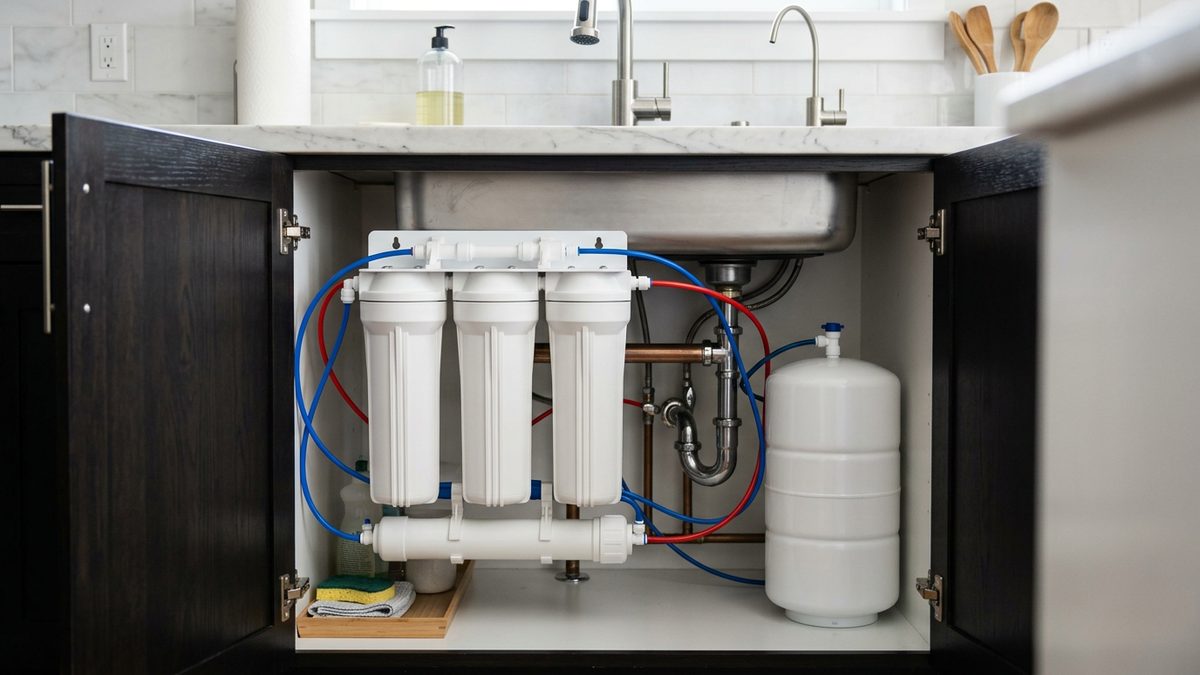
An under-sink RO system is not one connection. A typical five-stage unit has a cold-water supply tee, an inlet line to the sediment pre-filter, inter-stage lines between the carbon and membrane housings, a line to the pressurized storage tank, a drain line to a saddle valve on the sink’s P-trap, and a dedicated faucet that usually requires drilling a hole in the countertop or sink deck.
That is four to six points where water can escape, plus a drill step that intimidates a renter or a first-time DIY buyer. Every one of those points is either a push-to-connect fitting or a threaded fitting that needs tape and a wrench. The difference between those two is where returns are won or lost — and it is the only part of the system the manufacturer controls completely.
Tool-Less Design Removes the Failure Point
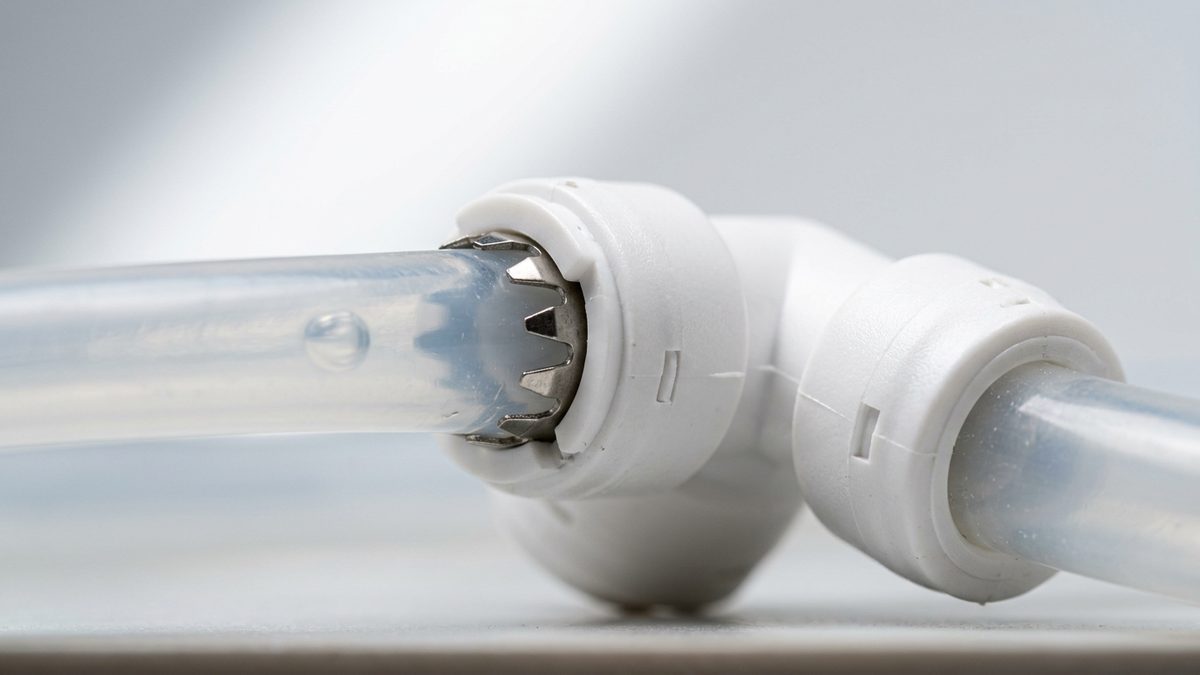
A push-to-connect fitting seals when the tube is inserted past an internal O-ring and a stainless-steel grab ring locks it in place. No tape, no torque spec, no “hand-tight plus a quarter turn” that varies by who is turning the wrench. The tube either seats or it does not. The install is binary, which is exactly what you want when the person at the other end of the manual is not a plumber.
ONEMI’s own assembly and QA line moved to quick-connect fittings across the under-sink range because the threaded alternative kept surfacing in leak-related claims. Color-coded tubing — blue for product water, red for concentrate, clear for feed — removes the second most common install error: plumbing a line to the wrong port. A pre-assembled manifold goes further, collapsing four inter-stage connections into a single molded block so there is nothing to cross.
| Attribute | Threaded fitting | Quick-connect fitting |
|---|---|---|
| Seal mechanism | PTFE tape + torque | Internal O-ring + grab ring |
| Tools required | Wrench or pliers | None — push to seat |
| Install time per fitting | Minutes, tape-dependent | Seconds |
| Leak risk driver | Under- or over-torque | Improper insertion depth |
| Removal for service | Wrench, re-tape | Release collar, reuse |
NSF/ANSI Applies to the Fittings, Not Just the Membrane
A lot of importers check the membrane against NSF/ANSI 58 and stop there. The fittings, tubing, and housings that contact drinking water are covered by NSF/ANSI 61 for material safety and NSF/ANSI 372 for lead content, capped at a 0.25% weighted average. Under the EPA’s Lead and Copper Rule, the action level for lead in tap water was tightened to 10 ppb in 2024, and the rule mandates replacement of the nation’s remaining lead service lines within a decade.
None of that is optional for a US-bound product line. A fitting that is not certified is a compliance liability. A fitting that is certified but badly engineered is a return liability. The two risks stack, and the importer eats both.
What to Spec Before You Commit to a Container
Before locking a purchase order, walk the line down this checklist. The goal is to move failure risk off the install site and onto the factory floor, where it is controllable and measurable.
- Connection type — quick-connect throughout, or at minimum at the cold-water supply and the drain saddle, the two highest-leak points.
- Fitting material and certification — NSF/ANSI 61 and 372, with test reports you can actually read, not a logo pasted on a PDF.
- Tubing — food-grade PE with color coding and clear insertion-depth marks so a novice can see when the tube is fully seated.
- Pre-assembled manifold — fewer inter-stage connections, fewer chances for a crossed line.
- Drain design — a saddle valve with a positive clamp rather than a friction-fit clip that walks loose under water hammer.
- Manual and video — an install sequence under 30 minutes that a non-plumber can follow without a second person.
These decisions get made at spec time, not after the first returns arrive. That is exactly what an OEM or ODM run is for: locking the design inputs before a single unit ships.
The ONEMI Position
ONEMI is a Guangdong-based water purification equipment manufacturer. We treat installation friction as a cost-of-quality line item, not a marketing afterthought. A unit that installs cleanly in 30 minutes, with no tools and no call to support, is a unit that does not come back — and a unit that does not come back is margin that stays on the importer’s books.
That is why the under-sink RO range ships with quick-connect fittings, color-coded PE tubing, and a pre-assembled manifold, and why we track leak-related claims per connection point rather than per unit. The 400 GPD smart under-sink system is built to the same spec, with the same quick-connect, tool-less install path a non-plumber can finish before the kettle boils.
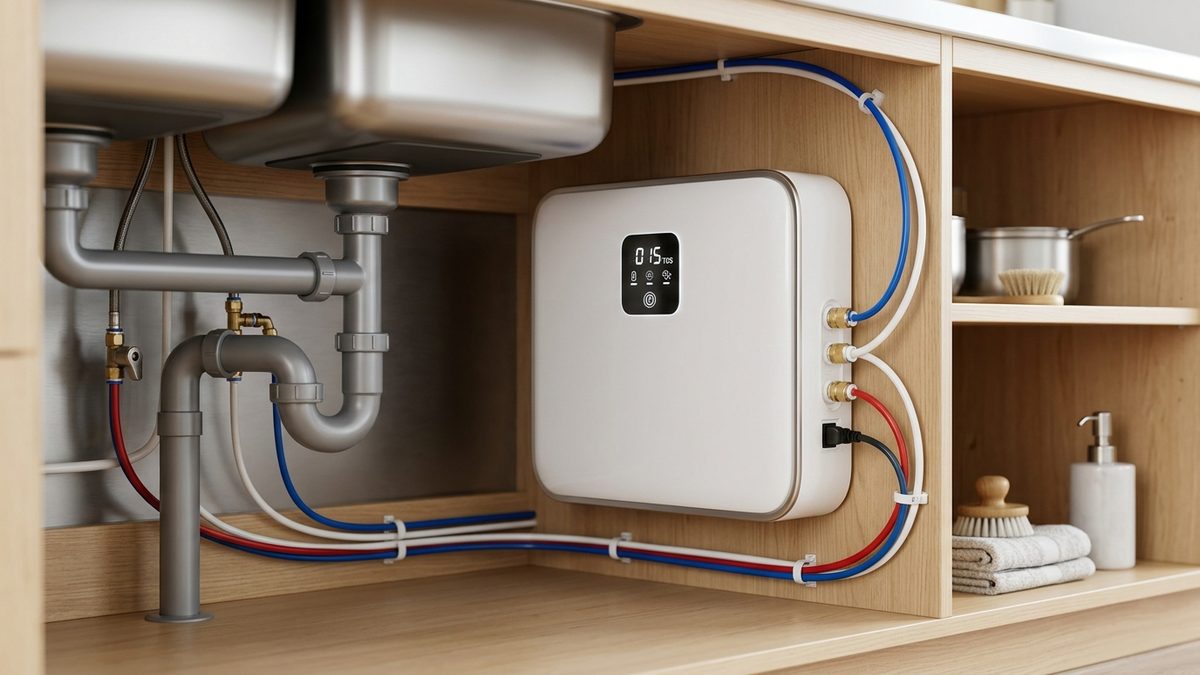
Returns are a design output. Spec the fittings, the tubing, and the manifold the same way you spec the membrane — because a unit that leaks at the first connection is a unit whose spec sheet never mattered.