




 한국어
한국어

- India’s water purifier market is forecast to grow from about $1.24 billion in 2025 to roughly $3.25 billion by 2035, a 10.1% CAGR, with South India the fastest-growing region.
- Reverse osmosis still leads on unit share, but UV and UF systems are the fastest-growing segments as buyers in low-TDS and microbiologically contaminated regions turn away from pure RO.
- Roughly 76% of India’s groundwater carries fluoride, arsenic, or nitrate contamination, which is why technology choice is regional, not uniform.
- IS 10500:2025 and CPCB’s November 2025 device rules are tightening compliance and forcing non-certified brands out, raising the entry bar for importers.
India is the one water purifier market where a single technology cannot win. A unit that sells in Delhi, where total dissolved solids routinely run past 800 ppm, is the wrong unit for Kerala, where the threat is microbial contamination in surface and shallow-well water. Importers who treat India as one homogeneous market end up holding inventory that moves in one state and stalls in another.
The market is worth taking seriously on size alone. Expert Market Research puts India’s water purifier market at roughly $1.24 billion in 2025, on track to reach about $3.25 billion by 2035 at a 10.1% CAGR. Mordor Intelligence places the global water purifier and filter market at $34.60 billion in 2025, growing to $52.39 billion by 2031, with Asia-Pacific holding 43.74% of that value and India among its fastest-growing national markets. The demand is real; the question is which technology captures it.
Why RO still leads, and why that is changing
Reverse osmosis has been the default answer in India for over a decade, and it still holds the largest single share. Mordor Intelligence attributes 37.37% of the global water purifier market to RO technology in 2025, and in India the share runs higher in high-TDS urban centers. RO is what a household buys when the water is hard, saline, or heavy with dissolved contaminants that only a semi-permeable membrane can strip.
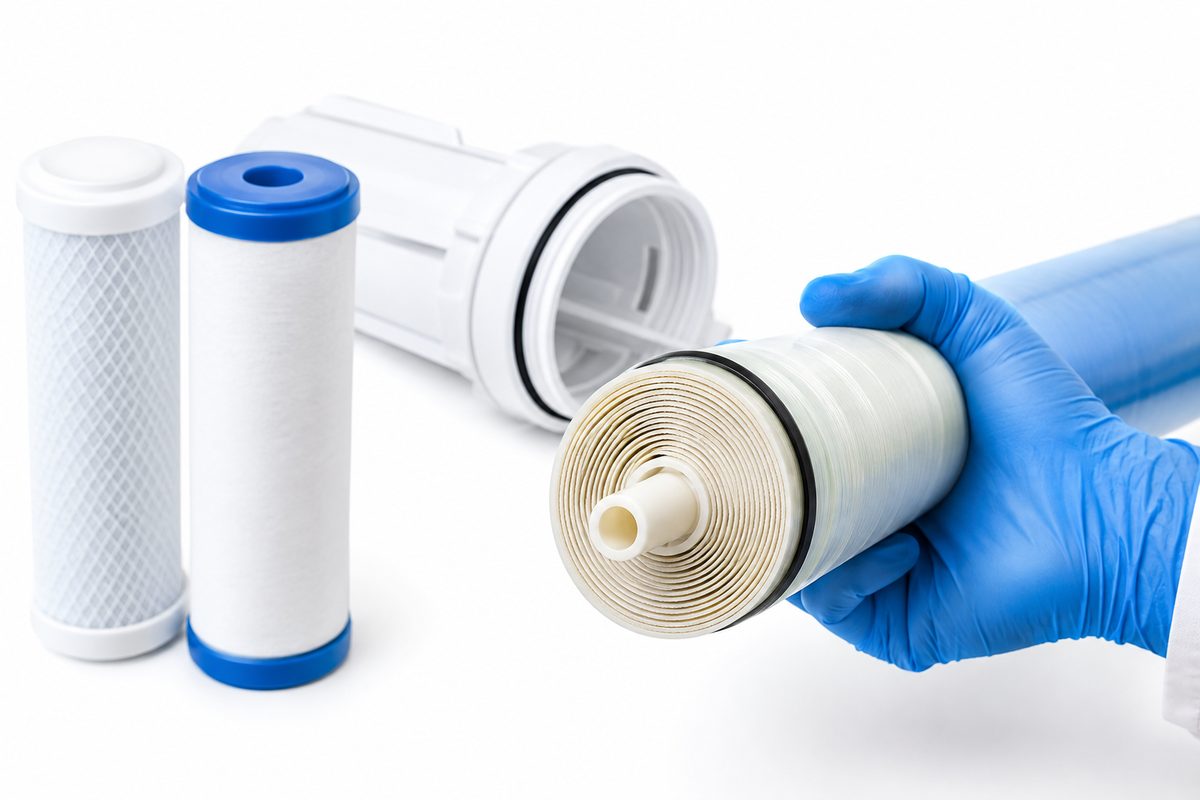
That dominance is now being chipped at from two sides. First, buyers in low-TDS regions are realizing that RO strips beneficial minerals and wastes water to remove contaminants that are not there in the first place. Second, UV and UF systems deliver disinfection and particulate removal without the reject-water penalty, which matters in water-stressed states and in rural areas where electricity is unreliable. For a deeper look at how the membrane technologies compare, the RO membrane vs UF membrane comparison walks through removal ranges and pressure requirements side by side.
UV and UF are the growth story
Ultraviolet and ultrafiltration systems are the fastest-growing segments, and the reason is geographic. India’s contamination profile splits cleanly: the northern and western belts carry fluoride, arsenic, and nitrate in groundwater, while the eastern and coastal belts carry microbial and biological contamination. UV is the answer where the threat is bacteria and viruses; UF is the answer where the threat is turbidity, cysts, and suspended solids, and neither one demands the electricity draw or reject-water flow of RO.
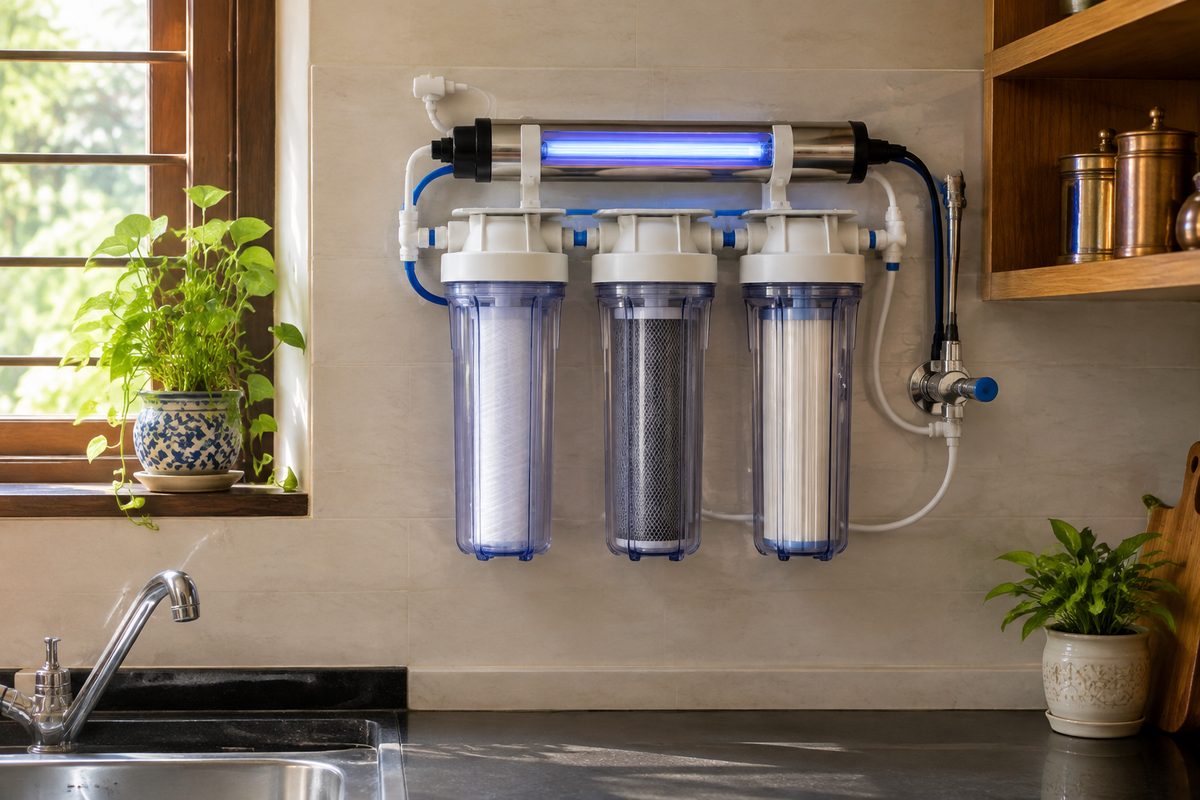
Mordor Intelligence projects UV to advance at an 8.76% CAGR through 2031, ahead of several other technology categories. UF rides the same current, because it is the natural pairing stage ahead of UV and because it works under gravity or low pressure where power is intermittent. The combined UV-plus-UF unit has become the standard recommendation for microbiologically compromised water, and that is exactly the segment importers should be planning inventory against. The UV vs RO bacteria removal guide for importers breaks down which contaminant profile each technology actually resolves.
How the three technologies stack up
| Technology | Removes | Does not remove | Best-fit region in India | Power / reject water |
|---|---|---|---|---|
| Reverse osmosis | Dissolved solids, heavy metals, arsenic, fluoride, nitrate | Nothing at high pressure, but strips minerals | High-TDS north and west (Delhi, Rajasthan, Gujarat) | Needs power; 3-4x reject water |
| Ultraviolet (UV) | Bacteria, viruses, pathogens | Dissolved solids, chemicals | Microbially compromised east and coast (West Bengal, Kerala) | Needs power; no reject water |
| Ultrafiltration (UF) | Turbidity, cysts, suspended solids, some pathogens | Dissolved contaminants, viruses | Low-TDS, high-turbidity rural and peri-urban | Low/no pressure; no reject water |
The table is the practical sourcing answer: RO for dissolved-contaminant regions, UV-plus-UF for microbial regions, and a staged combination for buyers who cannot predict what they are drawing. Importers who stock one configuration and try to push it nationwide are leaving share on the table in at least two of the three regional profiles.
What India’s water quality actually dictates
The single most important input to technology choice is groundwater chemistry, and India’s is unusually hostile. Industry estimates point to roughly 76% of the country’s groundwater carrying fluoride, arsenic, or nitrate above safe levels in some districts. The Jal Jeevan Mission, India’s national program to deliver functional household tap connections, has explicitly prioritized arsenic- and fluoride-affected habitations, which means the public intervention is pulling purification demand toward post-connection household devices in exactly the regions where dissolved contaminants are worst.
That has a direct commercial consequence: the government is building the pipe, but it is not solving the last-mile chemistry. A household that gets a tap connection to fluoride-heavy groundwater still needs a device that removes fluoride, and that is RO territory. Where the program reaches areas with clean but biologically suspect water, UV and UF take over. The result is a market that is growing everywhere but fragmenting by technology as it grows.
Standards are tightening, and that raises the bar
Compliance is the other force reshaping the market. India’s Bureau of Indian Standards updated IS 10500 to the 2025 revision, adding tighter limits on heavy metals and requiring pretreatment and advanced purification for a wider set of contaminants. The Central Pollution Control Board followed in November 2025 with a device quality rule that forces purifier output to meet IS 10500:2025 and requires online platforms to register the devices they sell.
For an importer, this is the entry ticket, not a differentiator. A unit without BIS registration and IS 10500:2025 test documentation is increasingly unsellable through organized retail and e-commerce, and the subsidy programs run by states like Uttar Pradesh, Maharashtra, and Tamil Nadu only pay out on certified equipment. The compliance stack differs from the US and EU in the specifics, but the pattern is the same one reshaping the Asia-Pacific water purifier market: certified, documented systems are taking share from unbranded imports.
What importers and OEM buyers should watch
Three shifts matter most for sourcing decisions over the next two to three years. First, the center of gravity is moving south and down-tier: South India is the fastest-growing region, and tier-2 and tier-3 cities plus rural districts are where first-time adoption is happening, which favors mid-range, low-maintenance, low-power units over flagship RO towers. Second, the replacement cycle is compressing as filter-change intervals shorten from twelve months toward nine, which makes consumables and the recurring-revenue model as important as the box itself.
Third, the intelligent-unit segment is scaling fast: IoT-enabled purifiers with filter-life alerts crossed 800,000 shipments in 2025, about 8% of the home market, and are forecast to reach roughly 12% in 2026. For a manufacturer, that is where margin and differentiation now live. For a related view on how tankless high-capacity systems are shifting procurement, the tankless RO market forecast covers the compact end of the same trend.
Where ONEMI fits an India-facing line
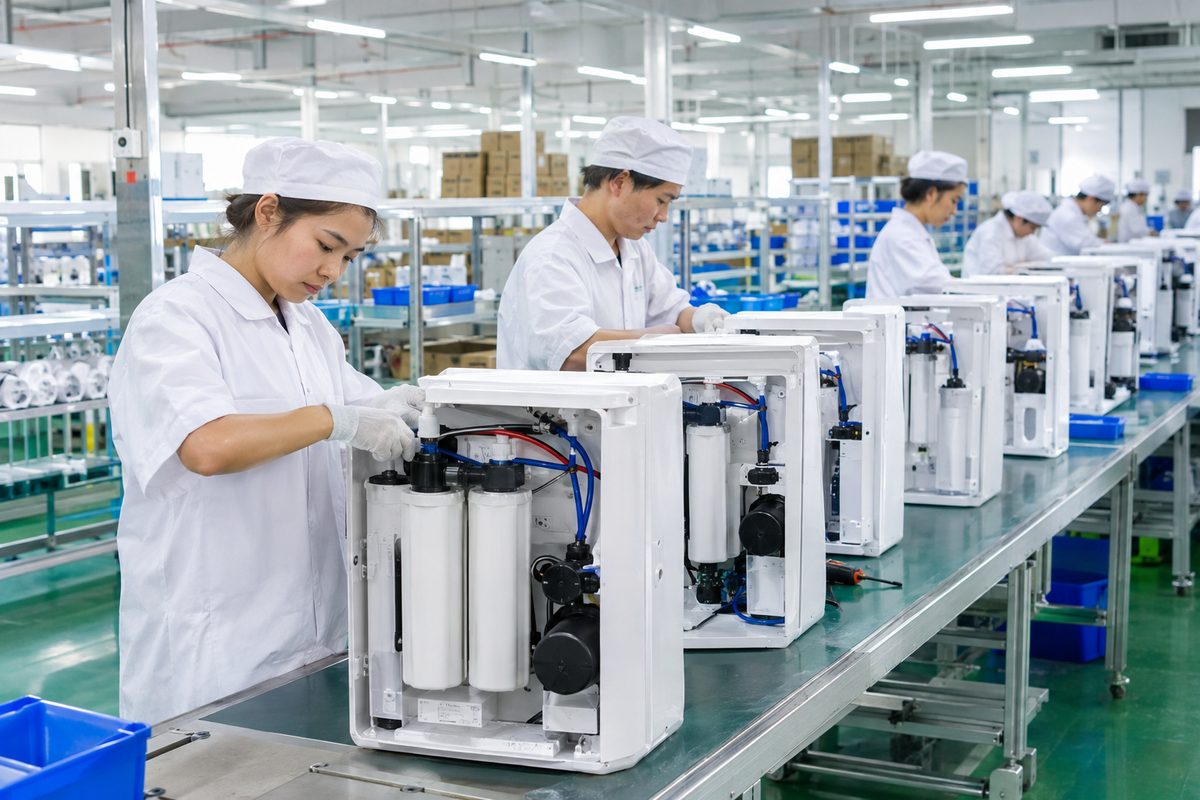
ONEMI, a Guangdong-based water purification equipment manufacturer, runs under-sink RO, countertop, and UF platforms that map directly onto India’s three regional profiles. The RO line covers the high-TDS dissolved-contaminant belt, the UF and UV-plus-UF configurations cover the microbial and turbidity belts, and the cartridge and membrane range feeds the compressing replacement cycle that makes Indian distribution profitable over time.
The practical sequence for an importer is to anchor on BIS-registrable RO and UV-plus-UF units with IS 10500:2025 test data, build the compliance documentation for the target states, then layer on the consumables program that turns a one-time box sale into a recurring account. India is a market that rewards region-specific configuration and certified documentation over generic product. The importers who treat it that way are the ones who hold the channel when the next compliance rule lands.