




 한국어
한국어

- Tankless RO purifier sales reached roughly $721 million in 2025 and are projected to near $1.04 billion by 2032, a 5.5% CAGR (Global Info Research, 2026).
- The category’s momentum rests on one technical leap: 800 GPD direct-flow membranes that deliver 2.1 liters per minute without a storage tank.
- Direct-flow systems cut the pure-to-waste ratio to as low as 1:0.8, against the 1:3 to 1:4 typical of tank-based units.
- For importers, the near-term differentiator is certification depth: NSF/ANSI 42, 58, and 372, plus EPA PFAS compliance.
The under-sink reverse osmosis category is splitting in two. On one side sit tank-based machines that have barely changed in a decade. On the other, a fast-growing class of tankless units that skip the storage tank entirely. The second group is where the volume is moving, and the reason is not marketing. It is a membrane problem that finally got solved.
What “tankless” actually changes
A conventional RO system stores treated water in a pressurized tank, usually 2 to 4 gallons, so it can deliver a full glass on demand. The trade-off is well documented. The tank eats under-sink space, holds water at room temperature, and becomes a slow source of secondary contamination if it is not sanitized. Every component between the membrane and the faucet is a potential recontamination point.
A tankless, or direct-flow, system removes the tank and the entire problem. Water is filtered the moment you open the tap, pushed through the membrane by a high-flow pump and a large-area RO element. There is no standing water, no air gap, and no reservoir to breed bacteria. The unit shrinks to roughly the height of a two-liter bottle, which matters in rental kitchens and compact European apartments where the machine has to fit a 30-centimeter cabinet.
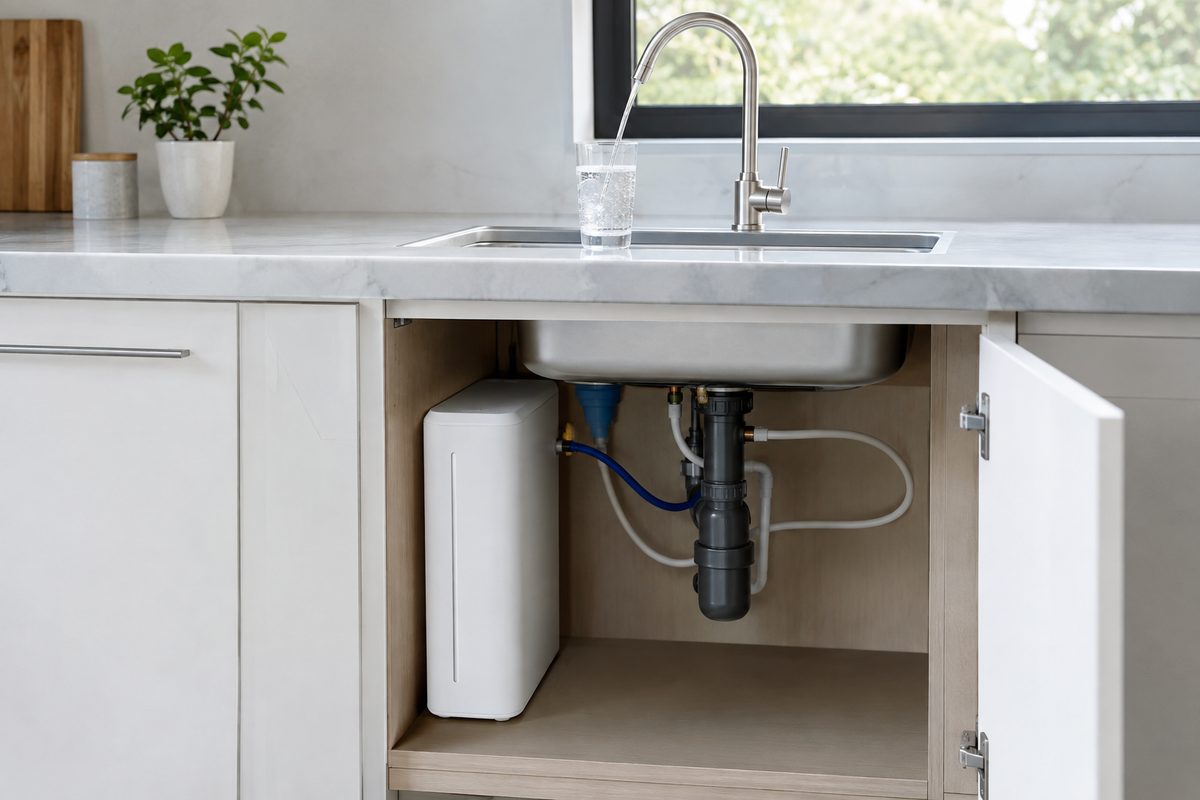
This is the same logic that moved the tank-versus-tankless debate from a niche argument into a procurement question. The spec sheet no longer hinges on tank capacity. It hinges on membrane rating, pump performance, and how fast the unit can produce a full flow.
Market size and where the growth sits
Global Info Research, the research arm behind LP Information, sized the global tankless RO water purifier market at about $721 million in 2025, with a path to roughly $1.04 billion by 2032 at a 5.5% CAGR. The figure is a subset of a much larger reverse osmosis category, which Global Growth Insights pegged at $8.89 billion in 2025 rising toward $16.13 billion by 2035.
| Market view | 2025 | Forecast | CAGR | Source |
|---|---|---|---|---|
| Tankless RO purifiers | $721M | $1.04B (2032) | 5.5% | Global Info Research, 2026 |
| Reverse osmosis systems (all) | $8.89B | $16.13B (2035) | 6.14% | Global Growth Insights, 2026 |
Asia-Pacific leads the regional split, which is unsurprising given the density of membrane and pump supply chains in Guangdong, Ningbo, and the Pearl River Delta. North America and Europe follow, driven less by raw water scarcity than by regulation and replacement cycles.
The growth drivers stack. EPA’s 2024 PFAS rule set a 4 nanograms-per-liter limit on PFOA and PFOS, and the agency’s Lead and Copper Rule Improvements pushed the lead action level from 15 to 10 parts per billion. Both rules give households a concrete reason to upgrade older equipment, and both favor RO as the highest-removal point-of-use technology. The reference on US under-sink sourcing and NSF/PFAS rules covers the compliance detail importers need.
Tank versus tankless: a straight comparison
Put the two architectures side by side and the differences are specific, not stylistic. The table below is the version a procurement team actually fills in, with the numbers that matter to a retail buyer.
| Dimension | Tank-based RO | Tankless (direct-flow) RO |
|---|---|---|
| Under-sink footprint | Large, tank + machine | Compact, single unit |
| Standing water | 2-4 gallons stored | None, on-demand |
| Flow rate | Fast from tank, slows after drawdown | 800 GPD = ~2.1 L/min continuous |
| Pure-to-waste ratio | Typically 1:3 to 1:4 | 1:0.8 to 3:1 |
| First-glass TDS | Can spike from standing water | Managed by auto back-flush |
| Secondary contamination risk | Higher (tank, air gap) | Lower (sealed path) |
One caveat keeps the tank architecture alive in specific niches. A tank delivers a burst of flow instantly, which matters in a commercial setting where a coffee machine or ice maker draws water in pulses. Direct-flow systems close the gap but still trade instantaneous burst for continuous flow. For a household kitchen, the trade is almost always worth it; for a bar espresso setup, a tank or a hybrid may still win.
The 800 GPD threshold and direct-flow engineering
The tankless category only became viable once membranes crossed a performance line. Early RO elements produced 50 to 100 gallons per day, far too slow to serve a tap directly. Today’s direct-flow units run 600, 800, or 1,000 GPD elements. An 800 GPD membrane translates to about 2.1 liters per minute of on-demand flow, enough for a kitchen tap without a reservoir.
The engineering shift is not trivial. A direct-flow RO needs a high-pressure pump that can deliver stable pressure across a wide flow range, a membrane with enough surface area to hit the rated output at household line pressure, and a control board that manages a startup flush. The flush matters because RO membranes suffer from TDS creep: dissolved solids diffuse across the membrane while the system sits idle, so the first glass can carry elevated TDS. A well-designed tankless unit runs an automatic back-flush to clear that standing water before it reaches the tap.
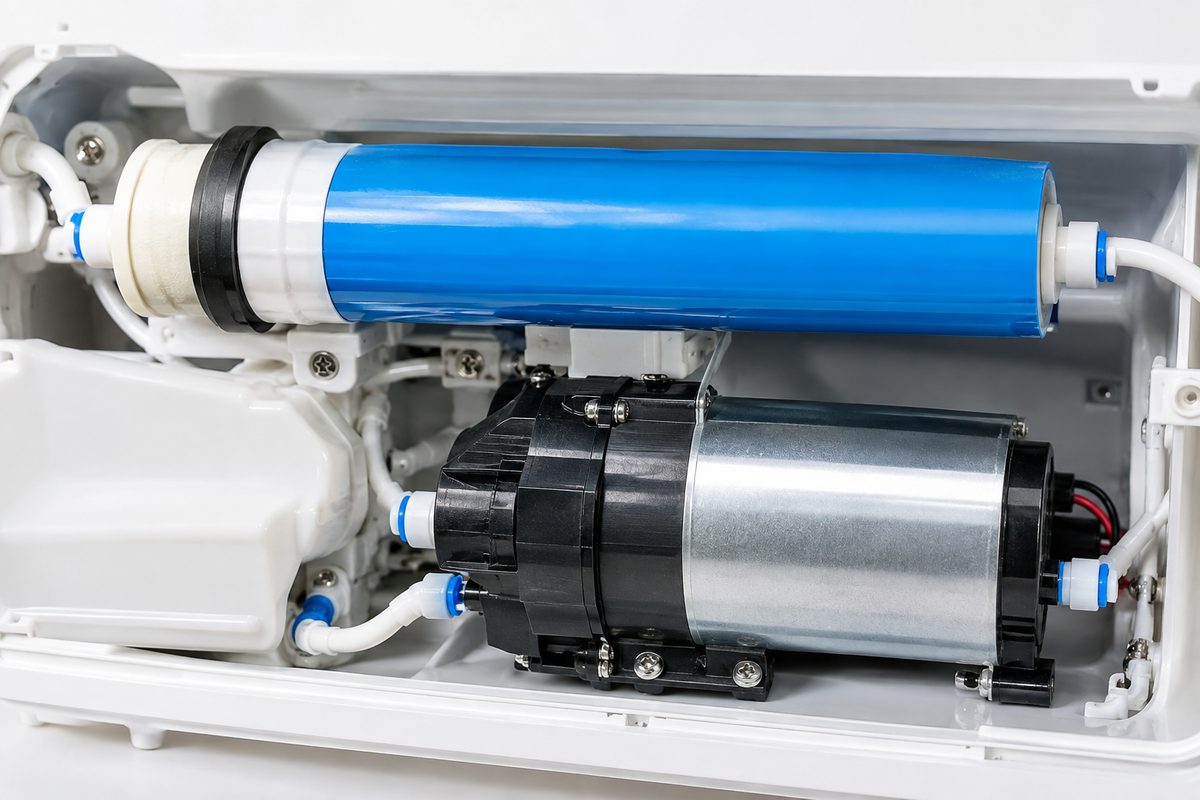
Waste ratio is the other lever. Traditional systems send three or four liters to drain for every liter of clean water. Direct-flow engineering pushes that to between 1:0.8 and 3:1 depending on the membrane and pump pairing. The zero-waste and high-recovery RO discussion goes deeper on how recovery is traded against membrane life. Higher recovery is not free: it concentrates feed water on the membrane surface, which accelerates fouling and shortens element life unless the flush cycle and pre-filtration are dialed in.
What the numbers mean for importers
The tankless segment is the most useful place for a manufacturer or distributor to differentiate, because the spec table finally has visible, comparable rows. Buyers compare GPD rating, flow rate in liters per minute, pure-to-waste ratio, filter replacement interval, and noise. A machine that holds 800 GPD, 2.1 liters per minute, and a 3:1 recovery at under 45 decibels reads as a serious product; a unit that hides behind “high flow” without a number does not.
ONEMI, a Guangdong-based water purification equipment manufacturer, runs its RO line on this logic. The product range includes direct-flow units built around 100 GPD and 400 GPD smart platforms, with the larger models aimed at the same kitchen-installed segment the tankless category is expanding into. The full line is documented on the ONEMI 400G smart water purifier page.
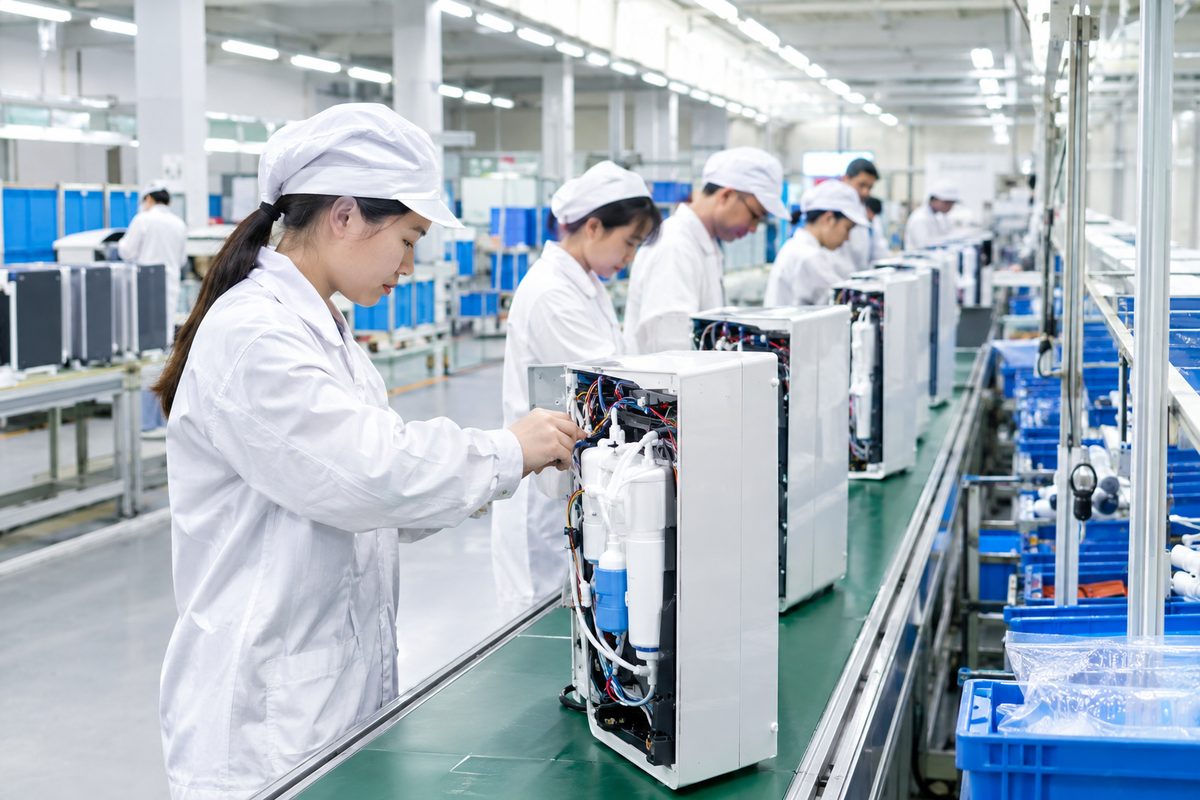 For buyers working through a private-label or OEM program, the starting point is the tankless RO B2B procurement guide, which walks the cartridge-lock and tooling questions.
Certification is the entry ticket
For the US market, the certification stack is not optional. The relevant standards are NSF/ANSI 42 for aesthetic claims like chlorine taste and odor, NSF/ANSI 58 for the reverse osmosis system itself, and NSF/ANSI 372 for lead-free materials. NSF/ANSI 53 covers health-effect claims including lead and PFAS reduction. A tankless unit marketed on “reduces lead” must carry the 53 listing; one marketed on taste can rest on 42 plus 58.
There is a scope rule importers trip on repeatedly. ONEMI’s whole-machine certifications are CE, UL, FCC, and RoHS. NSF applies to the filter cartridge, not the complete appliance. Any listing that claims whole-machine NSF certification for an imported unit is a compliance flag, not a selling point. The precise boundary matters when a retail buyer or a compliance officer asks for documentation.
What to watch through 2030
Three forces should shape the next five years of the tankless category. First, regulation keeps tightening, and each new contaminant limit converts an older installed base into a replacement pipeline. Second, recovery ratios and waste rules will push direct-flow engineering toward higher efficiency, which is already a procurement criterion in water-stressed states. Third, the price delta between tank and tankless continues to narrow, which erodes the last argument for shipping a storage tank at all.
For importers and distributors, the practical move is to lead with measured performance, get the certification stack right before the first container ships, and treat the cartridge as the recurring revenue line rather than an afterthought. The tankless RO market is not the largest segment in water treatment, but it is the one where the spec sheet and the regulation are both moving in the same direction.