

 한국어
한국어

- Tankless (direct-flow) RO now leads premium residential demand in the US, delivering 400-1200 GPD straight to the faucet with no storage tank.
- Tank RO still owns the value segment and high-draw commercial installs where a pressurized buffer is an asset, not a liability.
- The US water purifier market cleared roughly $7.09 billion in 2025 and is forecast to reach $10.35 billion by 2032 (Fortune Business Insights).
- Certifications decide the deal: NSF/ANSI 58 for the RO system, 42 and 53 for the cartridges, and 372 for lead-free wetted components.
The US water purifier market cleared $7 billion in 2025, and the fastest-moving slice of it is a product that barely existed in North American kitchens a decade ago: the tankless reverse osmosis system. Importers and distributors who spent years restocking conventional tank RO units are now watching their spec sheets get rewritten. The question is no longer whether tankless will displace tank systems. It is which segment each platform belongs in, and how to source both without betting a container on the wrong SKU.
What Actually Separates Tankless From Tank RO
Both architectures run the same core process. Feed water passes a sediment pre-filter, a carbon stage, then a reverse osmosis membrane that rejects dissolved solids down to roughly 0.0001 microns. The split happens after the membrane, and everything downstream of that point is different.
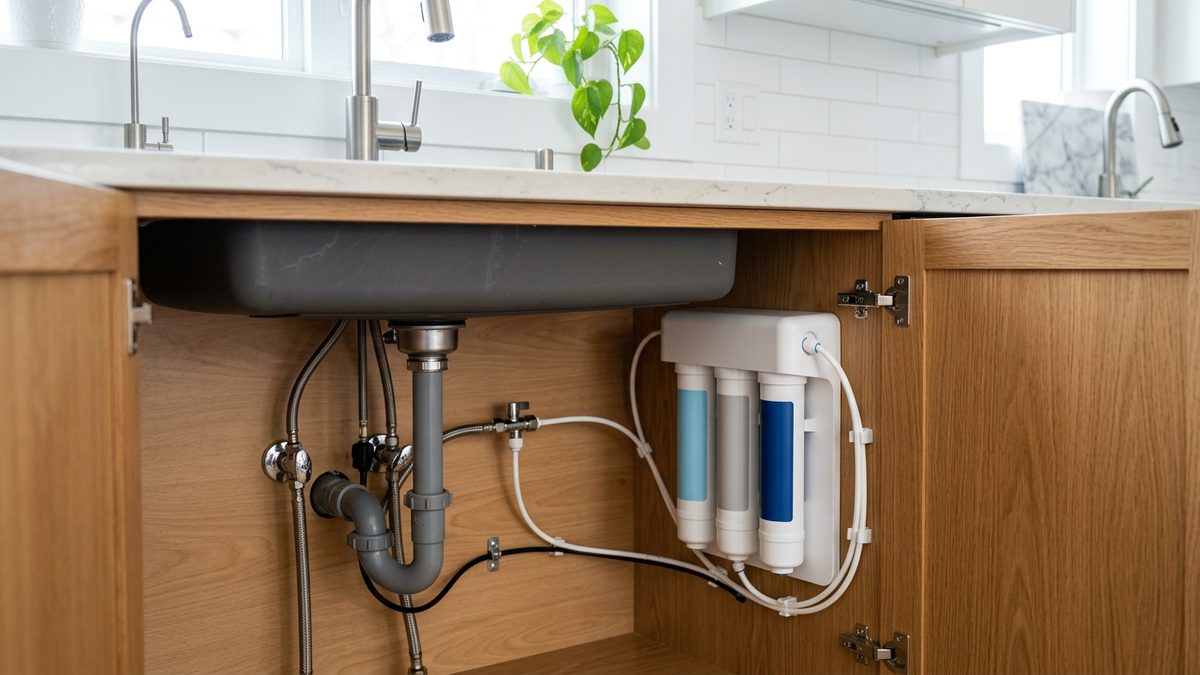
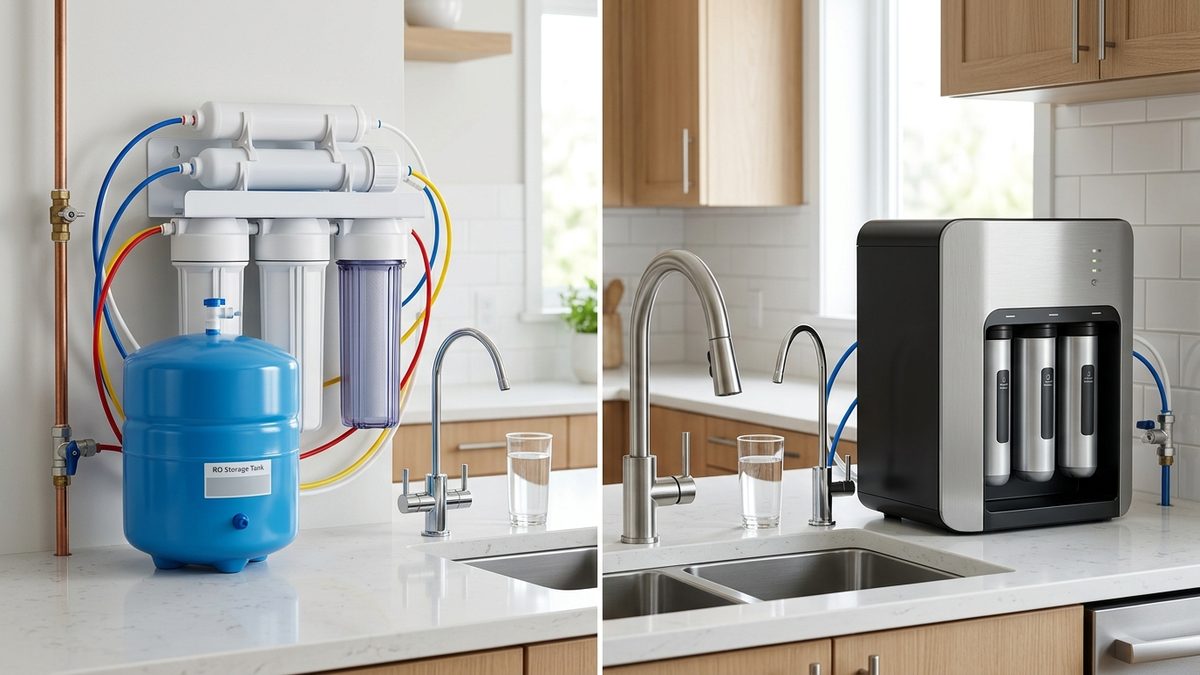
A conventional tank RO pushes filtered water into a pressurized storage bladder, typically 3.2 gallons, or about 12 liters. The faucet draws from that reservoir, which is why a tank unit can deliver a sudden burst even though its membrane only makes 50 to 100 gallons per day. A tankless, or direct-flow, unit skips storage entirely: a larger membrane and a booster pump push water straight to the tap at 400 to 1200 gallons per day.
The trade-offs shake out like this:
| Dimension | Tank RO | Tankless RO |
|---|---|---|
| Rated output | 50-100 GPD membrane, reservoir for bursts | 400-1200 GPD direct flow |
| Under-sink footprint | System plus 3.2 gal tank | Single compact chassis, no tank |
| First-cup TDS | Higher, from TDS creep in the idle tank | Lower, freshly filtered draw |
| Peak simultaneous draw | Buffered by the tank | Limited by pump and membrane capacity |
| Sanitation concern | Standing water in the reservoir | No standing water reservoir |
| Bill of materials | Lower | Higher, from the larger membrane and pump |
TDS creep is the detail that separates buyers who test from buyers who trust the brochure. When an RO system sits idle, dissolved solids diffuse across the membrane into the permeate side. In a tank system that higher-TDS water mixes into the reservoir, so the first cup after an idle night can read noticeably higher than a mid-stream sample. Tankless units sidestep most of this because the first draw is freshly filtered rather than stored. It is a small difference on paper and a large one on the tongue.
Why Tankless Is Winning US Retail and Distribution
Three forces are pushing tankless into the lead position in premium residential demand. The first is kitchen geometry. US under-sink cabinets are tight, and a 12-liter tank eats the space a customer would rather use for a disposal or a pull-out bin. A tankless chassis at roughly a third of the footprint fits where a tank unit simply will not.
The second is the flow-rate expectation. A homeowner who has lived with a 50-GPD tank system for years accepts the slow trickle as normal. A first-time buyer comparing against a pitcher filter does not. Direct-flow units fill a glass in seconds, and that experience is what closes the sale at retail.
The third is the broader market itself. Fortune Business Insights sized the US water purifier market at about $7.09 billion in 2025, with a path to $10.35 billion by 2032. Growth at the top of the price band is outpacing the entry tier, and that favors the higher-spec tankless platform.
For a distributor the message is blunt: the margin-rich, fast-turning residential SKUs are increasingly tankless. The 400G and 600G direct-flow units are becoming the default recommendation for under-sink installs in new and renovated homes.
Where Tank RO Still Earns Its Keep
None of this means the tank platform is dead. It means its job description has narrowed, and understanding that narrowing matters before you commit volume.
Budget is the first reason. In price-sensitive segments and rental-property channels, the lower bill of materials on a 75-GPD tank unit keeps landed cost down and sell-through predictable. A landlord equipping twelve units does not care about first-cup TDS; they care about upfront outlay and the availability of cheap replacement cartridges.
High simultaneous draw is the second. A small restaurant, a warehouse break room, or a clinic with a five-gallon dispenser all pull water in bursts. The storage bladder absorbs that demand in a way a direct-flow membrane cannot without oversized pumps. For light-commercial and office point-of-use installs, tank RO remains the practical choice.
The third is the replacement ecosystem. Decades of tank RO installs mean the cartridge aftermarket is deep and standardized. A distributor who supplies replacement cartridges, the steady repeat-purchase revenue stream, keeps a tank line running simply because that installed base still needs filters every six to twelve months.
The Spec Sheet That Separates Good Sourcing From Guesswork
Most sourcing mistakes on RO systems happen because a buyer evaluates the membrane GPD number and ignores everything around it. The full picture is checkable before a single container ships.
| Parameter | Why it matters | US import baseline |
|---|---|---|
| Membrane GPD rating | Determines real flow, not marketing flow | 100G tank / 400-1200G tankless |
| TDS rejection | Water quality actually delivered | 90%+ typical, 96%+ on 600G membranes |
| Recovery rate | Waste ratio and water bill | 1:1 to 1.5:1 pure-to-waste |
| Booster pump spec | Pressure under low inlet conditions | 24V DC, self-priming |
| Fittings and tubing | Lead-free compliance | NSF/ANSI 372 listed |
| Certifications | Gate for US retail and e-commerce | NSF/ANSI 42, 53, 58 |
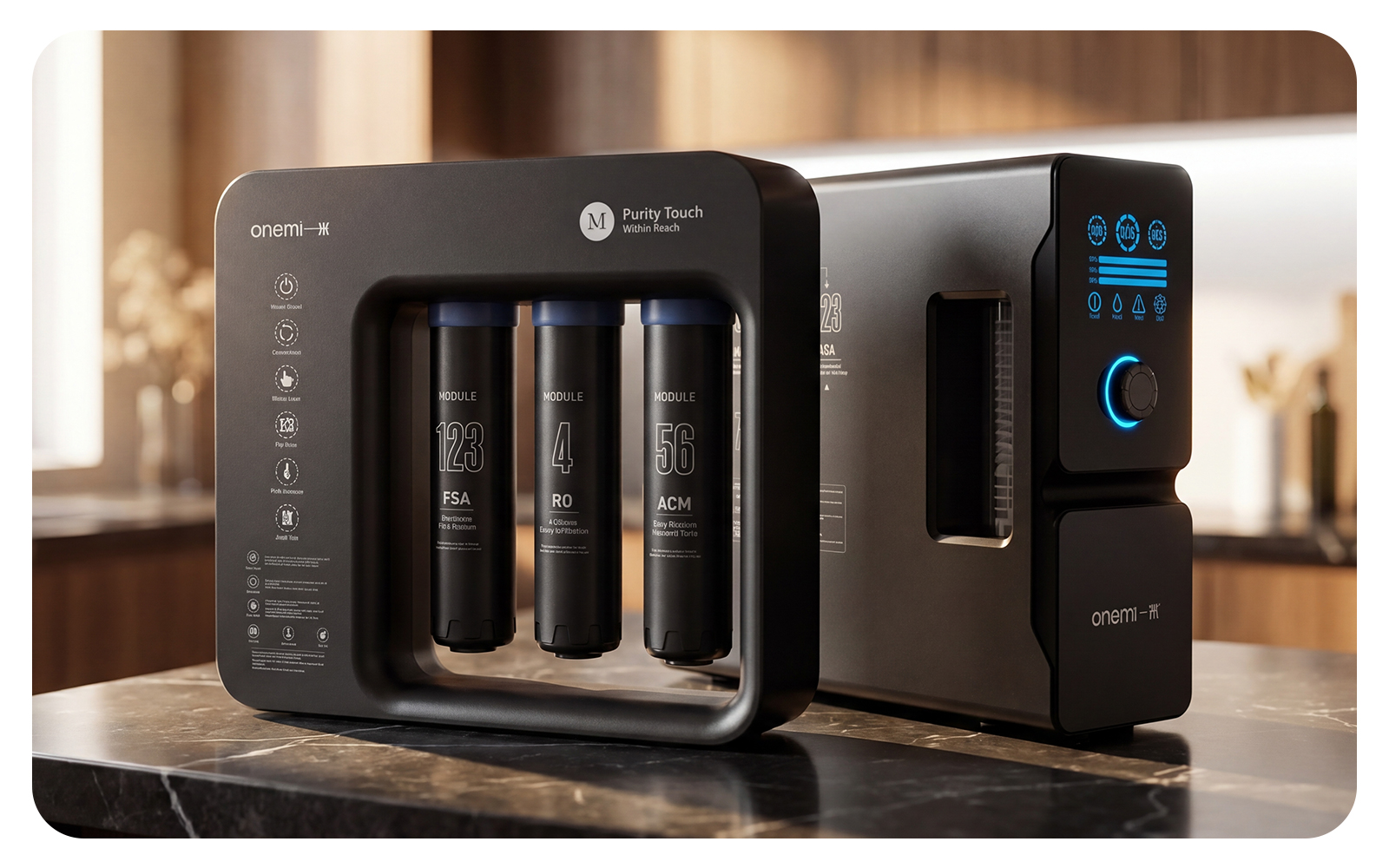
ONEMI ships both platforms, which is the point of bringing the factory into the comparison. The RO-400G smart purifier is a tankless, direct-flow unit built for under-sink installs and rated for 400 gallons per day. The RO-100G is a conventional tank system aimed at the value and light-commercial segment. Keeping both on the line is deliberate: a manufacturer that only makes tankless cannot serve the replacement-cartridge channel, and one that only makes tank units misses the premium margin.
Certification and Compliance for the US Market
Certifications are where imports live or die, at the border and in the marketplace. A unit without the right listings is unsellable through Amazon, big-box retail, and most plumbing distributors.
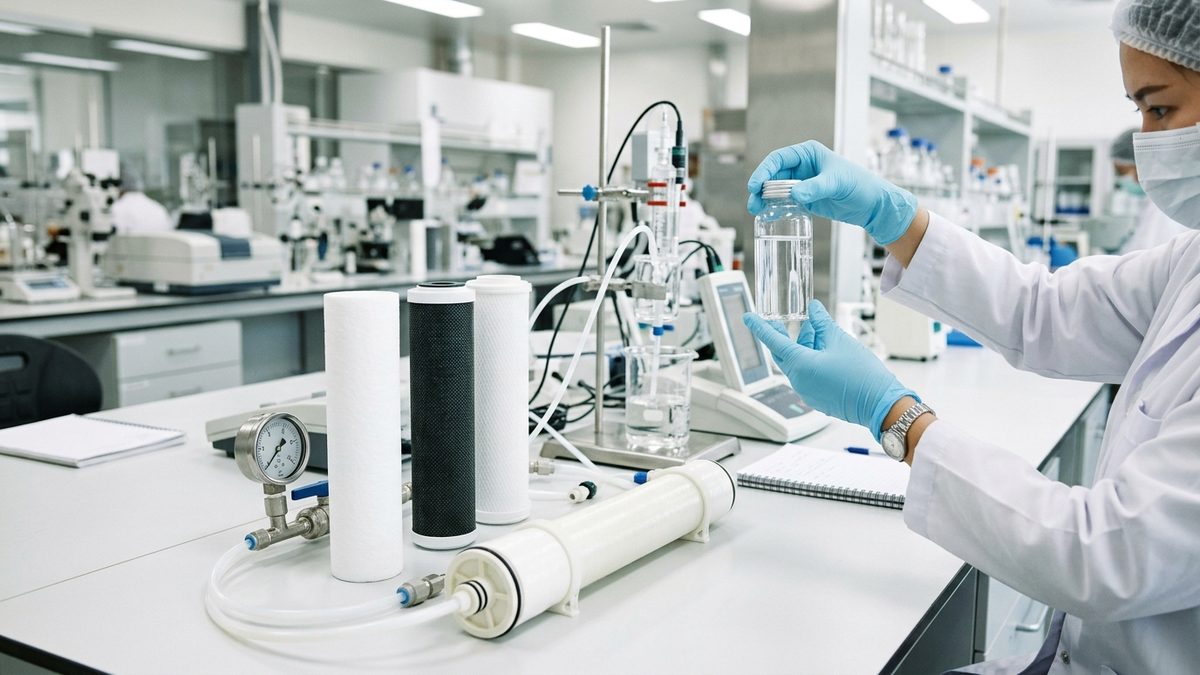
NSF/ANSI 58 covers the reverse osmosis system itself and certifies TDS reduction performance. NSF/ANSI 42 handles aesthetic claims like chlorine taste and odor, while NSF/ANSI 53 handles health-effect contaminants including lead, arsenic, and PFAS. NSF/ANSI 372 is the lead-free standard for wetted components, effectively mandatory under the Reduction of Lead in Drinking Water Act. NSF/ANSI 61 governs materials safety for anything touching drinking water.
Two checks belong on every importer’s routine. First, confirm the certification is real by looking up the listing on the certifier’s database. Second, confirm the mark applies to the exact model you are buying, not a sibling SKU. A certificate for a 100G tank unit does not transfer to a 600G tankless. ONEMI’s units carry CE, UL, FCC, and RoHS for the complete systems, with NSF listings on the filter cartridges, and a granted US patent on the universal cartridge structure. Ask for the certificate numbers and verify them, because the paper trail is what survives a regulator’s review. See the full picture on the certification page.
OEM and Sourcing Considerations
The sourcing mechanics differ between the two platforms, and a buyer should know which levers they are pulling before negotiating.
On tankless units the membrane and booster pump dominate the bill of materials, so spec those precisely and ask for the membrane brand and model in writing. On tank units the storage bladder and the shut-off valve are the components most likely to fail in year two, so warranty terms on those two parts matter more than the headline GPD.
Minimum order quantities vary by configuration. A factory running private-label and OEM programs will typically quote a lower MOQ on a standard tank chassis than on a tankless unit with a custom fascia and smart features. If you are launching a private-label brand, the factory’s ability to handle custom color, packaging, and a unique model number without ballooning lead time is the real test of an OEM partner.
For buyers serving the US market through Global Sources, Amazon FBA, or dropshipping, the practical checklist is short: lead-free wetted parts, NSF/ANSI listings for the exact SKU, mail-order packaging that survives a four-foot drop, and a factory that holds consistent quality across a container rather than a single golden sample.
Stock Both, Lead With Tankless
The data does not support abandoning the tank platform. It supports repositioning it. Tank RO stays where budget and burst demand rule: value residential, rental fleets, light commercial, and the cartridge aftermarket. Tankless takes the premium residential lead, where footprint, instant flow, and first-cup quality are the buying triggers.
For an importer building a US line card in 2026, the sensible structure is a tankless flagship in 400G or 600G, a value tank unit at 75G or 100G, and a cartridge program that feeds both installed bases. That mix captures the growth at the top and the recurring revenue at the bottom, without betting the container on a single architecture.
ONEMI is a Guangdong-based water purification equipment manufacturer serving US and global importers with OEM, ODM, and private-label programs.