



 한국어
한국어

- Lead-testing deadlines for US schools are binding, not advisory. Washington State begins mandatory five-year retesting in July 2026, with a 5 ppb action level per outlet.
- The EPA’s 2024 Lead and Copper Rule Improvements tightened the federal lead action level from 15 ppb to 10 ppb and requires removal of roughly 9-10 million lead service lines within ten years.
- Specify point-of-use filters certified to NSF/ANSI 42 and 53 for lead reduction, NSF/ANSI 58 for reverse osmosis, and NSF/ANSI 61 for all wetted components.
Few drinking water problems get a facility manager’s attention faster than lead in a school. Unlike taste, odor, or hardness, lead is invisible, odorless, and tied to measurable harm in developing children. The problem has been on the federal books since 1988, but the past two years have turned a long-standing concern into a compliance workload with hard deadlines.
For the companies that supply drinking water equipment to schools and daycares, that shift matters. Districts are no longer asking for a generic filter; they are asking for equipment that satisfies a state sampling plan, meets a specific NSF standard, and can be documented. This article lays out what those requirements are and how to spec against them.
Why school water lead is now a compliance issue
The legal foundation is older than most people realize. The federal Lead Contamination Control Act of 1988 was written to reduce lead exposure in drinking water at schools and child care centers, initially by removing drinking water coolers with lead-lined tanks. Its monitoring provisions were challenged in court and never fully enforced, which left school lead testing to a patchwork of state laws for decades.
That patchwork is tightening. The Environmental Protection Agency’s 2024 Lead and Copper Rule Improvements lowered the federal lead action level from 15 parts per billion to 10 ppb and set a ten-year schedule to remove an estimated 9 to 10 million lead service lines nationwide. The compliance cost estimates run well beyond $45 billion. Schools that operate their own water systems fall directly under the federal Lead and Copper Rule; most schools, however, buy water from a public system and are instead governed by state school-specific laws.
State rules are where the day-to-day pressure sits. Washington State’s RCW 28A.210.410 requires public K-12 buildings constructed, or with all plumbing replaced, before 2016 to test drinking water outlets for lead, with a 5 ppb action level at any outlet and retesting at least every five years starting July 1, 2026. Other states run similar programs with their own thresholds and sampling calendars. The common thread is the same: the era of treating school lead testing as optional is over.
What the rules actually require
There is a difference between what the federal government requires and what a given state requires, and suppliers who conflate the two will spec the wrong equipment. The federal framework sets the ceiling through the Safe Drinking Water Act and the Lead and Copper Rule; state school laws set the floor for the buildings themselves.
For a school or daycare, the practical obligations usually come down to three things. First, test every drinking outlet — water fountains, kitchen taps, classroom sinks — on a state-defined schedule. Second, act when a sample exceeds the state action level, which commonly means taking the outlet out of service and installing treatment or replacing the fixture. Third, document the remediation and communicate results to families. None of that works without a filter that actually removes lead and can be verified.
On the plumbing side, Section 1417 of the Safe Drinking Water Act defines “lead free” as a weighted average of 0.25% lead across wetted surfaces of a pipe, fitting, or fixture. NSF/ANSI 372 is the certification that proves a product meets that requirement. A filter can be excellent at removing lead from the water and still fail the job if its own housing leaches lead back into the stream.

The NSF standards specifiers need to know
NSF/ANSI standards are the de facto language of drinking water treatment in North America, and specifiers lean on them because they are third-party verified rather than self-declared. For school and daycare applications, four standards carry most of the weight.
| Standard | Scope | Why it matters here |
|---|---|---|
| NSF/ANSI 42 | Aesthetic effects: chlorine taste, odor, particulate | Baseline for taste and turbidity, the first stage of most school units |
| NSF/ANSI 53 | Health effects: lead, cysts, VOCs, and other contaminants | The lead-reduction certification that remediation actually hinges on |
| NSF/ANSI 58 | Reverse osmosis systems | For schools that want point-of-use RO for both lead and broad contaminant removal |
| NSF/ANSI 61 | Health effects of wetted components | Confirms the materials themselves don’t add contaminants back |
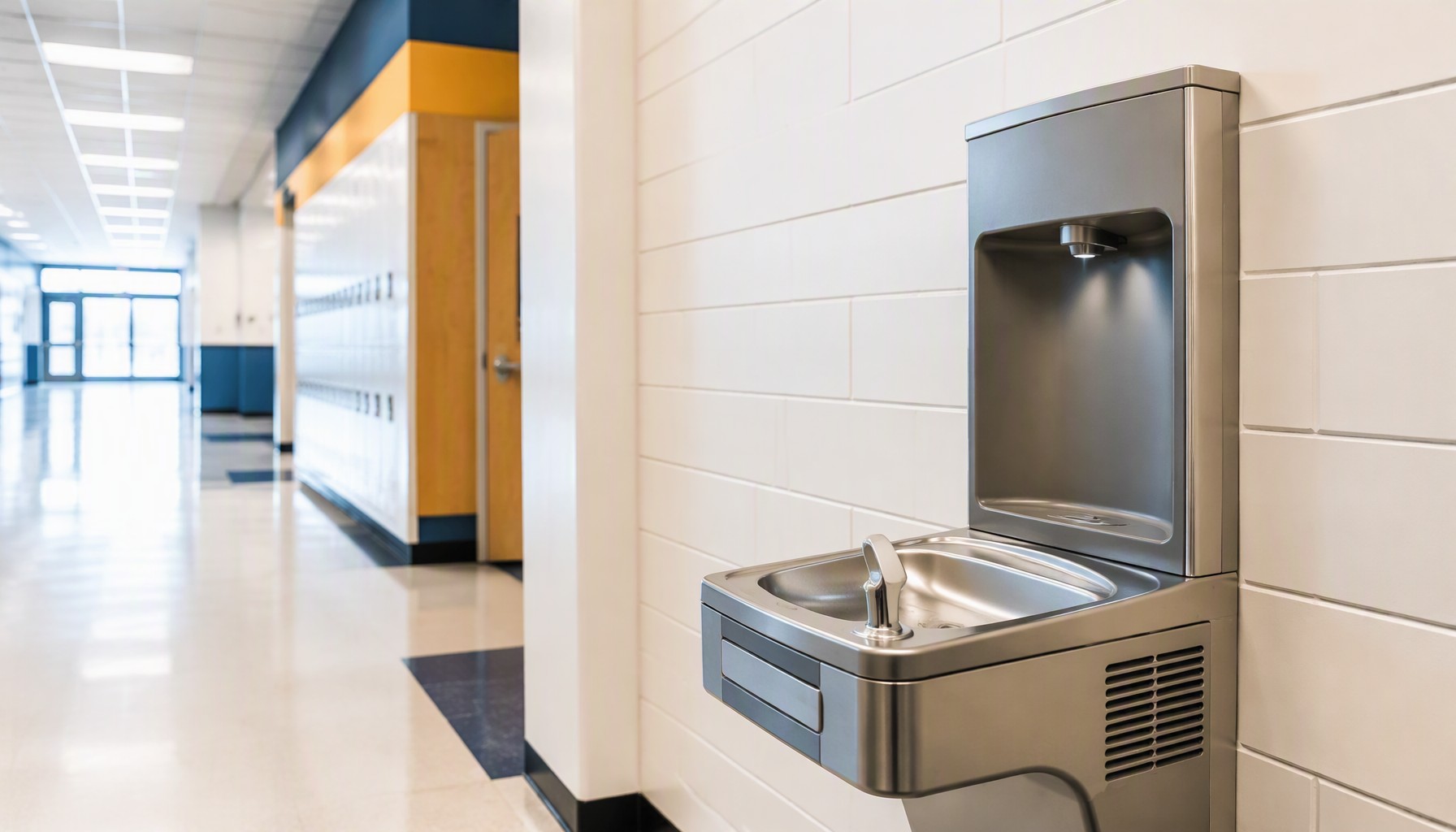
A practical spec for a school water fountain retrofit might read: point-of-use filter certified to NSF/ANSI 42 and 53 for particulate and lead reduction, with all wetted components meeting NSF/ANSI 61, installed at the bottle-filling station and at each outlet that sampled above the action level. For kitchens and labs that want a single high-assurance point of use, an NSF/ANSI 58 reverse osmosis unit is the stronger choice.
The documentation burden is real. A filter that is “tested to” a standard is not the same as one “certified to” it. Specifiers should require the actual certification listing, not a manufacturer’s claim, because state remediation plans and parent communications increasingly reference certification numbers.
Point-of-use versus point-of-entry: what schools actually need
Schools rarely need whole-building treatment for lead, and there is a good reason for that. Lead in school water almost always comes from the last few feet of plumbing — the fixture, the solder joints, the small-diameter supply line — not from the water main. Treating the entire building to solve a problem that lives at the outlet is expensive and misses the point.
Point-of-use filtration is the standard remedy. Bottle-filling stations with built-in filtration are the highest-visibility upgrade because they serve the most students per fixture and their replacement cartridges are designed for high cycle counts. Classroom sinks and kitchen taps that test above the action level get individual point-of-use units until the fixture can be replaced.
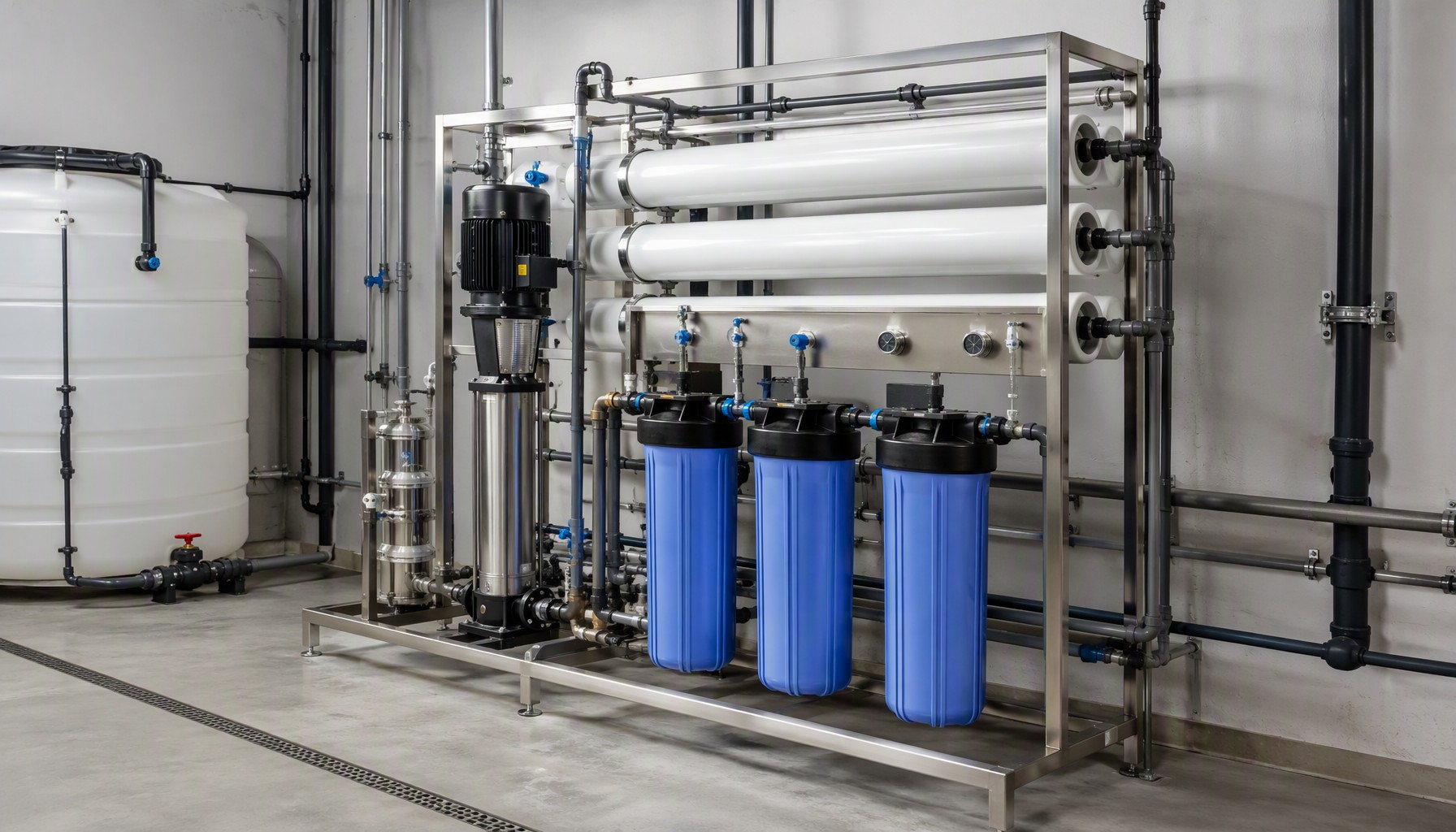
Point-of-entry systems do have a place: sediment and scale protection for the building’s mechanical equipment, or whole-building particulate filtration on well-served rural schools. But for lead compliance specifically, point-of-use is where the requirement is satisfied.
What to look for in a filtration supplier
For distributors and OEM buyers supplying this market, the differentiators are certification depth, cartridge availability, and documentation support — not marketing language. A supplier should be able to provide the NSF listing for each filter, a replacement cartridge SKU with realistic lead times, and enough documentation to survive a state remediation review.
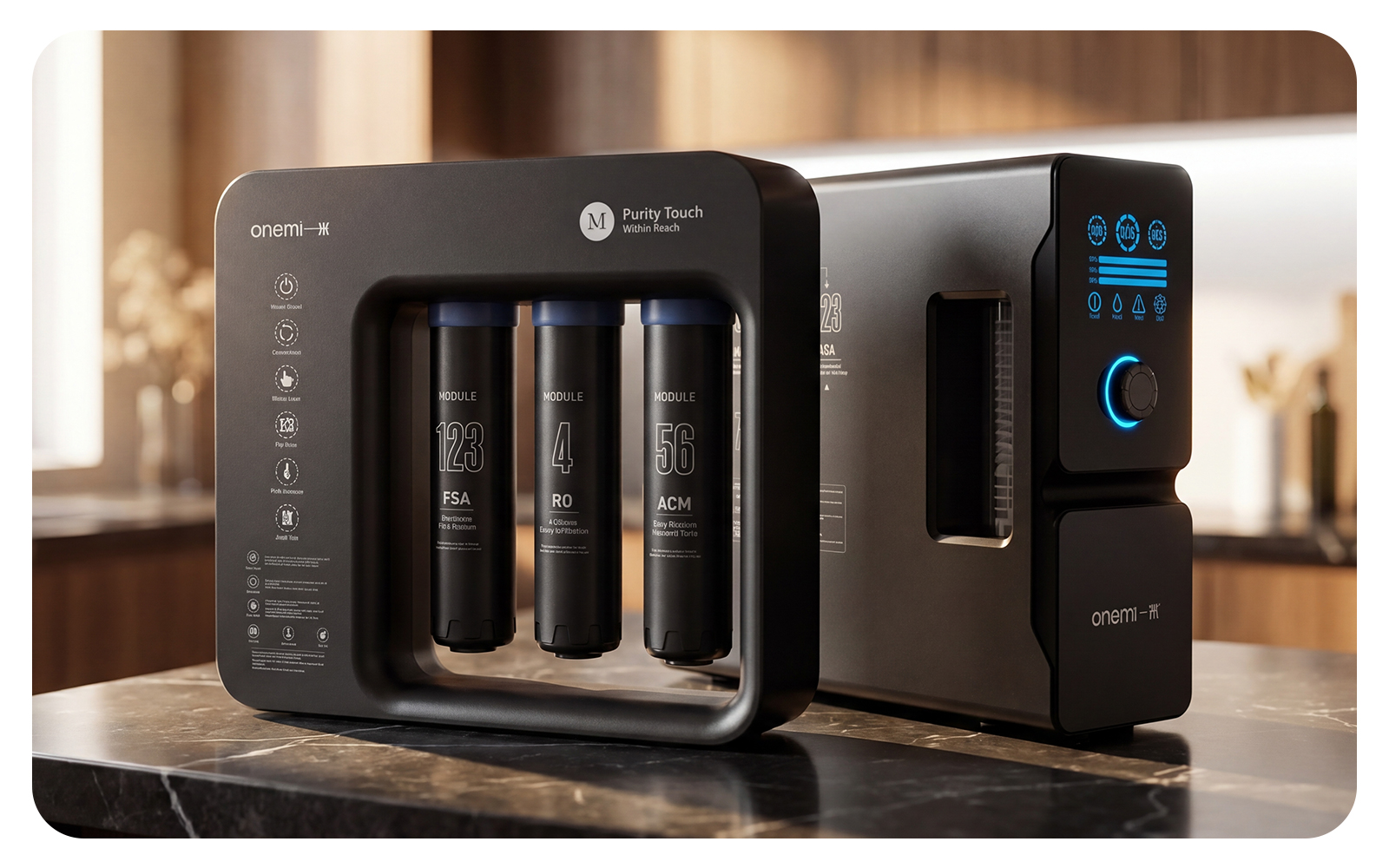
ONEMI is a Guangdong-based water purification equipment manufacturer serving OEM and distribution customers, with point-of-use RO systems and filtration components certified to the standards this market runs on — CE, UL, FCC, and RoHS at the product level, with NSF certification on filter cartridges specifically. Schools and their suppliers generally spec a point-of-use RO unit for kitchens and labs alongside certified filtration at bottle-filling stations, which is exactly the configuration this market has standardized on. Buyers evaluating factory partners should verify certification listings, minimum order quantities, and cartridge replacement logistics before committing, because lead remediation projects run on schedules set by state sampling plans, not by shipping delays.
For product-level details on the point-of-use systems referenced here, see the product center and the 400G tankless RO system pages. Certification scope is summarized on the certification page, and OEM manufacturing capabilities are covered on the OEM and ODM factory page.
The bottom line
School and daycare water filtration is no longer a niche. It is a compliance-driven category with state deadlines, third-party certification requirements, and documentation that parents and regulators actually read. The winners in this market will be suppliers who can prove, in certification listings and consistent cartridge supply, that their equipment does what the spec demands.
Start from the requirement, not the product. Know which NSF standards the state’s action level implies, spec point-of-use treatment where lead actually originates, and partner with a manufacturer that can back every claim with a listing number.