
 한국어
한국어

- Hotel water fails first at the boiler, ice machine, and laundry, not the guest tap. Point-of-entry treatment protects all three from a single location.
- Legionella grows fastest between 77°F and 113°F (25–45°C). ANSI/ASHRAE Standard 188 and a written water management program are the baseline, not an upgrade.
- A convention resort can draw 200+ gallons per occupied room per day. Undersized systems lose pressure and fail exactly at peak occupancy.
Hotels treat water backwards. Most properties put a small point-of-use filter on a few guest-room taps and consider the job done, while the boiler that feeds every shower, the ice machine in the kitchen, and the laundry that turns over hundreds of linens a day run on raw supply. The result shows up as scale-clogged heat exchangers, cloudy ice, grey towels, and, in the worst cases, a Legionella notice from the local health department.
This is written for hotel and resort facilities managers, owners, and the importers and distributors who supply them. It walks through where hotel water actually fails, how to size treatment for peak occupancy, and what to specify so the system holds up when the property is full.
The four points where hotel water actually fails
A hotel is not one water system. It is four systems stacked on top of each other, each with a different failure mode.
The boiler and domestic hot water loop scale up first. Hard water minerals precipitate out as temperature rises, so the heat exchanger in a water heater is where scale builds fastest. A thin mineral film is enough to insulate the element and force it to work harder. The U.S. Department of Energy has long documented that even modest scale deposits reduce water heating efficiency and shorten equipment life, and the effect is worst in hard-water regions across the American West and Midwest.
The ice machine fails on chlorine and sediment, not on scale alone. Municipal supply is treated to carry a chlorine or chloramine residual, and that residual corrodes evaporator plates and gives ice an off taste. The sediment that survives the city main scores pump seals and clogs the fine orifices that make ice machines temperamental to begin with. A single ice machine failure during a banquet is a service call that costs more than a year of filtration.
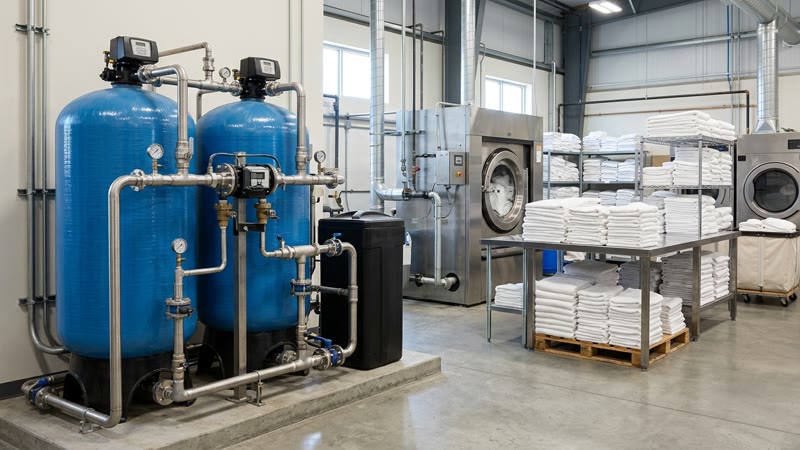
The laundry is where hard water quietly raises linen cost. Hard water doesn’t rinse detergent out; it reacts with it to form soap curd that stays in the fabric. Towels turn grey and stiff, sheets lose their finish, and the housekeeping team adds more detergent and hotter water to compensate. The Water Quality Association has reported that softening water can cut detergent use by as much as half, which on a property doing several hundred rooms of linen a day is a real line item.
Guest rooms are the easy part and the part everyone over-engineers. A point-of-use system under a room sink is simple to spec, but it solves the smallest share of a property’s actual water cost. It is also the part where undersized filtration shows up fastest: open three showers and two dishwashers at once and a system sized for average demand will drop pressure exactly when the property is busiest.
Legionella and the potable water system
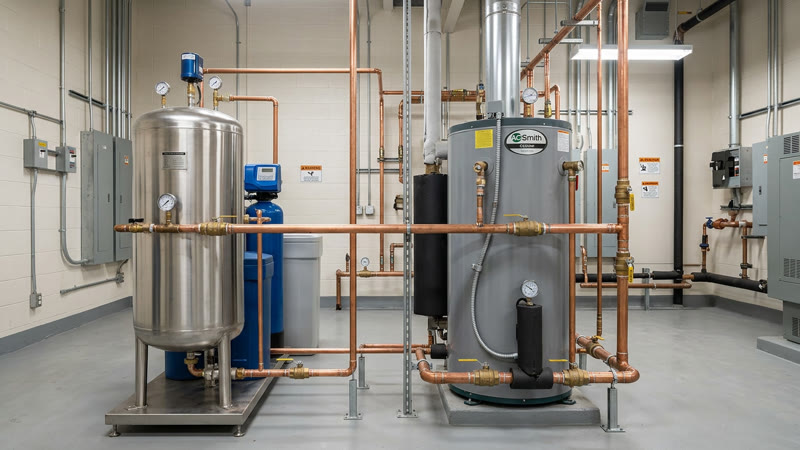
The highest-stakes failure in a hotel is biological, not mechanical. In 2025 the U.S. Centers for Disease Control and Prevention published an investigation into Legionnaires’ disease cases linked to two hotels in the U.S. Virgin Islands between October 2024 and April 2025. Investigators isolated Legionella from shower samples, cisterns, and the cold and hot water systems of both properties. The detail that matters for hotel operators: in tropical climates, cold water systems sit at 77°F to 113°F (25°C to 45°C) for much of the year, which is squarely inside the temperature range where Legionella multiplies.
That outbreak is a reminder that Legionella control is a design and operations problem, not a one-time disinfection. The governing framework in North America is ANSI/ASHRAE Standard 188, which requires building owners to maintain a written water management program covering the potable system. In practice that means hot water stored and circulated hot enough to suppress growth, a target the CDC’s Legionella Control Toolkit sets at keeping hot water return lines at or above 120°F (49°C), with thermostatic mixing valves placed close to fixtures to prevent scalding.
Filtration earns its place in that program at two points. A point-of-entry sediment and carbon stage removes the particulate and biofilm food that give Legionella a surface to attach to, and point-of-use sub-micron or UV treatment at high-risk outlets such as showers, spa areas, and drinking fountains adds a second barrier. No filter replaces temperature control and a documented program; a filter adds redundancy where the risk is highest.
Sizing for peak occupancy, not average day
The classic procurement mistake is sizing a hotel system on average daily flow and then watching it starve on a sold-out weekend. Historical data from the American Hotel and Motel Association’s long-running water survey put average consumption near 218 gallons per occupied room per day across surveyed properties, with convention and resort properties running higher than transient budget hotels. Translated to a system, a 200-room resort is a 40,000-gallon-plus-per-day operation at full occupancy, and the peak-hour draw is far higher than the daily average.
What that means in equipment terms is straightforward. The point-of-entry stage has to carry the whole property’s peak simultaneous flow, not the nameplate average. The softener feeding the laundry and boiler has to be sized for the regenerated volume the property actually moves, and the drinking-water line has to be sized for the food-and-beverage peak, not the room count alone.
| Property type | Typical draw per occupied room/day | Primary treatment priority |
|---|---|---|
| Transient budget hotel | 60–100 gallons | POE sediment + carbon, scale inhibitor |
| Full-service hotel (laundry, pool) | 75–130 gallons | Softener + POE carbon + drinking RO |
| Convention / resort | 200+ gallons | Central softener + dual RO + ice machine filtration |
This is where buying on price alone gets expensive. A softener rated at the property’s average flow will exhaust and regenerate mid-peak, and a POE filter bank sized for average day will spike pressure drop when every shower in the tower turns on. The number to put on the spec sheet is peak simultaneous flow, with the average as a sanity check, not the other way around.
The equipment stack, point by point
A hotel water treatment plan is a stack of stages, each matched to a specific system. The order matters.
Point-of-entry sediment filtration sits at the main inlet and protects everything downstream. It catches sand, rust, and pipe scale from the municipal main or the property’s own well, and it is the cheapest insurance in the stack because it extends the life of every cartridge and membrane behind it.
A central water softener feeds the hot water loop and laundry. This is the stage that pays for itself twice: once in boiler and heat exchanger life, once in detergent and linen costs. For a hotel, the softener is sized on the property’s hardness and daily volume, not on a residential template.
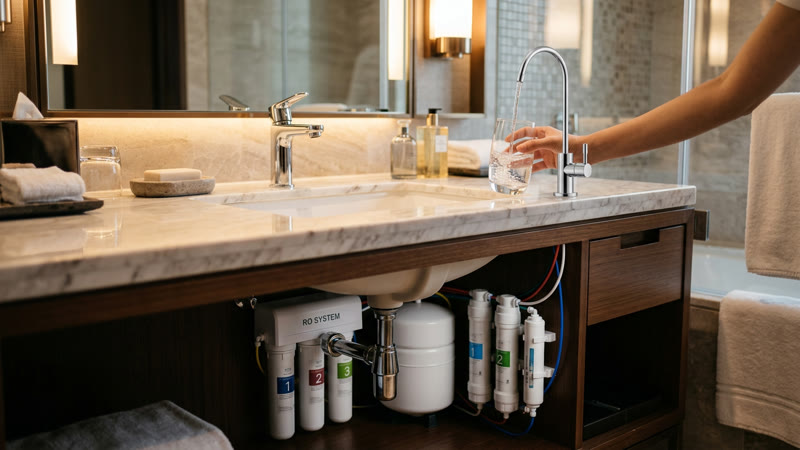
Point-of-use reverse osmosis handles drinking water and food and beverage. Guest rooms, coffee stations, bars, and the kitchen all want consistent, low-TDS water, and a commercial RO system delivers it at a flow rate a residential unit cannot sustain.
Ice machine filtration is its own small stage. A dedicated sediment, scale-inhibitor, and carbon cartridge on the ice machine feed keeps evaporator plates clean and the ice tasting neutral, which matters more to a bar or restaurant’s reputation than most operators price in.
Finally, UV disinfection or sub-micron filtration at high-risk outlets closes the biological loop, adding a barrier against Legionella and other pathogens in the potable system.
| Stage | What it treats | Relevant standard |
|---|---|---|
| POE sediment filter | Sand, rust, particulates | NSF/ANSI 42 |
| POE carbon filter | Chlorine, taste, odor | NSF/ANSI 42 |
| Central water softener | Hardness (calcium, magnesium) | NSF/ANSI 44 |
| Reverse osmosis | Dissolved solids, lead, PFAS | NSF/ANSI 58 |
| Ice machine filter | Scale, chlorine, sediment | NSF/ANSI 42 |
| UV / sub-micron filter | Bacteria, cysts | NSF/ANSI 55 / 53 |
Certifications and what a hotel should actually require
Procurement teams reach for “certified” as a checkbox without always knowing which standard applies to which stage. For drinking-water contact, the ones that carry weight are NSF/ANSI 42 for aesthetic treatment, 53 for health effects, and 58 for reverse osmosis systems; NSF/ANSI 61 and 372 govern material safety and lead-free compliance. WQA Gold Seal is the industry association’s equivalent mark, built on the same ANSI standards. See the full certification breakdown on ONEMI’s certification page.
For a hotel in the United States, the realistic spec is: components that are NSF or WQA certified to the standard matching their function, lead-free construction, and, in California, Prop 65 compliance on any chemical-exposure labeling. A hotel buying on the international market should ask the manufacturer to name the specific standard and standard number per stage, not just “international certifications” in the brochure.
Hardware sourcing is the other half of the compliance question. A property that wants consistent replacement cartridges and responsive support should work with a manufacturer that controls the full filter and system line rather than a reseller assembling mismatched parts. That is the argument for buying the central water treatment system, the softener, and the replacement consumables from a single supplier who can trace each component to its certification.
What the system pays back
The ROI case for hotel water treatment is built from four recurring costs, and none of them requires a consultant to verify.
Energy is the first. A scaled water heater runs longer to deliver the same temperature, and across a property’s hot water load that inefficiency compounds daily. The Department of Energy’s position on scale is consistent: deposits insulate the element and raise energy use, with the impact largest where hardness is high.
Linen and chemicals are the second. Softer water rinses cleaner, which means less detergent, less rewash, and longer fabric life. For a resort doing hundreds of rooms of laundry a day, a softening stage commonly repays itself through the housekeeping budget alone.
Equipment downtime is the third. An ice machine or boiler down during peak season is a repair bill plus lost revenue plus a guest complaint. Filtration is the cheapest way to push that failure further out.
Guest experience is the fourth and hardest to put on a spreadsheet. Neutral-tasting water, clear ice, and a shower that doesn’t run dry at 8 a.m. are the kind of details that show up in reviews. They don’t get line-itemed, but they do get paid for in occupancy and rate.
Sourcing the hardware from a single manufacturer
For importers and distributors serving the hospitality sector, the commercial case for a single manufacturing partner is cleaner than for residential. Hotels want matching stages, traceable certifications, and replacement cartridges that arrive on schedule year after year. ONEMI, a Guangdong-based water purification equipment manufacturer, builds the full stack for commercial and hotel applications: central water treatment, softening, and commercial and industrial RO sized beyond residential flow rates, plus the replacement consumables to keep a property running.
That same line of thinking extends to private label. A distributor that already sells into hotels can carry the treatment stack under its own brand without engineering it from scratch. For the specifics of how that works, the OEM/ODM factory overview covers what to ask a manufacturer about minimum order quantities, lead times, and certification support.
The point is to stop treating a hotel as a house with more taps. It is a commercial water plant, and it should be spec’d like one: point-of-entry first, peak occupancy as the design load, and a written water management program standing behind the hardware.