

 한국어
한국어

- Process water is an ingredient in food and beverage, so the FDA Food Code holds it to EPA drinking-water standards, not just “clean enough”
- Different plant applications (ingredient water, boiler feed, CIP, cooling) need different filtration, from multi-stage RO to carbon and softening
- Scale and chlorine damage equipment long before taste complaints surface, so filtration is a maintenance-cost decision as much as a quality one
In a food or beverage plant, water is rarely just water. It is an ingredient in the product, the working fluid in boilers and cooling towers, and the rinse in every clean-in-place cycle. Treat it as a single generic supply and the same molecules that quietly shorten equipment life will eventually show up in a batch rejection or a compliance finding.
This article breaks down where process water actually goes, which filtration each application needs, the standards that bind them, and the payback math behind getting the spec right the first time.
Why process water spec matters more than you think
Under the FDA Food Code, water used for food preparation, ingredient mixing, and ice making must be potable — meeting the same EPA drinking-water standards that apply to municipal supply. That is a compliance floor, not a quality ceiling. A beverage plant running its own bore water or a poorly maintained municipal line inherits whatever hardness, iron, chlorine, and biological load the source carries.
Most quality problems in food processing are not dramatic. They are slow: scale deposits that cut heat-transfer efficiency, chlorine that degrades membrane and resin, sediment that scores pump seals and fill valves. The cost shows up as energy waste and unplanned maintenance long before a consumer tastes anything wrong.
Where process water goes, and what each application needs
A single plant can run four different water streams, each with a different spec. Mapping them is the first step to a filtration design that is not over- or under-built.
| Application | Key risk | Typical filtration |
|---|---|---|
| Ingredient / product water | Taste, TDS, microbial | Multi-stage RO + carbon + UV |
| Boiler feed | Hardness scale, dissolved solids | Softening + RO |
| Clean-in-place (CIP) | Scale, suspended solids | Softening + sediment filtration |
| Cooling / utility | Scale, biological fouling | Softening + filtration |
Ingredient water is the most demanding: any dissolved solid, off-flavor compound, or microorganism is a direct product risk. Boiler feed is the most punishing on equipment, because hardness scale in a boiler is a measurable energy tax. CIP water mostly needs to be scale-free and particle-free so it does not re-deposit residue on cleaned surfaces.
Filtration technologies, matched to the job
Reverse osmosis is the workhorse for ingredient and boiler water. A typical food-grade RO membrane rejects the dissolved salts and minerals that drive both taste problems and scale, but it should always sit behind sediment and carbon pre-filtration to protect the membrane from chlorine and particulate damage.
Water softening handles hardness at the point of entry, using ion-exchange resin to pull calcium and magnesium out of boiler and CIP water. Activated carbon removes chlorine, taste, and odor — often the difference between a clean fill and a batch that fails sensory testing. Ultrafiltration and UV are the microbial layer, catching what filtration alone misses.
| Technology | Removes | Best fit |
|---|---|---|
| Reverse osmosis | Dissolved solids, salts, most contaminants | Ingredient, boiler feed |
| Water softener | Hardness (calcium, magnesium) | Boiler, CIP, cooling |
| Activated carbon | Chlorine, taste, odor | Ingredient pre-filter |
| Ultrafiltration | Bacteria, colloids, particles | Microbial barrier |
| UV sterilization | Microorganisms | Final polish |
The compliance stack food and beverage buyers check
North American buyers look for NSF/ANSI certification on treatment components. NSF/ANSI 42 covers aesthetic effects, NSF/ANSI 53 covers health effects like lead and cyst reduction, and NSF/ANSI 58 governs reverse osmosis systems specifically. NSF/ANSI 61 and 372 address material safety and lead content on wetted components, which matters for anything in direct contact with product water.
For dairy and other hygienic processing, 3-A Sanitary Standards apply to equipment design, and any filtration housing in a hygienic line needs to clean and drain properly. In the US, the baseline is the EPA’s Safe Drinking Water Act framework, which the FDA Food Code references for food-contact water.
ONEMI carries CE, UL, FCC, and RoHS across its complete machines, with NSF certification on filter cartridges. Before quoting a food and beverage line, buyers should pin down which of these the local inspector will actually ask to see — the requirements differ between a beverage bottler, a dairy, and a bakery.
The payback math: filtration as maintenance insurance
Scale is the clearest financial case. Roughly one millimetre of scale on a heat-exchange surface can add a noticeable percentage to energy consumption, and in a steam boiler that compounds daily. Softening boiler feed and running RO on ingredient water pays back through lower energy bills and longer equipment life before any product-quality gain is counted.
The recurring cost side is filter and membrane replacement, which should be scheduled rather than reactive. A well-specified plant budgets cartridge changes and membrane replacement on a calendar, not after a failure. That predictability is what separates a filtration system that protects the line from one that just adds another thing to maintain.
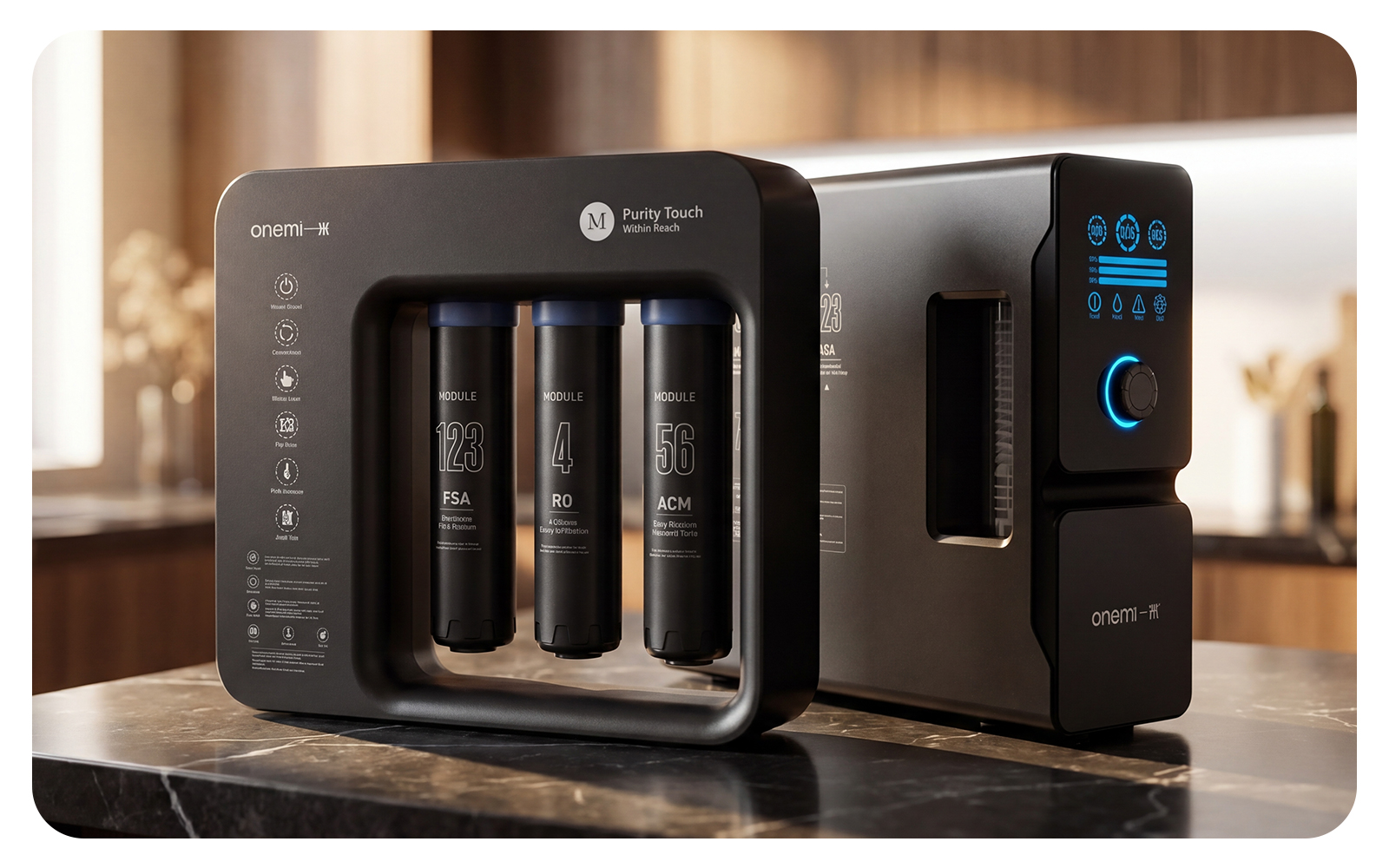
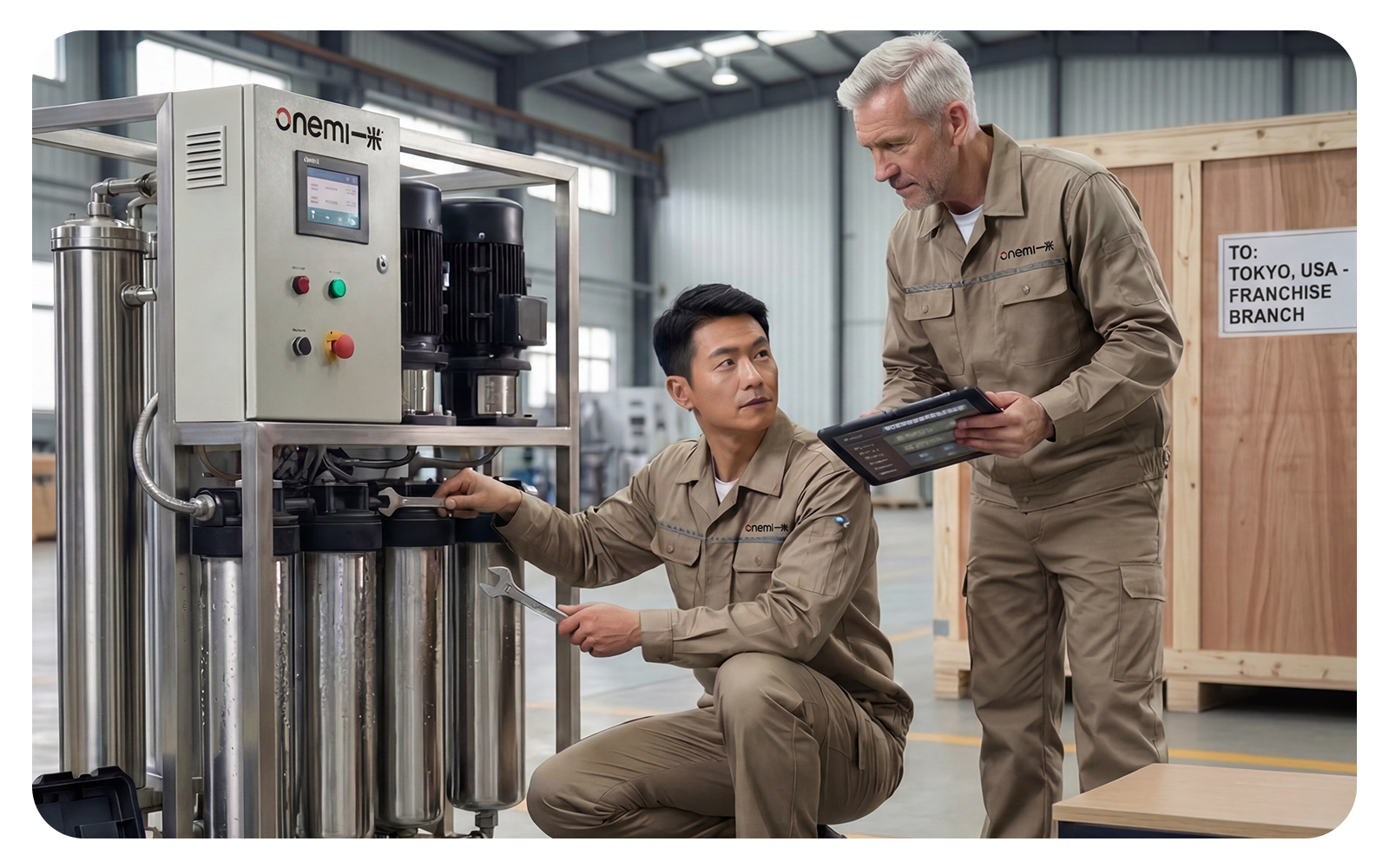
For importers and plant operators sourcing equipment, the questions to ask a manufacturer are concrete: what flow rate at what recovery, which NSF or CE documents ship with the unit, and what the annual consumables cost works out to. ONEMI’s OEM capability covers custom multi-stage systems built around these specs; details are on our OEM and ODM factory page. Certification documents we hold are listed on the certifications page, and our flagship RO systems show the multi-stage configuration most food and beverage lines start from. For general questions, start at our FAQ.
Process water is a specification problem more than a gadget problem. Map the streams, match the technology, and verify the certifications, and the water stops being a risk and becomes just another controlled input.