




 한국어
한국어

- The whole house water filtration market is on track to reach roughly $4.5 billion by 2031, growing near 10% a year.
- Multi-stage systems now account for close to half of new demand, and stage count keeps climbing as PFAS rules and aging pipe networks push buyers toward finer treatment.
- Single-cartridge units still own the budget and rental segments, but importers who read the margin shift early will hold the better position.
Whole house water filtration has stopped being one product category. It is now two categories fighting over the same pipe. Multi-stage systems—the kind that stack a sediment trap, a carbon block, and increasingly a specialty stage inside a single housing—are pulling ahead of single-cartridge units, and the 2026 numbers show the gap widening on both volume and margin.
This matters for anyone buying or selling filtration equipment at the point of entry. Inventory that leans the wrong way ties up working capital in a segment the market is quietly walking away from. Inventory that leans right captures a re-rating that is still early.
The Market Is Splitting, Not Collapsing
Industry trackers put the global whole house water filter systems market at roughly $2.57 billion in 2025, on a path to about $4.48 billion by 2031—a compound annual growth rate near 9.7%. That is a healthy category by any measure, but the headline number hides the split. Growth is not evenly distributed across architectures; it is concentrating in multi-stage designs.
The wider context is the same story at larger scale. Mordor Intelligence estimates the global water purifier and filter market reached $34.6 billion in 2025 and projects it to climb to $52.39 billion by 2031, a 7.14% CAGR. Whole house, or point-of-entry, treatment is one of the faster-moving slices of that total, because it sits at the intersection of three pressures that are not going away: contaminant regulation, aging municipal infrastructure, and buyer preference for protecting the entire home rather than a single tap.
What changed is the definition of “whole house.” A decade ago, a point-of-entry system meant a single sediment cartridge on the main line. Today the category splits into two distinct product architectures, and the market is voting with its dollars.
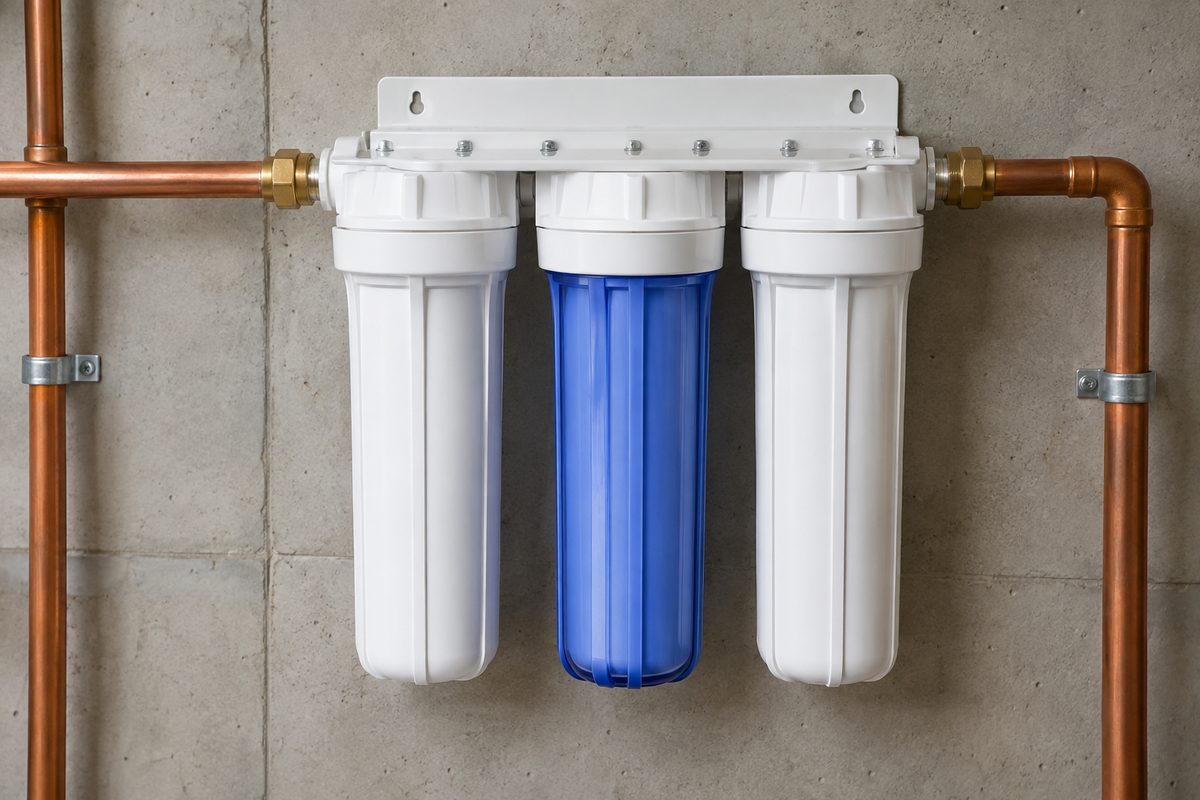
Why Multi-Stage Systems Keep Gaining Stages
Multi-stage systems earn their name. A typical unit now runs a 5-micron polypropylene sediment layer first, then a granular or block activated carbon stage, and then—this is the new part—a specialty media stage aimed at a specific contaminant. That third stage is where the margin and the growth live. It might target PFAS, chloramines, scale, or heavy metals, depending on the region.
The stage count is climbing for a reason that has little to do with marketing. Each stage does a job that a single cartridge cannot do alone. Sediment protects the carbon. Carbon handles chlorine and taste. The specialty media handles whatever the local water throws at it that carbon will not catch. Buyers understand this intuitively, and the data bears it out: multi-stage purification now accounts for roughly 47% of demand, and that share is rising.
Regulation is the accelerant. The U.S. Environmental Protection Agency’s first national PFAS drinking water standard, and the Lead and Copper Rule Improvements requiring lead service line replacement nationwide, have pushed homeowners to ask harder questions about what is actually in their water. The U.S. Centers for Disease Control and Prevention reported in May 2025 that waterborne illness affects more than 7 million Americans a year, at a healthcare cost above $3 billion. Numbers like that turn a “nice to have” filter into a default purchase.
For a distributor, the takeaway is blunt. Whole house water filtration systems that carry a specialty stage are easier to sell, easier to justify at a higher price point, and easier to re-supply—every additional stage is a consumable that comes back for replacement.
Where Single-Cartridge Systems Still Hold
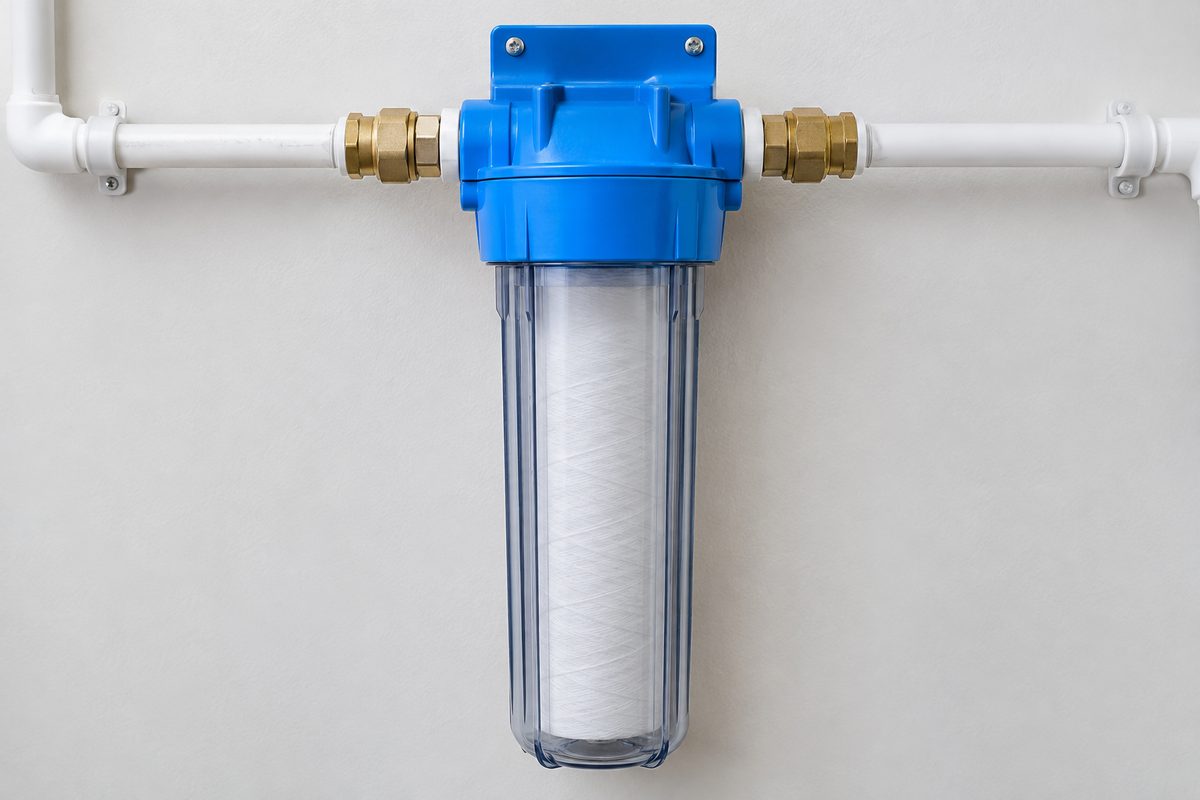
It would be a mistake to write off the single cartridge. It still owns two segments that are large and durable: budget entry-level installs and rental or apartment applications where nobody wants to maintain a three-stage train.
A single cartridge is cheap to produce, fast to install, and dead simple to explain. For a landlord putting filtration on a main line in a four-unit building, or a homeowner who wants “something better than nothing” without a $1,000 quote, the single cartridge remains the right answer. It also carries lower replacement friction—one cartridge, one thread, one swap.
The risk is not that single-cartridge demand disappears. It is that the category’s growth is flowing to the other side. A seller who stocks only single cartridges still has revenue, but they are missing the re-rating. A seller who stocks both, and knows which buyer wants which, has both cash flow and upside.
The Architecture Gap in One Table
| Dimension | Multi-Stage System | Single-Cartridge System |
|---|---|---|
| Typical stage count | 3–5 (sediment, carbon, specialty) | 1 (sediment or carbon) |
| Contaminant coverage | Sediment, chlorine, PFAS, scale, heavy metals | Sediment and/or chlorine only |
| Replacement cycle | Staggered—each stage on its own timer | Single swap, uniform cycle |
| Installation complexity | Moderate, more fittings | Low, one housing |
| Price point (retail) | Higher, but justified by coverage | Lower, price-led |
| Best-fit buyer | Homeowners, mid-to-premium, regulated markets | Budget, rental, entry-level |
| Recurring consumable revenue | Higher (multiple cartridges) | Lower (one cartridge) |
The table makes the margin argument visible. Multi-stage systems carry more line items of consumable revenue per install. For a distributor or a brand owner, that recurring stream is the difference between a one-time sale and a durable book of business.
Standards Importers Should Verify Before Ordering
Architecture is half the decision. Compliance is the other half, and it is where a sourcing decision goes right or wrong long before a unit lands in a warehouse.
In the United States, the standards that matter for point-of-entry systems are NSF/ANSI 42 for aesthetic effects like chlorine taste and particulate, and NSF/ANSI 53 for health-related contaminants such as lead, VOCs, and—critically—PFAS reduction claims. Reverse osmosis stages fall under NSF/ANSI 58. Material safety for wetted components sits under NSF/ANSI 61, and lead content in the metal parts under NSF/ANSI 372.
For the European market, CE marking is the baseline, and in the United Kingdom a product touching the drinking water supply should clear WRAS approval before it is sold into plumbing applications. A supplier that cannot produce the certificate chain for each of these is not ready for a serious import order, regardless of how clean the sample looks.
The practical test is simple: ask for the certificate, not the claim. A manufacturer that lists “NSF” on a datasheet but cannot produce the certifying body’s listing for the specific model and media is selling a label, not a product. Sediment pre-filtration and specialty media stages should each carry their own documentation, because a buyer’s liability travels with the weakest link in the chain.

What This Means for Importers in 2026
Here is the uncomfortable part for buyers who have been sourcing the same way for years: the architecture shift changes what a good order looks like. Importers who optimize for the lowest landed cost of a single-cartridge line are buying into a segment whose share of growth is shrinking. Importers who build a mixed portfolio—single cartridge for the budget shelf, multi-stage for the mid and premium shelf—are positioned for both cash flow today and margin tomorrow.
There is a second shift, and it is easier to miss. The specialty stage is turning a hardware purchase into a media decision. PFAS-selective resin, catalytic carbon, and anti-scale media are not interchangeable, and the buyer who does not understand which media their region needs will end up with systems that underperform the local water profile. A sourcing conversation that starts with “what stage configuration do you want” instead of “what is your price per unit” is the signal that a manufacturer understands the market.
ONEMI, a Guangdong-based water purification equipment manufacturer, builds whole house and point-of-entry systems on exactly this logic—configurable stage trains where the sediment and carbon layers are standard and the specialty stage is matched to the target market’s water. That configurability matters more than it did two years ago, because a single fixed architecture cannot serve a distributor selling into both a PFAS-sensitive U.S. state and a hard-water Middle East market with the same unit. Working with an OEM manufacturing partner that can adjust the stage configuration without re-tooling is what turns a commodity import into a differentiated product line.
The window to reposition is open but it will not stay open. The market has already decided which architecture it prefers; it is only a matter of how long the rest of the supply chain takes to catch up.
For buyers deciding between whole-house versus point-of-use treatment, the answer in 2026 is increasingly both—but the point-of-entry side of that equation is the one being re-rated upward, and the multi-stage system is the reason why.