

 한국어
한국어

Let’s talk about the elephant in the utility room. You installed a commercial reverse osmosis system to secure pure water for your boilers, ingredient mixing, or micro-manufacturing, but now the electricity bills are rolling in and they are ugly. Most facility managers look at their high-pressure pumps and assume that a massive power draw is just the cost of doing business. It isn’t.
The truth is that traditional RO setups are incredibly wasteful. We are talking about systems running on old-school high-energy membranes that force your pumps to work twice as hard as they actually need to. When you factor in the rising industrial electricity rates across the United States—which averaged 8.26 cents per kilowatt-hour nationally but spiked past 17 cents in places like California and New York last year—that extra horsepower translates directly into thousands of dollars of wasted capital every single month.
Executive Summary
- High-pressure pumps consume 65% to 75% of total commercial RO energy, but switching to Low-Energy (LE) membranes can slash operating pressure by 30% to 40% immediately.
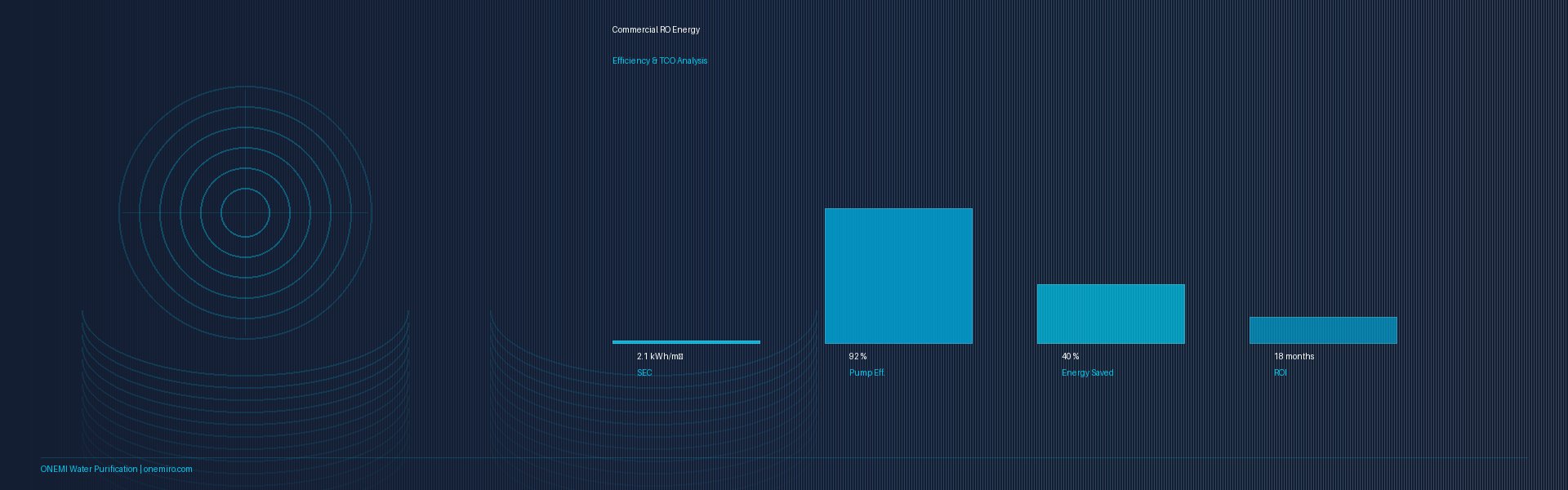
- Real-world data shows that upgrading to variable frequency drives and energy recovery devices can reduce overall system energy consumption from 3.5 kWh/m³ down to less than 1.8 kWh/m³.
- A comprehensive Total Cost of Ownership (TCO) analysis reveals that while low-energy membrane elements carry a 15% retail premium, they pay for themselves within the first 9 months of continuous operation.
If you are still running your system the way it was configured ten years ago, you are literally flushing money down the drain along with your concentrate water.
The Energy Drain: Standard Membranes vs. Low-Energy Alternatives
To understand where the power goes, we have to look at the physics of the membrane itself. Standard polyamide thin-film composite membranes require a massive amount of driving pressure to overcome natural osmotic pressure and force clean water through the microscopic pores. For brackish water with a Total Dissolved Solids (TDS) level of around 2,000 parts per million, a standard system might require an operating pressure of 225 to 250 pounds per square inch (psi). That demands a serious pump, and that pump eats kilowatts for breakfast.
Now look at the alternative. Low-Energy (LE) and Ultra-Low Energy (ULE) membranes utilize modified polymer chemistry that increases the surface hydrophilicity of the membrane barrier. Essentially, they make it much easier for water molecules to slip through while still blocking 99.0% to 99.5% of dissolved salts. Because the resistance is lower, you can drop your operating pressure down to 120 or 150 psi.
What does that pressure drop actually mean for your daily power consumption?
It means your high-pressure pump doesn’t have to work nearly as hard. Since pump power consumption is directly proportional to both flow rate and pressure, dropping your operating pressure by 40% cuts your pump’s energy usage by almost the exact same margin. You get the exact same permeate flow rate, the same water quality, but your utility meter spins at a fraction of the speed.
Here is a real-world comparison of how these two setups stack up in a typical mid-sized industrial facility processing 50,000 gallons of feed water per day:
| System Parameter | Standard RO Membrane Setup | Low-Energy (LE) Membrane Setup | Net Savings / Difference |
|---|---|---|---|
| Average Operating Pressure | 225 psi (15.5 bar) | 130 psi (9.0 bar) | – 42.2% Pressure Required |
| Salt Rejection Rate | 99.7% | 99.2% | – 0.5% Rejection Change |
| Pump Motor Power Draw | 7.5 kW | 4.2 kW | – 3.3 kW (44% Reduction) |
| Annual Power Consumption (8k hrs) | 60,000 kWh | 33,600 kWh | – 26,400 kWh Saved |
| Annual Energy Cost (@ $0.12/kWh) | $7,200 | $4,032 | $3,168 Saved per Year |
Look closely at that salt rejection line. Yes, you lose about half a percent of salt rejection when you move to low-energy membranes. For 95% of industrial applications—like pre-treatment for boilers, cooling tower makeup, or general food production—this minor drop is completely irrelevant because the product water still easily meets or exceeds the required purity standards. Unless you are manufacturing microchips or highly sensitive pharmaceuticals that demand absolute zero-TDS water, paying a massive energy premium for that extra 0.5% rejection is a terrible business decision.
The Hidden Cost of Constant Speed Pumps
Most commercial RO systems are built with a single-speed high-pressure centrifugal pump. It is either completely off, or it is running at 100% capacity. This is fine if your feed water temperature, pressure, and salinity never change, but in the real world, water is dynamic.
Take municipal tap water in the Midwest as an example. In July, the water temperature might sit around 72°F (22°C). In January, that same water drops to 41°F (5°C). Cold water is much more viscous than warm water, meaning it requires significantly more pressure to force it through the same membrane pores. If your system has a single-speed pump, it has to be sized to handle that worst-case winter scenario. That means during the spring, summer, and autumn, your pump is producing way more pressure than necessary, and your system is throttling that excess energy away through control valves. It is the equivalent of driving your car with your foot floored on the gas pedal while controlling your speed using only the handbrake.
By installing a Variable Frequency Drive (VFD) on your high-pressure pump, you allow the system to automatically adjust its motor speed to match the real-time physical requirements of the water. When the feed water is warm, the VFD slows the pump down, saving up to 30% on your power bill during those months. When the water gets cold, it ramps up just enough to maintain your targeted permeate flow rate. Leading manufacturers like ONEMI integrate smart VFD controllers directly into their commercial RO builds to prevent this exact type of operational waste without requiring manual oversight from your maintenance crew.
Let’s look at a concrete case in point: a commercial laundry facility in Cleveland, Ohio, was struggling with seasonal water fluctuations. During winter, their RO system struggled to meet demand because the cold water slowed down filtration rates. During summer, the pump ran hot and wasted energy because the system had to throttle back the excessive pressure manually via a needle valve. By retrofitting their system with a smart VFD and modern low-energy membranes, they stabilized their daily water production at exactly 45,000 gallons year-round while cutting their annualized energy costs by 38%.
Total Cost of Ownership: The Real Math Behind the Upgrade
When you are sourcing new equipment or planning a plant upgrade, it is easy to fall into the trap of focusing entirely on the initial purchase price. This is what we call CapEx bias. But if you look at the total lifecycle cost of a commercial RO system over a standard seven-year operational window, the initial purchase price of the machine represents less than 20% of the total cost. The remaining 80% is eaten up by electrical power, membrane replacements, chemical dosing, and routine maintenance.
Let’s run the actual numbers on a typical TCO calculation for a high-capacity industrial system operating 24 hours a day, 365 days a year.
A standard 100 Gallon Per Minute (GPM) RO system might cost $45,000 to purchase. A highly optimized, energy-efficient system with low-energy membranes, high-efficiency pumps, and integrated VFD controls might cost $54,000. That is a $9,000 premium on day one. For many purchasing agents, that price gap is enough to kill the energy-efficient option on the spot. But let’s look at what happens over the next five years of continuous operation.
The standard system draws roughly 22 kW of power to maintain its operating pressure of 220 psi. The optimized system, running at 135 psi, draws only 14 kW. Assuming an average commercial electricity rate of $0.11 per kWh, the standard system will cost you $21,200 in electricity every single year. The optimized system will cost you $13,490. That is an annual savings of $7,710 on power alone.
But the savings don’t stop at the power meter. Because the optimized system operates at lower pressures, there is less physical stress on the pipe fittings, O-rings, and pressure vessels. This reduces leaks, lowers the frequency of scheduled maintenance, and extends the overall lifespan of your membrane elements by up to 18 months. When you add up the power savings and the reduced maintenance overhead, that initial $9,000 premium is fully paid back in less than 14 months. Over a seven-year operational lifespan, the energy-efficient system will save your facility more than $45,000 in pure profit compared to the “cheaper” alternative.
It is also worth noting that many regional utility companies offer direct cash rebates for installing VFD-equipped pumps and energy-efficient water processing equipment. In states like Oregon and Massachusetts, these incentives can cover up to 50% of the cost difference between standard and high-efficiency systems, making the payback period even shorter.
The Critical Gotchas of Low-Energy Membrane Systems
Are low-energy membranes a magic bullet for every single water treatment application? Absolutely not.
Here is the practical catch that most sales reps won’t tell you: low-energy membranes are significantly more susceptible to biological fouling and chemical scaling than standard high-pressure membranes. Because they are designed with highly hydrophilic surface chemistries and tighter spacer grids to maximize water flow at low pressures, they tend to collect organic matter, silica, and calcium carbonate like a magnet if your pre-treatment system isn’t up to par.
If your raw feed water has high levels of hardness or organic carbon, and you simply swap out your standard membranes for low-energy ones without adjusting your antiscalant dosing or carbon filtration, you will likely find your new membranes completely fouled within three to six months. When a membrane fouls, the feed pressure required to maintain your flow rate spikes right back up, completely erasing any energy savings you were supposed to achieve. In some cases, severe fouling can destroy the membrane elements entirely, forcing an expensive premature replacement that wipes out your entire utility budget for the quarter.
This is why proper pre-treatment design is non-negotiable. Before you make the switch to low-energy technology, you must perform a comprehensive water analysis to measure your feed water’s Silt Density Index (SDI), total hardness, silica levels, and iron content. If your SDI is consistently above 3.0, or if your iron levels exceed 0.1 ppm, you must address these issues with proper multi-media filtration, water softening, or targeted chemical dosing before letting that water touch a low-energy membrane element.
For facilities looking to balance high efficiency with long-term system reliability, working with an experienced manufacturer like ONEMI can make all the difference. Their engineering teams don’t just sell off-the-shelf hardware; they analyze your specific local water chemistry to ensure your pre-treatment line is perfectly matched to your membrane selection, protecting your investment from premature fouling.
Another major factor to consider is the physical design of your RO system’s recovery rate. Many operators try to push their systems to recover 75% or 80% of their feed water as pure permeate to save on water utility bills. However, as you push more water through the membranes, the concentration of salts in the remaining wastewater becomes extremely high. This concentration polarization increases the local osmotic pressure at the membrane surface, requiring even more pump energy to overcome. In many cases, scaling back your recovery target from 80% to 70% can actually lower your overall energy consumption and drastically extend your membrane life, resulting in a lower net operating cost at the end of the year.
Ultimately, optimizing a commercial water purification system isn’t about buying the most expensive components on the market; it is about understanding the delicate balance between water chemistry, system pressure, and pump efficiency. By upgrading to low-energy membranes, integrating smart variable-speed pumps, and maintaining a robust pre-treatment regimen, you can turn your water treatment room from a massive utility drain into a highly optimized, cost-saving asset for your entire business. Brands like ONEMI continue to push the boundaries of what is possible in this space, proving that sustainability and bottom-line profitability can go hand in hand when you design with data instead of guesswork.