


 한국어
한국어

Walk into any high-traffic commercial facility—whether it is a corporate campus in Chicago, a healthcare complex in Houston, or a regional distribution hub—and the facility management team is likely fighting a quiet, expensive war against water infrastructure. Most office buildings operate on a blind, calendar-based maintenance schedule for their drinking water systems. Every six months, a technician goes around replacing expensive carbon blocks and RO membranes, regardless of whether those filters are completely clogged or still have 40% of their operational life remaining. Conversely, in areas with sudden heavy sediment spikes, those same filters might fail three months early, leading to foul-tasting water, scale buildup in downstream ice machines, and a flood of tenant complaints.
This is not just an operational headache. It is a massive capital leak.
Executive Summary
- Traditional calendar-based filter replacements waste between 25% to 40% of useful consumable life or risk severe water quality drops before the next service interval.
- Next-generation AI-driven monitoring leverages real-time turbidity, TDS, and pressure differential sensors to predict consumable exhaustion within a tight window.
- Implementing smart purification systems lowers total cost of ownership (TCO) by reducing emergency maintenance dispatch rates and extending commercial appliance lifespans.
The Realities of Commercial Water Quality Management
Municipal water quality in North America is highly variable, fluctuating based on seasonal agricultural runoff, aging cast-iron municipal mains, and local treatment changes. For instance, a facility drawing from the Great Lakes faces entirely different mineral profiles and seasonal turbidity spikes than one relying on deep groundwater aquifers in the Southwest. Standard commercial water dispensers and filtration systems are typically dumb boxes. They do not know what is in the incoming water; they only know how many gallons have flowed through or how many days have passed since the last reset button was pushed.
This lack of visibility creates a dangerous guessing game. If your incoming Total Dissolved Solids (TDS) level spikes from a baseline of 150 ppm to over 450 ppm due to local water main construction or seasonal shifts, your reverse osmosis membrane is going to degrade at an accelerated rate. If you wait for the scheduled six-month PM, you are serving subpar water for weeks. On the flip side, in areas with pristine incoming water, throwing away high-capacity filters on a strict time-based schedule is simply burning cash.
What if your water system could tell you exactly when it was losing efficiency, down to the week?
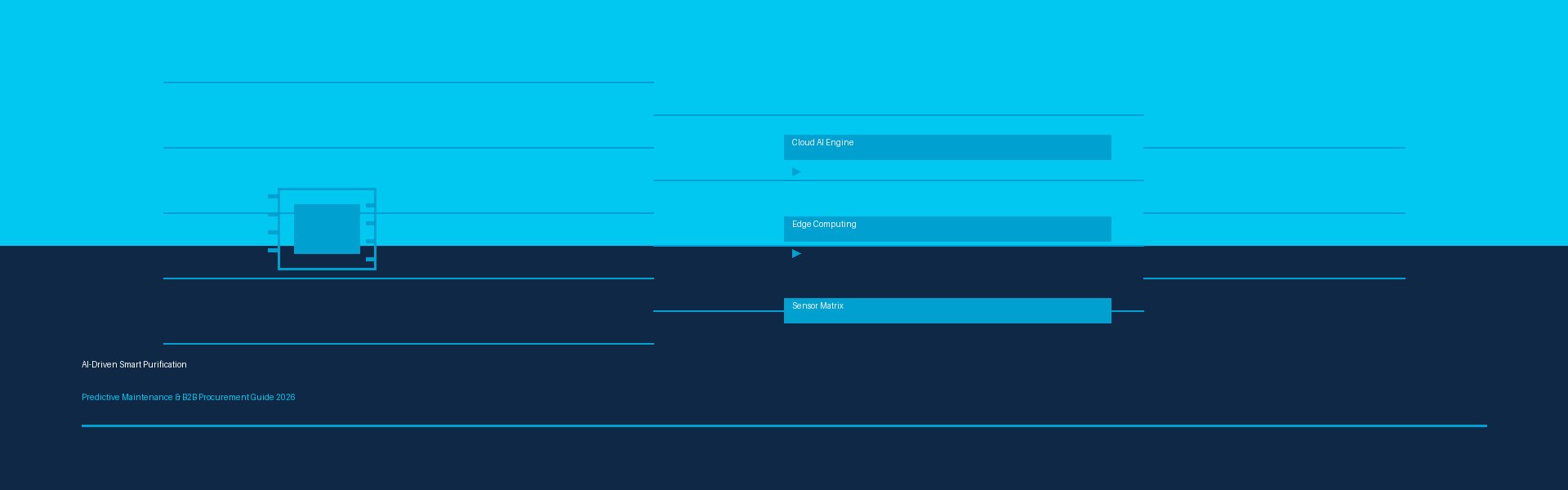
This is where the shift from reactive or scheduled maintenance to predictive, sensor-driven monitoring changes the economics of facility management. Modern B2B water purification platforms integrate real-time sensor arrays that track key chemical and physical metrics continuously. By feeding this stream of data into localized predictive models, facility managers can transition to a dynamic utility model where maintenance occurs precisely when needed.
How AI-Driven Predictive Maintenance Models Work
To understand how predictive maintenance works in a practical setting, we have to look past the marketing buzzwords and examine the actual sensor inputs and data loops. A smart water purification system does not rely on a single data point. Instead, it aggregates data from multiple inline sensors to build a comprehensive health profile of the filtration train.
The system constantly monitors several critical variables:
- Differential Pressure (ΔP): Sensors measure the water pressure before and after the filtration stages. As particulate matter clogs a sediment or carbon filter, the pressure drop across the filter increases. A sudden curve deviation indicates rapid clogging.
- Total Dissolved Solids (TDS): By measuring electrical conductivity, the system calculates the concentration of dissolved inorganic salts. A sharp rise in post-membrane TDS indicates a compromised RO membrane.
- Flow Rate Dynamics: Tracking the volumetric flow rate relative to pressure drop helps differentiate between a temporary drop in municipal supply pressure and actual filter restriction.
- Turbidity (NTU): Optical sensors measure light scattering to detect suspended solids, signaling when pre-filtration is taking a heavy hit from municipal line disturbances.
These raw data streams are processed by localized microcontrollers and uploaded to cloud-based diagnostic platforms. Rather than relying on static thresholds, the predictive algorithms analyze the rate of change over time. For example, if the pressure differential is increasing at a non-linear rate of 8% to 12% week-over-week, the system projects the exact intersection point where the flow rate will fall below acceptable user thresholds. This projection typically narrows the optimal replacement window to a highly accurate timeframe, often within 5 to 9 days of actual exhaustion.
Let us look at how these diagnostic metrics map to specific system behaviors and required actions:
| Sensor Metric | Observed Trend | System Diagnosis | Predictive Action Window |
|---|---|---|---|
| Differential Pressure | Non-linear increase > 15% over 14 days | Pre-filter particulate saturation | 7 to 10 days until flow restriction |
| Post-RO TDS | Steady climb exceeding 15% of baseline | Membrane degradation / scaling | 14 to 21 days before taste degradation |
| Flow Rate vs. ΔP | Low flow with stable pressure drop | Municipal supply pressure drop | No action required (external issue) |
| UV Intensity | Output drop below 80% of baseline | UV lamp scaling or LED degradation | 5 to 7 days before disinfection compromise |
By utilizing this matrix, facility managers avoid the trap of premature replacements. In a large office building with 30 or 40 drinking water stations, delaying filter replacements safely by even 45 days based on real-time usage data can save thousands of dollars annually in consumable costs alone, not to mention the saved labor hours of the maintenance staff.
The Hidden Operational Costs of Traditional Water Systems
To truly appreciate the value of an intelligent system, we have to look at the actual costs associated with legacy commercial water dispensers. When a traditional dispenser fails or begins dispensing slow, bad-tasting water, the sequence of events is always reactive and expensive. First, a tenant or employee submits a work order. The facility manager reviews it, attempts to troubleshoot internally, and then dispatches an external service technician.
In major metropolitan areas, the dispatch fee alone for a commercial plumber or water specialist ranges from $150 to $280, before parts or hourly labor are billed. If the technician arrives only to find that the specific proprietary filter cartridge is out of stock in their van, a second visit must be scheduled, doubling the downtime and increasing the administrative overhead. Meanwhile, staff resort to buying single-use plastic water bottles, directly undermining corporate sustainability initiatives.
ONEMI systems address this operational bottleneck by integrating IoT-enabled diagnostics directly into the building’s management network. When a filter approaches its true end-of-life, the system automatically triggers an alert to the facility team or even directly to the replenishment vendor. This ensures that the replacement parts arrive on-site before the system fails, allowing maintenance teams to schedule the swap during low-traffic hours, completely eliminating emergency dispatch fees.
There is also the critical issue of scale prevention in downstream equipment. Many commercial water purification systems feed into other office assets like ice machines, coffee brewers, and rapid-steaming ovens. When water filtration fails, hard water scale begins to deposit on heating elements and evaporator plates. A 1/16-inch buildup of scale on a boiler heating element can decrease heat transfer efficiency by up to 15%, driving up energy bills and leading to premature compressor or element failure. Intelligent water monitoring protects these downstream investments by ensuring that water hardness and scale-forming minerals are consistently managed.
A Real-World Reality Check: The Pitfalls of Over-Engineering
While the promise of AI-driven monitoring is substantial, practical deployment in commercial spaces comes with real-world caveats that B2B buyers must recognize. Let us look at a concrete scenario: a major corporate headquarters in downtown Philadelphia installed a highly complex, multi-sensor smart water system across its five-story campus. Within three months, the facility team was flooded with daily automated alerts. The culprit? The sensors were calibrated to such tight tolerances that minor, harmless fluctuations in municipal water pressure at 7:00 AM—when the city’s water demand spiked—triggered critical system warnings.
This is a classic case of sensor fatigue. If a system is too sensitive, maintenance teams will quickly learn to ignore the alerts altogether, defeating the entire purpose of predictive monitoring. B2B procurement teams must look for systems that utilize adaptive smoothing algorithms—software that filters out transient environmental noise and only alerts on sustained, statistically significant trend deviations.
Furthermore, local regulatory compliance cannot be ignored. In many jurisdictions, healthcare facilities and educational institutions must adhere to strict water safety plans under ASHRAE Guideline 12 or local health department mandates. Implementing ONEMI smart purifiers allows these organizations to maintain automated, digital logs of water parameters, simplifying the compliance auditing process. Instead of manually testing water and logging results on paper clipboards, facilities can export certified data logs showing consistent TDS reduction and UV disinfection runtimes over the entire fiscal year.
When selecting a smart water purification partner, procurement officers should evaluate the system based on its integration capabilities. A standalone dashboard that requires maintenance teams to log into yet another proprietary portal is unlikely to be used effectively. The ideal smart water platform should seamlessly push alerts and diagnostics directly into existing computerized maintenance management systems (CMMS) via open APIs. This integration ensures that water system alerts are treated with the same operational urgency as HVAC or fire safety alarms, streamlining workflow automation and maximizing the return on your smart building investment.
Ultimately, the transition to AI-driven water purification is not just about clean drinking water; it is about converting a historically unmanaged, unpredictable utility expense into a highly optimized, predictable operational asset. By leveraging real-time telemetry, facilities can protect their infrastructure, eliminate waste, and provide consistent, high-quality water to every employee and visitor.