


 한국어

- Remineralization cartridges are projected to grow at roughly 8.5% CAGR from $274 million in 2025, outpacing standard PP and carbon replacements on the back of RO adoption.
- The demand engine is consumer wellness: buyers now want calcium and magnesium restored to RO water, not just contaminant-free output.
- For importers, the post-RO mineralization stage converts a one-time machine sale into a 6–12 month consumable carrying gross margins near 38%.
Reverse osmosis is the most thorough filtration the residential market has, and its biggest weakness is that it works too well. The same 0.0001-micron membrane that strips lead, PFAS, and nitrate also removes the calcium and magnesium that give water its taste and body. A small but fast-growing category of post-treatment cartridges is built around putting those minerals back—and it is quietly becoming the most valuable consumable attached to a modern RO system.
RO’s flat-taste problem is a structural feature, not a bug
An NSF/ANSI 58 certified system has to cut total dissolved solids by at least 75%. In practice most household membranes run far below that floor, delivering finished water at TDS levels of 5 to 20 mg/L. Water that pure is slightly acidic, usually sitting between pH 5.5 and 6.5 once dissolved carbon dioxide is accounted for, and it tastes flat. That is not a defect to be fixed at the membrane; it is what the membrane is supposed to do.
Importers spent a decade treating this as a marketing problem. “It is pure, that is the point,” was the standard line to a skeptical buyer. The wellness wave changed the framing. A consumer who has been told for years that hydration, electrolyte balance, and mineral intake matter does not want water that has been stripped to nothing. They want water that is clean and then put back together.
What a remineralization cartridge actually does
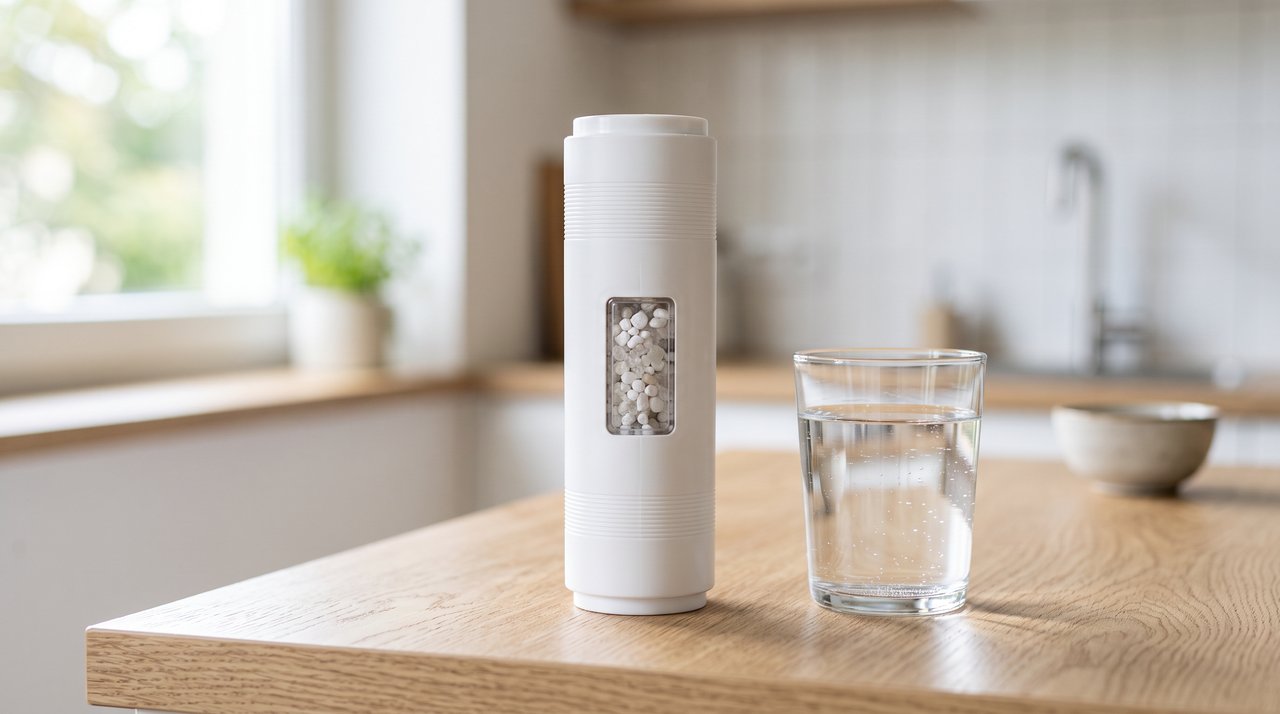
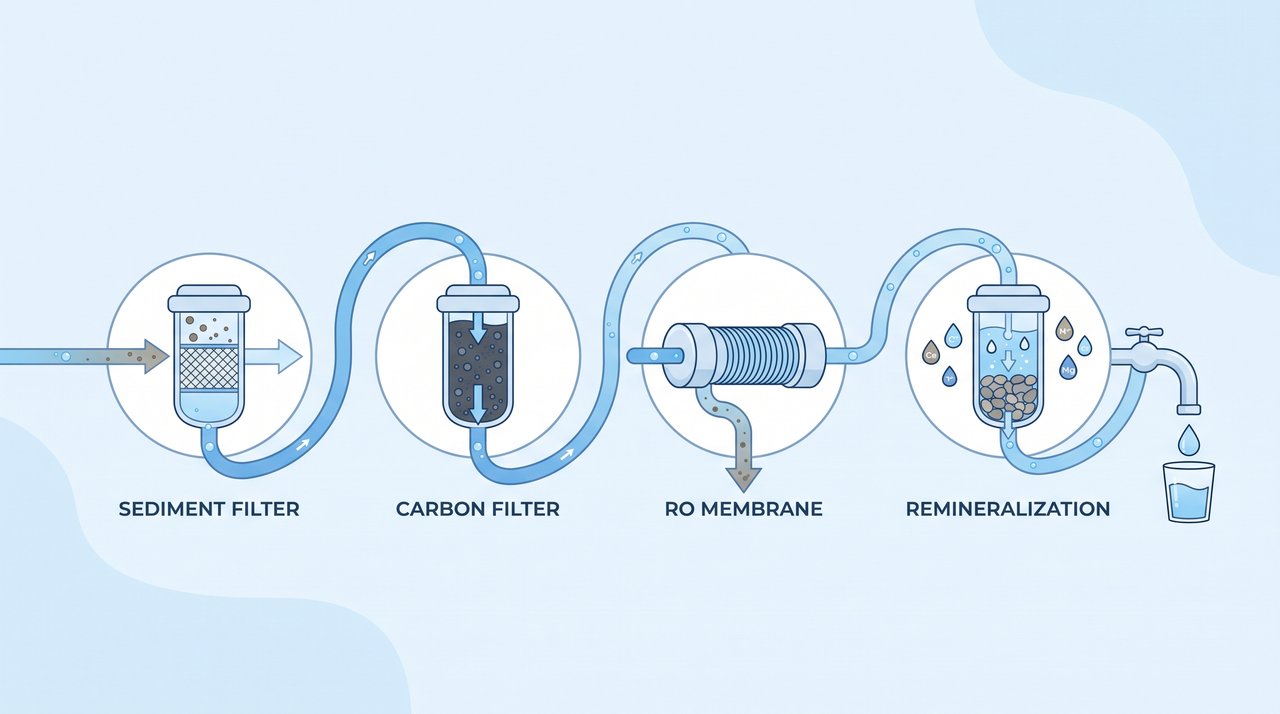
The cartridge sits downstream of the RO membrane and the post-carbon filter, as the final stage before the faucet. It dissolves a controlled dose of minerals back into the permeate water, nudging pH toward a neutral-to-slightly-alkaline range and restoring a recognizable mouthfeel. The media inside is not one material; it is a blend chosen for cost, solubility, and target profile.
| Media type | What it adds | pH effect | Relative cost |
|---|---|---|---|
| Calcite (calcium carbonate) | Calcium, slight alkalinity | Raises toward 7.0–7.5 | Low |
| Magnesium oxide / salts | Magnesium | Raises toward 7.5–8.5 | Mid |
| Alkaline mineral balls | Trace minerals, alkalinity | Raises toward 8.0–8.5 | Mid |
| Ceramic / composite blends | Calcium + magnesium, buffered | Stable, tuned per market | High |
The engineering challenge is dose stability. A cartridge that dissolves too fast spikes hardness in the first week and goes inert by month four. A cartridge that dissolves too slowly never moves the pH at all. The better designs rely on a compressed, graded media bed plus a flow restrictor, so mineral release stays linear across the rated life of the cartridge rather than front-loading.

The market data: a small segment growing faster than the core
The consumable itself is modest in absolute size but the trajectory is what matters. LP Information puts the global remineralization cartridge market at $274 million in 2025, rising to $495 million by 2032—a compound annual growth rate of about 8.5%. That is faster than the standard PP-sediment and activated-carbon replacement categories, which grow in line with installed-base replacement rather than new demand.
Step back to the device level and the same pattern holds. Global Info Research values the alkaline water purifier category at $1.927 billion in 2025, heading toward $3.373 billion by 2032 at an 8.4% CAGR. The regional split is lopsided and tells you where the near-term volume sits: Asia Pacific holds roughly 46% of alkaline mineral water filter revenue, North America about 23.5%, and Europe just under 14%. Those shares are shifting as the wellness narrative crosses into Western markets, but the installed base in China, India, and Southeast Asia still anchors the category.
Wellness, not purity, is the demand engine
For most of the category’s history, the selling argument was removal—lead, chlorine, cysts, PFAS. That story still sells, but it is no longer the only story. A growing share of buyers now frames the purchase around what the water gains, not what it loses. Magnesium is the clearest example: low magnesium intake has been linked in epidemiological literature to a range of cardiovascular and metabolic outcomes, and the notion that drinking water can be a meaningful mineral source has real traction in the premium segment.
This matters for product positioning because it changes the feature set that wins. A mid-range RO line that ships with a bare permeate stream is now a step behind a competitor that bundles a remineralization stage and markets “mineral-restored” output. The stage itself is cheap to add—the media and a housing—but it reframes the whole product from a filter into a wellness appliance. That reframing is where the margin lives.
The recurring-revenue math that matters to importers
Here is the number a procurement manager should actually care about: remineralization cartridges carry an estimated gross margin near 38%, which is higher than the standard sediment and carbon cartridges they ride alongside. The replacement cycle is short—typically six to twelve months depending on water hardness and household usage—which turns a one-time RO machine sale into a predictable consumable stream.
Think of it this way. The machine is a single transaction; the cartridge is a subscription the customer re-buys for the life of the system. A distributor who moves 10,000 RO units in a year is also seeding 10,000 households that will each need two to four cartridges annually. That recurring tail is the real asset, and it is exactly why the aftermarket cartridge segment has become its own sourcing discipline separate from hardware. For a fuller look at how cartridge economics compound, see this breakdown of recurring-revenue cartridge sourcing.
Compliance: mineral-addition claims have to be verifiable
The regulatory side is where careless sourcing gets expensive. A cartridge that adds calcium and magnesium is still a drinking-water contact component, which means the media, the housing, and the downstream plumbing all need to clear the material-safety bar—NSF/ANSI 42 for aesthetic effects, 53 for health effects, and 372 for lead content on any wetted metal parts. If the system itself is certified, it falls under NSF/ANSI 58, which requires the finished water to meet TDS reduction while the added minerals stay within taste, not health, parameters.
The risk point is the marketing claim, not the hardware. “Adds minerals” is a structural claim that a lab can verify; “alkaline water prevents disease” is a health claim that most jurisdictions will not let you make without evidence. The sensible position, and the one that survives scrutiny, is to certify the mineral-addition performance and stay silent on therapeutic language. That distinction is covered in this guide to the 42/53/58 standard stack, and the health-claim boundary is worth reading in this review of what the science actually supports.
There is a second regulatory tailwind worth noting. The US EPA’s 2024 PFAS rule set a 4 parts-per-trillion limit on PFOA and PFOS, phased toward 2031 enforcement. RO is the primary residential technology for hitting that bar, and a remineralization stage that restores taste after PFAS removal makes the compliance-driven RO purchase more palatable to a consumer who never asked for a flat-tasting glass of water. The two trends compound each other.
Sourcing considerations for OEM buyers
Buyers evaluating a remineralization line should ask three questions up front. First, media provenance and solubility curve: a $0.30 calcite cartridge and a $1.20 ceramic-composite cartridge are not interchangeable, and the difference shows up in month five, not week one. Second, interface format: quick-connect modules command better brand lock-in and cleaner margins, while universal 10-inch cartridges are cheaper to source but easier for a third party to undercut. Third, certification cost against target market: a cartridge destined for a market that demands NSF 42/372 carries a different compliance bill than one sold where CE and RoHS are sufficient.
ONEMI, a Guangdong-based water purification equipment manufacturer, builds the full stage stack under one roof—sediment, carbon, RO, and remineralization—which keeps the post-RO mineral stage matched to the membrane’s output rather than bolted on as an afterthought. For OEM and private-label buyers, the practical advantage is a single line item and a single compliance dossier across CE, UL, FCC, and RoHS, rather than four vendors and four paperwork trails. The broader alkaline and OEM landscape is covered in this guide to alkaline water OEM manufacturing.
Where this goes from here
The mineralization stage is no longer an upsell. For any RO line positioned at the middle or top of the market, it is becoming the default configuration, the way a sediment pre-filter became default a generation ago. The importers who treat it as a one-time add-on will find themselves re-negotiating price on hardware; the ones who treat it as a consumable SKU with its own replacement cadence will keep the margin on the back end.
The differentiation over the next few years is not going to be whether a system has a remineralization stage. It is going to be how stable the mineral release is across the cartridge’s life, and whether the claim on the box is one a lab will stand behind. Those are engineering and compliance problems, and they are exactly the kind of problems a buyer should want a factory to solve before the container ships.