



 한국어
한국어

Executive Summary
- The global water purifier market is projected to reach $40.6 billion to $49.6 billion by 2026, driven by a compound annual growth rate of 5% to 7%.
- Under-sink Reverse Osmosis (RO) systems command over 80% of the online retail market share in leading digital-first regions.
- Smart IoT sensors and predictive AI algorithms are replacing static, time-based filter replacement schedules with dynamic, consumption-based tracking.
For decades, household water filtration relied on a dangerous guessing game.
You bought a standard under-sink carbon or reverse osmosis system, tucked it away in the dark corners of your kitchen cabinet, and forgot about it. Perhaps you stuck a paper calendar label on the plastic housing, guessing that the filters would last six months. Or maybe you waited until the flow rate trickled to a miserable drip, or the taste of chlorine returned to your morning coffee, signaling that your family had been drinking unfiltered water for weeks. This is the reactive reality of traditional water purification.
By 2026, this blind approach is obsolete. The intersection of Internet of Things (IoT) sensors, cloud-based machine learning, and advanced membrane materials has shifted the industry from passive containment to active, predictive purification. As the global water purifier market scales toward its projected $49.6 billion peak, the line between appliance and digital health infrastructure has completely dissolved.
The Contrast: Blind Maintenance vs. Predictive AI Sensing
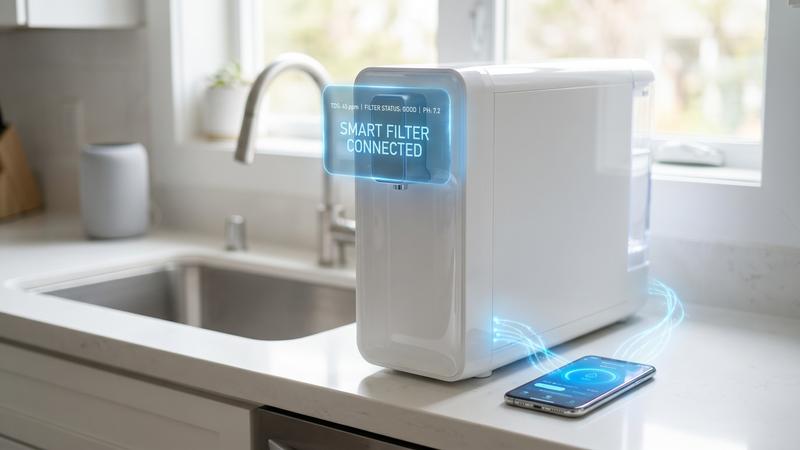
To understand the leap forward, we must examine the stark operational differences between legacy filtration systems and the smart architectures dominating the market today.
| Feature Category | Legacy Filtration Systems (Pre-2024) | Next-Gen AI/IoT Systems (2026) |
|---|---|---|
| Filter Life Tracking | Time-based estimates (e.g., “change every 6 months”). Ignores actual water usage or incoming TDS spikes. | Dynamic tracking via volumetric flow sensors and raw water quality metrics. Real-time lifespan calculation. |
| Water Quality Monitoring | Manual testing kits or zero visibility. Users assume the system is working. | Dual-channel, integrated TDS (Total Dissolved Solids) sensors measuring inlet vs. outlet water constantly. |
| Leak Prevention | None, or simple mechanical shut-off valves that fail under high pressure. | Continuous pressure-drop monitoring and moisture-sensing base plates with automatic solenoid shut-offs. |
| Wastewater Management | Fixed waste ratios, often dumping 3 to 4 gallons of water for every 1 gallon purified. | Adaptive drain-ratio algorithms adjusting from 2:1 up to 4:1 based on real-time membrane scaling resistance. |
Consider the typical municipal water supply in a major metropolitan area like Chicago. In 2024, a family living in a historic brick bungalow with older service lines would install an under-sink RO system and change the filters on a rigid, calendar-based cycle. However, during seasonal temperature shifts or municipal water main repairs, local turbidity levels can spike by over 300% within a 48-hour window. Under these conditions, a standard sediment filter becomes clogged in three weeks instead of six months, causing pressure drops that compromise the delicate RO membrane. The user remains completely unaware of this internal degradation until the system fails entirely.
In contrast, a 2026 smart system uses optical turbidity sensors and electromagnetic flow meters to monitor the physical volume of suspended solids entering the system. If a sudden construction project down the street sends a plume of rust and micro-sediments through the water main, the system instantly recalculates the remaining lifespan of the PP cotton pre-filter. It alerts the homeowner via a smartphone application, adjusting the system’s flushing frequency to protect the primary RO membrane from premature scaling. This is not just convenience; it is active asset protection.
The Anatomy of 2026 Smart Water Architectures
What does it take to build a truly intelligent water purification system? The answer lies in a multi-layered hardware and software stack that operates silently beneath the kitchen sink.
- Multi-Channel TDS Monitoring: High-precision titanium alloy electrodes are positioned at both the raw water inlet and the purified water outlet. By passing a micro-current through the water, the system measures electrical conductivity to calculate Total Dissolved Solids in parts per million (ppm). If the outlet TDS climbs above a pre-set threshold (typically 50 ppm for pure drinking water), the system triggers an alert.
- Digital Flow-Rate Analytics: Micro-turbine flow sensors measure the exact volume of water passing through each individual filtration stage. This data is processed by onboard microcontrollers to map usage patterns. The system learns that the household uses an average of 12 liters of water between 7:00 AM and 9:00 AM, but less than 2 liters during the afternoon, optimizing its automatic membrane-flushing cycles for periods of zero usage to prevent noise and water waste.
- IoT Cloud Integration: Modern systems utilize dual-band Wi-Fi and Bluetooth Low Energy (BLE) chipsets to sync telemetry data to secure cloud servers. This connection enables over-the-air (OTA) firmware updates that can optimize pump pressure algorithms, refine filtration profiles based on local municipal water reports, and coordinate automatic replacement filter deliveries before the old ones expire.
- Automated Solenoid Shut-Offs: Positioned at the main water inlet, these electronic valves act as the ultimate failsafe. If internal pressure sensors detect a sudden, unexplained drop in resistance—indicative of a cracked housing or a slipped O-ring—the system cuts off the incoming water supply within 500 milliseconds, preventing catastrophic kitchen flooding.
Here is a technical limitation that the industry rarely discusses openly: optical sensors in domestic water purifiers can sometimes misinterpret harmless micro-bubbles as organic turbidity. When a high-output RO pump runs at full speed, it creates micro-cavitation, releasing tiny pockets of dissolved oxygen into the sensor chamber. A cheap smart sensor will flag this as a contamination event, causing unnecessary panic for the user. High-end systems resolve this by implementing a brief, three-second physical settling chamber before the water passes the optical eye, allowing air bubbles to dissipate before measurement.
How AI Optimizes the Pure-to-Drain Ratio
One of the greatest criticisms of historical reverse osmosis systems has been their environmental impact. Early residential RO units were notoriously wasteful, discharging up to 75% of the incoming water down the drain to produce a single cup of purified water. This is where AI-driven dynamic waste-ratio adjustment changes the equation.
The rate of membrane fouling is not constant; it depends on water temperature, inlet pressure, and chemical composition. Cold winter water is more viscous, requiring higher pressure to pass through the semi-permeable membrane, which increases the risk of calcium carbonate crystallization on the membrane surface. A traditional system has a fixed flow restrictor that cannot adapt to these physical changes.
By utilizing real-time sensor inputs, modern AI algorithms dynamically adjust the backpressure regulator valve. When the system detects warm, low-TDS inlet water, it automatically increases the pure-to-waste ratio to 3:1 or even 4:1, saving thousands of gallons of water annually. Conversely, if the system detects cold, highly mineralized water, it lowers the ratio to 2:1 to flush the membrane surface aggressively, preventing irreversible scaling and extending the lifespan of the expensive RO element to over 36 months.
Let us look at a real-world scenario. In Phoenix, Arizona, municipal tap water often exceeds 450 ppm of dissolved solids, dominated by hard calcium and magnesium ions. A standard RO system operating in this environment without smart flushing would experience membrane failure within 8 to 12 months. An ONEMI smart system running adaptive flushing protocols can maintain a stable 3:1 waste ratio while preserving membrane integrity for up to 3 years, saving the homeowner hundreds of dollars in premature filter replacements.
This level of efficiency is no longer optional. As municipal water rates rise across major metropolitan areas, wasting water is both environmentally irresponsible and financially punitive.
A Checklist for Choosing a Future-Proof Water Purifier
If you are in the market for a modern water purification system, do not get distracted by flashy marketing buzzwords. Use this highly structured, contrast-driven checklist to evaluate whether a system is truly built for the future or simply repackaging old technology in a glossy plastic shell.
1. Sensor Architecture: Active vs. Passive
- Avoid: Systems that rely solely on a flashing LED light on the faucet that turns red after 180 days. This is a simple timer, not a sensor. It does not know if you filtered 10 gallons or 1,000 gallons.
- Demand: Dual-channel inline TDS sensors that display exact numerical values (in ppm) on both the faucet screen and a mobile application. Look for titanium or platinum-coated electrodes to prevent sensor corrosion over time.
2. Filtration Efficiency: Fixed vs. Dynamic Recovery
- Avoid: Systems with a fixed waste ratio of 1:1 or worse. These units run warm and cold water through the same physical pathway, destroying the membrane during high-TDS spikes or cold winter months.
- Demand: A minimum certified pure-to-waste ratio of 2:1, with smart scaling algorithms capable of reaching 3:1 or 4:1 under optimal source water conditions. This should be backed by an automatic membrane-flushing cycle that runs after every major dispensing event.
3. Maintenance and Lifecycle: Reactive vs. Predictive
- Avoid: Proprietary, non-standard filters that require professional plumbing tools to change, or systems that give no advance warning before shutting down due to a expired filter.
- Demand: Snap-in, quick-twist filter designs that can be replaced in under 3 seconds without turning off the main water supply. The system’s companion app must provide a predictive wear curve, showing you exactly how many liters of capacity remain based on your historical usage patterns.
4. Safety and Leak Protection: Passive Trays vs. Active Solenoids
- Avoid: Simple plastic drip trays or basic mechanical shut-off valves that rely on physical water pressure to close. If a high-pressure surge occurs at 3:00 AM, these valves can crack.
- Demand: An integrated electronic leak detection system featuring a gold-plated moisture sensor at the base of the unit, coupled with an automatic inlet solenoid valve that cuts off incoming water pressure instantly upon detecting a single drop of moisture.
The era of treating water purification as an invisible, unmanaged utility is over. By transitioning to an intelligent, sensor-driven system, you protect your family from volatile municipal water quality, reduce environmental waste, and eliminate the frustrating guesswork of home maintenance. The future of clean water is not just about finer filtration; it is about smarter integration.