


 한국어
한국어

Let’s be honest about the water coming out of our taps right now. For decades, we treated water filtration as a nice-to-have appliance purchase, something to make the ice taste a bit cleaner or get rid of that faint chlorine smell from municipal treatment plants. But the ground shifted beneath our feet recently, and if you are still looking at the residential water market through a pre-2024 lens, you are missing the massive regulatory wave that is about to peak in 2026.
Executive Summary
- The global water purifier market is on track to surge past $48.3 billion by 2026, ultimately scaling to $97.2 billion by 2035 with a steady CAGR of 7.5%.
- Strict new EPA regulations targeting PFAS at a mere 4.0 parts per trillion are forcing a massive shift from basic carbon pitchers to advanced multi-stage RO systems.
- Smart filtration systems with real-time TDS monitoring and waste-water reduction technology are transitioning from premium luxury items to baseline consumer expectations.
The global water purifier market isn’t just growing; it is undergoing a structural mutation. Driven by deteriorating municipal infrastructure and a sudden, intense public awareness of chemical contamination, the market is projected to surpass $48.3 billion by 2026. Looking further down the road, we are looking at a market expanding at a compound annual growth rate of 7.5% to hit $97.2 billion by 2035. Reverse osmosis (RO) remains the absolute heavyweight champion of this expansion, holding over 52% of the market share. But the way we design, manufacture, and sell these systems is changing overnight because of a few invisible, indestructible chemicals.
The Invisible Crisis Lurking in Local Municipal Tap Water
Here is the hard truth that municipal water districts do not want to broadcast on the evening news: our current water treatment infrastructure was never designed to handle synthetic industrial chemicals. We built our water treatment plants to kill bacteria, settle out dirt, and neutralize basic organic matter. We did not build them to filter out compounds that literally never break down in the environment.
I am talking about PFAS, or per- and polyfluoroalkyl substances. Often called “forever chemicals,” these compounds have spent the last eighty years leaking into our aquifers from military bases, airports, landfills, and factories making non-stick cookware and waterproof fabrics. The United States Geological Survey recently estimated that at least 45% of the nation’s tap water contains one or more types of PFAS. In some highly populated metropolitan areas, that number climbs past 70%. These chemicals build up in the human body over decades, linked by medical researchers to thyroid disease, liver damage, low birth weights, and several forms of cancer.
But here is a practical gotcha that many homeowners learn the hard way: buying a cheap, off-the-shelf carbon pitcher filter from the grocery store will not solve this. While those basic gravity-fed filters are great at making water taste less like swimming pool chlorine, their contact time with the water is far too short to reliably capture complex PFAS chains over the lifespan of the filter cartridge. They saturate quickly, and once saturated, they can actually start dumping collected chemicals back into your drinking water at higher concentrations than what came out of the tap. Consumers are starting to realize this, which is driving a massive migration toward under-sink RO systems that offer a physical, pressurized barrier to these micro-pollutants.
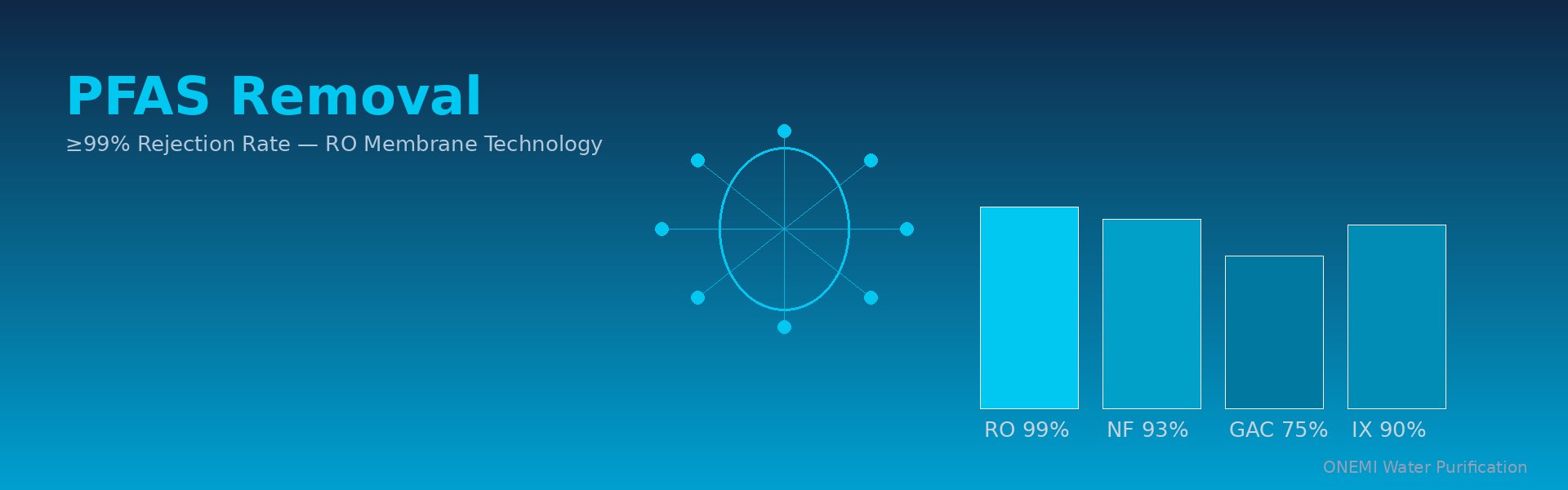
In response to this growing public health crisis, the US Environmental Protection Agency stepped in with a historic regulatory hammer. The EPA established legally enforceable Maximum Contaminant Levels for six specific PFAS compounds, setting the limit for major variants like PFOA and PFOS at an incredibly strict 4.0 parts per trillion. To put that number in perspective, 4.0 parts per trillion is equivalent to a single drop of water in twenty Olympic-sized swimming pools. It is an incredibly demanding standard that most local water utilities simply cannot meet without spending billions of dollars upgrading their centralized facilities—a process that will take them a decade or more to implement. In the meantime, the burden of purification has been effectively shifted directly to the kitchen counter and the under-sink cabinet.
How Multi-Stage Reverse Osmosis Solves the Contamination Problem
If you want to pull a molecule as tiny and persistent as PFOS out of water, you need more than just a simple screen. You need a multi-stage physical separation process that works at the molecular level. This is where modern RO systems prove their worth, utilizing a sequential filtration process that systematically strips out contaminants step by step.
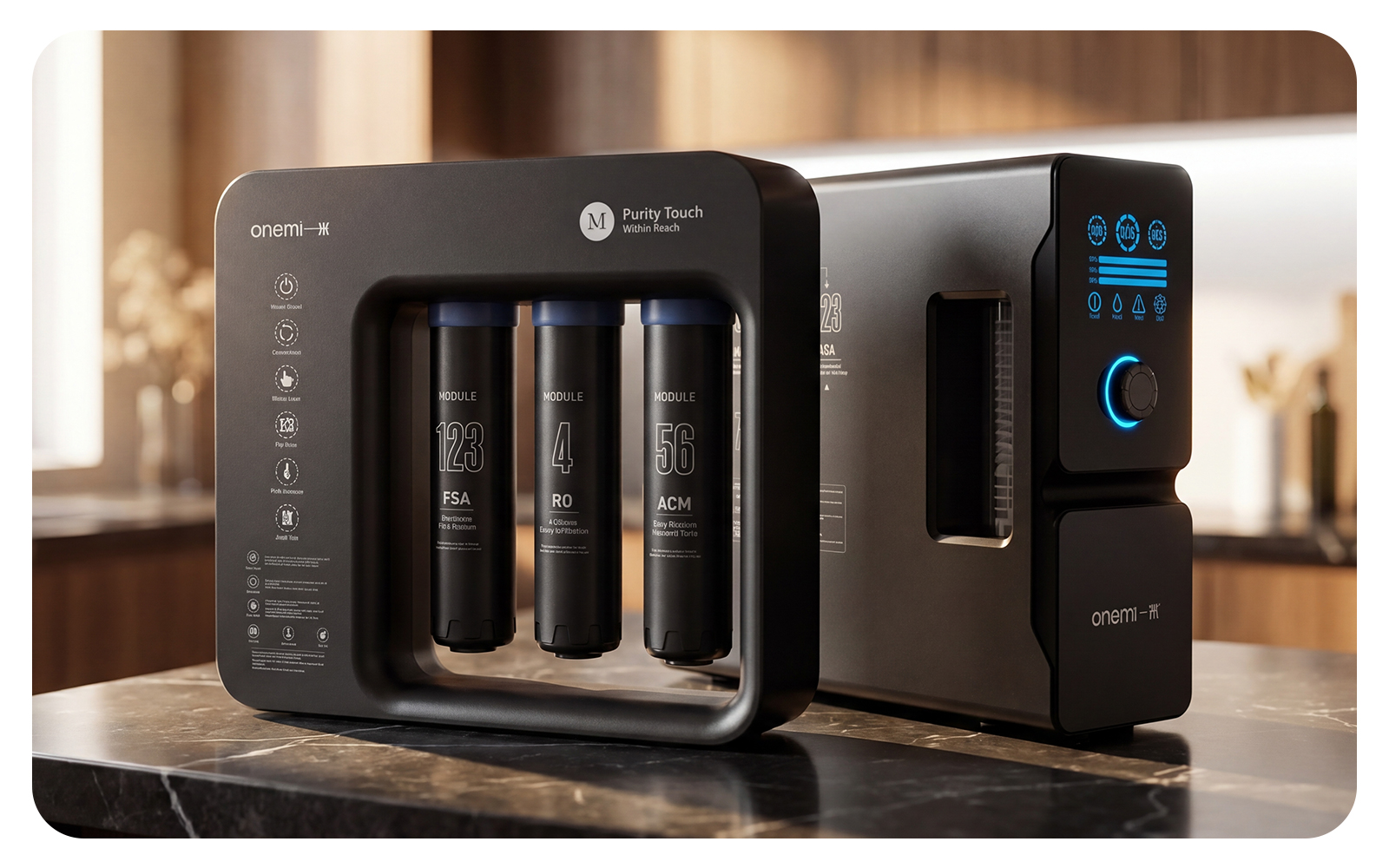
The process starts with a sediment pre-filter, which catches the heavy stuff like rust, sand, and silt that flakes off aging municipal water mains. Next, the water passes through an activated carbon block. This stage is crucial because carbon acts like a chemical sponge, absorbing volatile organic compounds, chlorine, and agricultural pesticides. It also protects the delicate RO membrane downstream, which can be easily degraded by chlorine exposure. ONEMI systems, for instance, utilize high-density carbon formulations in this stage to ensure maximum chemical adsorption before the water ever touches the primary membrane.
Then comes the heart of the system: the reverse osmosis membrane. Under high pressure, water is forced through a semi-permeable sheet with pores measuring approximately 0.0001 microns. For comparison, a human hair is about 70 microns wide, and a single virus is around 0.1 microns. At this scale, only pure water molecules can easily pass through. The larger, complex structures of PFAS, heavy metals like lead and arsenic, and dissolved salts are left behind on the high-pressure side of the membrane and are flushed away as wastewater. Finally, the water goes through a post-carbon polishing filter to restore a clean, crisp taste before it reaches the faucet.
| Contaminant Type | Typical Size / Properties | Standard Carbon Pitcher Removal | Multi-Stage RO Removal Rate |
|---|---|---|---|
| PFAS / PFOA / PFOS | Molecular chains (0.0005 – 0.002 microns) | Inconsistent (30% – 60%) | Excellent (>99.2%) |
| Lead & Heavy Metals | Ionic state (0.0001 – 0.0003 microns) | Moderate (70% – 85%) | Excellent (>98.5%) |
| Microplastics | Particulate (0.1 – 500 microns) | Good (90% – 95%) | Absolute (100%) |
| Bacteria & Viruses | Biological (0.02 – 2.0 microns) | Poor (0%) | Excellent (>99.99%) |
| Fluoride | Dissolved ion (0.0001 microns) | Negligible (<5%) | High (90% – 96%) |
Let’s address a common counter-intuitive finding that catches many consumers off guard: pure water from a high-efficiency RO system can actually taste slightly flat or acidic initially. Because reverse osmosis is so incredibly effective, it strips out the naturally occurring alkaline minerals like calcium and magnesium alongside the toxic heavy metals. This drops the pH of the output water down into the 5.5 to 6.5 range. To solve this, the latest 2026 residential filtration models feature integrated remineralization cartridges as their final stage. These cartridges slowly dissolve trace amounts of pure calcium carbonate and magnesium back into the purified water, raising the pH to a perfectly balanced 7.5 to 8.5 and giving it that crisp, refreshing mountain-spring taste profile.
The Real-World Implications of the RO Boom
This regulatory shift is causing massive ripples across the entire consumer appliance supply chain. For years, the knock on RO systems was that they were bulky, complicated to install, and incredibly wasteful. Traditional under-sink systems used to require a massive, pressurized storage tank that took up the entire cabinet, and they would routinely dump four gallons of wastewater down the drain for every single gallon of purified drinking water they produced.
That old design paradigm is completely dead in 2026. The market has shifted decisively toward tankless, high-flow systems. By utilizing powerful internal booster pumps, modern systems can deliver water in real-time at rates of 600, 800, or even 1000 GPD (Gallons Per Day). This means a consumer can fill a glass of pure water in under six seconds without needing a bulky, bacteria-prone storage tank underneath their sink. Furthermore, engineering breakthroughs have pushed wastewater ratios down from the abysmal 4:1 of the past to highly efficient 2:1 or even 3:1 pure-to-drain ratios, saving thousands of gallons of water per household annually.
Why does this matter so much for brands and distributors looking to capture a slice of this $48.3 billion market? Because the consumer expectation for what a water filter should do has been permanently raised. People do not want to guess if their filter is still working. They expect smart faucets with built-in LED rings that change color when the filter is expiring. They expect real-time Total Dissolved Solids (TDS) sensors built right into the appliance housing, showing them a digital readout of their water quality before and after filtration. For companies sourcing these products, partnering with an experienced manufacturer like ONEMI is critical to securing the advanced multi-stage technologies, high-flow pump integrations, and reliable OEM/ODM supply chains needed to meet these strict new consumer demands.
Think about a specific case in Cape Fear, North Carolina. For years, residents there drank water contaminated with GenX—a modern, shorter-chain PFAS chemical designed to replace older variants. Traditional carbon filters barely touched it. It was only when local homeowners began installing advanced, multi-stage under-sink RO units that they were finally able to drop their household GenX levels down to non-detectable limits. That real-world scenario is playing out in thousands of towns across the globe, and it is driving a permanent consumer migration toward high-performance home water treatment plants.
What to Look for in a 2026 Water Filtration Partner
If you are a brand manager, appliance distributor, or private label retailer looking to navigate this rapidly changing landscape, your product sourcing strategy needs to be incredibly precise. The days of importing generic, uncertified filtration housings and hoping for the best are over. With regulators cracking down and consumers becoming highly educated about water chemistry, your product lineup must meet rigorous performance standards.
First and foremost, look for systems that carry independent certifications. When a customer asks if your system actually removes PFOA, PFOS, and heavy metals, you need to be able to point to rigorous testing standards like NSF/ANSI 58 for reverse osmosis systems or NSF/ANSI 53 for chemical reduction. Having these certifications isn’t just a marketing advantage anymore; it is your shield against liability and the key to gaining shelf space at major national retailers.
Second, prioritize ease of maintenance. The number one reason consumers abandon under-sink RO systems is that changing the filters is too difficult. Traditional systems require a specialized wrench, a bucket to catch spills, and twenty minutes of wrestling with tight plastic housings. The industry standard for 2026 has shifted entirely to quick-twist, dry-change filter designs. These systems allow a homeowner to swap out a major filter cartridge in under three seconds with a simple quarter-turn, without having to shut off the main water line or use a single tool. This dramatically lowers product return rates and keeps your customers buying your proprietary replacement filters for years to come.
Finally, make sure your manufacturing partner has the engineering depth to support your growth. This is where ONEMI shines, offering comprehensive OEM and ODM services that allow brands to customize everything from the outer industrial design and smart faucet interfaces to the specific mineral blends used in the remineralization stages. By choosing a partner that controls the entire production process—from injection molding to cleanroom assembly and rigorous pressure testing—you ensure that your products will perform flawlessly under pressure, protecting both your customers’ health and your brand’s hard-earned reputation in a highly competitive market.