

 한국어
한국어

A major European household appliance distributor recently lost a lucrative municipal drinking water contract in the GCC region, despite offering the lowest bid and a flawless logistical plan. The reason was simple yet devastating: their manufacturing partner’s NSF/ANSI 58 certification was registered under a subsidiary name that did not match the bidding entity’s corporate registration. This minor administrative mismatch disqualified a multi-million dollar proposal in seconds, proving that in the world of high-stakes water filtration procurement, technical compliance is often a game of administrative chess rather than simple product testing.
Executive Summary
- NSF/ANSI certification serves as the primary legal and commercial gatekeeper for water purification systems entering North American and GCC markets, where regulatory bodies mandate compliance for municipal and retail distribution.
- Procurement professionals must navigate complex differences between structural integrity testing, material safety, and specific contaminant reduction claims to avoid costly import delays and customs seizures.
- Successful supply chain integration requires rigorous validation of OEM/ODM certification ownership, cross-referencing factory-level audits with official NSF listings to prevent compliance liability.
The Regulatory Landscape of Global Water Treatment
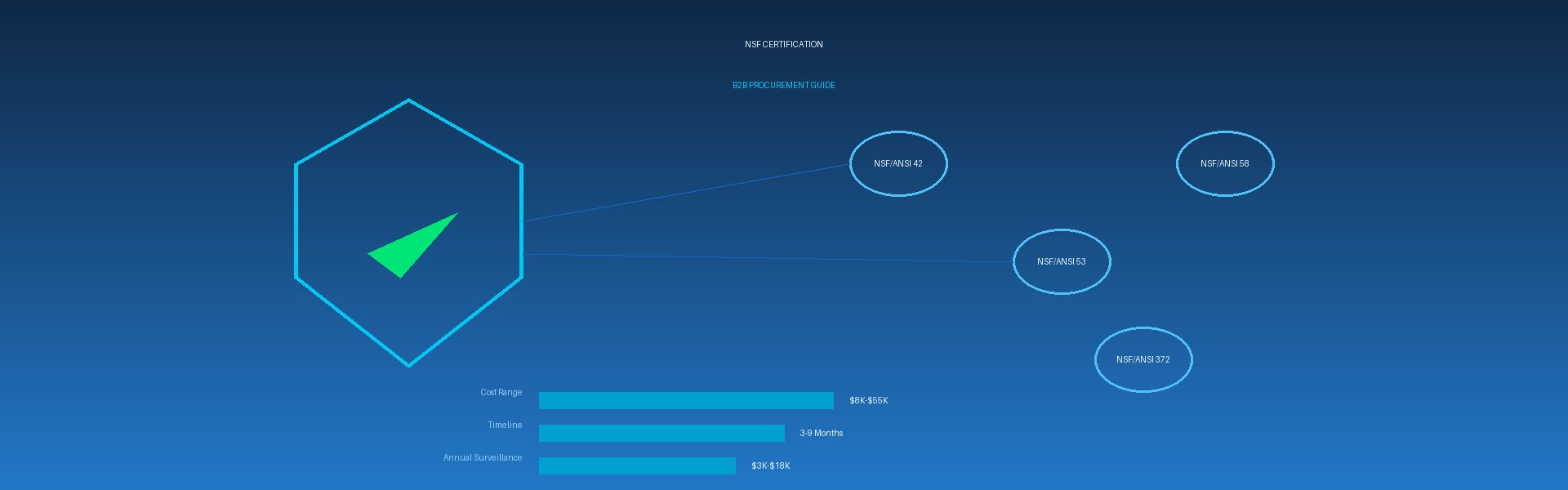
The global market for residential and commercial water purification is no longer governed by regional preferences; instead, it is dictated by a strict matrix of standardized public health codes. In North America, the United States Environmental Protection Agency (EPA) sets the baseline, but individual state plumbing codes convert voluntary standards like NSF/ANSI 42 and 53 into absolute legal mandates. For example, California’s Assembly Bill 1953 requires strict lead-free compliance for any device in contact with drinking water, a standard that is verified almost exclusively through third-party NSF certification pathways.
Across the Atlantic, European markets rely on a more fragmented approach, utilizing systems like the French ACS (Attestation de Conformité Sanitaire), the German KTW/W270 guidelines, and the British WRAS (Water Regulations Advisory Scheme). However, multinational procurement teams operating in the Middle East—particularly within the GCC—increasingly bypass local variations by specifying NSF/ANSI standards directly in government tenders. This convergence of international standards means that a manufacturer without these credentials is effectively locked out of approximately 70% of the high-value global market.
Consider the regulatory reality of importing water systems into the United States. Customs and Border Protection (CBP) officers, working alongside the Food and Drug Administration (FDA), routinely impound shipments of reverse osmosis systems that lack clear certification markings or contain materials not verified as food-grade. The financial penalty of a held shipment quickly eclipses the upfront cost of sourcing from a fully certified OEM partner.
Decoding the NSF Standards Matrix
For a procurement officer, simply asking a supplier “Are you NSF certified?” is a dangerous oversimplification. The term “NSF certified” can refer to several distinct standards, each targeting a different aspect of water treatment technology, material safety, or mechanical performance.
ONEMI engineers often point out that the most common point of confusion lies between aesthetic claims and health-related claims. A system can be certified under NSF/ANSI 42 for taste and odor control while remaining completely ineffective against heavy metals or microbiological pathogens. This distinction is critical when sourcing systems for regions with complex groundwater contamination profiles.
| Standard | Primary Focus | Key Contaminants Addressed | Typical Target Applications |
|---|---|---|---|
| NSF/ANSI 42 | Aesthetic Effects | Chlorine, taste, odor, particulate matter (Class I-VI) | Basic carbon block filters, refrigerator filters |
| NSF/ANSI 53 | Health Effects | Lead, asbestos, VOCs, MTBE, PCB, cyst reduction | Under-sink systems, gravity-fed counter systems |
| NSF/ANSI 55 | Ultraviolet Treatment | Pathogenic bacteria, viruses, Cryptosporidium (Class A/B) | Point-of-entry UV sterilizers, smart dispensers |
| NSF/ANSI 58 | Reverse Osmosis | TDS, arsenic, barium, cadmium, chromium, lead, radium | Multi-stage residential RO systems |
| NSF/ANSI 401 | Emerging Compounds | Pharmaceuticals, pesticides, herbicides, microplastics | Advanced multi-stage filtration, premium retail models |
Understanding these standards requires looking past marketing claims to analyze the specific testing protocols. For instance, NSF 53 testing requires the system to operate under elevated pressure and challenge water conditions that simulate worst-case scenarios, such as water with a pH of 8.5 to test for lead reduction. Many off-brand manufacturers boast “materials certified to NSF 61” (which covers municipal water components), but this does not mean the assembled filtration system is certified to reduce contaminants under NSF 53 or 58.
The Financial Reality: Certification Costs and Timeline Pitfalls
Why do so many suppliers cut corners on NSF certification?
The answer is found in the eye-watering costs and bureaucratic timelines associated with the testing process. For a standard reverse osmosis system seeking full NSF 58 certification, the initial testing and registration fees can easily range from $30,000 to over $100,000 depending on the complexity of the system and the number of specific contaminant claims being validated. This is not a one-time expense; annual registration maintenance fees, coupled with unannounced factory audits conducted twice a year, add a recurring financial burden of $5,000 to $15,000 per product line.
The timeline is equally challenging. A typical certification cycle takes anywhere from six months to a year. If a single component—such as an O-ring or a plastic fitting—fails the extraction testing for toxic substances, the clock resets. The manufacturer must source a replacement material, submit new documentation, and pay for re-testing. For a procurement manager working on a tight product launch schedule, a delay of this magnitude can miss market windows entirely, which is why working with established partners like ONEMI who maintain active, pre-certified product platforms is a common risk-mitigation strategy.
Furthermore, many buyers are shocked to discover that “component certification” does not equal “system certification.” If a factory uses an NSF-certified carbon block and an NSF-certified membrane, the complete assembled system still cannot bear the NSF mark unless the entire unit undergoes structural integrity and extraction testing. This is a common regulatory trap that catches inexperienced sourcing agents off guard during customs audits.
A Strategic Framework for Supplier Evaluation
To insulate your organization from compliance failures, your supplier evaluation process must go beyond reviewing PDF certificates provided by sales representatives. Fraudulent or altered certificates are remarkably common in the international supply chain, requiring a systematic verification protocol.
First, always bypass the supplier’s documentation and search the official online databases of certifying bodies directly. The three primary organizations accredited to certify products to NSF/ANSI standards are NSF International, WQA (Water Quality Association), and IAPMO (International Association of Plumbing and Mechanical Officials). A valid certification from any of these three ANSI-accredited bodies carries equal legal weight, but the product model number and the manufacturing facility address must match the database listing exactly.
Second, scrutinize the “List of Certified Materials.” A reliable OEM partner, such as ONEMI, will provide a transparent Bill of Materials (BOM) showing that every plastic housing, connector, and tube in contact with the water stream has been evaluated for material safety. This level of transparency prevents the post-purchase discovery of leaching issues during independent laboratory testing.
Finally, demand proof of the supplier’s quality management system. A factory capable of maintaining NSF-compliant production must run a highly controlled assembly line. This includes batch-testing raw plastic resins, maintaining traceability records for every roll of filtration media, and operating automated pressure-decay testing stations to verify the structural integrity of every single housing before it leaves the factory floor. If a supplier cannot produce these internal QC records, their external certifications are built on a shaky foundation.