
 한국어
한국어

A commercial developer in Austin, Texas recently discovered that installing decentralized under-sink reverse osmosis (RO) systems across a 150-unit luxury multifamily complex actually yielded a higher net operating income than a massive, centralized commercial filtration plant. Traditional engineering logic dictates that centralized utility rooms offer the lowest cost per gallon. Yet, when accounting for the localized piping degradation, EPA Lead and Copper Rule Revision compliance costs, and the staggering 15% to 25% water waste typical of older commercial scale systems, the micro-utility model won.
Executive Summary
- Decentralized under-sink RO systems are outpacing centralized water treatment installations in commercial and high-density residential developments due to lower capital expenditure and reduced maintenance complexity.
- The global point-of-use water purification market is projected to reach $24 billion to $29 billion by 2028, driven by rising municipal infrastructure failures and stricter PFAS regulations.
- Technical success in B2B installations relies on managing dynamic feed water parameters, pressure variations, and membrane recovery ratios to prevent premature scaling.
This shift in mechanical design represents a massive transition in how real estate developers, facility managers, and water treatment professionals view potable water infrastructure. What was once considered a residential luxury has matured into a highly standardized, commercially viable asset class. The numbers back this up: the global point-of-use water purification market is expanding rapidly, on track to hit a valuation range of $24.5 billion to $28.7 billion by 2028, sustained by a compound annual growth rate (CAGR) of 8.1% to 8.5%.
The Decentralized Water Revolution
Why are commercial properties abandoning the reliable central filtration room? The answer lies in the micro-contamination that occurs between the municipal entry point and the user’s glass. Municipal water systems in developed regions face unprecedented stress. In the United States alone, over 9.2 million lead service lines remain in active use, according to EPA estimates. Even if a central mechanical room successfully strips out heavy metals, biological pathogens, and agricultural runoff at the building’s main line, the water must still travel through hundreds of feet of internal risers, horizontal branch lines, and localized fittings. Lead, copper, and biofilm accumulation inside building plumbing frequently re-contaminate the water right before delivery.
Under-sink RO systems bypass this internal distribution risk entirely by treating the water at the actual point of consumption. By placing the final barrier membrane inches from the faucet, mechanical engineers eliminate the risk of secondary contamination from aging building pipes.
This decentralized approach completely alters the financial model of commercial water treatment. Centralized systems require massive upfront capital, dedicated square footage, complex three-phase power hookups, and highly specialized licensed technicians to perform routine maintenance. If a central system fails, the entire facility loses access to purified water. In contrast, a decentralized network of point-of-use systems distributes the operational risk. Maintenance can be scheduled incrementally during routine property inspections, and a single unit failure has zero impact on the rest of the building’s occupants.
Engineering the Perfect Under-Sink Installation
Successfully deploying under-sink RO systems at scale requires a deep understanding of localized hydraulic conditions. A common mistake among mechanical contractors is treating every installation site as a uniform environment. Feed water chemistry, incoming dynamic pressure, and daily output requirements vary wildly across municipal districts.
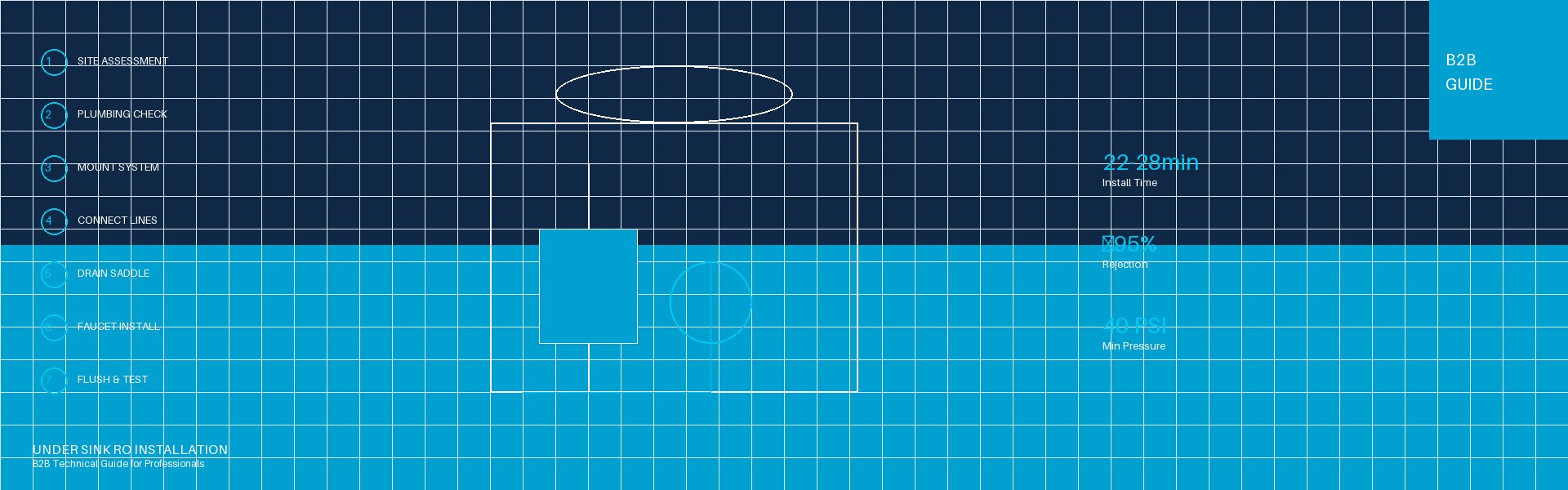
Incoming water pressure is the single most critical variable in membrane performance. Reverse osmosis relies on mechanical pressure to overcome natural osmotic pressure and force water molecules through a semi-permeable membrane. Most commercial-grade under-sink RO membranes are calibrated to perform optimally within a pressure range of 45 to 80 PSI. If the incoming pressure drops below 40 PSI, the system’s recovery rate plummets, leading to excessive wastewater production and rapid membrane fouling. Conversely, if the pressure exceeds 85 PSI, the physical integrity of the membrane housing and quick-connect fittings is compromised, risking catastrophic water damage. In high-rise developments, where municipal pressure can swing from 30 PSI on the top floors to over 100 PSI in the basement, installing pressure-regulating valves or dedicated booster pumps is non-negotiable.
Water temperature is another frequently overlooked variable that dictates actual output. Membrane manufacturers rate their daily gallon capacity (GPD) at a standardized temperature of 77°F (25°C). For every degree the water temperature drops below this standard, membrane flux decreases by approximately 1.5% to 2.0%. In northern climates during winter months, where incoming water temperatures can drop to a range of 40°F to 45°F, a system rated for 600 GPD may only deliver 300 to 350 GPD of purified water. Engineers must size their systems based on worst-case winter temperatures rather than optimistic summer baselines.
| Parameter | Ideal Operating Range | Critical Thresholds | System Impact |
|---|---|---|---|
| Inlet Pressure | 50 – 75 PSI | < 40 PSI / > 85 PSI | Low flow / structural failure risk |
| Feed Water Temp | 65°F – 77°F | < 40°F / > 100°F | Up to 50% capacity loss / membrane damage |
| Total Dissolved Solids (TDS) | 50 – 350 ppm | > 1,000 ppm | Rapid membrane scaling, high rejection load |
| Hardness (CaCO3) | < 5 grains per gallon | > 10 grains per gallon | Calcium carbonate scaling on RO surface |
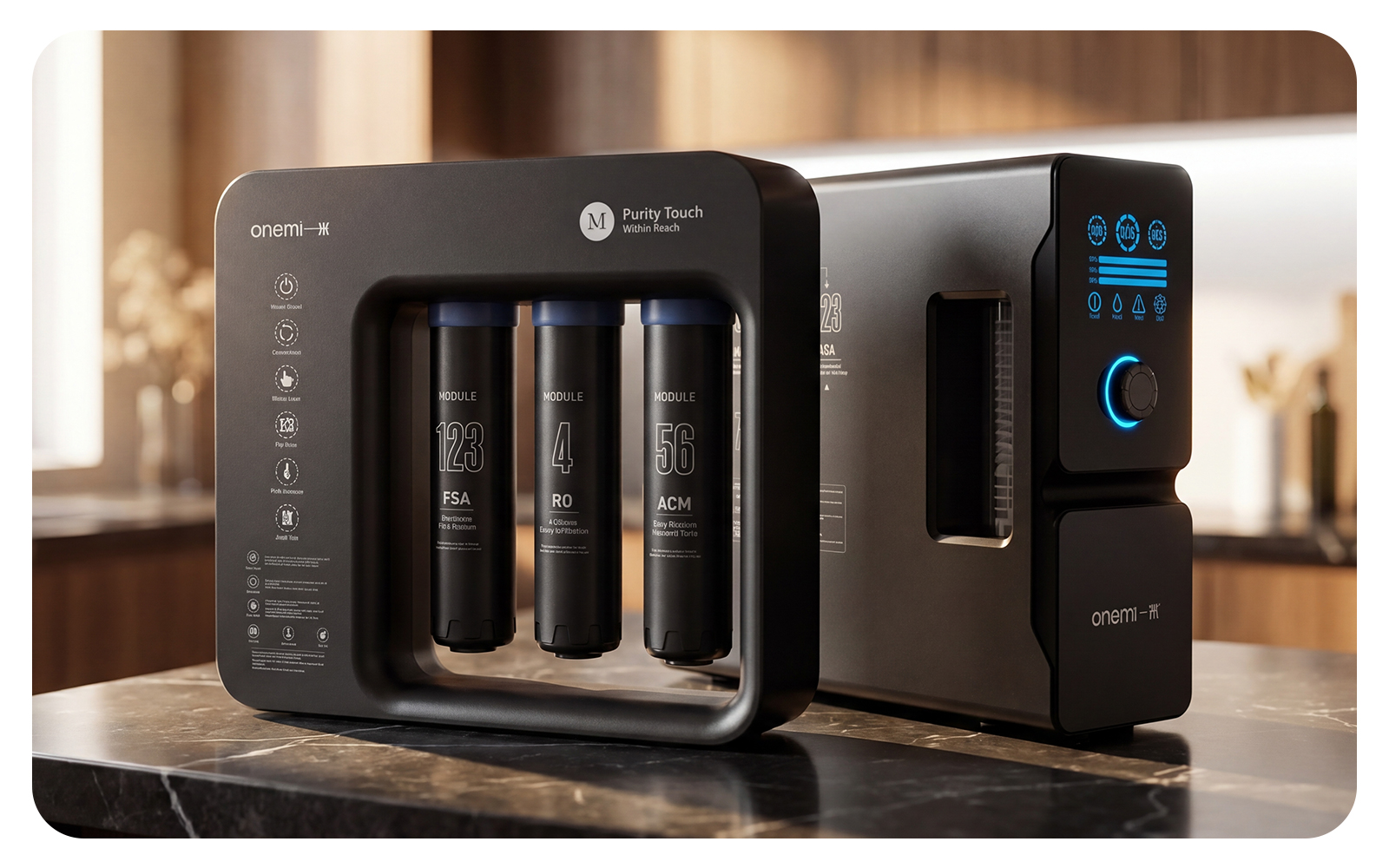
Pre-treatment configuration is the ultimate factor determining the lifespan of the RO membrane. Raw municipal water contains chlorine or chloramines, which are added by water utilities to prevent biological growth. However, chlorine chemically degrades polyamide thin-film composite (TFC) membranes by oxidizing the polymer structure, causing irreversible loss of salt rejection capabilities. A high-quality activated carbon block pre-filter is essential to reduce free chlorine levels to below 0.1 ppm before the water contacts the membrane. For B2B projects, choosing advanced systems like those featuring ONEMI filtration technology ensures that pre-treatment stages are precisely balanced to match the flow dynamics of the primary RO stage, preventing premature membrane degradation.
The Realities of Wastewater and Efficiency
We need to talk about the elephant in the engineering room: wastewater production. Traditional residential RO systems were notoriously inefficient, often discarding 3 to 4 gallons of concentrate water down the drain for every single gallon of purified permeate produced. In a modern commercial setting, this level of waste is environmentally and financially unacceptable. Many local municipalities in drought-prone areas like California and Arizona have enacted strict water conservation ordinances that actively penalize or outright ban low-efficiency RO systems.
To meet these stringent regulatory standards, modern under-sink RO systems utilize advanced wastewater recovery loops. High-efficiency systems can achieve pure-to-waste ratios ranging from 1.5:1 to as high as 3:1. These improved ratios are made possible by incorporating smart booster pumps that maintain a constant, optimal pressure across the membrane surface, alongside high-flux membrane chemistries that allow water molecules to pass through at lower net driving pressures.
However, there is an engineering catch that many manufacturers gloss over: pushing the recovery ratio too high increases the concentration of scaling minerals like calcium carbonate and silica in the wastewater stream. If the flow rate of the concentrate stream is too low, these minerals will precipitate out of solution and form a hard scale on the membrane surface, rapidly destroying its performance. Water treatment professionals must carefully balance the desire for high water efficiency with the localized hardness levels of the incoming feed water.
Long-Term Maintenance and Asset Management
The true cost of a B2B water treatment program is not the initial hardware purchase; it is the recurring operational cost of filter replacements, sanitization, and system monitoring over a five-to-ten-year lifecycle. When managing hundreds of under-sink assets across a commercial portfolio, manual tracking is a recipe for failure. Property managers frequently forget to change filters on time, leading to compromised water quality, or they replace filters prematurely, wasting thousands of dollars in unspent media life.
To solve this operational bottleneck, the industry is rapidly transitioning toward smart, connected under-sink RO systems. These next-generation units feature integrated sensors that track real-time flow rates, cumulative volume, and inlet/outlet Total Dissolved Solids (TDS). By utilizing IoT connectivity, these systems can transmit performance metrics directly to a centralized building management system (BMS) or a cloud-based dashboard. Instead of performing maintenance on a rigid calendar schedule, technicians are dispatched based on actual usage metrics. If a system in a low-use conference room has only processed 100 gallons over six months, the filter replacement can be safely deferred, while a high-use breakroom system can be serviced the moment its TDS rejection efficiency drops below a designated threshold.
Furthermore, sanitary design has become a major focus for commercial installations. Traditional under-sink systems with pressurized storage tanks are prone to biological stagnation if left unused for extended periods, such as during office holidays or tenant transitions. Tankless, high-flow direct-production RO systems eliminate this biological risk entirely. By utilizing high-capacity membranes (typically 600 to 1,000 GPD) paired with compact booster pumps, these systems deliver purified water on demand directly to the faucet, removing the need for a storage tank and drastically reducing the physical footprint under the sink.
Ultimately, the decision to deploy under-sink reverse osmosis systems across a commercial property portfolio comes down to balancing water quality security, regulatory compliance, and long-term operational efficiency. By shifting from centralized treatment plants to a highly managed network of point-of-use systems, B2B water professionals can deliver consistent water quality while maintaining complete control over their operational expenditures. As municipal water infrastructure continues to age, those who adopt these smart, decentralized filtration strategies will find themselves far ahead of the curve.