



 한국어

- Whole-house water filtration is shifting from a retrofit afterthought to a new-construction specification, with residential point-of-entry systems expanding at roughly 8.5% a year through 2035.
- The shift is regulatory, not cosmetic: roughly 4 million lead service lines remain in US distribution systems, and about 43 million Americans drink from private wells that sit outside federal oversight.
- Builder-spec systems are won on flow rate, maintenance interval, and third-party certification — not brand marketing — which changes how OEM suppliers should position whole-house lines.
The conversation around whole-house water filtration used to start with a homeowner staring at a clogged showerhead or a failed appliance. It is becoming a conversation that happens before the drywall goes up.
Across the United States and parts of Europe, builders are moving point-of-entry (POE) filtration from an upgrade checkbox to a standard line item in new-home specifications. The market data backs the observation. Residential whole-house water filtration systems were valued at about $1.57 billion in 2025 and are projected to reach $3.56 billion by 2035, a compound annual growth rate of 8.5%, according to Market Research Intellect’s 2026 report. The broader point-of-entry treatment market, which folds in softeners and media filters, was pegged at $10.32 billion in 2025 by AnalystView Market Insights, expanding at 6.1% through 2033.
For OEM suppliers and importers, the builder channel is a different animal from retail. It buys on specification, not impulse. That distinction reshapes everything from product design to how a factory presents its capabilities.
Why builders are moving filtration from retrofit to spec
New-construction adoption did not start with aesthetics. It started with liability and resale value.
The United States Environmental Protection Agency reported in November 2025 that roughly 4 million lead service lines remain in operation across the country. Replacing them takes years, not months. In the interim, point-of-entry filtration functions as a compliance bridge — a way to protect every tap in the house while the municipality works through its pipe-replacement backlog.
Private wells add a second layer of pressure. The US Geological Survey and the EPA put the number of Americans on private groundwater at more than 43 million, about 15% of the population. Private wells sit outside the Safe Drinking Water Act, which means the homeowner — and increasingly the builder — carries the entire regulatory burden. A new house on a well is a house that needs whole-house treatment from day one, not a retrofit five years later.
There is also a quieter commercial logic at work. A house that is plumbed and wired for filtration at construction costs far less to equip than a house that has to be retrofitted later. Builders understand this math. Market analysis from Data Insights Market notes a clear pattern of collaborations between filtration manufacturers and construction companies to integrate systems as a standard feature in new builds, particularly in luxury and eco-conscious developments. What begins as a differentiator for a premium community becomes, over a few years, the baseline for the segment below it.
What whole-house actually means on a spec sheet
Point-of-entry and point-of-use are not interchangeable terms, and builders treat them differently. A point-of-entry system mounts on the main supply line where water enters the structure and conditions every downstream fixture at once. A point-of-use system treats a single outlet — a kitchen tap, a refrigerator line.
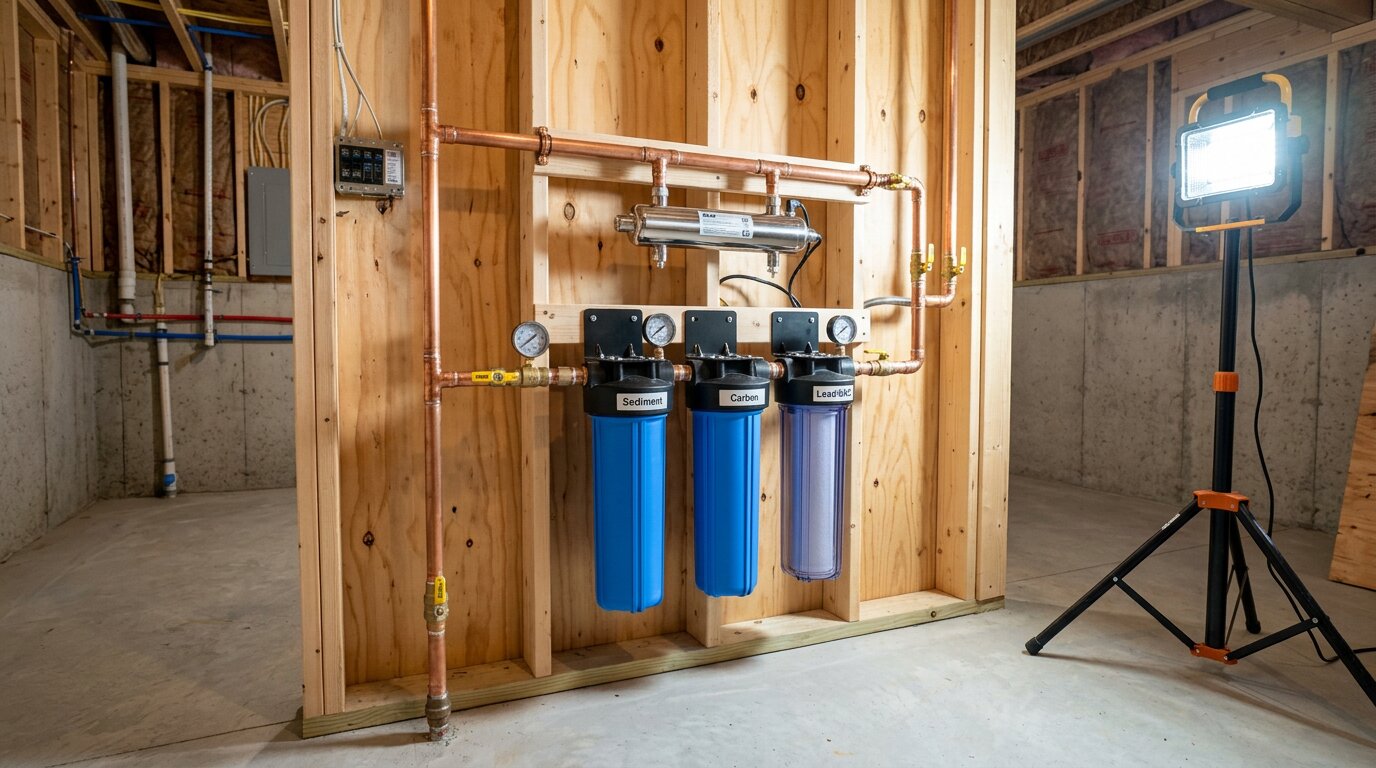
For a builder, the whole-house stack usually means three layers working in sequence:
- Sediment pre-filtration at the service entrance, capturing sand, rust, and particulate before it reaches appliances.
- Central filtration or softening, depending on whether the local problem is turbidity, chlorination byproducts, or hardness.
- Point-of-use drinking water, typically reverse osmosis, reserved for the kitchen where purity matters most.
The economics favor layering. A sediment pre-filter that costs a few hundred dollars to install protects a water heater, a washing machine, and a refrigerator that together cost thousands. That is the argument builders can make to a buyer in a single sentence, and it closes.
The technical parameters that actually move a spec are straightforward: rated flow, micron rating, backwash capability, and media service life. Everything else is secondary.
| Parameter | Typical builder requirement | Why it matters on a spec |
|---|---|---|
| Rated flow | 2,000–5,000 L/h for POE | Whole-home simultaneous demand with no pressure drop |
| Sediment rating | 40 μm or finer | Protects valves, heaters, and downstream membranes |
| Media service life | 5–10 years before replacement | Lowers lifetime cost, a resale talking point |
| Backwash / flush | Manual or auto, no cartridge swap | Reduces callbacks and homeowner maintenance |
| Certification | NSF/ANSI 42 or 53, or equivalent | Third-party proof for inspectors and buyers |
The numbers behind the builder channel
Whole-house filtration is not the largest slice of the residential water treatment market, but it is among the fastest-growing and the most channel-concentrated. The category’s trajectory matters less for its absolute size than for where the volume is flowing.
| Market segment | 2025 value | Projected | CAGR | Source |
|---|---|---|---|---|
| Residential whole-house filtration | $1.57B | $3.56B (2035) | 8.5% | Market Research Intellect, 2026 |
| Point-of-entry treatment (incl. softeners) | $10.32B | — | 6.1% (to 2033) | AnalystView Market Insights, 2026 |
| US water purifier market (all categories) | $6.75B (2024) | $10.35B (2032) | 5.5% | Fortune Business Insights |
Two things stand out. First, whole-house systems are growing faster than the overall water purifier category — 8.5% against 5.5%. Second, the growth is concentrated in a channel where one decision covers an entire development, not a single household. A builder who specs a system for a 200-home community places 200 units at once. That concentration changes what a supplier optimizes for.
The lead-line and private-well numbers give the trend a long tail. Four million service lines do not get replaced in a year, and 43 million private-well households do not suddenly move onto municipal supply. Both are structural, multi-decade demand drivers.
What a builder-spec system needs to survive
Retail buyers can be sold a story. Builders buy on four things: it has to work without callbacks, it has to fit a standard utility rough-in, it has to carry paperwork an inspector accepts, and it has to hold up for a decade or more.
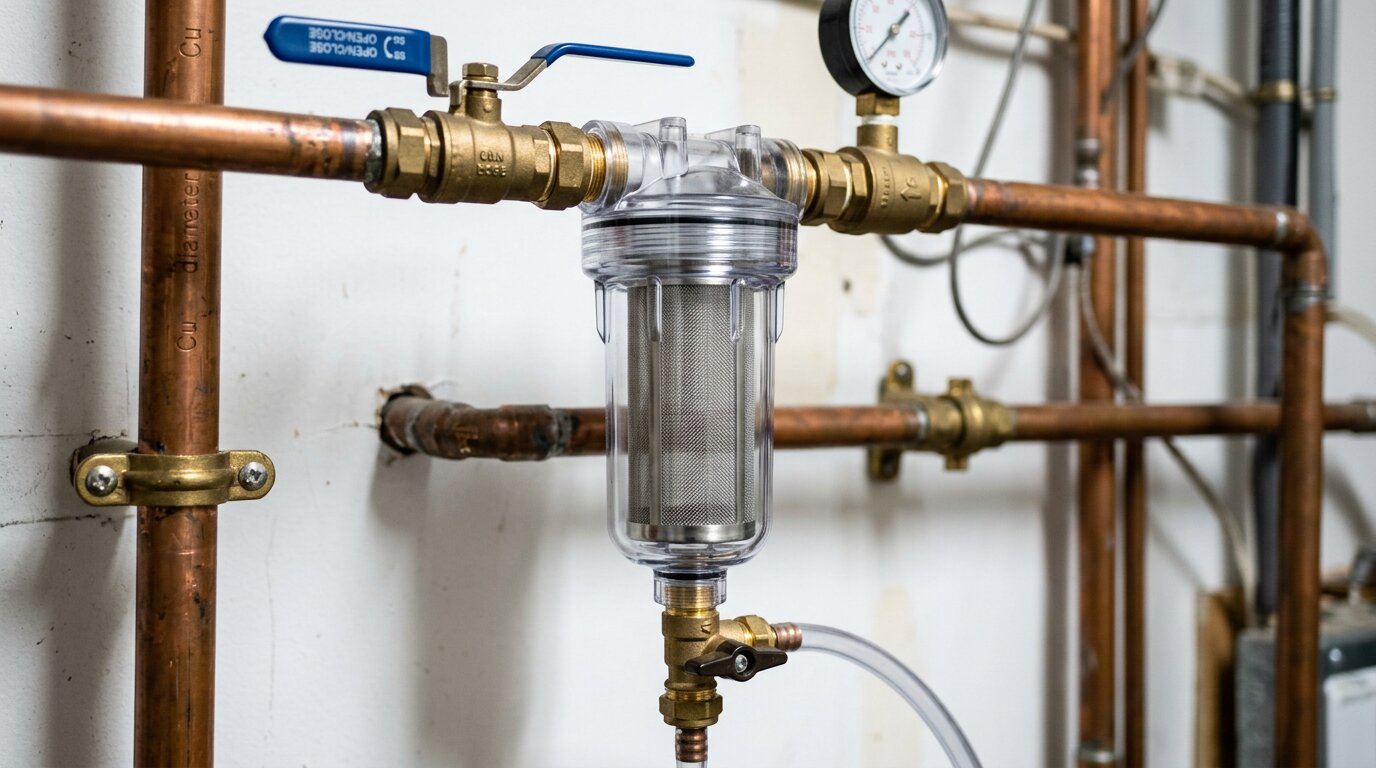
A 316 stainless steel mesh pre-filter with a 40 μm rating and a 10-year no-replacement service life — the design ONEMI uses in its R1 whole-house pre-filter — is built for exactly that profile. No cartridge to reorder, a 3,000 L/h flow rate, and a backwash cycle that clears the screen without shutting off the water. For a builder, a design with no replaceable consumable is the strongest maintenance line item there is.
Downstream, a central ultrafiltration unit such as the ONEMI S1 central water filter runs from 1,000 to 5,000 L/h at a 0.01 μm rating, with no electricity and zero waste water. No power requirement means no dedicated circuit, no transformer, and nothing for a new homeowner to reset after an outage. The 304 stainless housing, and the fact that it retains beneficial minerals rather than stripping them, addresses the two most common builder objections: durability and what the system does to the water a buyer actually drinks.
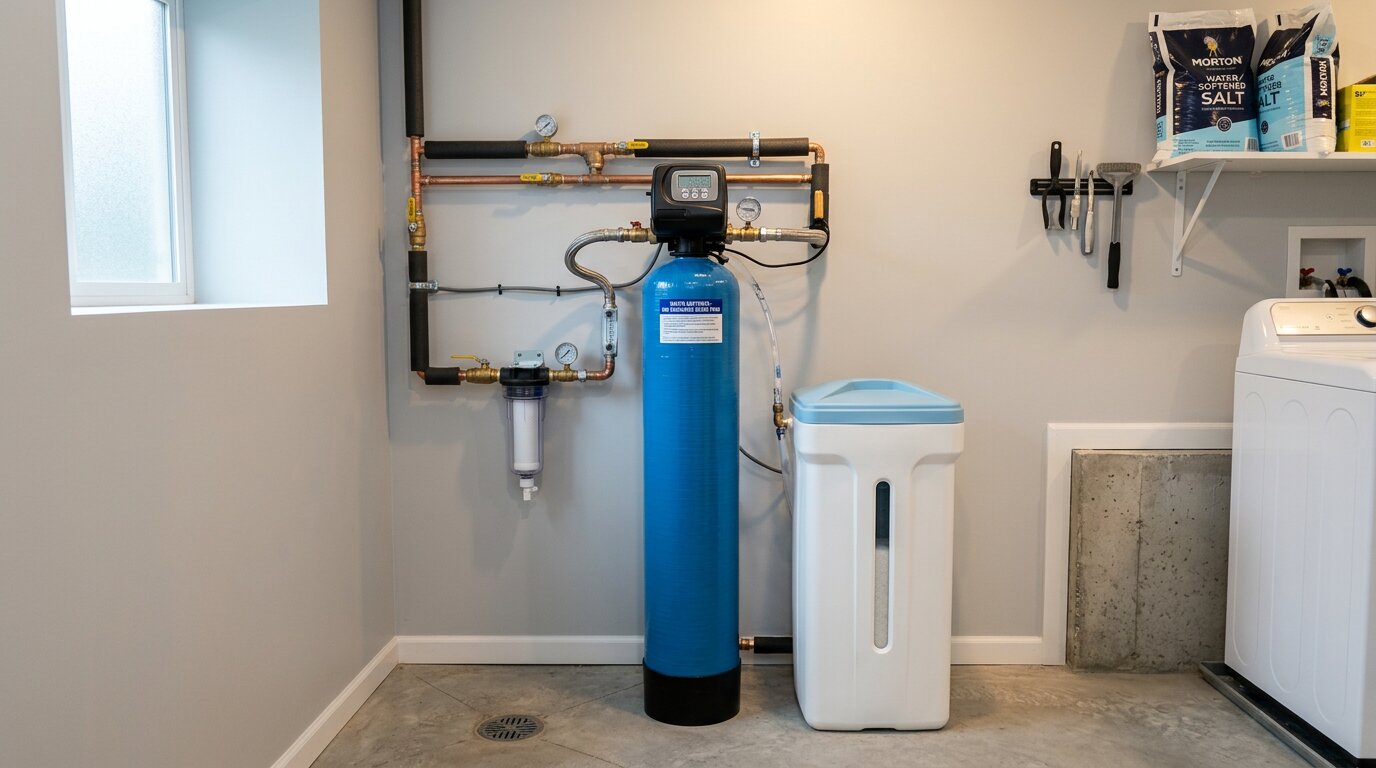
In hard-water regions, a central water softener slots in behind the pre-filter, using ion-exchange resin with a 2.1 eq/L exchange capacity and an automated valve that runs the full soften, backwash, and regenerate cycle. For a builder, the selling point is appliance longevity — a softener that prevents scale protects the water heater and the plumbing the builder is warranting.
Certification and code: what gets a system onto a spec
No certification, no spec. That is close to a hard rule in the builder channel.
The standards that matter for whole-house systems are NSF/ANSI 42 for aesthetic and chlorine reduction and NSF/ANSI 53 for health-related contaminants. Reverse osmosis drinking systems fall under NSF/ANSI 58. On the regulatory side, the EPA’s Lead and Copper Rule and its lead service line inventory are the documents that frame the US conversation, while international markets layer on their own requirements — WaterMark for plumbing safety in Australia, CE and WRAS in Europe.
The practical takeaway for a supplier is that certification is not a marketing badge in this channel; it is a procurement filter. Builders and their inspectors want a document they can file. A factory that can produce third-party test reports alongside the hardware removes a step from the builder’s approval process — and that speed is worth more than a discount. The relevant documentation lives under one certification reference precisely so a sourcing decision can move without a detour.
The sourcing angle: what OEM buyers should watch
For an importer or private-label buyer, the builder channel changes the shape of the product they should be asking for. It is not a slightly larger under-sink unit. It is a different category with different economics.
Three observations from the factory side:
- Durability outranks feature count. A builder-spec system lives in a utility room or a crawl space for a decade. Stainless housings, no-electricity designs, and backwashable media beat touchscreens and app connectivity in this segment.
- Flow rate is the first number checked. A system that cannot deliver 2,000 L/h or more across simultaneous fixtures will be crossed off before price is discussed.
- The consumable model flips. Retail systems monetize replacement cartridges. Builder-spec systems win on the opposite — long media life and infrequent service — because the homeowner, not the builder, absorbs future costs, and the builder wants to keep those costs off the resale sheet.
There is a meaningful opening for factories that can bundle the full POE stack — pre-filter, central filter or softener, and drinking-water point-of-use — from a single source. Builders prefer one vendor, one warranty, one set of paperwork. An OEM partner that ships the whole stack, with certifications already in place, removes the coordination burden that makes whole-house projects slow to close. ONEMI’s OEM and ODM capabilities are organized around exactly that bundle, from the entrance pre-filter through to the kitchen RO unit.
The builder channel is not the loudest segment in water treatment, but it may be the most structurally durable. Lead lines will keep getting replaced, private wells will keep needing treatment, and new construction will keep looking for ways to differentiate on something buyers can actually feel. Whole-house filtration sits at the intersection of all three. For a supplier, the question is no longer whether to enter the channel — it is whether the product line is built for it.