
 한국어
한국어

A mid-sized European appliance brand recently cut its time-to-market by nearly half while slashing its initial capital expenditure by roughly 40% on a new reverse osmosis line.
They did not invent a new membrane. They did not build a new cleanroom. Instead, they stopped trying to manage a fragmented regional supply chain and consolidated their production with a specialized Chinese OEM. This shift is happening across the industry as brands face stricter local water regulations and rising consumer demands for smarter, more compact filtration systems.
Executive Summary
- Consolidating production with a Chinese OEM reduces capital expenditure by approximately 40% and accelerates product launches.
- Compliance with evolving regional standards like NSF/ANSI 58 and the EU Drinking Water Directive is simplified through pre-certified manufacturing ecosystems.
- Modern OEM partnerships leverage advanced injection molding and automated assembly to deliver high-precision, leak-free filtration systems at scale.
The Financial Reality of Modern Water Filtration Production
Building a water filtration manufacturing facility from scratch is a fast way to burn through venture capital or corporate budgets. Setting up a single high-precision injection molding line for food-grade plastics easily costs hundreds of thousands of dollars, and that is before you even consider the ISO class cleanrooms required for sanitary filter assembly. For most brands, the math simply does not work out in favor of in-house manufacturing anymore.
By partnering with an established OEM in China, brands bypass these massive upfront capital expenditures entirely. The infrastructure is already built, calibrated, and running at peak efficiency. This allows businesses to reallocate their capital toward brand building, customer acquisition, and localized marketing campaigns where it actually moves the needle.
Let us look at how the cost structures compare across key development phases:
| Development Phase | In-House Manufacturing Cost | OEM Partnership Cost | Time-to-Market Impact |
|---|---|---|---|
| Tooling & Mold Design | $80,000 – $150,000+ | Amortized or Shared | Saves 3 to 5 months |
| Compliance & Certifications | $30,000 per market | Pre-certified platforms | Saves 6 to 9 months |
| Assembly Line Setup | $200,000+ (Cleanroom) | $0 (Leveraged) | Immediate scaling |
| Minimum Order Runs (MOQ) | High overhead risk | Flexible tiered options | Optimizes cash flow |
Scale changes everything in manufacturing. A factory producing 50,000 units a month buys raw polypropylene, activated carbon blocks, and reverse osmosis membranes at a fraction of the price of a brand producing 1,000 units. These volume discounts are passed directly to you, keeping your bill of materials low and your gross margins healthy.
Navigating Global Water Quality Standards and Regulations
Water quality is not a one-size-fits-all problem, and neither is the regulation surrounding it. In the United States, municipal water systems face growing scrutiny over PFAS, lead, and microplastics, driving demand for systems certified to NSF/ANSI Standards 53 and 58. Across the Atlantic, European brands must comply with the strict material migration limits set by the EU Drinking Water Directive and country-specific approvals like WRAS in the UK or ACS in France.
A common mistake is assuming a standard off-the-shelf filter will pass these tests. It won’t.
This is where deep technical expertise becomes critical. Experienced manufacturers like ONEMI design their systems from the ground up using raw materials that already carry FDA, NSF, and RoHS certifications. When the base plastics, O-rings, and carbon blocks are already verified safe, getting the final assembled product certified by local testing bodies becomes a straightforward, predictable process rather than an expensive game of trial and error.
Consider the varying regional water profiles that your products must address:
- North America: High demand for lead reduction, chloramine filtration, and PFAS removal in aging urban infrastructures.
- Western Europe: Focus on limescale prevention (hardness mitigation) and chemical-free bacterial retention.
- Southeast Asia: Heavy reliance on multi-stage reverse osmosis to tackle high Total Dissolved Solids (TDS) and microbiological contamination.
If your OEM does not understand the difference between filtering municipal tap water in Chicago and well water in Munich, you will end up with high return rates and damaged brand equity.
The Technical Pillars of High-Performance Water Purification
A water purifier is a pressurized appliance that sits inside someone’s home, often hidden under a sink. If a smartphone fails, it stops working; if a water purifier fails, it can flood a kitchen and cause thousands of dollars in property damage. This reality makes manufacturing precision the ultimate differentiator between a successful product line and a logistical nightmare.
It all starts with precision injection molding. The water pathways inside modern tankless RO systems are incredibly complex. Any slight warping in the plastic housing during the cooling phase creates micro-gaps. Under constant water hammer effects—where water pressure spikes when a faucet is turned off—these micro-gaps eventually turn into hairline cracks. High-end OEMs utilize advanced automated molding machines and real-time pressure testing to ensure every single manifold can withstand structural integrity tests up to 100,000 cycles of water pressure testing.
But what about the filtration media itself? The performance of an activated carbon block depends entirely on the uniformity of its pore structure. If the carbon is packed too tightly, the flow rate drops to a trickle; if it is too loose, water channels through the path of least resistance, leaving contaminants unfiltered. Automated assembly lines ensure that every carbon block, sediment layer, and hollow fiber membrane is compressed and sealed with mathematical consistency.
Is your current partner using automated ultrasonic welding, or are they still relying on manual gluing that degrades over time?
A Practical Framework for Selecting and Auditing Your OEM Partner
Choosing a manufacturing partner is not a decision you should make based on an email quote or a slick presentation deck. You need a structured framework to evaluate their actual capabilities on the factory floor.
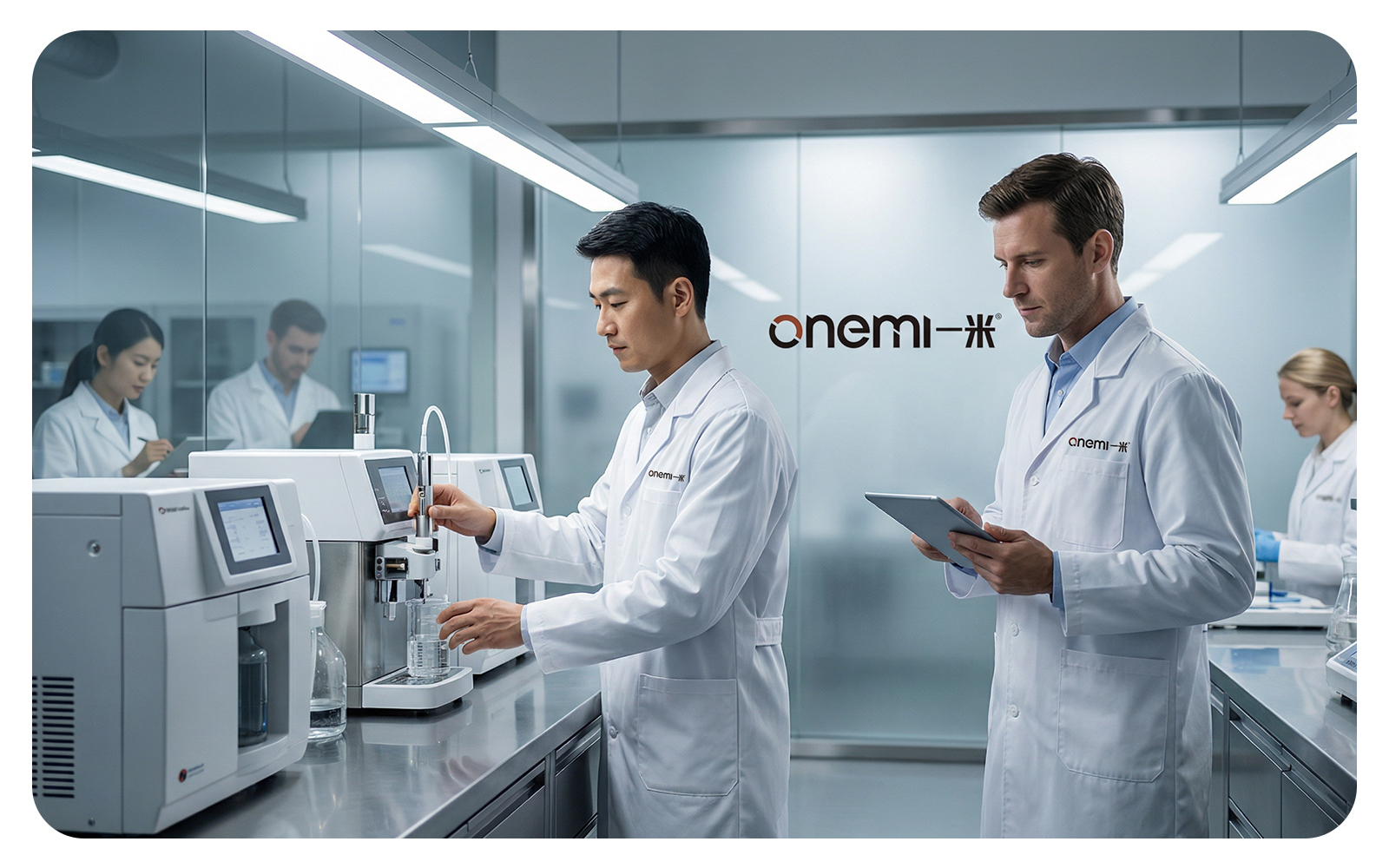
First, look at their quality management system. A reputable partner must hold ISO 9001:2015 certification at a minimum, but you should also look for ISO 14001 for environmental management if your brand values sustainability. Ask to see their internal testing laboratory. Do they have the equipment to perform burst pressure testing, salt spray testing for corrosion resistance, and microbiological challenges in-house? If they have to outsource basic quality checks, your production schedules will inevitably suffer delays.
Second, evaluate their engineering depth. A true ODM partner does not just accept your CAD files and start cutting steel molds. They should actively participate in Design for Manufacturing (DFM) reviews. They should point out potential assembly bottlenecks, suggest material substitutions that improve durability while lowering costs, and help optimize the internal layout to minimize pressure drops across the filters.
Finally, inspect their supply chain transparency. A world-class water purifier is only as good as its weakest component. You must know exactly where they source their RO membranes, their UV-C sterilization LEDs, and their pressure sensors. A reliable partner will gladly provide a transparent Bill of Materials (BOM) and allow you to audit their sub-tier suppliers to ensure consistency across every production batch.
In the end, the brands that dominate the water purification market are not those with the biggest factories, but those with the smartest supply chain alliances.