


 한국어

- No federal limit or mandatory removal standard for microplastics in drinking water exists in the US yet; California’s SB 1422 covers monitoring only.
- NSF/ANSI 401 is the closest thing to a benchmark, requiring 85% reduction of particles down to 0.5 µm, while NSF/ANSI 53 covers particles above 1 µm.
- RO membranes at 0.0001 µm remove 99%+ of microplastics including nanoplastics; carbon block and ceramic leave gaps below roughly 0.5 µm.
There’s a gap between what consumers assume their water filter does about microplastics and what any certification actually guarantees. For an importer or brand building a water filter line in 2026, that gap is the single most useful thing to understand. It shapes product claims, lab budgets, and which certification marks actually move units off the shelf.
The regulatory vacuum around microplastics
Microplastics are plastic particles under 5 millimetres, and the smaller nanoplastic fraction below 1 micrometre is the part most capable of crossing biological barriers. Yet the United States has no federal maximum contaminant level for them. The closest regulatory signal is California’s SB 1422, which requires public water systems to monitor for microplastics in drinking water. Monitoring is not the same as a removal standard. It tells utilities what’s in the water; it doesn’t tell a filter maker what “removes microplastics” has to mean.
The World Health Organization reviewed microplastics in drinking water in 2019 and judged the acute health risk low, while flagging the real problem: data gaps on nano-sized particles and long-term exposure. That verdict has aged. A 2024 Columbia University study found roughly 240,000 plastic fragments per litre in bottled water, about 90% of them nanoplastics. Consumer concern has moved far faster than the standards.
NSF 401 is the closest thing to a benchmark
For a manufacturer, there is exactly one certification that treats microplastics as a named claim: NSF/ANSI 401, the emerging compounds and incidental contaminants standard. It added a microplastics claim in 2018 and updated it in 2022, and it requires a certified system to reduce at least 85% of particles down to 0.5 µm. That number matters because it sets a floor, not a ceiling. Two filters can both say “reduces microplastics” and perform very differently below half a micron.
NSF/ANSI 53, the health-effects standard, covers particulate reduction above 1 µm, which catches the larger microplastic fraction but misses the sub-micron particles consumers now worry about most. NSF/ANSI 42 handles aesthetic particulate but isn’t a health claim. When a supplier lists all three, the buyer still needs to read which claim is actually attached to microplastics specifically.
Why the testing protocol is still unsettled
The reason there’s no clean, universal test is simple: nobody has settled on what a “reference microplastic” looks like. Real microplastics vary in polymer type, shape, and size distribution. A polyethylene sphere behaves differently in a filter than a weathered polypropylene fragment. Test labs have to pick a surrogate, and two labs picking different surrogates get different removal numbers for the same product.
Size range is the second problem. Most certifications stop at 0.5 µm, but nanoplastics run down into the tens of nanometres. A filter can be fully certified for microplastics and still pass a measurable share of the nanoplastic fraction, because nothing in the standard demands testing below the claim’s floor. That’s not a defect in the product; it’s a hole in the protocol.
What the technologies actually deliver
Reverse osmosis is the blunt instrument that closes most of the gap. An RO membrane’s pores sit around 0.0001 µm, three orders of magnitude smaller than the microplastic threshold, so it removes essentially all microplastics and the bulk of nanoplastics by physical sieving, on top of dissolved contaminants. Carbon block is weaker on this metric: an effective pore size of 0.5 to 2 µm captures most particles above that range but is partial on nanoplastics. Ceramic sits in between, from 0.2 to 0.9 µm depending on grade.
| Technology | Effective pore size | Microplastic removal | Nanoplastic (<1 µm) |
|---|---|---|---|
| Reverse osmosis | ~0.0001 µm | 99%+ | Strong |
| Carbon block | 0.5–2 µm | Most >2 µm | Partial |
| Ceramic | 0.2–0.9 µm | Most >0.2 µm | Partial |
The commercial takeaway is that RO is the only technology where the microplastic claim doesn’t quietly rely on a size-range asterisk. That’s why the highest-value product positioning pairs an RO stage with the microplastic claim rather than leading with a carbon block alone.
What this means for B2B buyers
For an importer or brand, the playbook is concrete. Ask the factory for the specific NSF 401 microplastics claim, not a generic “removes microplastics” line, and request the test report with the particle size range and removal percentage stated. Check whether the claim is attached to the whole system or just a single stage. And if the target market is the US or EU, plan for certification as a product-design input, not a marketing afterthought.
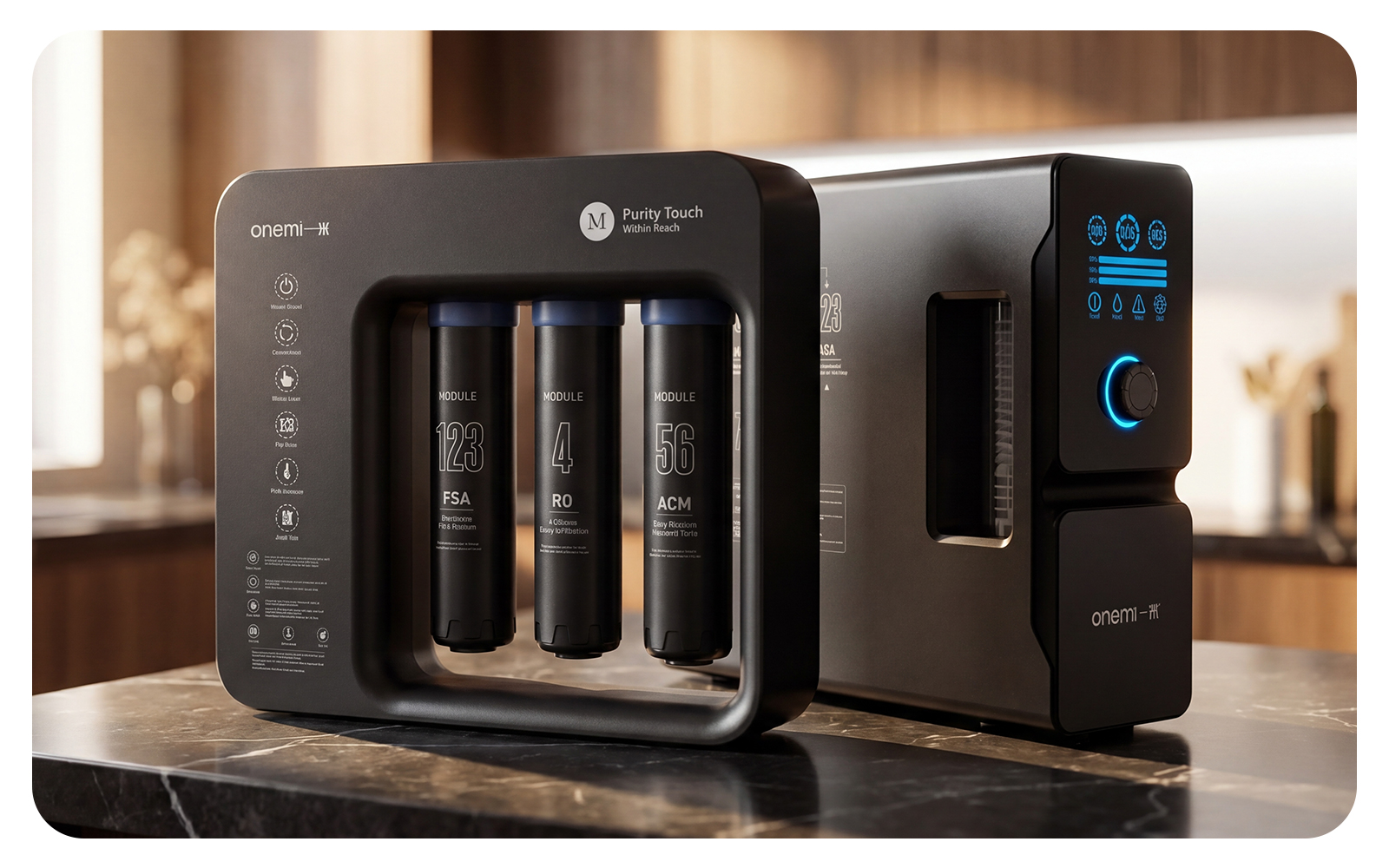
ONEMI, a Guangdong-based water purification equipment manufacturer, builds under-sink and countertop RO systems around a 0.0001 µm membrane that clears the microplastic threshold by a wide margin. The relevant lines start with the 100G reverse osmosis system and scale up to the 400G smart water purifier, both built for certification-driven buyers rather than commodity price competition. For brands sourcing a private-label line, the filter cartridge and RO membrane configuration is where the microplastic story is won or lost; see the OEM/ODM factory capabilities for how cartridge design is handled. Certification scope across the product range is documented on the certifications page.
The microplastics standard will eventually catch up to the demand. Until it does, the brands that win shelf space will be the ones that can point to a specific claim, a specific size range, and a specific test report—not a vague promise printed on the box.