


 한국어

- Replacement cartridges made up 62.1% of the $5.45 billion water-filter-pitcher-and-cartridge market in 2025 — the consumable, not the machine, is where the margin lives.
- Quick-change cartridges swap in seconds with no tools, but they ship without a universal standard like the 10-inch x 2.5-inch housing — and that absence is usually a deliberate lock-in play.
- Keyed engagement, auto shut-off, and quarter-turn locking are patent-protected now, which quietly converts one-off hardware sales into recurring replacement revenue.
There is a quiet structural shift happening inside the water-filter business, and it has almost nothing to do with how well a filter cleans water. It is about how a cartridge attaches to a head. Replacement cartridges were 62.1% of the $5.45 billion global pitcher-and-cartridge market in 2025, according to PW Consulting, and the format winning that segment is the one most buyers never think about until the first refill: the quick-change, twist-lock, bayonet cartridge.
The economics are simple once you see them. A standard 10-inch housing cartridge is cheap, universal, and interchangeable — which is exactly why no brand can own it. A twist-lock cartridge with a proprietary keying profile is the opposite: it costs more, fits only one head, and turns every replacement into a reorder from a single supplier. For an OEM, an importer, or a brand owner, that difference is the whole game.
The format split: quick-change versus standard housing
Every replaceable water filter falls into one of two physical camps, and the camp determines the margin structure more than the media inside does.
Standard housing cartridges — the 10-inch by 2.5-inch drop-in and its jumbo cousins — have been the industry workhorse for decades. They are universal: any brand’s cartridge fits any brand’s housing of the same size. That universality keeps per-cartridge cost down to roughly $0.50 to $5, but it also makes the cartridge a commodity. The buyer can swap suppliers on every refill and lose nothing.
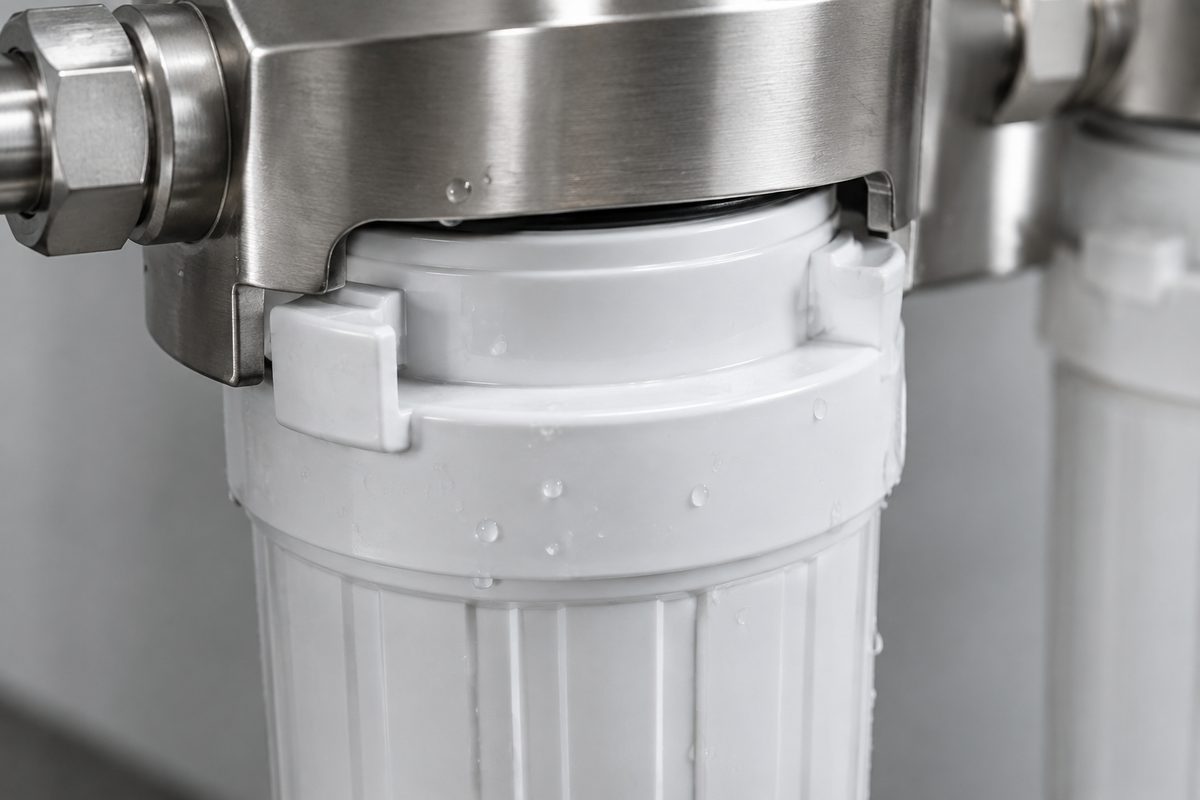
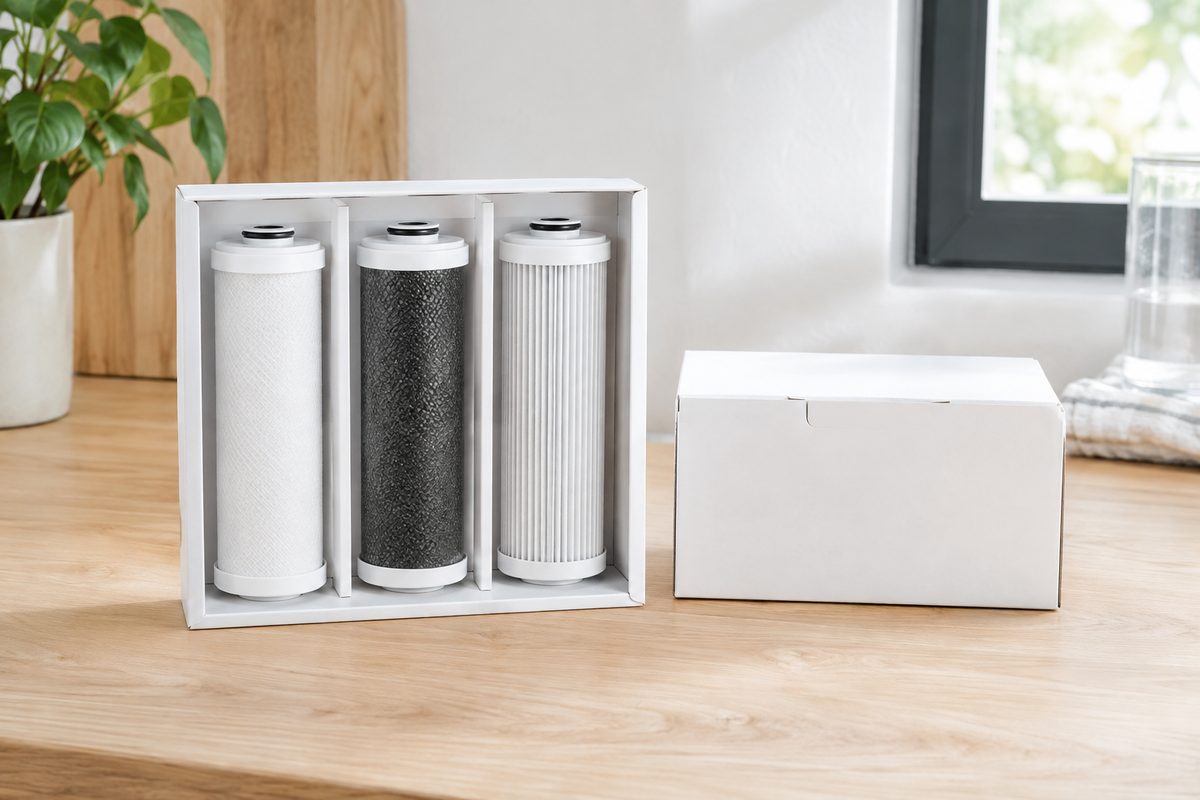
Quick-change cartridges are the self-contained unit: the media is sealed inside a disposable shell that pushes or twists into a permanent manifold head. A quarter-turn, a click, and the old cartridge comes out; the new one goes in with no wrench, no O-ring handling, and no shut-off. Replacement takes 30 seconds to two minutes, against five to fifteen minutes for a housing system. The cartridge costs more — $5 to $25 is typical — but the trade-off is control.
| Attribute | Quick-change (twist-lock/bayonet) | Standard housing (drop-in) |
|---|---|---|
| Replacement time | 30 seconds – 2 minutes | 5 – 15 minutes |
| Tools required | None | Housing wrench, bucket |
| Per-cartridge cost | $5 – $25 | $0.50 – $5 |
| Compatibility | Proprietary, single head | Universal (10″ x 2.5″ standard) |
| O-ring maintenance | None (seal built in) | Required at each change |
| Supplier lock-in | High | None |
That last row is the one that matters for anyone who owns a brand. Universal compatibility is a feature for the buyer and a ceiling for the seller. Proprietary compatibility is a friction for the buyer and a recurring-revenue engine for the seller. The quick-change format did not take over because it filters better. It took over because it locks better. We covered the aftermarket mechanics of that shift in our breakdown of how aftermarket cartridges are taking OEM revenue.
Why the proprietary lock is the real product
The twist-lock mechanism looks like a convenience feature. It is actually a business model wearing a convenience feature.
There is no universal standard for quick-change cartridges the way there is for the 10-inch drop-in. A push-fit fitting from one manufacturer does not seat in another’s manifold. A bayonet profile with three lugs will not rotate into a head designed for two. That absence of a standard is not an accident; it is the point. Every quick-change system quietly requires the buyer to return to the original cartridge maker for every replacement for the life of the unit.
Patent activity is hardening that moat. Recent filings describe keyed engagement where a cartridge’s groove must match a head’s keying member before it will seat, check valves and a rotating bypass disc that stop water during a swap without a shut-off valve, and quarter-turn heads that eliminate the seal-misalignment failures of older screw-in designs. One keyed-engagement patent, US 12,728,373, was granted in September 2026, with a Chinese counterpart published the same year. The message is hard to miss: the locking mechanism itself is now protected intellectual property.
For a brand owner, that patent layer changes the sourcing conversation. A tool-less, keyed cartridge is not something you can spec once and forget; it is a designed, molded, and often patent-cleared assembly. We walked through the return-rate economics of that design choice in our piece on how tool-less design cuts returns for importers.
The replacement market is where the money moved
The numbers explain why the locking mechanism suddenly gets this much attention. The global water-filtration-pitcher and replacement-cartridge market was valued at $5.45 billion in 2025 and is projected to reach $9.41 billion by 2032, a compound annual growth rate of 8.12%, per PW Consulting. Within that total, replacement cartridges held a 62.1% share in 2025 — more than the hardware they attach to. North America led the regional split at $1.90 billion.
That is the structural point worth sitting with: in a mature filtration category, the recurring part outsells the one-time part. A household buys a unit once and a cartridge every six to twelve months, year after year. The brand that controls the cartridge format controls the lifetime value. The brand that sells a universal drop-in is, in effect, renting out the refill to whoever is cheapest. That is why the recurring-revenue angle is the single biggest lever in cartridge sourcing today — the full logic is in our guide to sourcing cartridges for recurring revenue.
Design trends an OEM should be watching in 2026
Four design directions are consolidating the quick-change segment, and they interact. They are worth understanding separately before you commit to a mold.
First, keyed engagement is replacing the plain bayonet. A keyed head and matching groove means a cartridge cannot be forced into the wrong system, and it gives the OEM a defensible fitment that generic aftermarket makers cannot easily copy. Second, auto shut-off valves are moving into the manifold itself, so a user can pull a spent cartridge without touching the water line — the pressure is cut at the head, not at the tap. Third, the quarter-turn is edging out the screw thread; a 90-degree rotation avoids the O-ring misalignment and seal wear that plague multi-turn designs. Fourth, the cartridge and head are being treated as one sealed assembly, with the media permanently bonded inside the shell, which removes the open-sump cleaning step entirely.
None of these are cosmetic. Each one changes a different number on the spec sheet: return rate, warranty claims, service-call frequency, and — most consequentially — the difficulty of a third party making a compatible cartridge.
What an importer or OEM buyer should verify
If the quick-change format is the direction your line is heading, the sourcing checklist shifts. The filter media matters, but the interface matters just as much, and it is the part most buyers under-inspect.
Ask about the locking geometry first. Is it a licensed profile, a generic bayonet, or a custom keyed design you will own? A custom keyed design costs more up front — tooling, testing, and often a patent clearance search — but it is the only version that protects the refill stream. A generic bayonet is cheaper to launch and easier for a competitor to undercut.
Ask about certification scope second. A cartridge built for the US market still has to clear the same standards regardless of how it attaches: NSF/ANSI 42 for aesthetic claims, 53 for health-effect claims, 58 for reverse-osmosis systems, 61 for material safety, and 372 for lead content. A claim of “NSF certified” without the standard number means nothing, and a cartridge certification does not extend to the whole system. The standard-by-standard mapping is laid out in our NSF/ANSI guide for importers.
Ask about replacement continuity last, and treat it as a hard requirement. The entire economics of the twist-lock format rest on the cartridge remaining available, unchanged, for years. If the factory cannot commit to keeping the exact same fitment and media in production, the lock-in works against you instead of for you.
Where ONEMI fits
ONEMI, a Guangdong-based water-purification equipment manufacturer, builds its cartridge lines around this exact structure: NSF/ANSI-tested cartridges, long-running replacement-part continuity, and tool-less twist-lock designs aimed at low return rates and a defensible refill stream. Whole-machine certifications cover CE, UL, FCC, and RoHS, while NSF coverage applies to the filter cartridges specifically — a distinction we keep explicit rather than letting a “fully certified” claim blur the line. For the factory-level picture, see our OEM/ODM manufacturing overview.
The quick-change format did not win because it was new. It won because it moved the durable advantage of the category — the repeat purchase — from the open market back to whoever designed the lock. That is the part of the water-filter business worth getting right in 2026.