

 한국어

- NSF/ANSI 401 is the main standard behind microplastics claims, requiring an 85% reduction of 0.5-1 micron particles under a defined test protocol
- A filter with only NSF 42/53 certification has not been independently proven to remove microplastics
- RO membranes at 0.0001 micron remove microplastics by default, but only a dedicated test report turns that into a defensible marketing claim
Microplastics Claims Are Everywhere. Verifiable Testing Is Not.
Walk any water filter trade show in 2026 and “microplastics removal” appears on half the booths. Dig into how many of those claims carry an independent test report, and the number collapses. Microplastics have become the fastest-growing claim in residential filtration, and the least verified one.
The scale of the concern is real. A 2024 Columbia University study found an average of 240,000 plastic particles per liter in bottled water, with roughly 90% of those nanoplastics small enough to cross biological barriers. Global plastic production approached 380 million tonnes in 2025, and most of it eventually fragments into particles that end up in source water. Consumers read these numbers. Buyers read them. Brands are scrambling to respond.
That scramble is exactly where the compliance risk sits. A manufacturer can print “removes microplastics” on a box tomorrow. Defending that claim against a retailer audit, a competitor challenge, or a class-action inquiry is a different job entirely. That job starts and ends with one standard: NSF/ANSI 401.
Which Standard Actually Covers Microplastics
The microplastics certification landscape is narrow, and knowing what each standard does and does not cover is the difference between a defensible claim and a liability. Four standards matter, and they are not interchangeable.
NSF/ANSI 401, the “Emerging Compounds/Incidental Contaminants” standard, is the primary vehicle for microplastics claims. Its microplastics requirement was added in 2018 and updated in 2022. A certified filter must demonstrate at least an 85% reduction of particles in the 0.5 to 1 micron range. That threshold is the number behind nearly every legitimate microplastics claim in the market today.
NSF/ANSI 42 Class I particulate covers particles in the same 0.5 to 1 micron band and is used as a surrogate test in some certifications. NSF/ANSI 53, the health-effects standard, addresses particles above 1 micron. Neither of these, on its own, is a microplastics certification. A filter carrying only NSF 42 or NSF 53 has not been independently proven to remove microplastics, a distinction a surprising number of importers still miss.
For the most rigorous claims, NSF/ANSI 244 is the dedicated microplastics standard, and NSF/ANSI 58 governs reverse osmosis systems where microplastics removal is implicit in the membrane’s pore size. The table below maps what each standard actually proves.
| Standard | What It Covers | Microplastics Relevance |
|---|---|---|
| NSF/ANSI 401 | Emerging contaminants, incl. microplastics | Primary standard; 85% reduction of 0.5-1 micron particles |
| NSF/ANSI 42 Class I | Aesthetic effects, particulate | Surrogate test, 0.5-1 micron particles |
| NSF/ANSI 53 | Health effects, particles >1 micron | Not a microplastics certification on its own |
| NSF/ANSI 244 | Microplastics, most rigorous | Dedicated microplastics standard |
| NSF/ANSI 58 | Reverse osmosis systems | Microplastics removal implicit in 0.0001 micron membrane |
What the NSF 401 Protocol Actually Measures
An 85% reduction claim sounds simple. The testing behind it is specific in ways that determine whether a product passes or fails, and importers should understand the protocol before they commission a certification run.
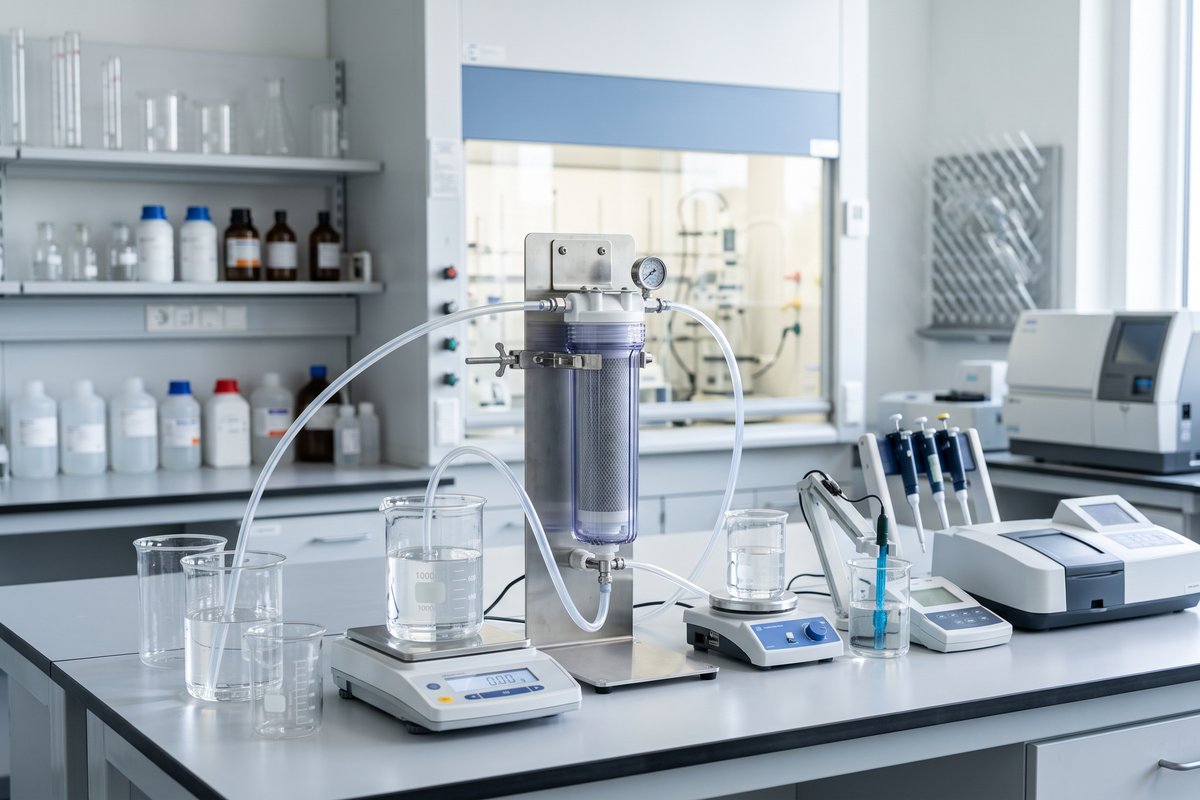
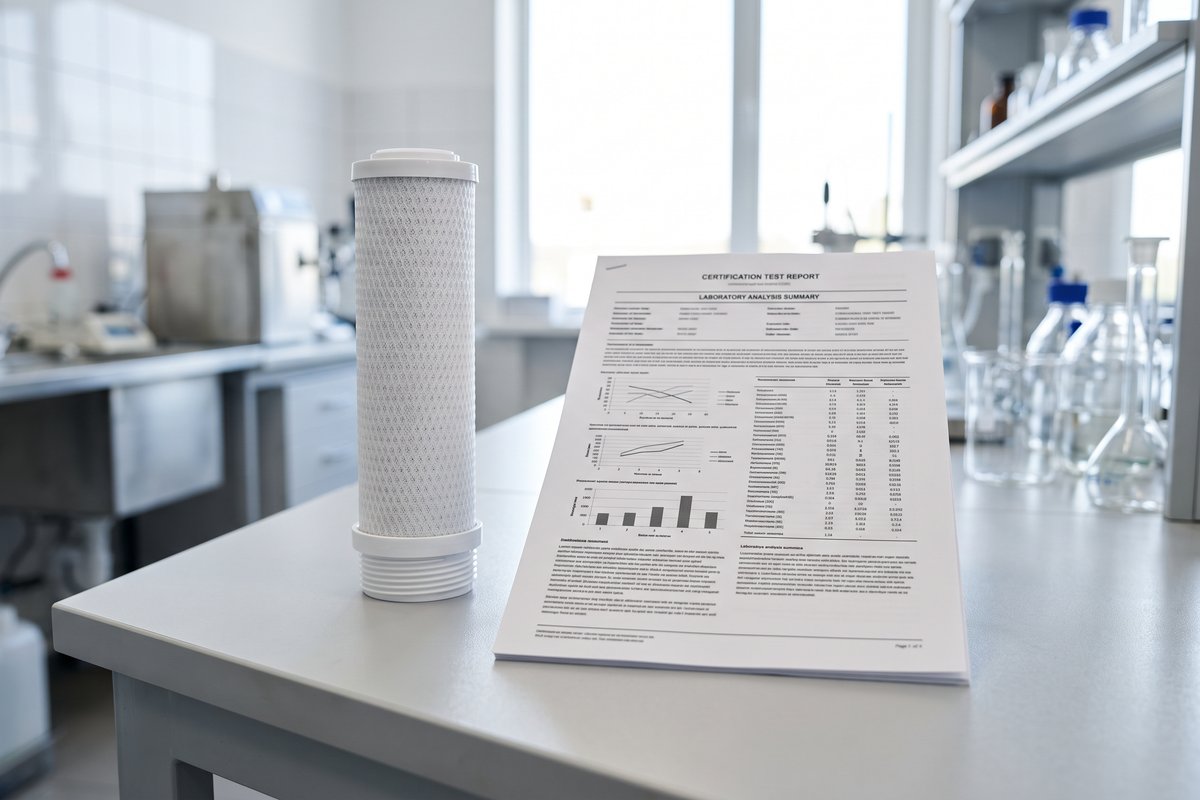
The test introduces a challenge load of plastic particles sized 0.5 to 1 micron into the influent water and measures the effluent particle count. To pass, the filter must reduce that count by at least 85% across the specified particle size range. The certification also requires material safety testing in line with NSF/ANSI 372 for lead content, structural integrity testing, and the reduction claim itself, evaluated by an ANSI-accredited body such as NSF International, WQA, or IAPMO.
Two practical points matter for sourcing decisions. First, the claim is size-specific. A filter certified to 0.5-1 micron reduction is not automatically proven against nanoplastics below 0.1 micron, which is the range RO membranes address. Second, certification is product-specific. A brand cannot certify one model and quietly apply the claim to a different SKU with different media, even from the same factory. Both of these are exactly the corners where claims get cut in a cost-down cycle.
RO, Carbon Block, and Ceramic: Different Technologies, Different Proof
The filtration technology determines both the real-world microplastics performance and the certification path available to it. Importers should match the technology to the claim they intend to make, rather than starting from the claim and hoping the media supports it.
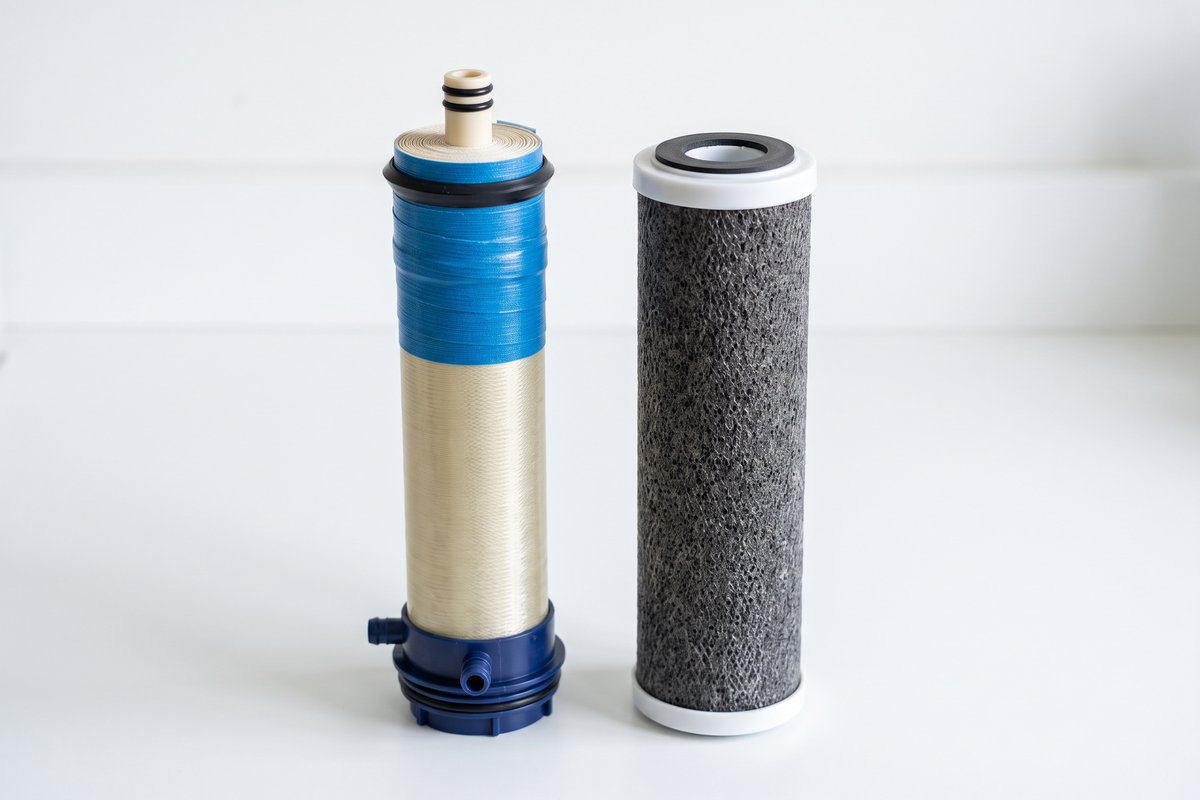
Reverse osmosis is the strongest position. An RO membrane’s pores measure around 0.0001 micron, roughly 10,000 times smaller than a human hair, so microplastics and most nanoplastics are removed as a matter of physics, not marketing. Well-maintained RO systems remove over 99% of microplastics in practice. The challenge is proving it: because there is no universal RO-specific microplastics standard, leading manufacturers have worked with test bodies like Intertek to build custom protocols, in some cases verifying reduction of nano-sized particles down to 30 nanometers.
Carbon block is the most common and the most often overstated. A dense carbon block with an effective pore size around 0.5 to 2 microns will physically sieve many microplastics, but standard carbon filters certified only for chlorine and lead are not microplastics-certified. The claim only becomes defensible with a dedicated NSF/ANSI 401 listing and an absolute, not nominal, micron rating.
Ceramic filters strain particles through a porous shell, typically 0.2 to 0.9 micron, which catches most microplastics but does nothing for dissolved chemicals without a carbon stage. The table below sets out the realistic position of each technology.
| Technology | Pore Size | Microplastics Performance | Certification Path |
|---|---|---|---|
| Reverse osmosis | ~0.0001 micron | 99%+ incl. nanoplastics | NSF/ANSI 58 + custom particle protocol |
| Carbon block | 0.5-2 micron | Most particles >2 micron | NSF/ANSI 401 with absolute rating |
| Ceramic | 0.2-0.9 micron | Most microplastics | NSF/ANSI 401 or equivalent |
How a Buyer Should Verify a Supplier’s Microplastics Claim
Microplastics is the one category where “trust but verify” is not optional, because the marketing has run far ahead of the testing. A disciplined sourcing process takes the claim apart in three steps.
First, demand the certification number and check it. NSF International, WQA, and IAPMO all publish searchable databases. A product that “meets NSF 401” but has no verifiable certification number in a database has not been independently certified, whatever the spec sheet says. This single check filters out most overstated claims in minutes.
Second, confirm the claim scope. Does the listing cover the exact model and media you are importing, at the same micron rating and flow rate? A certification earned on one configuration does not transfer to a cost-reduced variant with different media density. This is where factory substitutions quietly erase a certification’s value.
Third, ask for the particle size range and removal percentage in writing, and compare it against the 0.5-1 micron, 85% benchmark. If the supplier cannot state both numbers, the claim is not test-backed, period.
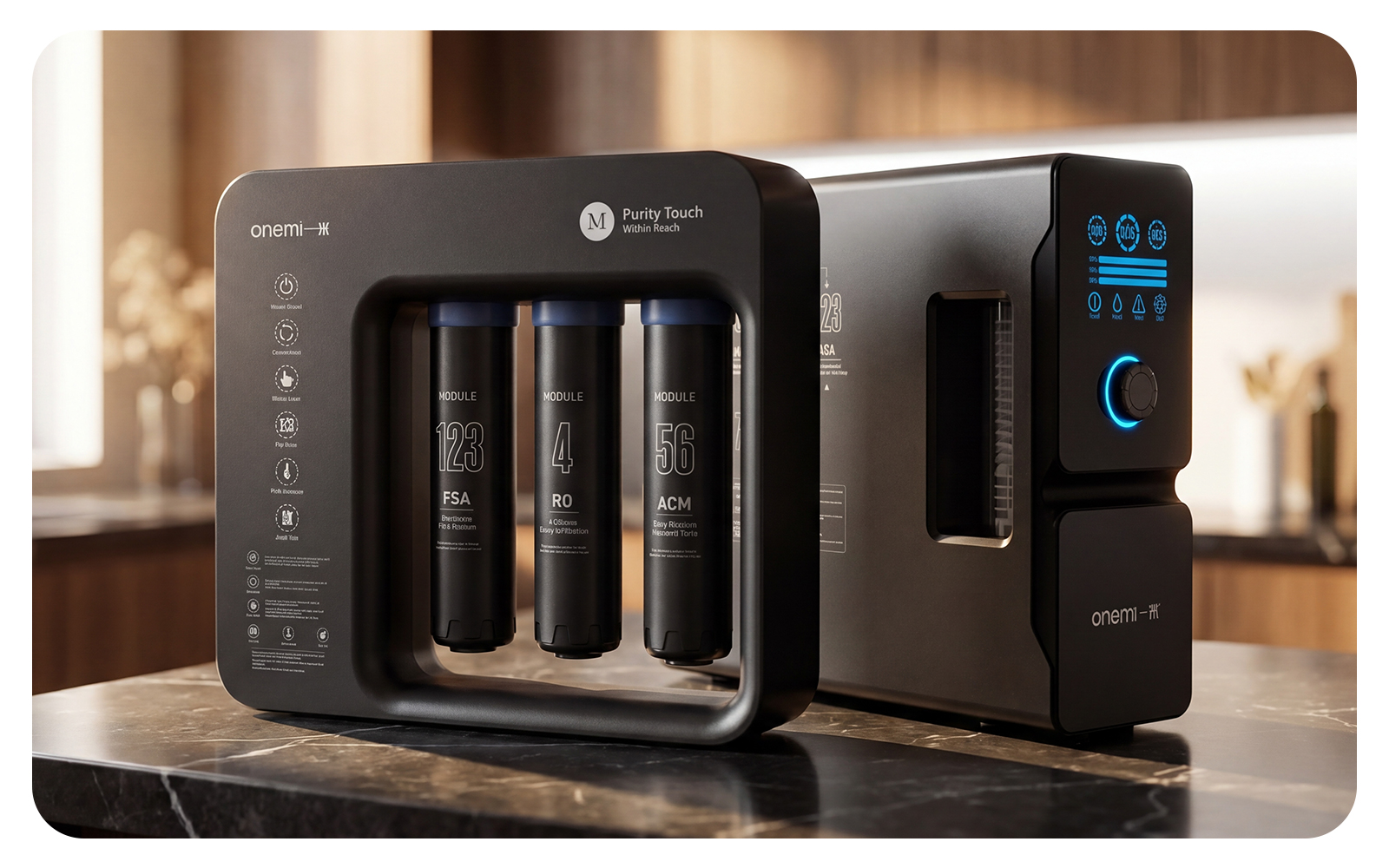
For brands sourcing from a manufacturer, the right question is not “does your factory remove microplastics” but “can you take my specific model through NSF/ANSI 401 certification and provide the test report under my brand.” ONEMI, a Guangdong-based water purification equipment manufacturer, works with importers and private-label brands on exactly this path — for a fuller view of the OEM process itself, see how to build a private-label filter brand — supplying RO systems and carbon block cartridges and supporting the certification process from material selection to the final test run. Certification details and manufacturing capability are outlined on the certifications page and the OEM factory page.
The Gate Is Rising, and That Favors Prepared Brands
Microplastics regulation is immature but moving in one direction only. As testing protocols standardize and retailers start requiring third-party verification for microplastics claims, the brands that invested in real certification will find themselves with a durable competitive moat, and the brands that bought a box label will find themselves rewriting product copy under legal review.
The commercial logic is straightforward. A filter with a verifiable NSF/ANSI 401 microplastics listing commands a defensible premium and survives the scrutiny that is coming. A filter with an uncertified claim is a liability wearing a feature’s costume. The difference between the two is not the factory’s opinion. It is a test report with a number on it.
For importers deciding where to put their next certification budget, microplastics is no longer an optional differentiator. It is the gate.