
 한국어

- Office water dispensers have shifted from a hardware sale to a recurring service: the global bottleless water cooler market is growing around 8% a year, well ahead of bottled coolers
- In a rental model, machine durability and filter cost decide the P&L — a dispenser that breaks or needs a cartridge every few months erases the operator’s margin
- For OEM and private-label suppliers, the winning spec is low total cost of ownership: long-life filters, hot/cold energy efficiency, and IoT remote diagnostics
The office water cooler used to be a box you bought, or a bottle you rented. Increasingly it is neither. The fastest-growing part of the commercial hydration market is the plumbed-in, bottleless dispenser delivered under a water-as-a-service contract: a monthly fee that covers the machine, installation, filters, and maintenance. The shift matters for anyone sourcing dispensers, because it changes what a buyer actually pays for — uptime and predictable operating cost, not the machine itself.
That is a different kind of business, and a different kind of product requirement. This article breaks down the market, the unit economics, and what OEM suppliers need to build to win a rental-model buyer.
The Unit Economics That Turned Dispensers Into a Service
A water-as-a-service contract looks simple from the outside: the provider owns the machine, the client pays a flat monthly fee per dispenser, and the provider eats the cost of filters, service calls, and eventually replacement. What makes it work is that the provider’s margin is the gap between that monthly fee and the machine’s true operating cost — and most of that operating cost is not the hardware, it is the consumables and the truck rolls.
Filter replacements are the recurring cost that dominates. In high-usage commercial settings, cartridges typically need changing every 8 to 12 months, and in institutional sites like schools and hospitals, maintenance scheduling and labor can account for more than 15% of the operational budget. Every service call a provider can avoid — by using longer-life filters, by diagnosing problems remotely, by shipping a machine that does not leak — drops straight to the bottom line.
That is why the rental model has quietly rewritten the hardware spec. A provider does not want the cheapest dispenser; they want the one with the lowest total cost of ownership over a three- to five-year service life. A dispenser that saves $30 at purchase but needs a $40 filter twice a year and breaks down in year two is a losing asset.
Market Size and Where the Growth Is
The numbers confirm the direction. Dataintelo estimates the global bottleless water cooler market at roughly $3.8 billion in 2025, growing to about $6.9 billion by 2034 at an 8.2% compound annual rate — well ahead of the broader water dispenser category. The wider point-of-use water cooler market, which includes plumbed-in systems, sits near $8.3 billion in 2025 on a path to $13.7 billion by 2034.
Two details inside those figures are worth noting. First, the bottleless segment is the growth engine precisely because it removes the logistics of bottled delivery — the lifting, storing, and reordering that bottled coolers require. Grand View Research tracks bottleless dispensers as the fastest-growing segment, with an 8.7% CAGR through 2033. Second, corporate buyers are the pull: market research puts the share of corporate offices preferring point-of-use systems over bottled at around 68%, driven by sustainability targets and the cost of bottled delivery.
| Segment | 2025 size | 2034 forecast | CAGR |
|---|---|---|---|
| Bottleless water coolers | $3.8B | $6.9B | 8.2% |
| Point-of-use water coolers (total) | $8.3B | $13.7B | 6.4% |
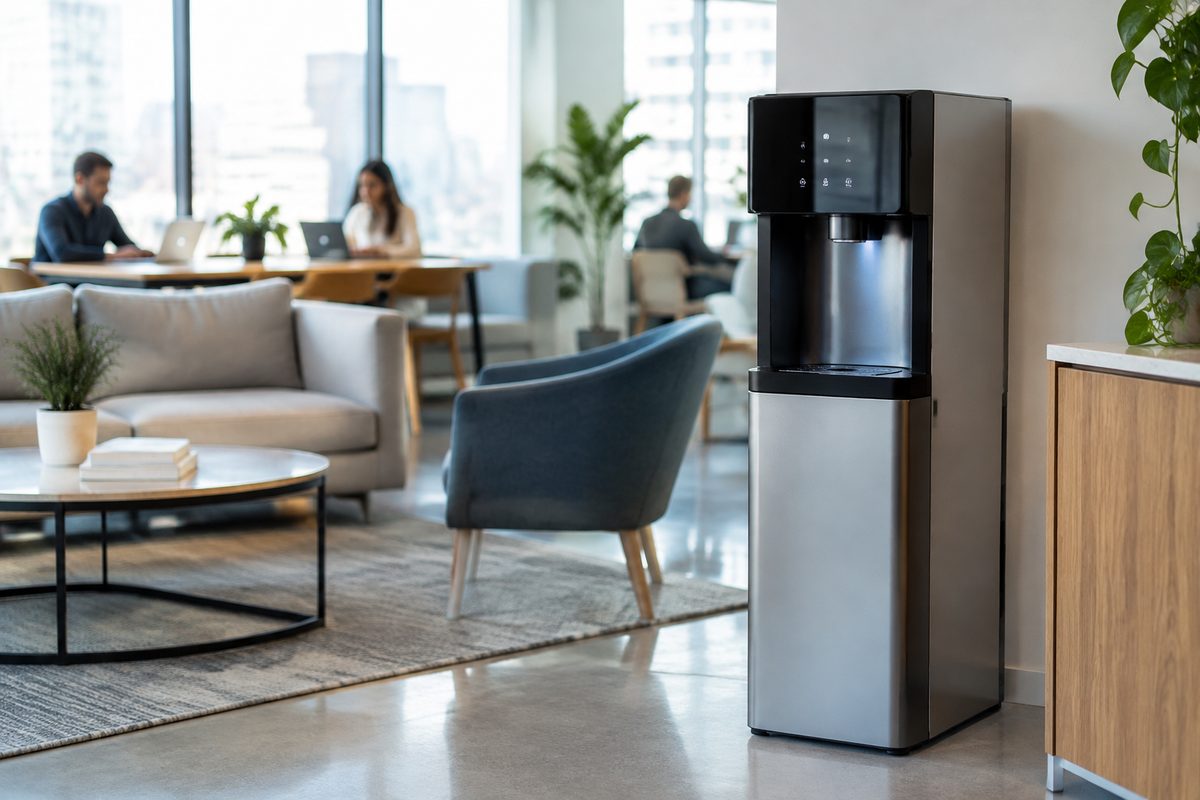
Why Hardware Quality Decides the Rental P&L
Under a rental contract, the supplier’s margin is hostage to the machine’s reliability. This reframes three hardware decisions.
First, filtration and filter life. The longer the filter interval, the fewer service visits and the lower the consumable cost. Multi-stage filtration — sediment, carbon, and where the water demands it, RO or UV — should be sized to the local water quality and usage, not shipped as a one-size-fits-all default. A filter that fails early in a hard-water region does not just cost money; it generates churn.
Second, energy. Plumbed-in dispensers run compressors and heating elements around the clock. Energy-efficient cooling and on-demand heating change the operating cost materially over a multi-year contract, and energy standards are tightening in Europe and North America. A provider pricing a five-year contract needs to know the standby draw, not just the peak rating.
Third, connectivity. IoT is moving from a gimmick to a margin tool: roughly 22% of new point-of-use units ship with WiFi or IoT connectivity, used for usage tracking, remote filter diagnostics, and predictive maintenance. For a provider managing hundreds of machines across a city, remote diagnostics is the difference between one truck roll and three. That is a direct line to the provider’s bottom line — and to the spec sheet they hand their OEM.
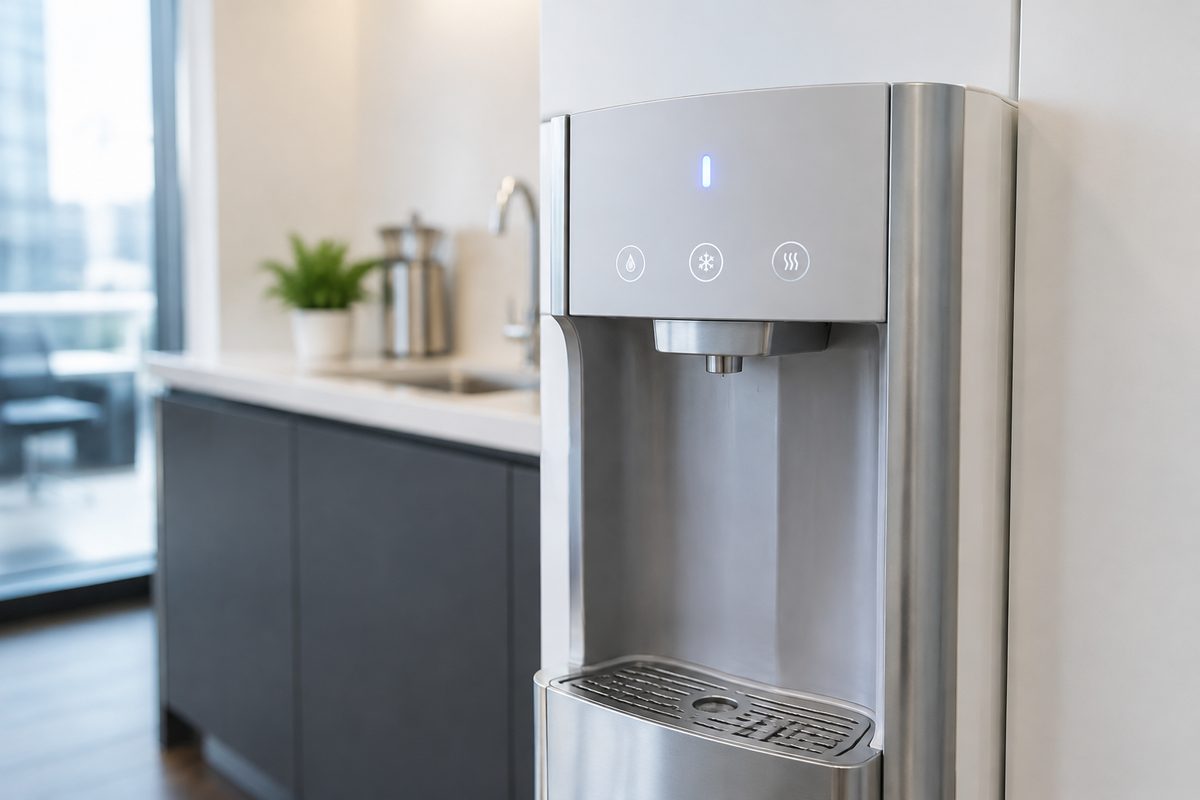
What OEM and Private-Label Suppliers Must Offer
If you supply dispensers to service operators, distributors, or private-label brands, the rental model dictates what you build. The buyer’s real question is not “what does the unit cost” but “what does it cost to run for five years.” Your answer needs four parts.
One, a documented filter life under stated water conditions, with consumables priced so the operator’s monthly margin holds. Two, energy figures — standby and in-use — that a provider can put into a contract. Three, a reliability track record and a spare-parts and service network, because a rental operator is on the hook for downtime. Four, certification: CE, UL, FCC, and RoHS on the machine, and NSF on the cartridges where the market requires it, so the provider can close enterprise contracts without compliance friction.
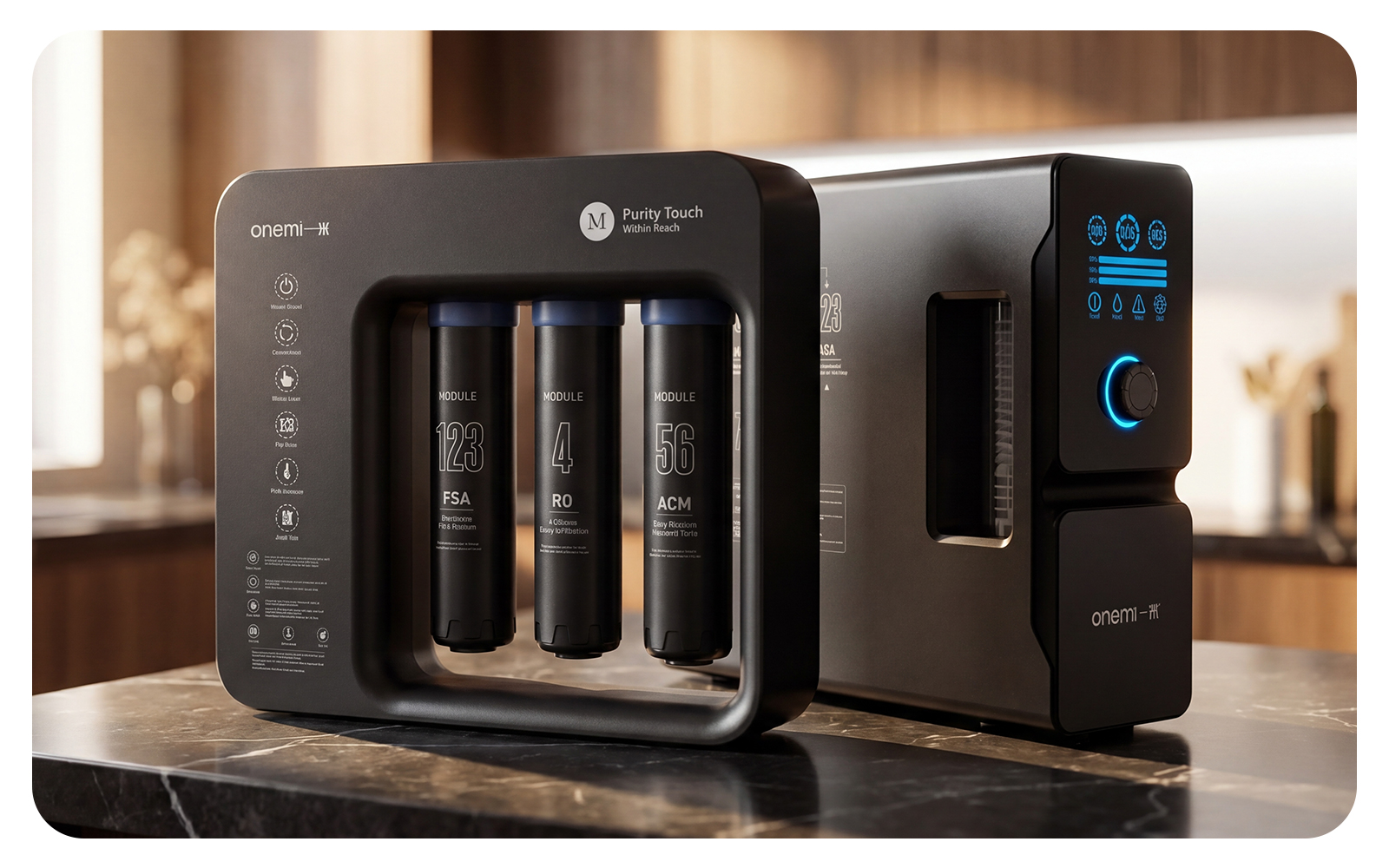
For a manufacturer, the most valuable thing you can hand a rental operator is a predictable spec — the one ONEMI, a Guangdong-based water purification equipment manufacturer, builds toward. Whole-machine CE, UL, FCC, and RoHS certification, NSF on filter cartridges, and OEM/ODM capability across dispensers, RO systems, and cartridges give a service operator a single accountable supplier rather than a patchwork. Details are on the certifications page, manufacturing capability on the OEM/ODM factory page, and the instant hot/cold dispenser line on the product page. Sourcing questions are answered in the OEM FAQ.
The office water dispenser is not really a product anymore; it is a service delivery vehicle. The suppliers who build for that reality — for low operating cost, remote diagnosability, and five-year reliability — are the ones rental operators will standardize on. Everyone else is just selling a box into a market that has moved on.