


 한국어
한국어

A commercial property manager in Boston recently spent nearly twelve thousand dollars installing a state-of-the-art Point-of-Entry (POE) filtration system, only to have tenants complain about rusty, metallic-tasting drinking water just three weeks later. It turns out the building’s century-old copper risers were leaching heavy metals into the water after it passed through the pristine basement filtration unit. This expensive mistake highlights a critical truth in commercial water management: choosing between whole-house and point-of-use systems before mapping your actual pipes is a recipe for wasted capital.
Executive Summary
- Skipping a localized piping audit before choosing a water treatment architecture is the primary cause of post-installation water quality failures in commercial properties.
- Point-of-Entry (POE) systems are essential for protecting infrastructure like boilers and cooling towers, but they cannot guarantee drinking-water safety at the tap due to secondary building-side contamination.
- Point-of-Use (POU) systems offer precise, 0.0001-micron filtration at specific taps, making them highly cost-effective for drinking water but useless for protecting a building’s mechanical assets.
Most facility managers look at water treatment as a simple binary choice. You either clean everything coming into the building, or you clean it right at the tap. If you only look at the spec sheets, you will probably end up buying the wrong system because water quality degrades as it travels through your internal infrastructure.
The Real-World Performance Gap Between POE and POU
Let’s look at how these systems actually behave when you install them in a busy commercial environment. A Point-of-Entry system, often referred to as a whole-house or centralized system, sits right where the municipal water line enters your property. It is your first line of defense, designed to handle massive volumes of water—often thousands of gallons per hour. Its main job is to catch sediment, reduce chlorine, and soften water before it reaches your water heaters, cooling towers, and commercial laundry machines.
But here is the catch. Once that water leaves the basement, it has to travel through hundreds of feet of internal piping, risers, and horizontal runs. If your building was built before the late eighties, there is a very high chance those pipes contain lead solder, brass fittings that leach zinc, or simply decades of accumulated biofilm. By the time that “purified” POE water reaches a breakroom faucet on the sixth floor, it is no longer pure. This is where ONEMI commercial filtration solutions often come into play, bridging the gap between bulk treatment and absolute purity at the glass.
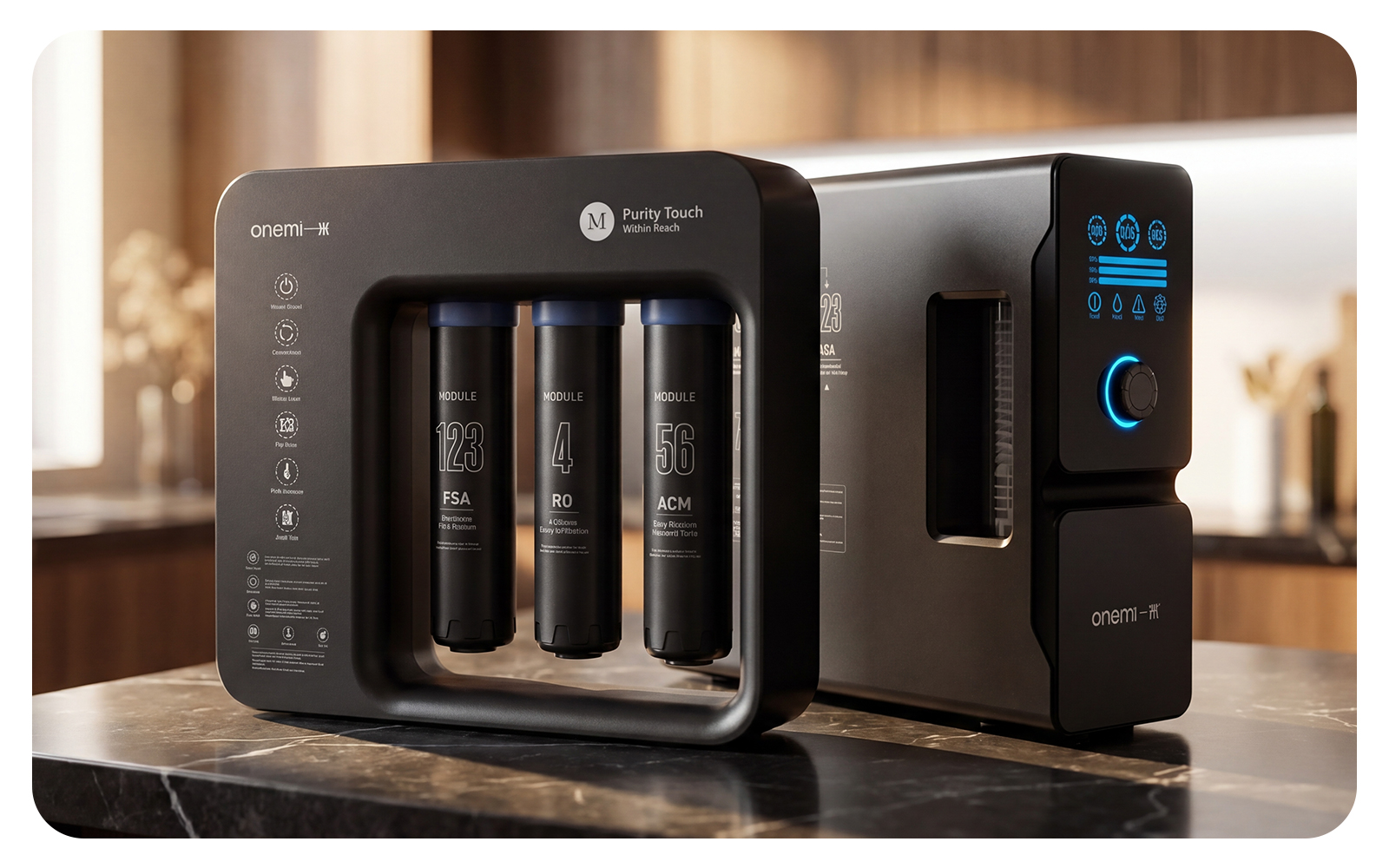
Point-of-Use (POU) systems, such as under-sink reverse osmosis units or countertop dispensers, do not care about your building’s internal plumbing. Because they sit right at the terminal point, they purify the water seconds before it is consumed. These systems can filter down to 0.0001 microns, effectively stripping out lead, microplastics, PFAS, and bacteria. But if you try to run your entire building’s mechanical systems on POU filtration, your boilers will scale up and fail within a year because POU does nothing to protect the miles of pipes feeding your infrastructure.
Are you willing to risk your multi-million dollar HVAC system just to get clean drinking water in the breakroom?
Comparing the Technical Specifications
To make an informed decision, you need to understand how these systems compare across key operational metrics. The table below breaks down the technical and spatial requirements for both setups in a typical mid-sized commercial building of about fifty thousand square feet.
| Operational Metric | Point-of-Entry (POE) Systems | Point-of-Use (POU) Systems |
|---|---|---|
| Filtration Precision | Typically 5 to 20 microns (sediment & carbon) | Down to 0.0001 microns (Reverse Osmosis) |
| Flow Rate Capacity | 50 to 200+ gallons per minute | 0.5 to 2 gallons per minute per tap |
| Space Requirements | Requires 2 to 4 square meters in utility room | Fits under standard sinks or on countertops |
| Primary Target | Hardness, chlorine, scale, heavy sediment | Heavy metals, pathogens, PFAS, VOCs |
| Maintenance Cycle | Semi-annual or annual professional service | Quarterly to bi-annual cartridge swaps |
We often see facilities managers get blinded by the high flow rates of POE systems. They assume that because a system can process two hundred gallons a minute, it must be better than a small under-sink unit. That is like buying a dump truck to deliver a single letter; it is the wrong tool for the job if your goal is providing high-purity drinking water to your staff.
Local Regulations and the True Cost of Compliance
Depending on where your facility is located, local water regulations might make this decision for you. In municipal areas across the United States, the EPA’s Lead and Copper Rule Improvements (LCRI) are forcing commercial property owners to take a hard look at their terminal water quality. If you run a healthcare facility or a school, simply showing that the water entering your building is clean is no longer legally sufficient. You must prove the water coming out of the actual drinking fountain meets safety standards.
This is where POE systems often fail the compliance test. If your building has dead legs—sections of piping that are rarely used—water sits stagnant there for days, breeding Legionella and leaching metals. No basement filtration system can prevent this. To guarantee compliance at the glass, you almost always need POU filtration at the specific outlets designated for consumption.
The financial math of compliance is also counter-intuitive. Installing a commercial-grade POE system to treat an entire office building might cost twenty thousand dollars upfront, with annual maintenance running around fifteen hundred dollars. That sounds reasonable until you realize you are paying to treat the water used to flush toilets and irrigate lawns. Why spend money to purify water to 0.0001 microns just to wash it down the sewer drain?
Conversely, installing POU systems at twenty key drinking stations might cost ten thousand dollars upfront, but the filter replacements are highly targeted. You only pay to purify the water people actually drink. ONEMI systems are designed to balance these operational costs, allowing facility managers to deploy high-efficiency POU units precisely where they are needed without over-engineering the central supply.
Building Your Hybrid Water Strategy
The smartest facility managers do not choose between POE and POU. They use a hybrid approach that leverages the strengths of both technologies while minimizing their weaknesses.
Start by analyzing your water bill to see how much water actually needs to be purified to drinking standards. In a typical office building, less than five percent of total water consumption is used for drinking, cooking, or coffee making. The remaining ninety-five percent goes to HVAC cooling towers, landscaping, and sanitation.
For the ninety-five percent, use a basic POE system. You do not need expensive reverse osmosis here. A simple sediment filter and a water softener will protect your boilers, extend the life of your appliances, and prevent scale buildup in your pipes. This keeps your capital expenditure low and protects your physical plant.
For the five percent of water that actually enters a human body, deploy high-precision POU systems. Place these at breakroom sinks, water coolers, and ice machines. This guarantees that even if your building’s internal pipes are degrading, your staff and visitors are drinking perfectly safe, highly filtered water. By confining your high-maintenance, ultra-fine filtration to the point of consumption, you drastically cut your filter replacement costs and simplify your compliance reporting.
Before you sign a contract for any water treatment system, hire an independent lab to test your water at the water meter and at the furthest tap from that meter. The difference between those two test results will tell you exactly how much your internal pipes are contaminating your water, and it will point you directly to the right filtration strategy. ONEMI systems are built to fit seamlessly into these hybrid configurations, ensuring that your facility’s water strategy is both economically sensible and physically effective.