




 한국어
한국어

- Southeast Asia’s water dispenser market is projected to grow from $308.3 million in 2025 to $707.3 million by 2035, an 8.7% CAGR
- Bottled dispensers still hold 70% of the market, but bottleless point-of-use systems are growing faster where plumbing and service infrastructure allow
- Thailand is the largest market at a 26% share, while Indonesia is the fastest-growing country
Southeast Asia’s water dispenser market is not one market but several. Singapore treats drinking water as a regulated utility; parts of the Philippines still lean heavily on refilling stations. That divergence shapes what buyers actually purchase, and it is the reason dispenser demand keeps climbing even where tap water is nominally safe.
Global Market Insights pegged the Southeast Asia water dispenser market at $308.3 million in 2025, rising to a projected $707.3 million by 2035 at an 8.7% compound annual growth rate. The growth is not uniform across countries or segments, and for importers and OEM buyers the difference between the two tracks matters.
Bottled Units Still Dominate, but Bottleless Is Gaining
The bottled segment accounted for roughly 70% of the market in 2025. That dominance is practical rather than sentimental: a bottled dispenser needs no plumbing, no installation, and no filter service contract. In markets where municipal water quality is uneven or consumer trust is low, the visible, replaceable bottle is itself the selling point.
Bottleless point-of-use systems are the faster-growing side. They eliminate recurring bottle logistics — delivery, storage, and empty-bottle handling — and align with the ASEAN Declaration on Plastic Circularity endorsed in 2024. But adoption depends on three conditions: plumbing access, filter servicing, and user confidence in the incoming supply. Where those hold, the economics shift toward direct-connect equipment.
Country by Country: Thailand Leads, Indonesia Accelerates
Thailand held a 26% share of the regional market in 2025, generating about $78.9 million, supported by mature retail and service infrastructure and high consumer awareness. Indonesia is the fastest-growing market, driven by urbanization and the expansion of the formal food service and office sectors.
The Philippines illustrates the trust gap that keeps bottled formats relevant. In 2024, 53.1% of Filipino families had access to safely managed drinking water, and 57.9% obtained water from refilling stations, according to the Philippine Statistics Authority. Even with improving access, the refilling-station habit keeps bottled and station-based dispensers commercially relevant.
HoReCa and Offices Are the Demand Centers
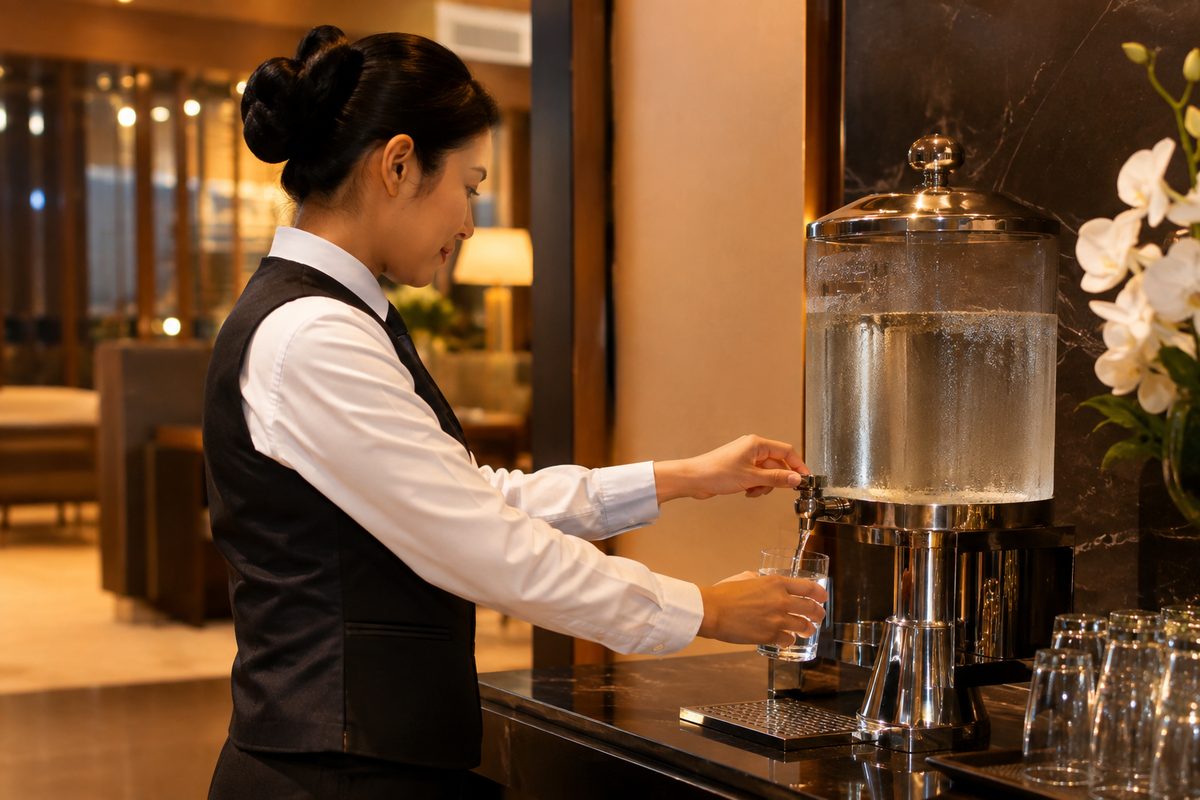
Hotels, restaurants, cafes, and offices are where commercial dispenser demand concentrates. These venues need reliable hot and cold water at high frequency, with minimal staff involvement. For HoReCa operators, the calculation is about uptime and service response, not just the upfront price of a unit.
Floor-standing dispensers held a 64% share in 2025, generating $196.6 million, precisely because their capacity and durability fit high-usage commercial settings. The commercial segment rewards equipment that can run continuously and be serviced quickly.
What This Means for OEM and Import Buyers
For importers and brands sourcing in the region, the two-track market points to a dual product strategy. Bottled-format dispensers remain the entry product for lower-trust markets and price-sensitive channels. Bottleless point-of-use systems are the growth play for urban offices, better-served buildings, and hospitality operators chasing plastic-reduction commitments.
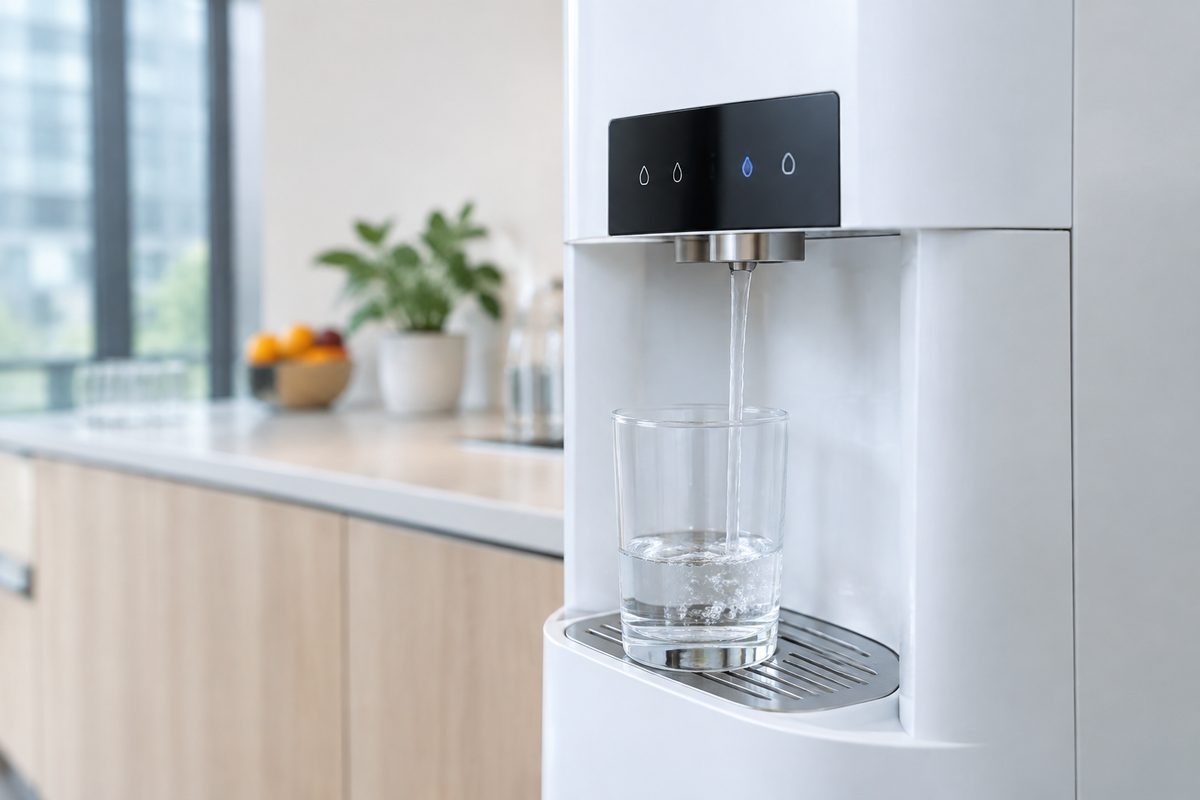
The engineering requirements differ sharply. Bottleless systems demand reliable filtration, quick-change cartridge design, and serviceability, because the recurring revenue and the maintenance burden both sit with whoever sold the machine. Sourcing decisions in this category hinge on manufacturing capability and after-sales support more than on unit price alone.
ONEMI, a Guangdong-based water purification equipment manufacturer, supplies both formats through its OEM and ODM programs. From countertop instant dispensers like the T1 countertop instant water dispenser to commercial direct-connect systems, the product line covers the residential and commercial ends of the same demand curve. Buyers evaluating a water purifier OEM partner should ask about filter interchangeability, lead time, and whether the factory can ship both bottled and bottleless configurations from one source. Certification documents are listed on the certifications page.
The regional numbers point one way: dispenser demand in Southeast Asia will keep growing, but the mix is shifting. Bottled formats protect the installed base; bottleless systems capture the growth. Sourcing both from a single manufacturer is how importers hedge that transition without carrying two supply chains.