


 한국어
한국어

- Global rainwater harvesting market projected to reach $150 billion by 2026, driven by water scarcity regulation across 54 countries
- Equipment costs dropped 32% since 2020; smart monitoring systems now account for 31% of new installations
- For importers and distributors, the margin opportunity lies in integrated “hardware + monitoring + service” packages, not standalone tanks
Rainwater harvesting isn’t a niche anymore. In 2026, it’s a $150 billion global market with regulatory tailwinds blowing from Brussels to California. For water treatment importers and distributors, the question has shifted from “should we carry rainwater products” to “which segment of the value chain do we own.”
The numbers tell a clear story, but the real opportunity is subtler than the headlines suggest.
The Regulatory Push That’s Reshaping Demand
As of Q1 2026, 54 countries have integrated rainwater harvesting into national water security strategies or building codes. This isn’t voluntary green branding anymore — it’s compliance-driven procurement.
The EU’s updated Energy Performance of Buildings Directive now requires rainwater utilization systems in all new public buildings constructed after 2025. In the US, the federal government offers up to $1,500 in tax credits for residential rainwater harvesting installations, and several states — Texas, California, Arizona — have gone further with mandatory commercial site requirements. Australia’s WaterMark certification scheme (AS/NZS 4348) governs every component that touches drinking water, making certified imports a hard gate, not a soft preference.
What this means for B2B buyers: the product specifications that win bids in 2026 are not the same ones that won in 2020. A system that meets EU standards needs CE marking plus material compliance under REACH. A system headed for the US needs NSF/ANSI 42 or 53 certification on the filtration stage. A system for Australia needs WaterMark. The regulatory landscape has fragmented, and generic “international standard” claims no longer open doors.
Where the Margin Actually Lives
Five years ago, a rainwater harvesting import business was mostly about moving tanks and basic filters. That model is thinning out. The equipment cost for integrated rainwater harvesting systems has dropped 32% since 2020, according to Global Water Intelligence — which is good for end users but squeezes the margin on hardware-only plays.
The value has shifted into three layers:
Layer one: smart monitoring. Systems with IoT-based water quality sensors, automatic first-flush diversion, and remote control now account for 31% of new installations. Distributors who sell a tank alone leave money on the table. The monitoring module — a few hundred dollars in hardware — unlocks recurring SaaS revenue and differentiates the offering from commodity imports.
Layer two: multi-stage filtration integration. The days of a simple mesh screen at the downspout are over. Commercial systems in 2026 routinely include sediment pre-filters, activated carbon stages, UV disinfection, and sometimes reverse osmosis polishing for potable applications. A distributor who can spec the right combination for a specific regional rainfall profile — high sediment in Southeast Asia, low pH in the Pacific Northwest — wins on expertise, not price.
Layer three: service contracts. In 2025, service revenue crossed 20% of total industry revenue for the first time. Filter replacement schedules, annual tank inspections, sensor calibration — these are predictable recurring charges that compound over the system’s 20-plus-year lifespan. The hardware is the gateway. The service is the business.
The Technology That’s Actually Shipping
Patent filings in rainwater harvesting reached 4,700 globally in 2025, with China accounting for 38% and the US 26%. But patent counts don’t tell you which technologies are in production and shipping. Here’s what’s real:
| Technology | Maturity | B2B Relevance |
|---|---|---|
| PP modular storage (HDPE) | Mature, commodity | Low margin; source on capacity and logistics |
| Automatic first-flush diversion | Mature, widely available | Table stakes; differentiate on reliability testing data |
| Multi-stage filtration (sediment + carbon + UV) | Mature, cert-dependent | High value; NSF/CE certification is the moat |
| IoT water quality monitoring + remote control | Growing, 31% penetration | Highest margin; recurring SaaS potential |
| Graphene composite membranes | Pilot stage | Monitor for 2028+; not yet commercially viable |
| Capacitive deionization (CDI) | Early commercial | Niche industrial; patent growth 19% YoY |
The practical takeaway: don’t bet your inventory on graphene membranes yet, but do make sure your filtration stage carries current NSF/ANSI or CE certification documents that your customers can show to building inspectors. That piece of paper is worth more than the filter housing itself.
The Trade Flow: Where Product Moves, Where Margins Build
Global trade in rainwater harvesting equipment hit $21.6 billion in 2025. Asia dominates exports at 44% of the total, with China as the largest single source. The Middle East and Africa are the fastest-growing import regions, driven by desalination-adjacent rainwater projects and international development funding.
But aggregate trade data hides the profitable niches. Southeast Asian countries — Vietnam, Thailand, Indonesia — are absorbing mid-range assembly orders that used to go exclusively to Chinese factories. The dynamics are shifting in ways that matter for sourcing strategy.
| Region | Import Growth (2025) | Key Demand Driver | Certification Required |
|---|---|---|---|
| Middle East & Africa | 11.2% | Desalination + rainwater dual systems | CE, ISO 9001 |
| North America | 8.5% | Federal tax credits + state mandates | NSF/ANSI 42, 53, 61 |
| EU/UK | 7.3% | Building directive compliance | CE, REACH, WRAS (UK) |
| Southeast Asia | 10.8% | Urbanization + groundwater depletion | ISO, local standards varying |
| Australia | 6.2% | Drought cycles + WaterMark mandate | WaterMark, AS/NZS 4348 |
What this map means for an importer: pick your regional certification lane first, then source. Trying to carry one SKU for “global markets” is a path to holding inventory that’s legal nowhere specific. A system certified for Australia (WaterMark) won’t automatically satisfy a US inspector (NSF). The compliance cost is front-loaded, but it also creates a barrier that keeps uncertified competitors out.
How ONEMI Approaches the Rainwater Filtration Supply Chain
ONEMI, a Guangdong-based water purification equipment manufacturer, has built its rainwater filtration component line around two principles: modular compatibility with existing tank systems, and upfront certification transparency.
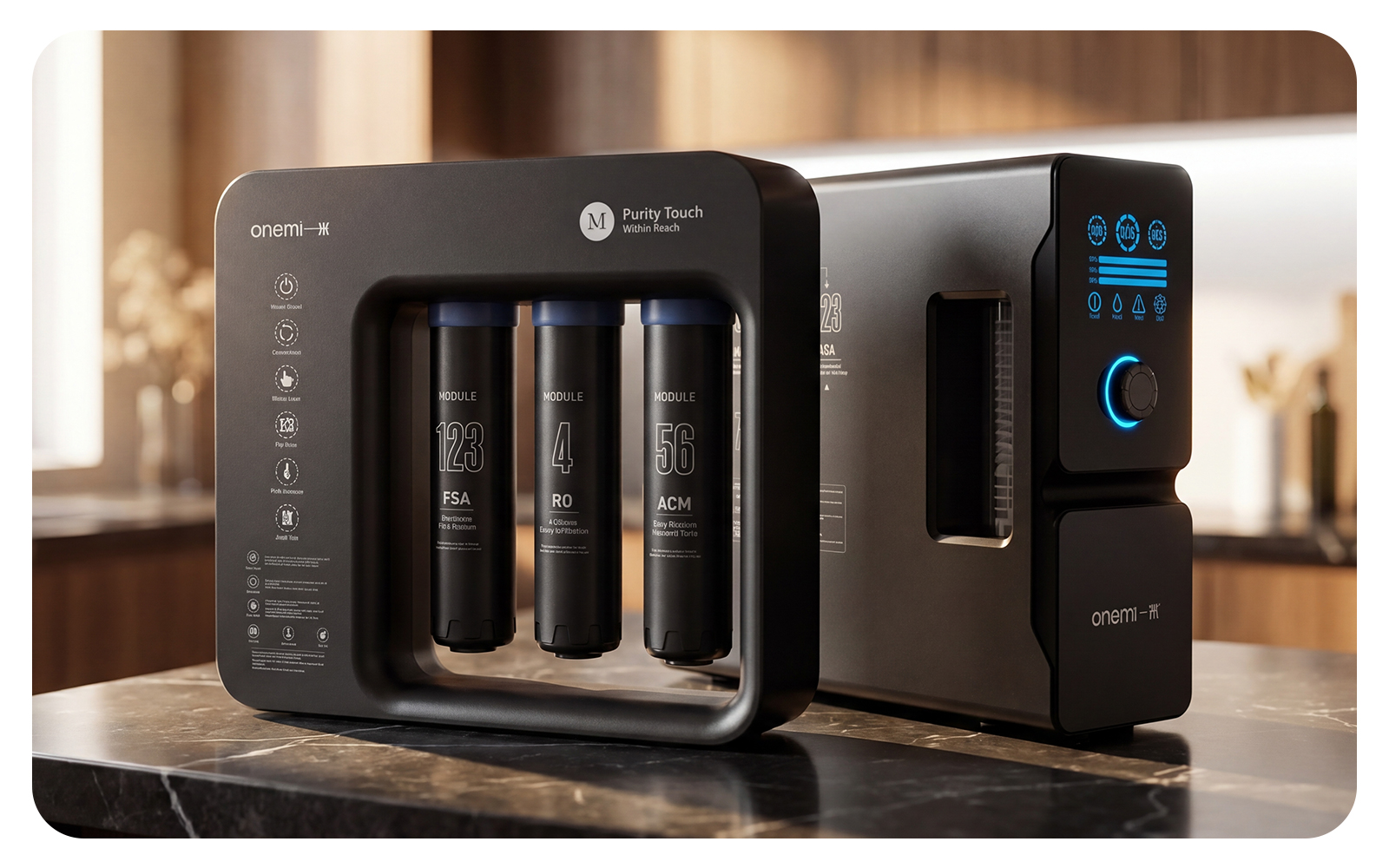
The filtration stages — sediment pre-filter, activated carbon block, UV sterilizer — are designed to drop into standard HDPE modular tank setups without proprietary connectors. This matters for distributors: you’re not locked into one tank supplier to sell the filtration upgrade. The certification package includes CE (whole unit), NSF/ANSI 42 (filter cartridges), and RoHS compliance documentation — see full certification details, provided in the shipment folder rather than as a separate upcharge.
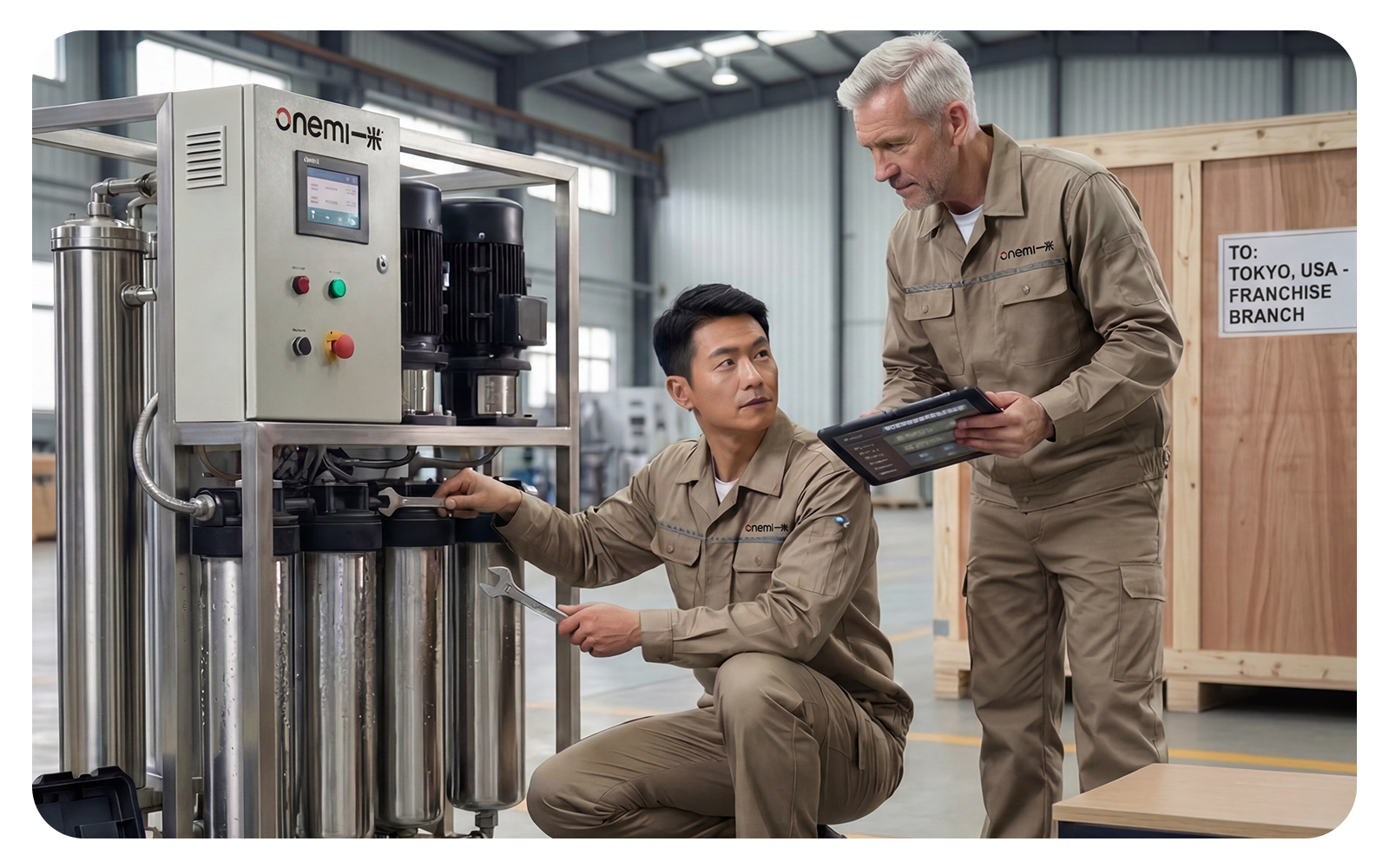
For importers sourcing rainwater systems, the filter stage is where most compliance failures happen — not the tank. A cracked tank leaks water. A non-certified filter introduces liability. ONEMI’s 12,000 sqm facility in Dongguan runs batch testing on every filtration unit before crating, with test reports included in the export documentation.
What to Ask Your Rainwater Equipment Supplier in 2026
Five questions that separate serious manufacturers from resellers:
1. Show me the test report for the filter media, not just the housing. A CE mark on the plastic shell means nothing if the activated carbon inside hasn’t been tested for chlorine reduction capacity under NSF/ANSI 42 protocols.
2. What’s your first-flush diversion tested to? The automatic diversion valve is the single highest-failure component in residential systems. Ask for cycle test data — at least 10,000 cycles without sticking or leaking.
3. Do you provide IoT API documentation? If the monitoring module uses a closed protocol, the distributor can’t integrate it into a building management system. Open API or at least Modbus compatibility is table stakes for commercial projects.
4. How do you handle regional certification variants? A manufacturer who says “our product meets international standards” without naming specific certs is telling you they haven’t actually been tested. The right answer sounds like: “We have NSF/ANSI 42 for the carbon stage, CE for the full assembly, and we’re finishing WaterMark for the Australian variant in Q3 2026.”
5. What’s the MOQ on the monitoring module separately? If they only sell complete systems and won’t let you order replacement sensors or controller boards separately, walk away. Rainwater systems have a 20-year lifespan. The filter media needs replacement every 6-12 months. The sensors need calibration. If you can’t stock spare parts, you can’t build a service business — and service is where the margin lives.
The Bottom Line
The global rainwater harvesting market isn’t just growing — it’s restructuring. Hardware margins are compressing as manufacturing scales up across Asia. The value is migrating to certification, smart monitoring, and long-term service contracts. For importers and distributors, the winning play in 2026 is to own the filtration and monitoring layer — the part of the system that requires recurring expertise and replacement parts — rather than competing on tank volume and price per cubic meter.
Regulatory tailwinds from 54 countries won’t reverse. Equipment costs won’t go back up. The window to establish a certified, service-backed rainwater product line is open now, and the compliance moats are getting deeper every year.