


 한국어
한국어

For water purification importers, distributors, and appliance brands, the real cost of a product is not the FOB price. It is the total cost of ownership, which heavily includes post-sale support, product returns, and installation friction. Under-sink Reverse Osmosis (RO) systems are historically notorious for high return rates due to installation complexity, water leak anxieties, and bulky configurations that do not fit local plumbing standards.
Executive Summary
- Under-sink RO installation complexity directly impacts B2B importer margins by driving up customer service calls and return rates.
- Field tests show tankless RO systems reduce installation times to an average of 22 minutes, compared to 45 to 55 minutes for traditional multi-stage tanked units.
- Standardizing plumbing connections, incorporating integrated waterways, and utilizing smart monitoring significantly lower the risk of post-installation water damage.
When a consumer opens an RO system box and sees a chaotic nest of PE tubing, brass fittings, and a heavy pressurized tank, cognitive overload sets in. This immediate frustration leads to customer service tickets or, worse, immediate product returns. In the North American and European markets, where professional plumbing labor costs range from $75 to $150 per hour, DIY-friendly installation is no longer a luxury feature. It is a critical financial defense mechanism for your brand.
The Real Cost of Installation Complexity in B2B Channels

Every additional connection point in a water filtration system increases the statistical probability of a leak. Traditional under-sink RO systems require a minimum of 12 to 14 external connection points. These include connections between individual filter housings, the storage tank, the automatic shut-off valve, the drain saddle, and the dedicated faucet. A single misaligned quick-connect fitting or an improperly cut PE tube can cause a slow drip that damages kitchen cabinetry, leading to expensive liability claims for the importer.
Customer support data from major appliance distributors indicates that 42% of all post-purchase inquiries occur within the first 48 hours of product delivery. Over three-quarters of these inquiries relate to installation confusion, missing adapters, or difficulty tapping into the cold water supply line. When customers cannot resolve these issues quickly, they repackage the unit and request a refund. For B2B importers, a returned unit is often a total loss due to return shipping costs, repackaging expenses, and the risk of component contamination.
Furthermore, local water regulations and plumbing standards vary significantly by region. In the United States, compliance with NSF/ANSI Standard 58 is critical, alongside the requirement for an air gap faucet in certain municipal jurisdictions to prevent backflow. In Germany and other parts of Western Europe, the DVGW regulations dictate strict backflow prevention measures, requiring installers to use specialized feed water adapters. Forcing a global product into a local market without adapting the installation kit is a recipe for high return rates. B2B buyers must procure systems designed with universal compatibility or regionalized hardware packages to avoid these costly bottlenecks.
Are your current product returns actually caused by poor filtration performance, or are they simply the result of a frustrating 15-step installation process that requires three different wrenches?
Comparing Tankless vs. Tanked RO Installation Workflows
The architectural difference between traditional tanked RO systems and modern tankless systems represents a massive shift in installation efficiency. To understand this impact, we must analyze the step-by-step physical labor required for both configurations.
| Installation Step | Traditional Tanked RO System | Modern Tankless RO System |
|---|---|---|
| Space Requirement | Requires 1.5 to 2.0 cubic feet of under-sink cabinet space to accommodate the tank and separate filter tower. | Requires less than 0.6 cubic feet. Slim, upright chassis fits easily alongside garbage disposals. |
| Tubing Connections | 4 to 5 separate color-coded PE tubes (inlet, tank, faucet, drain, permeate pump if applicable). | 3 direct connections (inlet, faucet, drain). No tank line required. |
| Mounting Complexity | Must mount the heavy filter bracket to the cabinet wall and secure the unstable tank. | Free-standing, compact unit sits directly on the cabinet floor without wall mounting. |
| Average Installation Time | 45 to 55 minutes for an experienced DIYer; up to 90 minutes for novices. | 18 to 25 minutes. True plug-and-play design with pre-assembled internal waterways. |
| Sanitization & Flushing | Requires filling and discarding 2 full tanks of water (takes 2 to 4 hours of waiting time). | Direct real-time flush of the membrane. Ready to use after a continuous 15-minute flush. |
Traditional systems require the installer to mount a heavy manifold, position a bulky 3.2-gallon pressurized storage tank, install an automatic shut-off valve, and run multiple color-coded tubes between these components. This creates a cluttered under-sink environment where objects stored in the cabinet can easily bump into the tubing, loosening quick-connect fittings over time and causing leaks.
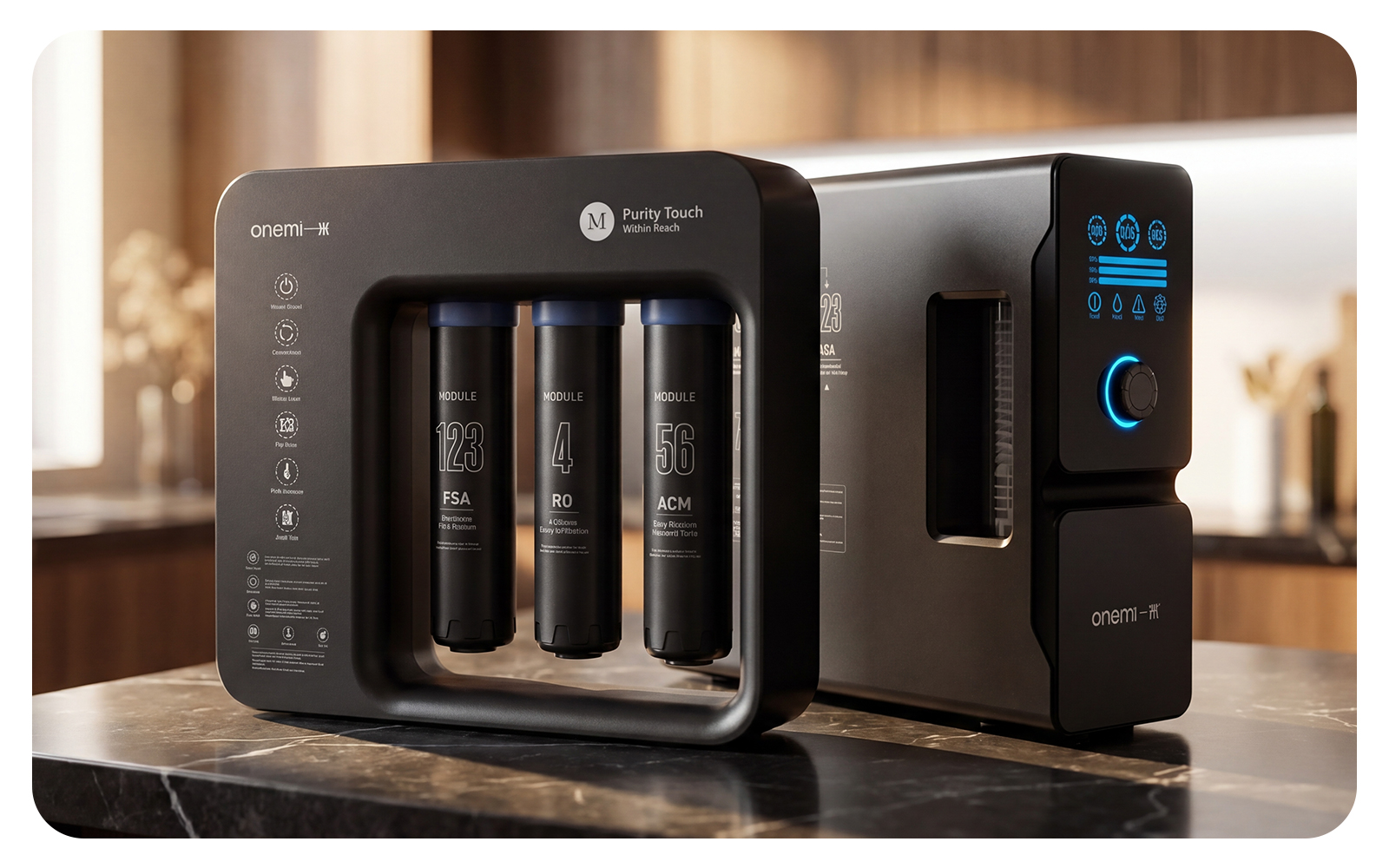
Tankless systems consolidate these components into a single, compact unit. By eliminating the storage tank, you eliminate the pressure tank valve, the tee connector, and the secondary carbon post-filter line. The water flows directly from the cold supply line, through the integrated sediment/carbon pre-filter, through the high-flow RO membrane, and straight to the faucet. This simplified loop reduces the physical footprint by up to 70%, freeing up valuable under-sink storage space for the end-user.
The Technical Architecture of a 20-Minute Installation
Achieving a sub-20-minute installation time requires deliberate engineering. It is not just about removing the tank; it is about redesigning the internal fluid dynamics and physical housing of the water purifier. Modern systems utilize integrated waterways, which replace the spiderweb of internal PE tubing with a single, injection-molded plastic manifold. This manifold contains engineered water channels that route the water through the filtration stages without the need for manual internal connections.
This integrated design eliminates up to 30 internal connection points, which are the primary source of manufacturing defects and shipping-induced leaks. For the installer, this means the unit arrives fully sealed. There is no need to open the chassis or verify internal connections before installation. They only need to connect three external ports: Water In, Water Out, and Waste Water.
Let us look at a real-world scenario from a multi-family housing development project in Brisbane, Australia. The mechanical contractor was tasked with installing under-sink RO systems across 120 luxury apartments. Initially, they budgeted 80 hours of labor using standard tanked filtration units. By switching to a tankless system with an integrated waterway and a pre-wired smart faucet, the actual installation time dropped to just 24 hours total. The contractors completed the entire project two days ahead of schedule, saving thousands of dollars in labor costs and avoiding the typical post-installation leak checks that plague large-scale residential projects.
Another crucial engineering element is the quick-twist filter design. Traditional filter housings require a specialized wrench to unscrew a sump, expose a wet filter cartridge, replace the O-rings, lubricate them, and screw the housing back on with precise torque to prevent leaks. This process is messy and prone to cross-threading. Modern tankless systems use dry-type, quick-twist cartridges. The end-user simply twists the old cartridge 90 degrees to unlock it, pulls it out, and inserts the new one. The water supply automatically shuts off during this process, preventing water spills inside the cabinet. This design turns a complex, 15-minute maintenance chore into a clean, 5-second task that any homeowner can perform without tools.
While these integrated systems offer unmatched speed and convenience, B2B buyers must acknowledge a technical limitation: integrated injection-molded manifolds are highly specialized. If a manifold suffers freeze damage due to improper winterization in northern warehouses, the entire unit must be replaced, unlike traditional systems where a single cracked fitting can be swapped for pennies. Therefore, proper storage temperature controls must be maintained throughout the logistics chain.
B2B Procurement Checklist: What to Look For in an OEM/ODM Partner
When sourcing under-sink RO systems from global manufacturers, B2B buyers must look beyond the basic filtration specifications like GPD (Gallons Per Day) and rejection rates. You must evaluate the physical design of the product and the completeness of the installation kit. Here is a technical checklist to guide your procurement decisions:
- Universal Feed Water Adapters: Ensure the manufacturer provides high-quality, lead-free brass feed water adapters that match the plumbing standards of your target market (e.g., 3/8-inch compression fittings for North America, 1/2-inch BSP threads for Europe and Australia). Cheap plastic adapters crack under pressure spikes and lead to catastrophic leaks.
- Pre-installed Tubing and Connectors: Look for systems that ship with the PE tubing pre-cut to standard lengths and pre-inserted into the quick-connect ports with locking clips in place. This reduces the installer’s work to simply connecting the other ends to the household plumbing.
- Smart Faucet Integration: High-end RO systems feature smart faucets with built-in LED indicators that display real-time TDS (Total Dissolved Solids) levels and filter life status. Ensure the wiring harness for these faucets is waterproof, color-coded, and uses a simple plug-and-play connector rather than bare wire terminals.
- Integrated Leak Detection: High-quality systems include a mechanical or electronic leak sensor at the base of the unit. If water accumulates in the drip tray, the sensor instantly shuts off the incoming water supply valve and sounds an alarm, protecting the homeowner’s property and shielding your brand from liability.
- Certified Components: Verify that all water-contact components, including the PE tubing, quick-connect fittings, and internal valves, carry NSF/ANSI 61 certification for material safety. This ensures no harmful chemicals leach into the purified water.
By partnering with an experienced OEM/ODM manufacturer like ONEMI, global brands can access highly engineered, tankless RO platforms that are optimized for rapid installation and minimal maintenance. Selecting a manufacturer that prioritizes these installation-friendly features allows B2B importers to protect their profit margins, reduce customer service overhead, and build a reputation for product reliability in a highly competitive market.