



 한국어

- EPA has set enforceable 4 parts-per-trillion limits for PFOA and PFOS; the agency is now steering nearly $1 billion in new funding to states for treatment, and opt-in compliance stretches to April 2031.
- Reverse osmosis removes 94% or more of PFAS including short-chain compounds, while granular activated carbon handles long-chain PFOA/PFOS but breaks through early on short-chain variants.
- NSF/ANSI 53 certification for PFAS requires reduction below 20 ppt. Importers should treat that as a compliance floor, not a marketing ceiling.
American water utilities now face an enforceable limit of 4 parts per trillion for PFOA and PFOS. That is a threshold low enough that most legacy filtration media fail it outright. For importers and distributors, the number has done something quietly significant: it turned PFAS from an environmental story into a stocking decision.
Reverse osmosis membranes and certified carbon blocks are about to become the fastest-moving cartridges in the US category. The buyers are not waiting for the deadline. Private well owners, early-adopter municipalities, and commercial operators are purchasing now, and they are asking one question at the point of sale: does this filter actually remove PFAS, and can you prove it?
The Regulatory Floor Is 4 ppt — and the Money Is Already Moving
In April 2024 the EPA finalized the first National Primary Drinking Water Regulation for PFAS, setting Maximum Contaminant Levels of 4 ng/L (parts per trillion) for both PFOA and PFOS, with non-enforceable health goals of zero. The agency has not walked that number back. In May 2026 it reaffirmed the 4 ppt limits while announcing nearly $1 billion in new funding to states for PFAS treatment and destruction, and it proposed an opt-in extension moving the compliance deadline from April 2029 to April 2031 for systems that formally apply.
Three things matter for anyone selling filters into this market. First, the 4 ppt standard is not being weakened; the extension is about installation logistics, not about relaxing the limit. Second, the money is real and flowing now, which means utilities are already procuring pilot systems and treatment media. Third, the EPA has separately proposed rescinding limits on four additional PFAS compounds (PFHxS, PFNA, HFPO-DA, and PFBS) on procedural grounds, not on science — the agency has said outright that the eventual re-issued limits could be more stringent.
The practical reading for importers: the enforceable compounds today are PFOA and PFOS, but the category is trending toward broader PFAS coverage. A filter that only claims to handle two compounds is already a dated SKU.
Not All Media Removes PFAS Equally
PFAS are thousands of compounds with different chain lengths, and the media that catches them split into two families: adsorption and membrane separation. Adsorption media — granular activated carbon (GAC) and ion exchange resin — trap PFAS molecules on a surface. Membrane media — reverse osmosis and nanofiltration — physically block them.
GAC is the workhorse. It adsorbs long-chain compounds like PFOA and PFOS well, which is why it anchors most certified pitcher, faucet, and whole-house systems. But it is noticeably weaker on short-chain PFAS such as PFBS and PFBA, and it saturates. Once a carbon bed is exhausted, it stops removing PFAS entirely, and there is no reliable visual cue that the breakthrough has happened. The Vermont Department of Health is blunt about this in its public guidance: GAC is most effective at PFOA and PFOS, less effective at other PFAS, and its performance depends on filter change frequency, filter size, and source water chemistry.
Ion exchange resin goes further. Independent bench-scale work — including a 2025 comparative study published in Science of the Total Environment — consistently finds that anion exchange offers greater capacity and longer operational life than GAC, and it captures short-chain PFAS that carbon misses. The trade-off is cost and disposal: spent resin typically cannot be regenerated on site and must be handled as a specialty waste stream.
Then there is reverse osmosis. A Duke University field study of real-world home filters found under-sink RO units achieved near-complete removal — 94% or more — across both legacy PFAS and newer replacement chemicals such as GenX. Membrane processes remain the only approach that removes short-chain and long-chain compounds in a single pass without the steep saturation curve of adsorbents.
| Media | Long-chain PFAS (PFOA/PFOS) | Short-chain PFAS | Lifecycle | Typical use |
|---|---|---|---|---|
| Granular activated carbon (GAC) | Good | Weak | Saturates, needs scheduled replacement | Pitcher, faucet, whole-house, RO pre-filter |
| Anion exchange resin | Good | Good | Longer than GAC; disposal cost | Point-of-use cartridges, POE systems |
| Reverse osmosis | Excellent (94%+) | Excellent | Membrane + pre/post filters | Under-sink, commercial, tankless RO |
| Nanofiltration | Excellent | Good (80%+) | Lower pressure than RO | Point-of-entry, light industrial |
The table explains why a single-media answer usually loses the sale. Distributors that position RO as the premium tier and a certified carbon block as the entry tier are selling two different promises to two different buyers — and that is a healthier line card than trying to make one filter do everything.
RO Is the Only Set-and-Forget Answer for the US Market
For a distributor, the strongest PFAS story in the US is a certified under-sink reverse osmosis system. It does not ask the customer to understand chain length or breakthrough curves. It just removes the compound, broadly, on a membrane spec the customer can read — typically 0.0001 micron, which is far smaller than any PFAS molecule.
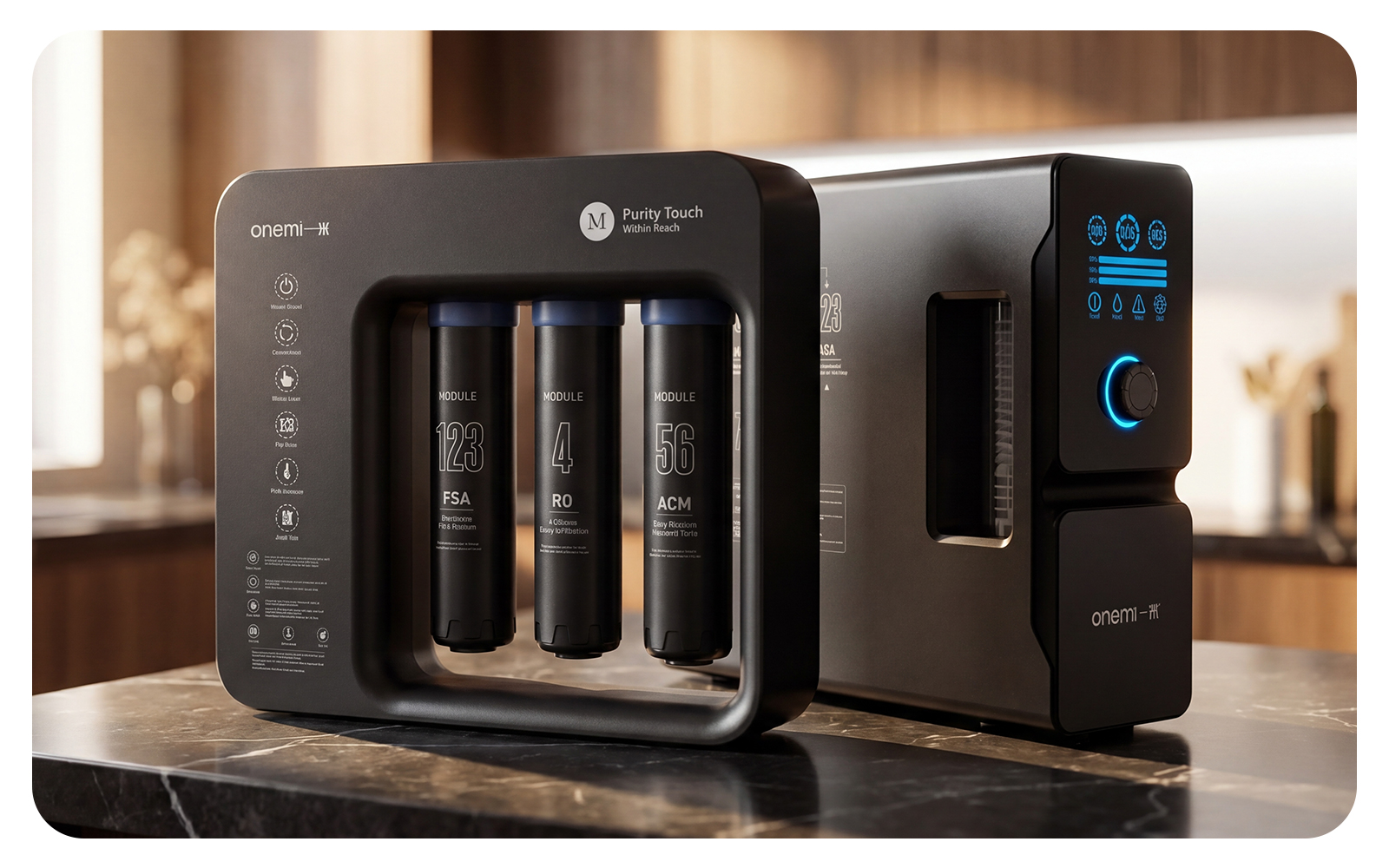
ONEMI, a Guangdong-based water purification equipment manufacturer, builds its RO line around this exact demand. Its 400 GPD smart under-sink RO system pairs a 0.0001 micron RO membrane with carbon pre- and post-filtration, which is the media stack that a PFAS-conscious buyer expects to see. For lower-volume and commercial installations, the 100 GPD RO system delivers the same membrane separation in a smaller footprint. Tankless direct-flow designs, which cut the storage tank and its associated bacterial regrowth risk, are increasingly the version importers request for the US — buyers read “tankless” as “modern,” and in PFAS-sensitive markets the modern SKU is the one that moves.
One caveat that trips up first-time importers: RO systems produce a concentrate stream. Under-sink units typically send two to four gallons of reject water to drain per gallon of filtered water. That is a normal operating characteristic, not a defect, but it has to be designed into the installation conversation, not discovered by the customer after the sale.
What NSF/ANSI 53 Actually Certifies — and What It Doesn’t
The single most common sourcing mistake in this category is treating “NSF certified” as a blanket claim. It is not. NSF/ANSI 53 is the standard for health-effects reduction claims, and the 2024 revision added a PFAS test protocol: a filter that claims PFAS reduction under 53 must demonstrate reduction to below 20 parts per trillion under challenge conditions. NSF/ANSI 58 covers whole reverse osmosis systems, and NSF/ANSI 401 covers a list of emerging contaminants that overlaps with the PFAS conversation but is a separate scope.
Here is the detail importers need in writing, because it comes up in every buyer audit: a filter can be NSF/ANSI 53 certified for lead, chlorine, and cyst reduction while making no PFAS claim at all. Certification is claim-specific. If a supplier says “NSF 53 certified” and the buyer assumes that covers PFAS, the assumption is doing the selling, not the certificate.
ONEMI holds NSF certification at the filter cartridge level, and its CE, UL, FCC, and RoHS coverage applies to complete machines. For a US importer assembling a PFAS-ready line, the diligence is the same every time: request the exact certificate, read the contaminant list on it, and confirm which media the claim attaches to. More on that workflow in our guide to sourcing NSF-listed under-sink RO systems for the US.
The Sourcing Checklist: Questions to Put in Front of a Factory
When you sit down with a filter manufacturer, a handful of questions will separate a compliant line from a liability. These are not hypothetical; they are the questions distributors are already getting from their own customers.
- What is the exact NSF/ANSI standard and contaminant list on the certificate — and can you provide the certificate number?
- What is the stated PFAS reduction claim, and under what challenge concentration was it tested?
- Which media does the PFAS claim attach to — the RO membrane, the carbon block, or the ion exchange cartridge?
- What is the rated filter or membrane life under real hardness and TDS, not just laboratory water?
- Can the housing and wetted parts meet NSF/ANSI 372 lead-free and California Prop 65 requirements for the US market?
The last point matters more than most importers expect. California’s Proposition 65 has listed PFOA and PFOS, and since January 2025 its short-form warning label has required naming the specific chemical. A product that performs well but carries a preventable Prop 65 exposure on a component is a sales problem dressed up as a legal one.
For a factory-side view of what a serious OEM should be able to show you, our OEM/ODM manufacturing capabilities page walks through certification documentation, material traceability, and the QA steps that a PFAS-era line card depends on.
Where the Margin Is Going
The pattern across every regulated contaminant before PFAS — lead, arsenic, disinfection byproducts — is the same. The hardware sale is thin; the replacement cartridge is where the gross margin compounds. PFAS will follow that curve, but with one twist: because carbon and ion exchange media saturate and require scheduled replacement, the recurring revenue argument is built into the technology itself.
For an importer, that suggests a specific stocking posture. Carry a certified under-sink RO system as the premium SKU and the headline PFAS answer. Carry a certified carbon block or ion exchange cartridge as the entry tier for the buyer who will not do plumbing. And treat the replacement cartridge as a separately tracked, reorder-driven line item rather than an afterthought. The distributor who gets the reorder cadence right on a PFAS cartridge owns a customer for years; the one who sells a one-time hardware box does not.
The deadline moved to 2031 for some systems, but the demand is not on the deadline’s schedule. It is on the buyer’s. Utilities are piloting now, well owners are testing now, and commercial operators are specifying PFAS capability into their food-service and beverage contracts now. The importer who waits for 2031 will be buying into a category that has already repriced itself.
For a deeper read on how PFAS is reshaping the broader market and the certification landscape, see our notes on PFAS removal technology and the NSF 53/58 certification trends affecting importers.