
 한국어

- UV and UF attack different failure modes: UV inactivates pathogens without changing water chemistry, while UF physically removes bacteria and protozoa and keeps minerals in the water.
- The UV water purifier market is tracking from roughly $4.37 billion in 2026 toward $6.64 billion by 2035; broader UV disinfection equipment runs from $6.81 billion in 2025 to a projected $24.18 billion by 2035.
- Most residential “UV” units are NSF/ANSI 55 Class B, which cannot legally claim pathogen reduction. The Class A vs Class B split, not the lamp wattage, is the sourcing decision that matters.
A boil-water advisory moves more point-of-use equipment than any spec sheet does. When a municipal system tells tens of thousands of households to boil their water, the next quarter’s orders for ultraviolet sterilizers and ultrafiltration units climb before the utility’s own paperwork is even filed. Importers who have learned to read those headlines as a demand signal are the ones restocking ahead of the spike instead of chasing it.
Outbreak headlines move orders before regulation does
The drivers here are structural, not seasonal. Roughly 44 million Americans drink from private wells that no utility tests or treats, and those wells sit outside the Safe Drinking Water Act’s coverage entirely. When a well owner tests positive for E. coli or total coliform, the fix isn’t a carbon block; it’s a barrier or a disinfection step.
On the municipal side, the threat profile has shifted. Cryptosporidium and Giardia are chlorine-resistant cysts that slip through conventional chemical disinfection. Legionella doesn’t come from the treatment plant at all; it breeds in warm, stagnant building plumbing and dead-leg pipes, then gets aerosolized in showers. Both of these have pushed spec writers toward two specific technologies: ultraviolet disinfection and ultrafiltration membrane.
Neither of those technologies is new. What changed is the trigger. A single well-publicized outbreak in a city or a resort now reorders the demand curve for an entire region, because the consumer response is immediate and the regulatory response is years behind it. That gap between panic and policy is where the margin lives.
UV and UF solve different problems, and buyers confuse them
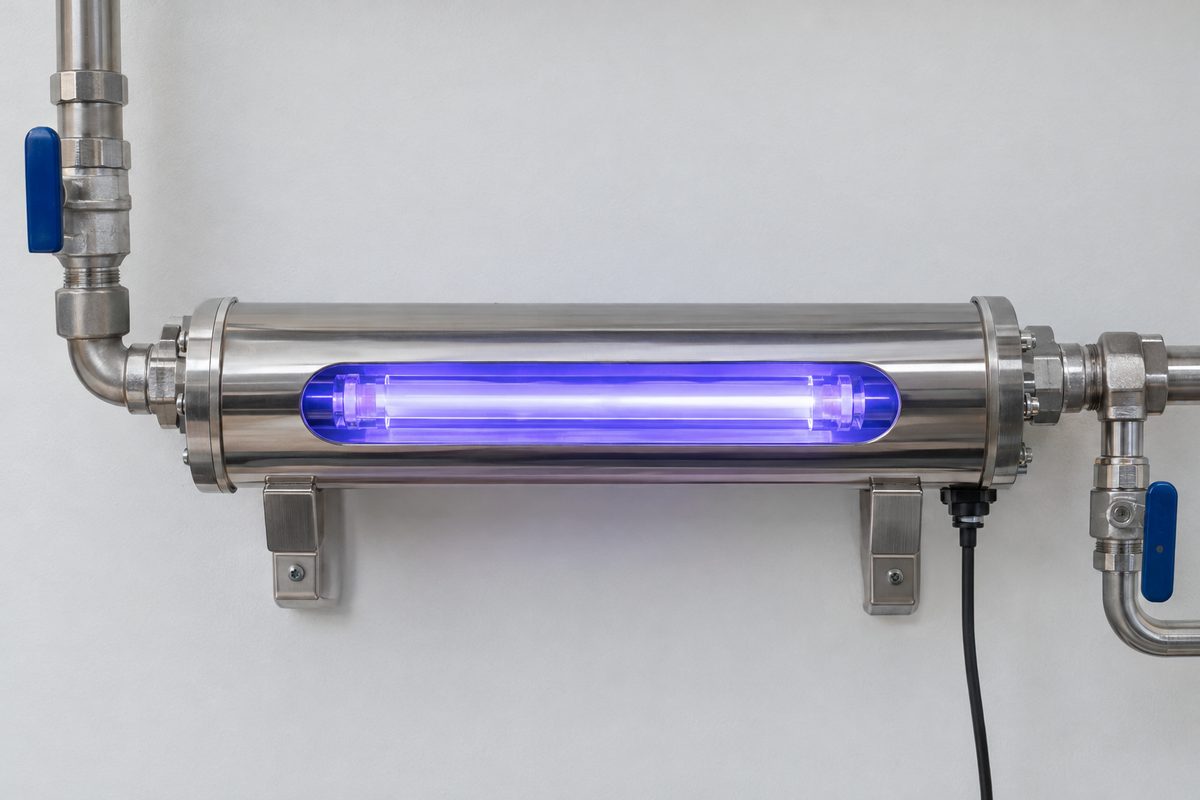
Ultraviolet light and ultrafiltration membrane are routinely bundled into the same product category, but they are opposites in mechanism. UV doesn’t remove anything. It floods the water with UV-C radiation in the 240 to 300 nanometer range, damaging the DNA of bacteria, viruses, and protozoa so they can’t reproduce. The dead cells stay in the water. The chemistry, taste, and mineral content are untouched.
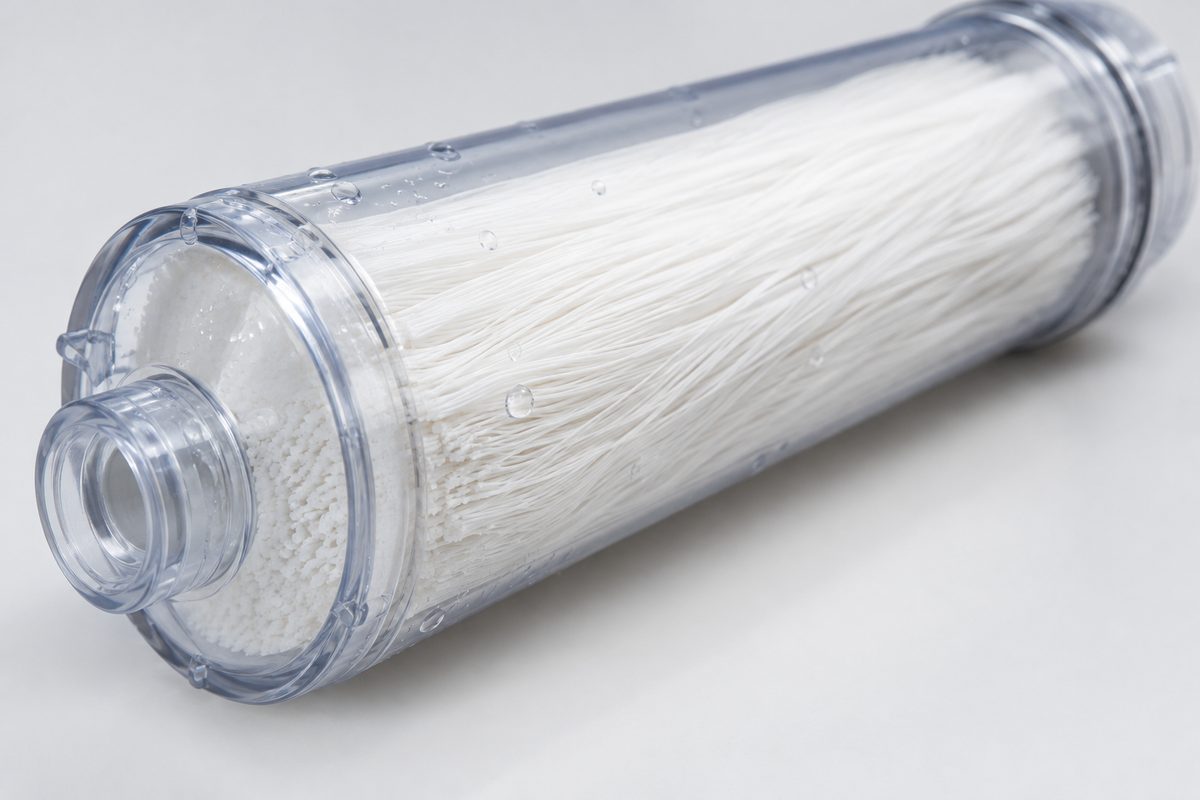
UF does the physical work. A hollow-fiber membrane with pores around 0.01 to 0.1 microns blocks bacteria, protozoa cysts, and a portion of viruses outright while letting dissolved minerals like calcium and magnesium pass through. There’s no electricity, no chemical feed, and no reject water. What UF catches, it holds; what it can’t catch, it lets through.
That distinction produces a clear pairing strategy, and a clear failure mode when a buyer picks one expecting the other to work. Here is the comparison that should be on every sourcing checklist:
| Attribute | Ultraviolet (UV) | Ultrafiltration (UF) | Reverse Osmosis (RO) |
|---|---|---|---|
| Mechanism | Inactivates pathogens with UV-C light | Physically strains out particles and microbes | Membrane + pressure, rejects dissolved solids |
| Bacteria / protozoa | Inactivates (needs clear water) | Removes (mechanical barrier) | Removes |
| Viruses | Inactivates (dose-dependent) | Partial (depends on pore size) | Removes |
| Minerals | Retained | Retained | Mostly removed |
| Power | Required | None | Required (pump) |
| Wastewater | None | None | Yes (reject stream) |
| Weak point | Turbidity shields pathogens | Dissolved contaminants pass | Strips minerals, needs remineralization |
The practical takeaway is that UV fails exactly where water is murky, and UF fails exactly where the threat is dissolved. Put a sediment or UF stage in front of UV and the pairing covers both. That pairing is the chemical-free answer to the outbreak concern, and it’s where forward-looking importers are heading. For a deeper read on the UV-versus-RO decision specifically, see our breakdown of UV vs RO for bacteria removal.
The market numbers behind the shift
The growth figures are directionally consistent even across competing trackers. Industry Research pegs the global ultraviolet water purifier market at about $4.37 billion in 2026, climbing to $6.64 billion by 2035 at a compound annual rate near 4.8 percent. Market Research Future puts the broader ultraviolet disinfection equipment market at $6.81 billion in 2025, rising to an estimated $24.18 billion by 2035 on a much steeper 14.6 percent curve, because that wider bucket includes municipal and industrial treatment, not just the countertop and under-sink units that OEM buyers source.
On the demand side, the same trackers report a durable preference for chemical-free purification, with roughly three-quarters of consumers leaning toward methods that don’t add chlorine or its disinfection byproducts. Ultrafiltration rides the same current. The hollow-fiber membrane category is expanding fastest where the water is biologically suspect but the power grid isn’t reliable, which is precisely why the no-electricity UF segment has become a sourcing play of its own. See our note on off-grid UF purifiers for the developing-market angle.
What the aggregate numbers miss is the spikiness. Outbreak-driven demand doesn’t follow a smooth CAGR. It arrives in a burst after a publicized contamination event, then settles at a higher baseline than before. For a distributor holding inventory, the difference between a steady forecast and a burst-forecast is the difference between a missed quarter and a captured one.
NSF/ANSI 55 Class A vs Class B is the real sourcing gate
Here is the part most importers get wrong, and it’s expensive to get wrong. NSF/ANSI 55, the standard for ultraviolet microbiological water treatment systems, splits UV units into two classes that do not mean the same thing.
A Class A system is validated to treat microbiologically unsafe water. It must deliver a UV dose of 40 mJ/cm² at its alarm setpoint, the equivalent of a 4-log virus reduction using MS-2 phage as the challenge organism, and it must carry a UV sensor and an alarm that trips visually or audibly, or shuts the water off, when the dose drops. Class A is the only class allowed to claim cyst reduction for Cryptosporidium and Giardia, and even then only with a certified pre-filter in front of the lamp.
A Class B system is a supplement, not a treatment. It delivers 16 mJ/cm² and is validated only for already-safe, disinfected municipal water, using T1 phage at a 2-log target. A Class B unit cannot make any pathogen or health claim. Most of the cheap residential “UV” cartridges flooding the market are Class B, and a distributor who repeats a Class A claim on a Class B unit is carrying a compliance and liability time bomb into the market.
The standard itself has moved recently: NSF/ANSI 55-2024 was superseded by NSF/ANSI 55-2026 in August 2026. Any wetted material in the system still has to clear NSF/ANSI/CAN 61 for extractables and NSF/ANSI 372 for a lead content at or below 0.25 percent weighted average. For a full map of how UV fits the broader certification landscape, read our UV water treatment B2B guide.
Where a 0.01 μm UF line fits the chemical-free spec
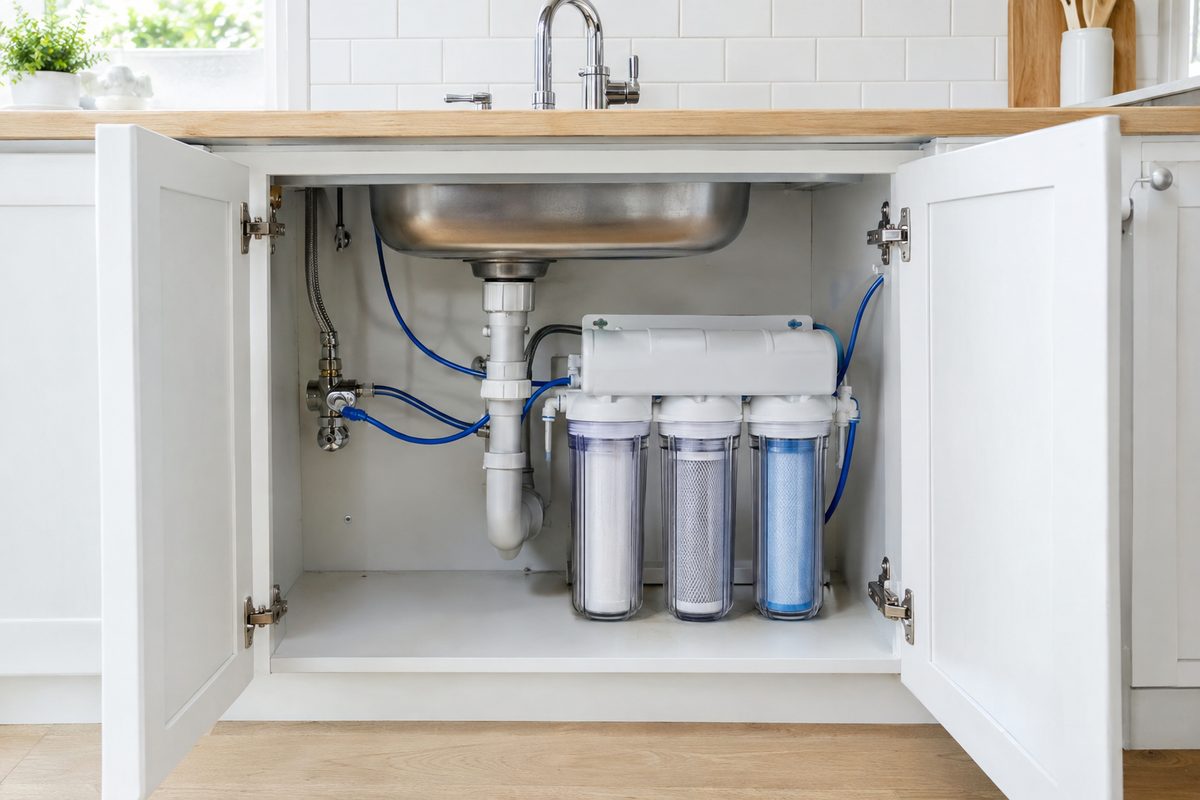
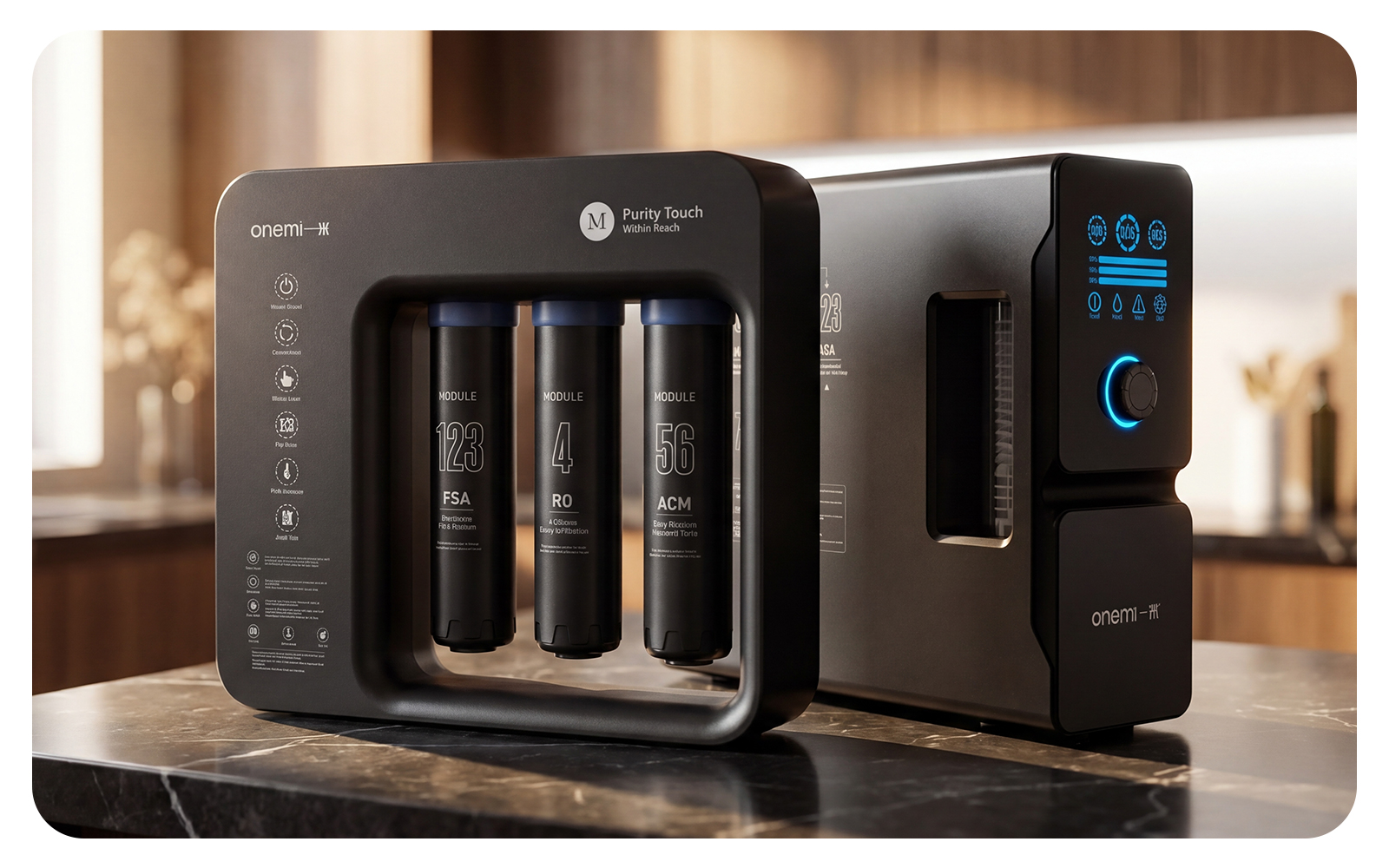
The UF side of this story is where ONEMI’s catalog does the heavy lifting. The Q5, Q6, and Q7 series are under-counter ultrafiltration purifiers built around a 0.01 μm hollow-fiber membrane that strains out suspended solids, bacteria, and colloids while keeping calcium, magnesium, and potassium in the water. They run on zero electricity and produce zero reject water, which is the exact profile a buyer wants when the brief says chemical-free and the installation site has no dependable power.
The three models ladder by filter stage. The Q5 runs a five-stage PP, carbon, PP, UF, post-carbon stack for a baseline 1.5 liters per minute of instant, mineral-retaining filtration. The Q6 adds a mineralizing carbon stage for weak-alkaline output and pH adjustment. The Q7 goes further with a strontium-releasing stage for mineral enrichment. For a buyer positioning a premium health line, the Q7’s mineral story is the differentiator; for a value line in a high-turbidity market, the Q5’s mechanical barrier is the workhorse.
The engineering detail worth noting is the open-cover cartridge swap on the Q series, which lowers the leak risk that plagues twist-in canisters when homeowners over-torque them. That’s a returns-reduction feature, not a marketing bullet. If you’re weighing UF against RO on membrane economics, the comparison is laid out in our RO vs UF membrane piece.
What this means for importers and OEM buyers
First, stop treating UV and UF as interchangeable. They are a redundant pair, not alternatives. A spec that stacks a UF barrier ahead of a Class A UV stage gives you mechanical removal plus disinfection redundancy, and it lets the UV do its job on clear water instead of turbid water. That stack is the product configuration that survives an outbreak-driven recall cycle without a single health claim that can be contested.
Second, anchor the certification early. NSF/ANSI 55 Class A testing runs on a six-to-eighteen-month clock, and it can’t be retrofitted onto a unit whose lamp, ballast, and flow cell weren’t designed for the 40 mJ/cm² dose at the alarm setpoint. If you’re going to claim pathogen reduction in the US market, Class A is the entry ticket, not an upgrade.
Third, look past the unit sale to the replacement cycle. A UF membrane and a UV lamp are both consumables with defined replacement intervals, which means every UV-plus-UF install you place generates a recurring cartridge and lamp revenue stream that outlives the hardware. That annuity is where the channel margin actually lives. It’s the same logic behind the private-label shift reshaping the category, which we covered in our note on UV LED replacing mercury lamps.
The outbreak concern is not a temporary demand spike. It’s a structural tilt toward chemical-free, redundant disinfection, and the importers who read it that way, who position UV-plus-UF as a paired defense layer rather than two standalone SKUs, are the ones who capture the margin before the utility companies finish their own infrastructure work.