



 한국어

- Replacement cartridges already hold roughly 62% of the global water-filtration pitcher-and-cartridge market by value — the installed base, not the initial hardware sale, is where margin lives.
- Whole house systems run on predictable cadences: sediment pre-filters every 3–6 months, carbon blocks every 6–12 months, softener resin every 10–20 years, UV lamps annually.
- A distributor that specs standard 10-inch housings and certified media turns every installation into a 15–20 year recurring revenue stream rather than a one-off sale.
Whole house filtration sells itself once. The hardware is a single transaction — a sediment housing, a carbon tank, a softener valve, all bolted onto the main line where it enters the building. The cartridges inside are different. They are consumed on a schedule, replaced on a schedule, and re-ordered on a schedule. That schedule is the business.
Importers and distributors who treat whole house systems as a box-moving exercise leave the most durable part of the category on the table. Fortune Business Insights pegs the U.S. water purifier market at about $6.75 billion in 2024, and the point-of-entry (POE) segment — whole house systems plus softeners — is the faster-growing slice of it. But the recurring side is even more lopsided than the headline number suggests. One 2025 market analysis puts replacement cartridges at an estimated 62% of the global water-filtration pitcher-and-cartridge market’s value, roughly $3.39 billion, and another forecasts the cartridge segment growing around 8.2% a year through 2034. The consumable out-earns the device it fits into.
The Aftermarket Is the Business Model
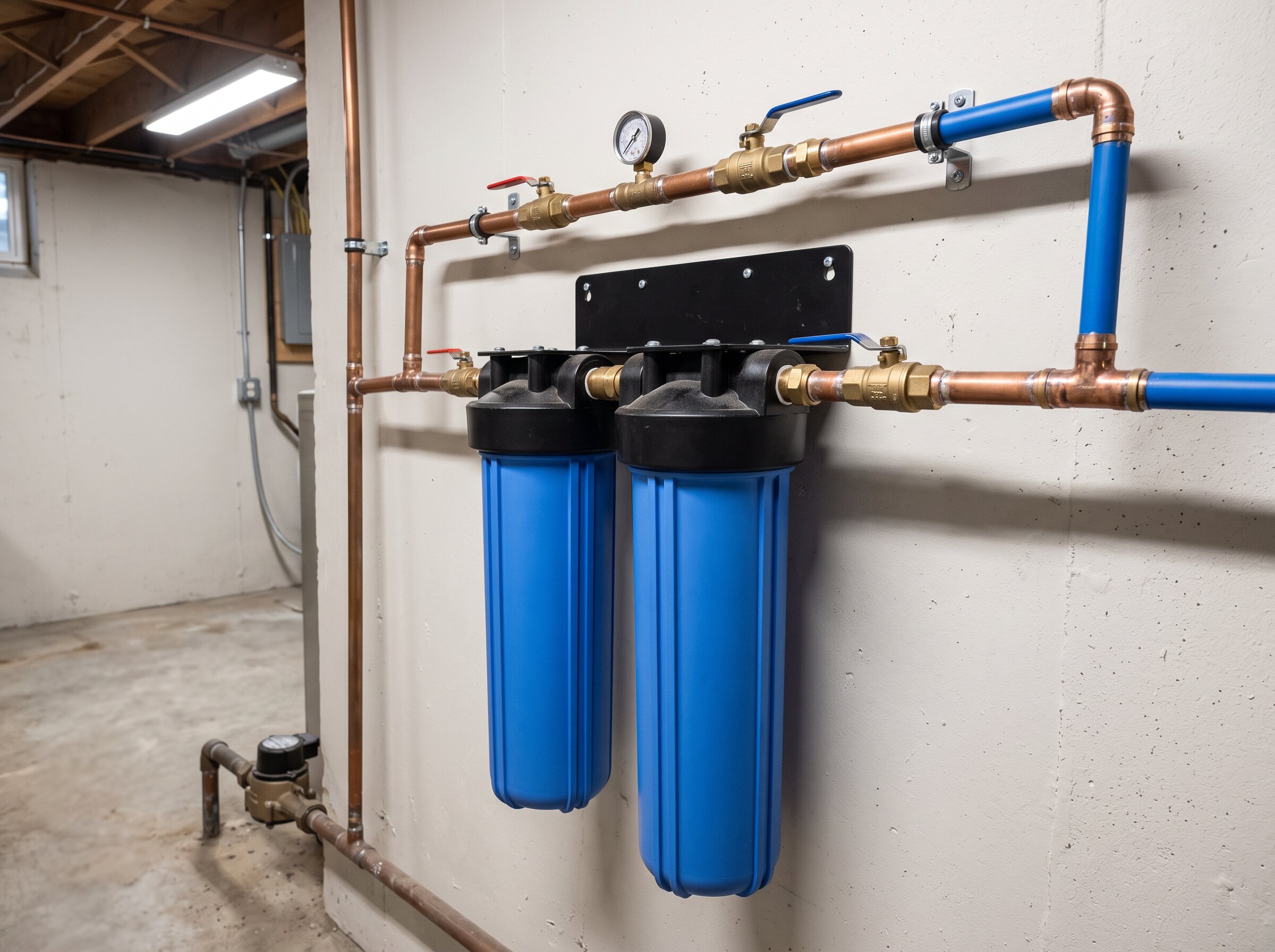
Here is the arithmetic that matters. A whole house system with two 10-inch housings — a sediment stage and a carbon stage — needs its first cartridge swap inside six months. Every swap after that is a reorder, and each reorder is a customer touchpoint a distributor can either own or surrender to a marketplace listing.
Whole house replacement demand is not a niche. Industry estimates attribute around 42% of U.S. water purifier sales to replacement and upgrade demand rather than first-time installs. That ratio only climbs as the installed base ages, because the system count compounds while the hardware purchase is flat. A distributor that sold 1,000 systems last year is sitting on roughly 1,000 carbon cartridges due for replacement in the next 6–12 months — and every year after that.
The margin structure is what makes this worth building deliberately. Cartridges are small, light, cheap to ship, and re-ordered on a cadence the distributor already knows in advance. That is a subscription business wearing a hardware product’s clothes. For a deeper look at how the aftermarket has evolved and where OEM-compatible cartridges fit, see our breakdown of the aftermarket filter cartridge market.
Replacement Schedules by Filter Stage
Every whole house system is a sequence of stages, and each stage has its own clock. The schedule below is the operating default for municipal and well water in North America; heavy sediment or chlorine loading pulls it shorter.
| Stage | Media / component | Typical replacement | What forces an early swap |
|---|---|---|---|
| 1 — Sediment pre-filter | Melt-blown or pleated polypropylene, 1–20 micron | 3–6 months | Visible browning, pressure drop, high sediment load |
| 2 — Carbon block | Extruded activated carbon, 5–10 micron | 6–12 months | Return of chlorine taste or odor (invisible exhaustion) |
| 3 — Granular carbon / backwashing tank | GAC media bed | 5–10 years (tank) / 6–12 months (cartridge) | Chlorine breakthrough, channeling |
| 4 — Softener resin | Cation exchange resin | 10–20 years | Hardness return despite salt refills, iron fouling |
| 5 — UV lamp | 254 nm germicidal bulb | 12 months | Bulb burns out silently; UV output degrades before that |
| 6 — RO membrane (if POE RO) | Thin-film composite membrane | 2–3 years | Rising TDS in product water, falling production rate |
Sediment pre-filters: the first line that shows its age
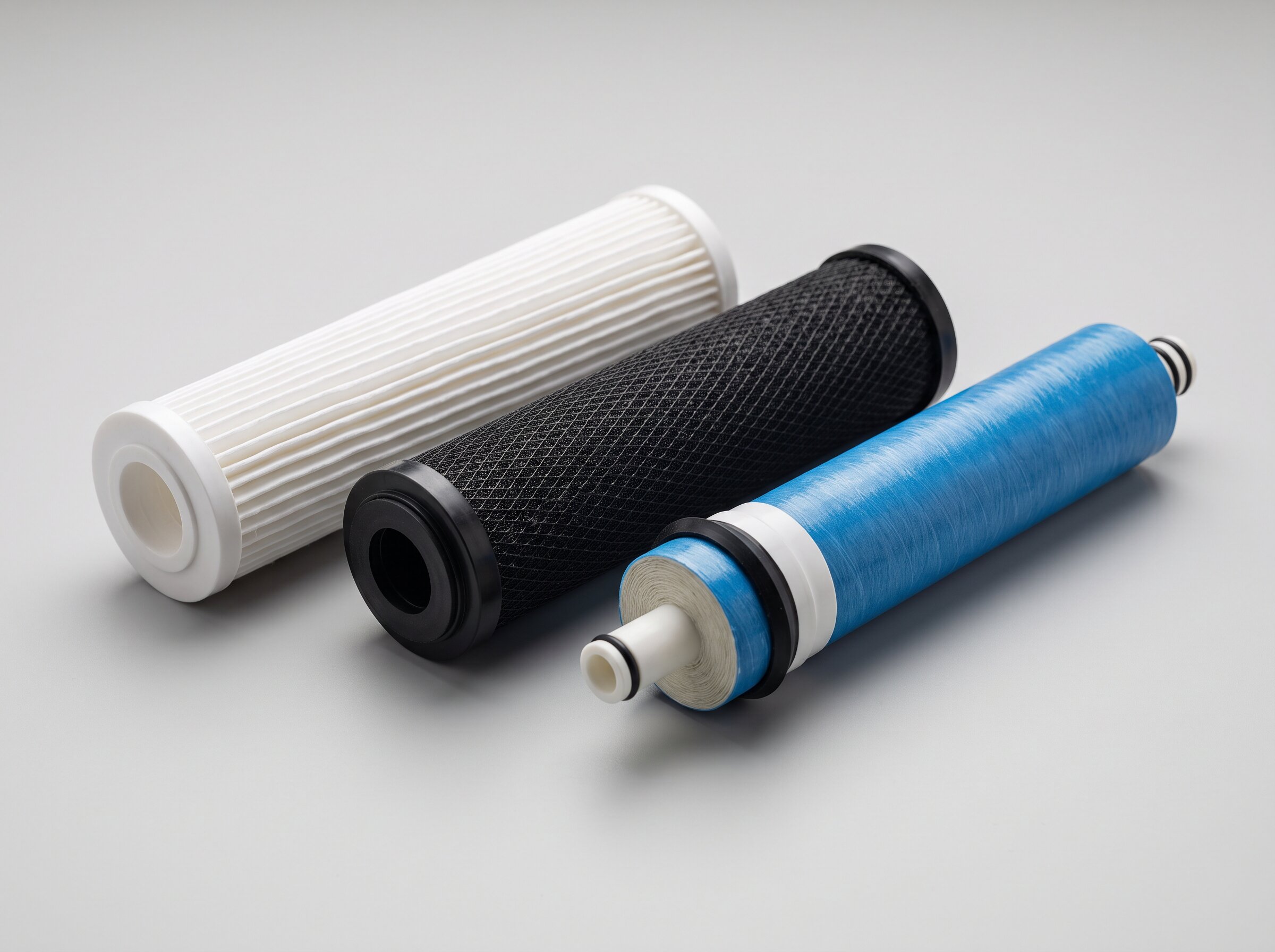
Sediment cartridges are the cheapest stage and the one that fails most visibly. Melt-blown polypropylene traps sand, rust, and silt mechanically, and it turns brown as it loads. In a home on clean municipal water, a 5-micron sediment cartridge runs about 6 months; on a well with iron or heavy silt, the same cartridge can be done in 4–6 weeks. This is the stage distributors should sell in bulk packs, because the cadence is short and the customer can see exactly when it is spent.
Carbon: the stage that fails invisibly
Carbon block is the dangerous one for customer trust, because it stops working long before it stops flowing. Chlorine adsorbs into the carbon matrix until the media saturates, and at that point the filter passes chlorine through while the customer still gets full pressure and clear water. The only reliable signal is a calendar or a gallon rating — which is exactly why the replacement schedule, not the customer’s senses, has to drive reorders. Carbon blocks for whole house use are commonly rated 6–12 months or a stated gallon capacity, whichever comes first.
Softener resin and the long tail
Softener resin is the slowest stage, rated 10–20 years, but it degrades faster on hard, iron-heavy water and dies early if the upstream sediment filter was skipped. Salt is the real consumable on a softener — a separate, high-volume, low-margin reorder stream that pairs naturally with resin replacement scheduling. Distributors building a whole house line should carry both, because the salt customer and the cartridge customer are the same household. See our central water softener OEM sourcing guide for what to spec on the resin and valve side.
What Actually Shortens a Filter’s Life
Replacement schedules are always a range, and the variables that compress them are measurable. The four that move the needle hardest:
- Source water. Well water with iron, manganese, and silt can cut a sediment cartridge’s life to weeks. Municipal water with heavy chloramine loading exhausts carbon faster than free chlorine.
- Household size and flow. A six-person household flushes two to three times the daily volume of a two-person home through the same housing, and the gallon rating runs out proportionally sooner.
- Stage order. A skipped or overdue sediment pre-filter dumps particulate onto the carbon stage, which then clogs and channels — one neglected stage cascades into the next.
- Water pressure. Consistently high pressure (above 80 psi) forces water through media faster and shortens contact time, accelerating carbon exhaustion.
None of this is exotic. It is the standard set of variables any distributor should be teaching its dealers, because a customer who understands why their cartridge died in five months is a customer who does not blame the product and churn to a competitor.
The Distributor’s Unit Economics
The reason to build the aftermarket deliberately is that the numbers justify it. A whole house system’s first sale is the lowest-margin event in the relationship; the reorder is the highest. Here is a representative cost structure for a two-stage whole house package (sediment + carbon), priced for a distributor buying factory-direct:
| Line item | Typical unit cost (factory-direct) | Typical resale | Notes |
|---|---|---|---|
| 10-inch sediment cartridge (5 micron) | $0.60–$1.20 | $8–$15 | Bulk-packed, 50+ per carton |
| 10-inch carbon block (5 micron) | $2.50–$5.00 | $20–$40 | Coconut-shell carbon costs more than coal-based |
| Whole house housing (clear or blue) | $8–$15 | $60–$120 | One-time; sump wrench upsell |
| Softener salt (40 lb bag) | $4–$7 | $12–$20 | Highest volume, lowest margin |
Notice the shape of it: the housing is a $100 one-time sale, but the two cartridges inside it re-sell every 3–12 months at multiples of their cost. A single customer on a 6-month carbon schedule represents six to ten reorders over the life of the system. The lifetime value of the consumables quietly exceeds the hardware sale several times over — which is why the distributor who controls the reorder channel, rather than handing it to a generic online listing, keeps the margin.
This is also why interchangeable standard sizing matters at the spec level. A 10-inch by 2.5-inch cartridge fits every standard housing regardless of brand, which means a distributor’s reorder stream is not hostage to one proprietary fit. For the parts and housing side of that equation, see our filter parts and accessories catalog.
Specifying Replacement Cartridges That Sell Themselves
A cartridge is a commodity until certification and material spec differentiate it. Buyers in North America increasingly ask two questions before they trust a replacement filter: is it certified, and what is it made of. Distributors who can answer both with documentation rather than adjectives win the reorder.
On certification, the baseline is NSF/ANSI 42 for aesthetic claims (chlorine, taste, odor, particulate) and NSF/ANSI 53 for health claims (lead, cysts, VOCs, and increasingly PFAS). A carbon block carrying both, with a real listing number, is a different product than an uncertified block at the same micron rating. For whole house systems that include reverse osmosis at point of entry, NSF/ANSI 58 governs the membrane — it requires at least 75% total dissolved solids rejection as a structural performance floor. Material-contact safety falls under NSF/ANSI 61, and lead-free compliance under NSF/ANSI 372, which caps weighted average lead content at 0.25%. These four — 42, 53, 61, 372 — are the set a distributor should insist on before private-labeling a cartridge line.
On material spec, the details that separate a reorderable product from a return-prone one are concrete: the carbon source (coconut shell outperforms coal-based on chlorine capacity per gram, at a higher cost), the block’s binder and whether it is acid-washed, the end-cap material, and the housing pressure rating. A 10-inch housing rated to 80 psi at 100°F is a different proposition than an unrated one on a municipal line that spikes to 90 psi at night. These are the parameters a factory-direct partner should be able to produce on a single spec sheet, not across five email threads.
Building the Recurring Revenue Engine
The reorder does not happen by itself. Three mechanisms, used together, turn a one-off whole house sale into a scheduled revenue stream:
- Install-date labeling. Write the install date on every cartridge with a permanent marker, and set the next swap date at the time of sale. The customer gets a concrete date, not a vague “check it sometime.”
- Bulk multi-packs. Sell sediment cartridges in 4- or 6-packs and carbon blocks in pairs. Bulk pricing is materially cheaper per unit, and it front-loads the customer’s commitment while cutting per-order shipping cost for the distributor.
- Subscription reorder. A scheduled delivery program — two carbon blocks every six months, four sediment cartridges every quarter — removes the single biggest reason reorders lapse, which is simple forgetting. This is the mechanism that converts an ad-hoc customer into an annuity.
The subscription model is not hypothetical. The same market analysis that flags recurring cartridge costs as a consumer friction point also names scheduled replacement programs and smart filter-life monitoring as the growth mechanism manufacturers and distributors are actively building toward. A cartridge with a flow-based or time-based reminder — or a smart housing that pings when pressure drop signals a loaded filter — closes the loop between the installed base and the reorder.
Sourcing Whole House Cartridges Factory-Direct
For a distributor or private-label brand, the unit economics above only hold if the cartridges are sourced close to the factory, not bought through two middle layers of markup. That is the argument for working with a manufacturer that can produce the housing, the sediment cartridge, the carbon block, and the softener resin against one spec, one certification set, and one lead time — rather than stitching four suppliers together.
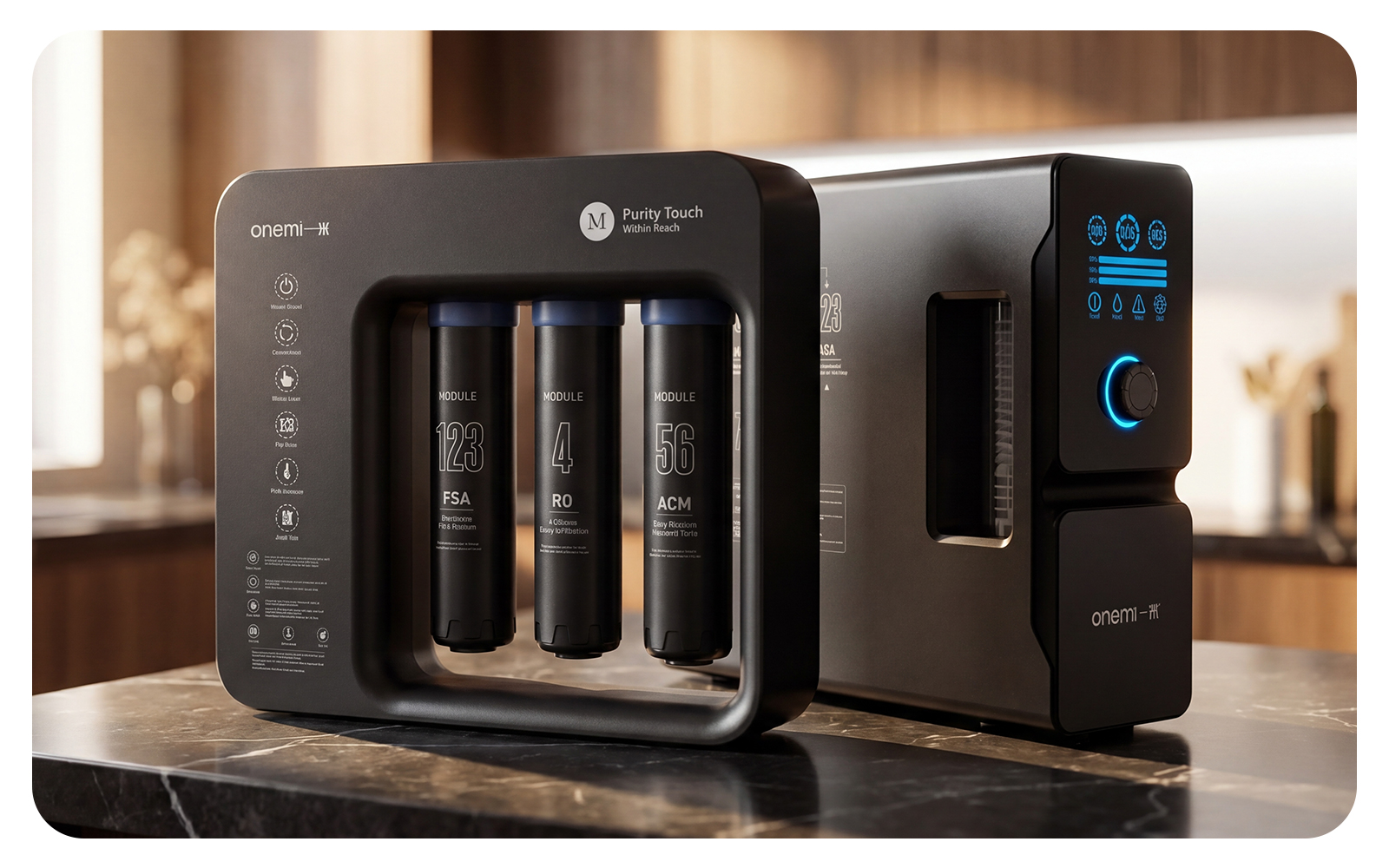
ONEMI, a Guangdong-based water purification equipment manufacturer, runs this category as a full POE line rather than a parts grab-bag. The relevant capability is not a slogan; it is that the sediment, carbon, and softener stages are produced under one roof, which means consistent dimensions, one compliance file, and one container. A distributor specifying a two-stage whole house package with NSF/ANSI 42- and 53-certified carbon blocks, 372-compliant materials, and interchangeable 10-inch housings can consolidate that entire reorder stream through a single OEM/ODM manufacturing partner instead of chasing four vendors.
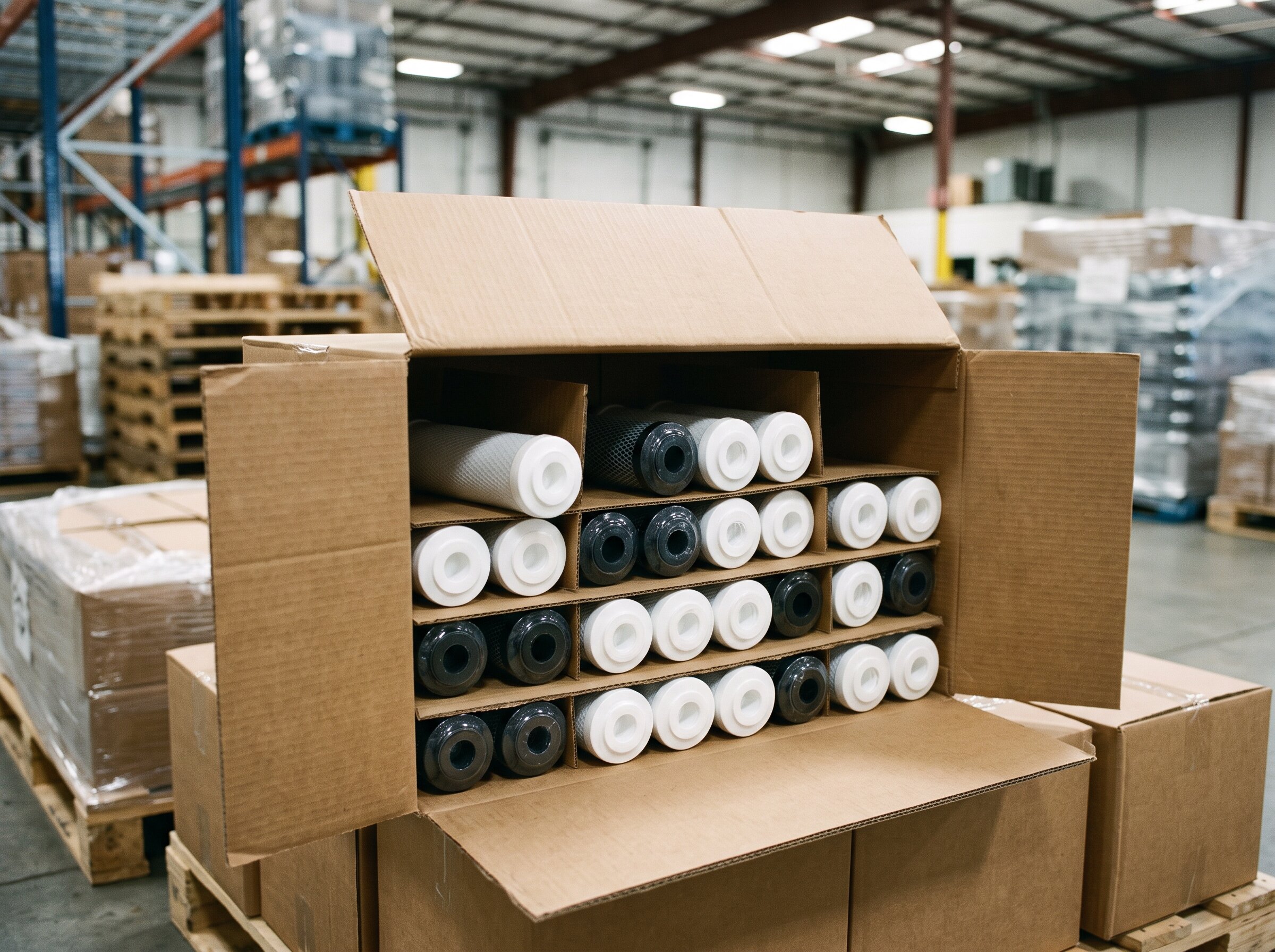
For brands that want the whole house line under their own nameplate, the path is private label: specify the media, the micron ratings, the certification targets, and the packaging, and the cartridges ship with your logo and your install-date labeling built in. The private label and OEM build path is the step between “reselling someone else’s cartridge” and “owning a recurring revenue line.”
The whole house filter is sold once. The cartridge inside it is sold for the next fifteen to twenty years. The distributor who treats the replacement schedule as the product — not the afterthought — is the one who keeps both the margin and the customer.