

 한국어

- Reverse osmosis removes 95% or more of dissolved solids — lead, PFAS, nitrate, arsenic, fluoride — while carbon block adsorbs chlorine, chloramine, and VOCs. They solve different problems and almost always run in series.
- RO leads the US point-of-use market by dollar share, roughly 35 to 42 percent, but carbon-block cartridges are the volume and reorder workhorse across every segment.
- The stocking decision is about margin and reorder cadence, not technology: carbon cartridges drive recurring revenue, while RO membranes drive ticket size and premium positioning.
Every importer building a water filter line hits the same question in year one: do I lead with reverse osmosis or with carbon filtration? It gets framed as an either-or, and that framing is the first mistake. RO and carbon block are not two products fighting for the same shelf slot. They are two stages of the same water treatment chain, and they make money in different ways.
Treat them as rivals and you mis-stock. You either sink cash into high-ticket RO systems with slow turns, or you flood a channel with cheap carbon cartridges that erode margin. The right move is to understand what each technology actually does, where the certification risk sits, and where the money lives — then stock both, positioned differently.
RO and Carbon Are One Supply Chain, Not Two Rivals
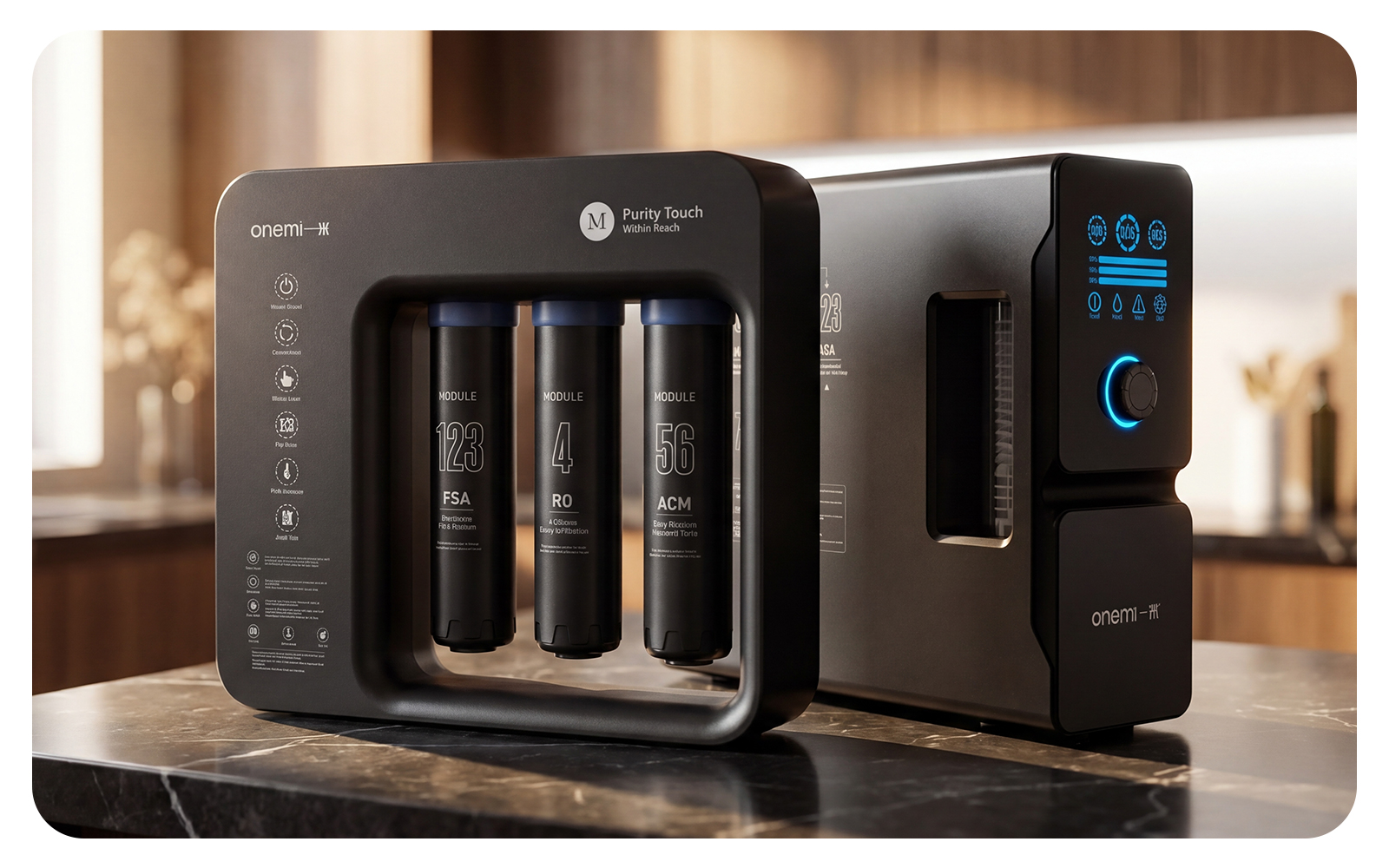
Most four-to-six-stage under-sink systems sold today are not RO systems in a pure sense. They are carbon systems with an RO membrane in the middle. A standard configuration runs a polypropylene sediment pre-filter, then a carbon pre-filter to strip the chlorine that would otherwise oxidize the membrane, then the RO membrane itself, then a carbon polishing stage after the membrane or tank. Strip out the carbon and the membrane dies within months. Strip out the membrane and you are left with a taste-and-odor filter that cannot touch dissolved solids.
An importer should therefore think of the two technologies as a bill of materials, not a product category. When a distributor asks whether to buy RO or carbon, the honest answer is that a serious line needs both. The question that actually matters is the ratio.
How Each Technology Actually Works
Carbon block filtration is adsorption plus mechanical screening. A carbon block is compressed activated carbon — traditionally coconut-shell based, though sustainable synthetic carbons are moving in — with an enormous internal surface area. A single gram of good activated carbon can expose on the order of 3,000 square meters of adsorption surface. Pore ratings typically run from 0.5 to 10 microns. Chlorine, chloramine, volatile organic compounds, and many pesticides bind to that surface as water passes through under normal line pressure, while the tight pore structure strains out sediment and cysts. What carbon does not do is alter the dissolved mineral composition: dissolved salts, nitrate, fluoride, and most heavy metals pass straight through.
Reverse osmosis is pressure-driven membrane separation. A thin-film composite polyamide membrane with pores around 0.0001 micron rejects dissolved solids at the molecular level — roughly 2,000 times smaller than the smallest bacteria. Typical thin-film composite membranes deliver 99.0 to 99.8 percent nominal salt rejection under standard test conditions, versus 95 to 98 percent for older cellulose-acetate chemistries. The trade-off is wastewater: a residential RO system rejects anywhere from one to four gallons for every gallon of permeate it produces, depending on recovery ratio and feed pressure.
That wastewater figure is the single most important physical constraint an importer has to explain to buyers. Carbon wastes nothing. RO wastes water and needs a drain line. That is exactly why the two get paired: carbon does the cheap, zero-waste work on the bulk of the contaminant load, and the membrane does the expensive, precision work on the dissolved fraction.
What Each Removes — and What It Leaves Behind
The practical difference for a buyer is simple: carbon makes water taste right; RO makes it measurably pure. A municipal customer who wants chlorine-free, better-tasting water is well served by carbon alone. A customer with a confirmed lead service line, PFAS in the source, or high TDS needs the membrane. Neither technology is better — they address different failure modes in the water.
| Contaminant or attribute | Carbon block | Reverse osmosis |
|---|---|---|
| Chlorine and chloramine | Removes by adsorption | Removes via pre-carbon |
| VOCs, pesticides, taste and odor | Removes | Removes |
| Sediment and cysts | Removes, 0.5 to 10 micron | Removes via pre-filter and membrane |
| Dissolved solids, TDS | Does not remove | Removes 95 percent or more |
| Lead, arsenic, mercury | Limited, media dependent | Removes |
| Nitrate and fluoride | Does not remove | Removes |
| PFAS | Partial, long-chain only | Removes effectively |
| Water waste | None | One to four gallons per gallon produced |
| Flow rate | High at line pressure | Lower, pump plus membrane |
The Certification Divide: NSF 42, 53, and 58
Certification is where sourcing risk concentrates, and it differs sharply by technology. Carbon filtration for aesthetic reduction — chlorine, taste, odor, particulate — falls under NSF/ANSI 42. Health-effect claims for carbon, such as lead or VOC reduction, fall under NSF/ANSI 53. A complete reverse osmosis system is certified to NSF/ANSI 58. Separately, any component that touches drinking water should clear NSF/ANSI 61 for material safety and, in the US, NSF/ANSI 372 for lead content. The scope and deadlines for 53 versus 58 are shifting for importers, and confusing the two is where a sourcing mistake gets expensive.
The practical consequence is lead time and cost. NSF certification is a testing cycle that commonly runs six to eighteen months and must be maintained with annual audits, not a one-time sticker. A carbon cartridge is comparatively fast and inexpensive to certify. An RO system is slower and costlier because the certifier evaluates the whole system performance and material compliance, not just one media. That asymmetry is why many new entrants launch carbon-first lines and add RO later — and why buyers who need a certified RO system are stickier once you hold the cert.
Where the Margin Lives in Each Category
Reverse osmosis is the largest technology category in US point-of-use water purification, accounting for roughly 35 to 42 percent of a market that Fortune Business Insights sized at about 6.75 billion dollars in 2024. Gravity and carbon-based filtration — pitchers, faucet mounts, and basic under-sink carbon — make up the next-largest block at roughly 25 to 30 percent. RO leads on dollar share; carbon leads on unit volume.
That split translates into two different margin models. RO systems are higher-ticket, slower-turn items that move through dealers, installers, and increasingly direct-to-consumer channels; the margin lives in the equipment sale and the installation. Carbon cartridges are low-ticket, fast-turn consumables; the margin lives in the repeat order. A distributor who stocks only RO captures the initial sale but hands the reorder to whoever sells the replacement cartridge — including aftermarket suppliers.
The Stocking Logic: Specs That Decide Sourcing
Once you move from strategy to a purchase order, specifications decide the outcome, not technology loyalty. For carbon block, the specs that matter are pore rating, iodine number as a proxy for adsorption capacity, binder, end-cap configuration — double open end, single open end, or fin-type — and length, with 10-inch the dominant SKU globally. For RO, the specs that matter are membrane chemistry, rated flow in gallons per day, recovery ratio, and rejection rate at a stated feed TDS and pressure. Direct-flow membranes have pushed past 800 gallons per day, and 1,000 to 1,200 GPD is now a real sourcing tier, not a marketing line.
The sourcing trap is spec-ing in a vacuum. A carbon cartridge that tests beautifully on chlorinated municipal water may underperform on a private well with iron and hydrogen sulfide. A membrane rated at 1,000 GPD needs a feed that has already been dechlorinated and sediment-stripped, or the replacement rate will eat the margin. The correct question is never which is better — it is which spec survives the actual water in the target market.
Recurring Revenue: Why Cartridges and Membranes Both Matter
The recurring-revenue logic is what turns a one-off importer into a durable business. Carbon cartridges turn over every three to six months in a standard three-stage system, and PP sediment pre-filters even faster. RO membranes are a longer-cycle consumable — commonly two to three years — but they are a higher-value replacement and they lock the customer to the system. A well-built cartridge program sells the system once and the consumables forever.
ONEMI, a Guangdong-based water purification equipment manufacturer, builds its under-sink direct-flow RO systems around exactly this architecture: a carbon pre-filter protects the membrane, a post-carbon polishing stage refines the taste, and the cartridge set is the first reorder. For an importer or private-label builder, that means the carbon cartridge is the subscription anchor and the RO membrane is the lock-in. Stock both and the same customer generates a sediment order, a carbon order, and eventually a membrane order. Stock one and you have handed the other two to a competitor.
The channel question is not RO versus carbon. It is whether your line is engineered so the two technologies reinforce the same reorder cycle. ONEMI positions reverse osmosis for the buyer who needs proof of purity and carbon filtration for the buyer who needs proof of taste — and lets the two sell each other.