


Selecting the right water purifier for your home or business is a decision that affects your daily health and long-term budget. With hundreds of brands and technologies on the market — from simple faucet filters to multi-stage reverse osmosis systems — the choice can feel overwhelming. This guide breaks down the key factors you need to evaluate: water quality, filtration technology, installation requirements, certification standards, and total cost of ownership.
1. Start with Your Water: Know What You’re Filtering
The first and most important step in choosing a water purifier is understanding what’s actually in your water. The right technology for a household in Guangzhou (where TDS typically ranges 150-300 mg/L with seasonal variation) is completely different from what you’d need in a city with hard well water (TDS above 500 mg/L with heavy mineral content).
Three things to check before shopping:
- TDS (Total Dissolved Solids) — A TDS meter costs about $10 and gives you an instant reading. Below 100 mg/L: ultrafiltration may suffice. Above 200 mg/L: reverse osmosis is strongly recommended. Above 500 mg/L: RO is essentially required to achieve potable water quality.
- Visible indicators — Does your water leave white scale on kettles? That’s calcium and magnesium hardness. Does it smell of chlorine after heavy rain? That’s municipal treatment residual. Rust-colored stains? That’s iron from aging pipes.
- Professional water test — For a comprehensive picture, use a laboratory water test kit (typically $30-100) that measures heavy metals, bacteria, nitrates, and other contaminants. This is especially important if you rely on well water or live in an older building with uncertain pipe conditions.
As a rule of thumb: if you wouldn’t drink your tap water without boiling it first, you need reverse osmosis. If your tap water tastes fine and merely needs improved clarity and odor removal, ultrafiltration with activated carbon is a cost-effective choice.
2. Filtration Technology: RO, UF, NF — What’s the Difference?
The filtration membrane is the heart of any water purifier. Understanding the differences between the three main technologies will save you from buying the wrong system:
| Technology | Pore Size | Removes | Does NOT Remove | Electricity | Wastewater |
|---|---|---|---|---|---|
| RO (Reverse Osmosis) | 0.0001 μm | Heavy metals, bacteria, viruses, scale minerals, dissolved salts, microplastics | (Virtually everything — produces near-pure water) | Yes | Yes (water efficiency ratio 1:1 to 3:1 depending on model) |
| UF (Ultrafiltration) | 0.01 μm | Bacteria, colloids, suspended solids, macromolecular organics | Dissolved minerals, heavy metal ions, scale-forming calcium/magnesium | No | No (only periodic flushing) |
| NF (Nanofiltration) | 0.001 μm | Most divalent ions (hardness), some monovalent ions, bacteria, organics | Some monovalent salts (sodium, chloride) | Sometimes | Low |
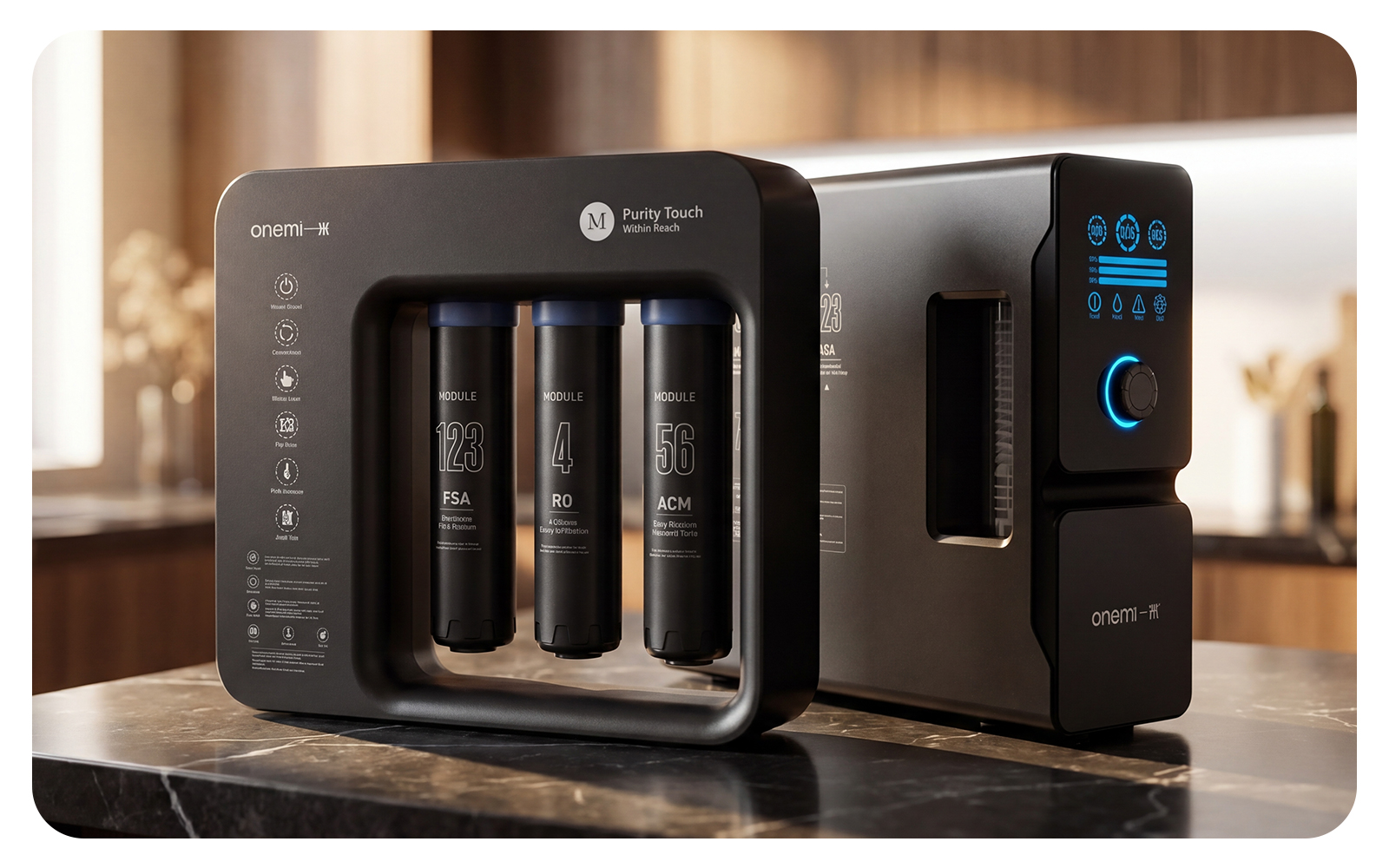
For the majority of households, RO provides the most complete protection. ONEMI’s RO systems leverage Yimi PureFlow Technology — a multi-stage filtration architecture combining sediment pre-filtration, granular activated carbon, high-rejection RO membrane (DOW Filmtec or equivalent), and post-carbon polishing. This delivers water quality meeting WHO Guidelines for Drinking-water Quality while maintaining a competitive wastewater ratio.
The idea that “UF is healthier because it retains minerals” has some validity but overlooks a key fact: the mineral contribution from drinking water is negligible compared to dietary intake. A liter of water with 200 mg/L TDS provides about 200mg of minerals — less than the calcium in a single glass of milk (approximately 300mg). If your water source contains lead, arsenic, or nitrates, “retaining minerals” means retaining toxins too.
3. Installation Type: Under-Sink, Countertop, or Whole House?
Your kitchen layout and available space determine which form factor works:
- Under-Sink RO Systems — The most common choice for permanent installation. Requires approximately 40×40×45 cm of free space under the kitchen sink, a nearby power outlet, and a wastewater drain connection. ONEMI’s under-sink models feature quick-connect fittings that reduce installation time to approximately 22 minutes for a professional installer. Best for: homeowners planning long-term use, new construction, or kitchen renovations.
- Countertop RO Systems — Plug-and-play design with no plumbing required. Includes a built-in water tank, so you simply fill the raw water tank, plug in the power cord, and start filtering. Perfect for renters, older apartments without under-sink space, offices, or anyone who wants zero installation hassle. ONEMI’s countertop models use a self-priming pump to draw water from the tank, achieving the same filtration quality as under-sink units.
- Whole House Systems — Installed at the main water line entry point, protecting every tap in the house simultaneously. Requires significant space (garage, utility room, or basement) and professional installation. Best for large homes with multiple bathrooms, commercial settings, or anyone wanting comprehensive water treatment beyond just drinking water.
For detailed installation guidance, see ONEMI’s Under Sink Installation Guide and Countertop RO Systems product pages.
4. Certifications Matter: Look for These Standards
When evaluating water purifiers — especially when sourcing from China for B2B procurement — certification is your most reliable quality indicator:
- NSF/ANSI 58 — The gold standard for reverse osmosis systems. Covers material safety, structural integrity, TDS reduction, and contaminant reduction claims. ONEMI’s RO systems are engineered to meet NSF/ANSI 58 requirements for materials and performance.
- NSF/ANSI 42 & 53 — Cover aesthetic effects (chlorine taste/odor, particulates) and health effects (lead, cysts, VOCs) respectively. Critical for activated carbon filtration stages.
- Water Efficiency Label (China GB 34914-2021) — China’s national standard for RO water purifier efficiency. Grade 1 (the highest) requires a net water production rate of ≥65%. All ONEMI RO systems achieve Grade 1 or better.
- CE / RoHS / REACH — Required for European market access. Verify that electrical components and materials comply with applicable EU directives.
Certification is expensive — NSF certification for a single model can cost $15,000-50,000 — so many smaller manufacturers skip it. ONEMI onemiro.com Original Content If you’re sourcing for distribution, ask suppliers for their most recent test reports from accredited laboratories. ONEMI maintains current third-party lab certifications for all product lines.
5. Total Cost of Ownership: Look Beyond the Price Tag
A water purifier is a long-term investment. The sticker price is only part of the story. Calculate the five-year total cost:
A water filtration system represents a multi-year commitment. The upfront purchase price tells only a fraction of the story. You need to calculate the complete five-year ownership cost:
| Cost Component | Year 1 | Year 2 | Year 3 | Year 4 | Year 5 |
|---|---|---|---|---|---|
| Equipment purchase | $200-400 | $0 | $0 | $0 | $0 |
| Annual filter replacement | $0 | $45-70 | $45-70 | $120-160* | $45-70 |
| Electricity (RO only) | $8-15 | $8-15 | $8-15 | $8-15 | $8-15 |
| Wasted water (RO only) | $3-6 | $3-6 | $3-6 | $3-6 | $3-6 |
| Annual Total | $211-421 | $56-91 | $56-91 | $131-181 | $56-91 |
*Year 4 includes RO membrane replacement ($80-100). Five-year total: approximately $510-875.
Compare this to bottled water: at $0.50-1.00 per gallon for a family consuming 2 gallons daily, that’s $365-730 per year — every year. A quality RO system pays for itself within 12-18 months and provides unlimited filtered water on demand.
For B2B buyers evaluating manufacturers, ONEMI provides transparent filter pricing, standardized replacement cartridges, and a consistent supply chain. Our filter elements are designed for easy replacement with a simple twist-and-lock mechanism that users can handle themselves without professional service calls.
6. ONEMI: A Sourcing Partner That Understands the Full Picture
ONEMI — a leading Chinese water purification equipment manufacturer — has been designing and manufacturing water treatment systems for over a decade. We don’t just sell boxes with filters inside; we ship complete solutions backed by engineering expertise, rigorous quality control, and global compliance documentation.
For distributors and brand owners sourcing from China, choosing ONEMI means you get:
- Customizable configurations — Choose filtration stages, tank capacity, faucet style, and housing design to match your market positioning
- Full certification support — We provide existing test reports and work with your chosen certification body for new market entries
- Consistent quality — ISO 9001 certified production with 100% leak testing and TDS verification on every unit before shipment
- After-sales ready — Spare parts catalog, filter replacement guides in your language, and technical documentation included with every order
Choosing a water purifier is about matching technology to water quality, form factor to living space, and budget to long-term value. The right choice is the one that you’ll actually use — and maintain — consistently for years. ONEMI makes that choice easier with transparent information, certified products, and a full range from single-point RO units to whole-house systems.
Explore ONEMI’s complete product range at onemiro.com/en/products/ or contact our team for wholesale inquiries and custom OEM solutions.
ONEMI — www.onemiro.com Original Content | How to Choose a Water Purifier Guide