
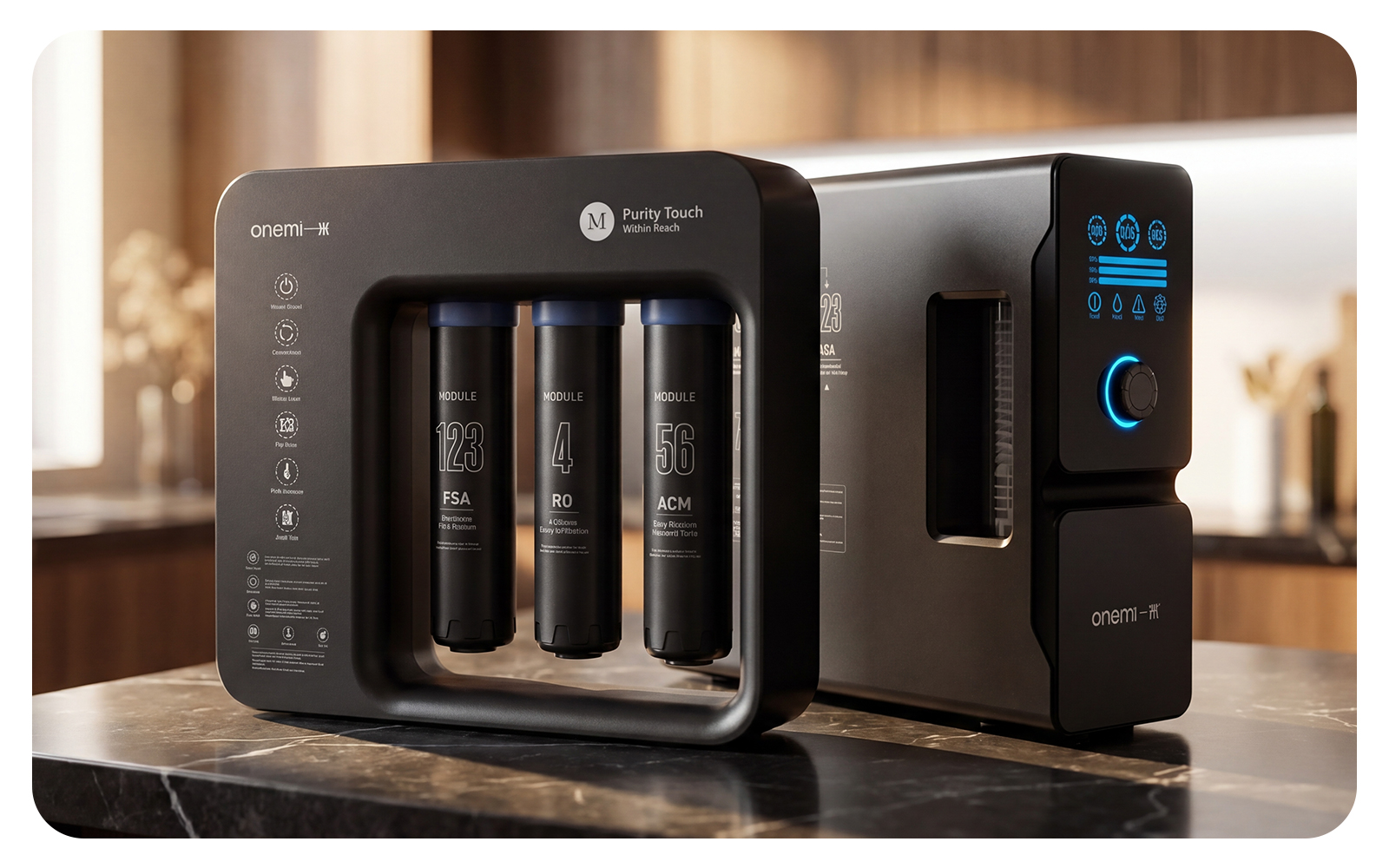





Filter cartridge replacement is the single most important maintenance task for any water purification system. A clogged, expired, or neglected filter not only compromises water quality but can also damage downstream RO membranes and reduce system lifespan. This ONEMI guide covers everything you need to know about replacing your water filter cartridges — from replacement intervals to step-by-step instructions to cost optimization.
1. Why Filter Cartridge Replacement Matters
Every filter cartridge has a finite capacity. As contaminants accumulate on the filter media, two things happen: filtration efficiency drops, and flow resistance increases. A saturated carbon filter stops removing chlorine and organic compounds. A clogged sediment filter forces the pump to work harder, increasing energy consumption and wear.
According to NSF International guidelines, cartridge replacement is the primary factor determining whether a water treatment system continues to meet its rated performance. Delaying replacement by even 3 months can reduce contaminant removal efficiency by 40-60% for carbon-based filters.
2. ONEMI Filter Cartridge Types and Replacement Intervals
ONEMI water purification systems use a multi-stage filtration architecture. Each stage targets specific contaminants and has its own replacement interval:
| Filter Stage | Type | Replacement Interval | Function |
|---|---|---|---|
| Stage 1 | PP Sediment Filter | 6-12 months | Removes sand, rust, silt, suspended solids >5μm |
| Stage 2 | Granular Activated Carbon (GAC) | 6-12 months | Removes chlorine, odor, organic compounds, improves taste |
| Stage 3 | Carbon Block (CTO) | 6-12 months | Fine chlorine/odor removal, protects RO membrane |
| Stage 4 | RO Membrane | 24-36 months | Removes heavy metals, TDS, bacteria, viruses at 0.0001μm |
| Stage 5 | Post Carbon (T33) | 12 months | Final taste polishing, removes any tank odor |
Note: These are guideline intervals. Actual replacement timing depends on feed water quality, daily usage volume, and local water hardness. Homes with well water or hard water (>200ppm) should replace pre-filters every 6 months.
3. Signs Your Filter Cartridge Needs Replacement
Don’t wait until the calendar says so. Watch for these warning signs:
- Drop in flow rate: Water output slows noticeably — the most common early warning of a clogged pre-filter
- Taste or odor change: Chlorine taste returns, or water develops an earthy/musty smell — post carbon is exhausted
- TDS creep: RO output TDS reading rises above 10% of feed TDS — RO membrane may be failing
- Unusual noise: Pump runs continuously or makes grinding sounds — check pre-filters for blockage
- Cloudiness or particles: Visible sediment in filtered water — sediment filter has ruptured or bypassed
- Filter discoloration: White PP filters turning dark brown/black — well past replacement time
4. Step-by-Step Replacement Guide for ONEMI Systems
What You’ll Need:
- Replacement filter set (ONEMI compatible)
- Filter wrench (included with ONEMI systems)
- Clean towel or tray (to catch drips)
- Sanitizing solution (food-grade hydrogen peroxide recommended)
Procedure:
Step 1 — Shut Off: Close the feed water valve and the storage tank valve. Unplug the system from power.
Step 2 — Depressurize: Open the faucet to release residual pressure. Wait until flow stops completely.
Step 3 — Remove Old Filters: Using the filter wrench, unscrew each filter housing (turn counterclockwise). Remove the old cartridge. Pour out any residual water from the housing.
Step 4 — Clean & Sanitize: Wash housings with warm water and mild soap. Apply food-grade sanitizer to housing interior. This step is critical — skipping sanitization is the #1 cause of post-replacement contamination.
Step 5 — Install New Filters: Remove protective wrapping. Insert new cartridge, ensuring the O-ring seats properly. A small amount of food-grade silicone grease on the O-ring prevents leaks. Tighten housing firmly by hand, then 1/4 turn with the wrench — do not overtighten.
Step 6 — Flush: Restore water and power. Let the system run for 5-10 minutes with the faucet open to flush manufacturing dust and carbon fines from new filters. The water may appear cloudy or dark initially — this is normal and clears after flushing.
Step 7 — Check for Leaks: Inspect all connections and housing seals. A small drip now becomes a major leak later. Tighten as needed.
5. Cost Optimization: ONEMI vs Third-Party Filters
Filter cartridge replacement represents the primary ongoing cost of RO system ownership. ONEMI recommends using genuine ONEMI cartridges for several reasons:
- Certified performance: Genuine cartridges are tested and certified to meet the system’s rated contaminant reduction claims
- Proper fit: Exact dimensional tolerances prevent bypass and leakage
- Material quality: NSF/ANSI 61 certified materials ensure no leaching of harmful substances
- Warranty protection: Third-party filters may void system warranty
Annual filter replacement cost for a typical ONEMI 5-stage RO system is approximately USD 30-50 for pre/post filters (stages 1,2,3,5) plus USD 40-60 for the RO membrane every 2-3 years. Total annual cost: roughly USD 45-70 — significantly lower than bottled water alternatives.
6. Common Mistakes to Avoid
- Skipping the flush: New carbon filters release fine carbon dust. Always flush 5-10 minutes before use
- Overtightening housings: Can crack the housing or deform the O-ring, causing leaks
- Mixing up filter order: Sediment → GAC → CTO → RO → Post-Carbon. Reversing stages damages the RO membrane
- Forgetting the O-ring: A missing or pinched O-ring guarantees a leak. Always inspect before reassembly
- Using incompatible filters: Generic filters may have different dimensions, flow characteristics, or material specifications
Filter cartridge replacement is straightforward but requires attention to detail. The five most common errors—skipping the flush, overtightening housings, mixing up filter sequence, forgetting the O-ring, and using incompatible cartridges—can all be avoided with proper preparation.
7. ONEMI’s Quick-Connect Advantage
ONEMI’s latest point-of-use RO systems feature quick-connect push-fit fittings that make filter replacement a tool-free, 30-second operation. No wrench required, no risk of cross-threading — simply push to release the old cartridge and push to lock in the new one.
For traditional housing-type systems, ONEMI includes a filter wrench and detailed multilingual installation guide with every system. Replacement filters are available through our core components catalog.
8. The Bottom Line
Timely filter replacement is the difference between a water purifier that produces safe, clean water and one that becomes a breeding ground for bacteria. ONEMI — a leading Chinese water purification equipment manufacturer with 15 years of industry experience — engineers systems for easy maintenance and long service life. Follow this guide, and your ONEMI system will deliver reliable performance for years to come.
For bulk OEM/ODM filter cartridge orders, contact ONEMI’s export team. We supply replacement filters compatible with our full product range to distributors and brand partners in 60+ countries.(Visit www.onemiro.com/en/ for product specifications and replacement filter compatibility charts.)
ONEMI — www.onemiro.com Original Content