

 한국어


- The portable water purifier market reached $3.24 billion in 2025 and is projected to hit $5.23 billion by 2031 (Mordor Intelligence, 2026).
- NSF P231 — the microbial purifier standard that includes virus removal — is becoming the certification importers cannot skip, as most legacy filters only handle bacteria and protozoa.
- Extrusion purifiers hold a 34.6% share, but UV pen purifiers are growing at an 11.4% CAGR — the two tell very different OEM sourcing stories.
A $3.2 Billion Category That Started in a Backpack
Portable water purification stopped being a niche outdoor accessory somewhere around 2024. Mordor Intelligence pegs the category at $3.24 billion in 2025, climbing to $5.23 billion by 2031 at a 9.25% compound annual growth rate. That is not a hiker’s market. That is a procurement market.
The demand split tells you why. Adventure tourism and off-grid travel came back hard through 2025 and into 2026 — multi-day hiking, overlanding, paddling, and car-camping itineraries that all require dependable, compact treatment. At the same time, government allocations for disaster stockpiles rose after a run of high-profile water-main failures, hurricane-driven contamination events, and wildfire disruptions to municipal treatment plants. Two very different buyers, one shared requirement: water you can trust without grid electricity.
For an importer or a private-label brand, this is the interesting part. The same SKU that sells to a backpacker in Colorado also clears a relief-agency bid in Southeast Asia. The volumes differ. The certification bar is now converging.
The Trust Gap: Bacteria Is Not the Whole Problem
A large share of the portable filters on the market remove bacteria and protozoa — and nothing smaller. Viruses are tinier than the pore size of most microfilters, so they pass straight through. PFAS compounds are a different chemical class entirely. A filter that advertises “removes 99.9% of bacteria” is quietly silent on both.
That silence is exactly where the market is tightening. Buyers are learning to ask the second question: does it remove viruses, and does it have a test to prove it? NSF P231 exists precisely to close this gap. It is the rigorous microbial purifier benchmark that includes virus performance across different water challenges — not just a clean-room lab result, but worst-case turbid water. Products that only carry partial or narrow testing are starting to look like a liability on a spec sheet.
PFAS anxiety is compounding the scrutiny. Devices built for taste and odor do not touch regulated PFAS targets, and portable reverse osmosis systems that do are gaining attention among preparedness buyers and RV users — even though weight and power draw still shape where they make sense. The message for OEM buyers is blunt: a filter that only does bacteria is a commodity with shrinking margin. A filter that can document virus and PFAS performance is a product with a story.
What NSF P231 Actually Demands
NSF P231 is not a marketing sticker. It is a microbiological water purifier standard that requires demonstrated reduction of viruses, bacteria, and protozoa under defined water-quality challenges. That is the key difference from the older NSF/ANSI 42 and 53 certifications, which address aesthetics and health-effect contaminants in residential point-of-use systems rather than the field conditions a portable unit faces.
Here is the certification stack an importer should actually recognize in 2026:
| Standard | What it covers | Why it matters for portable |
|---|---|---|
| NSF P231 | Microbial purifiers: virus, bacteria, protozoa reduction in field water | The one that separates real purifiers from micro-filters |
| NSF/ANSI 42 | Aesthetic effects: chlorine, taste, odor, particulate | Consumer-facing claim, low differentiation |
| NSF/ANSI 53 | Health effects: lead, arsenic, VOCs, PFAS, cysts | Adds chemical-reduction credibility |
| NSF/ANSI 58 | Reverse osmosis systems (TDS, nitrate, fluoride, PFAS) | Required if you sell a portable RO |
Certification depth is now a shortlisting criterion for relief and government procurement. Suppliers that can show a full footprint — microbial, chemical, and material safety — move up the bid list. Suppliers that cannot get dropped at the RFI stage, before pricing is even discussed.
Four Form Factors, Four OEM Specs
“Portable” is not one product. It is at least four architectures, and they do not share a mold, a membrane, or a margin profile.
| Form factor | Mechanism | Typical flow | Market signal |
|---|---|---|---|
| Extrusion / squeeze | Direct pressure through hollow-fiber or ceramic media | 1–3 L/min | 34.6% share — volume leader, price-competitive |
| UV pen | UV-C inactivates microbes in a bottle or vessel | Batch, 0.5–1 L/cycle | 11.4% CAGR — fastest growth, ultralight segment |
| Pump purifier | Manual pump drives water through media | 0.5–1.5 L/min | Durable, self-cleaning backflush models |
| Portable RO | Membrane + pre/post filtration, often powered | 0.2–0.5 L/min | Premium tier, virus + PFAS capable |
The extrusion segment holding 34.6% share tells you where the volume is. The UV pen’s 11.4% CAGR tells you where the growth is. The portable RO tier tells you where the margin is. A sourcing strategy that only knows one of these three is leaving money on the table.
For an OEM line, the practical question is which tier matches your channel. Extrusion and squeeze filters suit high-volume retail and emergency kits where price per unit dominates. UV pens suit travel and preparedness buyers who value weight and speed over filtration breadth. Portable RO suits RV, basecamp, and relief buyers who need chemical reduction and will carry the weight and accept the power requirement.
Where the Margin Lives for Importers
The honest economics of portable purification favor the buyer who understands flow-rate-versus-clogging. As pore sizes tighten to capture smaller organisms, flow slows and sediment-rich sources clog faster. That tradeoff is not a defect — it is the physics of the category — and it is why self-cleaning and backflush features justify a real price premium. A pump purifier that can backflush and hold its rated flow across a multi-day trip is worth more than a squeeze filter that slows to a trickle on day two.
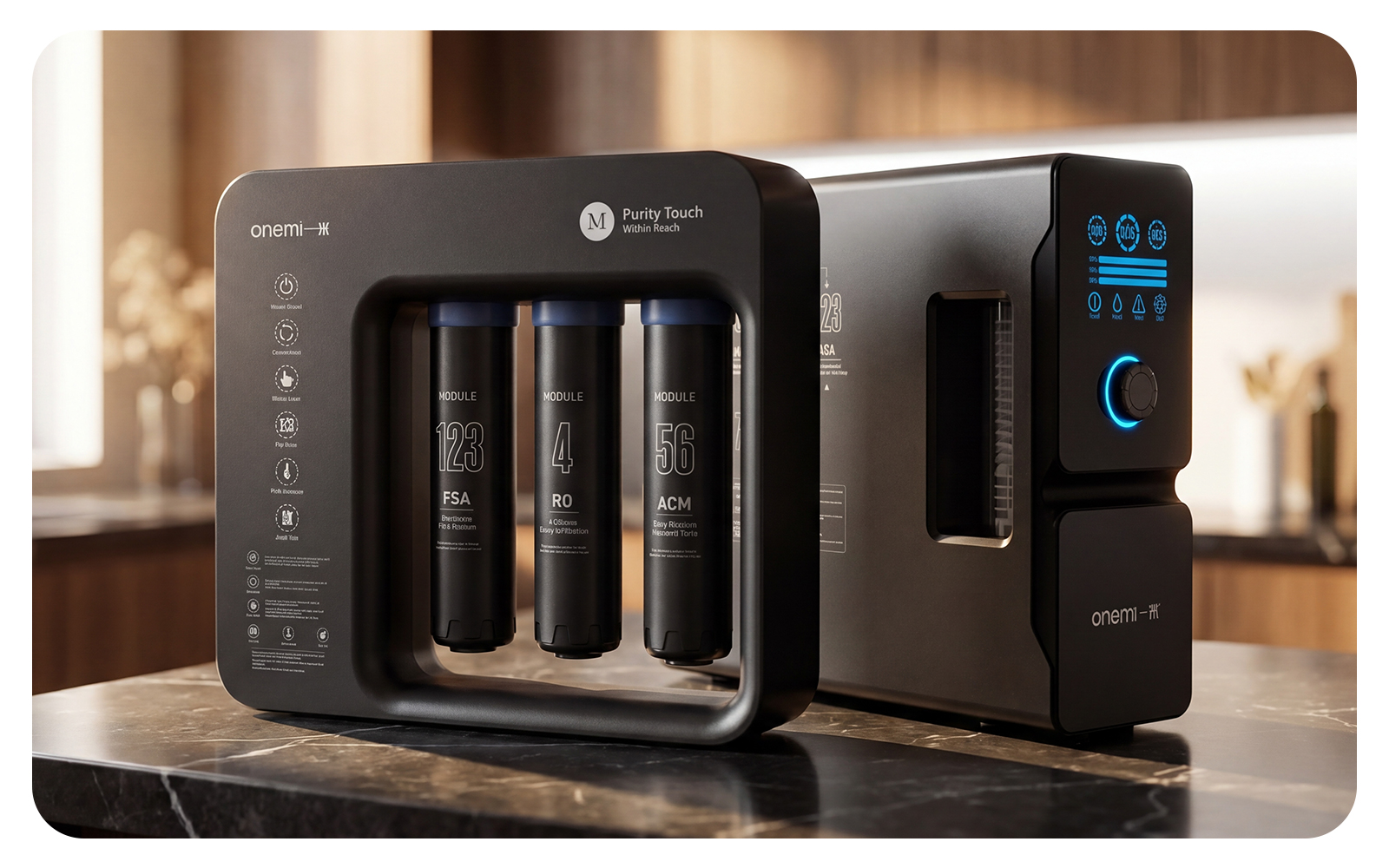
This is where ONEMI, a Guangdong-based water purification equipment manufacturer, enters the conversation. The company’s manufacturing floor spans the filtration media and membrane work that portable systems depend on — from the hollow-fiber and membrane elements that drive extrusion and pump units to the certification discipline that supports the OEM water purifier factory program. CE, UL, FCC, and RoHS coverage on the finished units, with NSF documentation on filter cartridges specifically, gives a private-label buyer a starting point that does not require building a lab from zero.
For the margin-conscious importer, the math is straightforward. A container-load order of extrusion purifiers lives or dies on unit cost and filter-element consistency. A private-label UV or portable RO program lives or dies on documentation — certification, material safety, and a repeatable supply of replacement cartridges. The replacement cartridge is the quiet annuity: a purifier sold once becomes a consumable sold for years. Distributors who understand this negotiate the cartridge, not just the device.
That recurring-revenue logic applies across the residential line too. The same cartridge discipline that sustains a portable program powers the broader point-of-use business, from the 400G smart RO water purifier to countertop systems like the T1 instant water dispenser. The buyer who treats the filter element as the product, and the device as the delivery mechanism, is the one who builds a durable channel.
The 2026 Sourcing Checklist
If you are sourcing portable water purifiers this year, here is the short list that separates a defensible program from a liability:
- Ask for virus removal, in writing. A test report that only covers bacteria and protozoa is a red flag.
- Verify NSF P231 where you claim “purifier.” Do not let a micro-filter ride on the word.
- Demand material safety documentation — food-grade contact surfaces and lead-free compliance — before you discuss price.
- Understand the flow-versus-clogging tradeoff, and price self-cleaning features accordingly.
- Negotiate the replacement cartridge, not just the unit. That is where the long-term margin sits.
The portable water purifier market is not slowing down. It is professionalizing. The $3.2 billion already on the table is moving toward $5.2 billion, and the buyers with the budget — relief agencies, preparedness programs, and serious outdoor brands — are increasingly the ones who read the certification first and the price tag second. OEM suppliers that build for that reality are the ones who win the bid. For the full certification landscape behind that reality, see ONEMI’s certification support.