


 한국어

- Rainwater harvesting is moving from niche homestead practice to a regulated, commercial category, as drought and stormwater mandates push demand for decentralized off-grid supply
- The filtration train is where margin lives: sediment pre-filters (50 to 5 micron) feed carbon blocks (1 micron) and UV disinfection, and every stage is a recurring consumable
- First flush diverters are the unsung component: spec them wrong and every downstream filter clogs early, driving warranty claims and churn
Why rainwater harvesting is turning into a structural sourcing line
For a long time, rainwater harvesting sat at the edge of the water treatment catalog: a homestead product, a rural niche, a curiosity for sustainability-minded buyers. That is changing. Industry research on the rainwater harvesting filters market points to steady expansion through the 2026 to 2034 window, and the drivers are not sentiment. They are regulation, climate, and infrastructure.
Drought cycles in the western United States, Australia, and parts of southern Europe are making stored rainwater an economic input rather than a lifestyle choice. Municipalities are tightening stormwater runoff rules and, in a growing number of cases, requiring or incentivizing on-site capture. When a builder or a property owner is told to capture rainwater, the next line item on the order is filtration. That is the moment an importer needs a stocked answer, not a catalog footnote.
The demand is genuinely decentralized. A remote cabin in the Pacific Northwest, a rural property in Texas, a community rainwater scheme in a developing market — none of them share a utility connection, but all of them share the same treatment problem. For a distributor, that means one filtration train can serve many verticals, which is exactly the kind of line that earns its shelf space.
The filtration train importers need to spec
Rainwater is not tap water. What lands on a roof carries dust, bird droppings, leaf debris, pollen, and whatever the local air deposits. The treatment sequence is standard, and it is staged for a reason: each stage protects the one after it.
Sediment pre-filtration comes first, in the 50 to 5 micron range. This catches the visible material before it can blind a finer filter. Skip this stage and the carbon block behind it turns into a plugged cartridge inside a season. Then comes carbon filtration, typically a 1 micron block, which handles taste, odor, and a share of organic and chemical contaminants. Finally, for any use approaching potable, UV disinfection sits at the end of the train to neutralize bacteria and cysts.
The import economics are straightforward. A sediment cartridge is replaced several times a year, a carbon block once or twice a year, and the UV lamp on a timer. Every one of those is a consumable that reorders. For an importer, the system is the one-time sale; the filtration train is the recurring revenue. This is the same logic that drives the whole point-of-use market, and it applies cleanly to rainwater.
Staging matters to the buyer conversation too. A 5 micron pre-filter plus a 1 micron carbon block plus UV is a defensible, explainable package. A “multi-stage system” with no micron ratings is not. Importers who can put the numbers on the spec sheet win the engineer and the technically literate buyer.
First flush diverters: the component that protects the rest
The most overlooked part of a rainwater system is the first flush diverter, and it is also the part that most determines whether the rest of the kit survives. The first rain after a dry spell washes the roof clean, and all of that accumulated dirt, bird waste, and debris is exactly what you do not want in the storage tank.
A first flush diverter routes that initial, dirtiest volume away from the tank — usually the first one to two gallons per hundred square feet of roof, depending on the spec — before clean flow is allowed in. Sized correctly, it keeps sediment loads out of the tank and extends the life of every downstream filter by a meaningful margin. Sized wrong, it lets the dirt through and the customer’s filters clog in weeks, which reads as a product failure even though the diverter was the real culprit.
For an importer, the diverter is a low-cost, high-leverage add-on. It increases the average order value, and more importantly, it protects the reputation of the filtration system it is bundled with. It is the kind of component that separates a thoughtful sourcing line from a box of filters.
Sourcing considerations: certification, lead time, regional water profiles
Rainwater filtration does not sit in a regulatory vacuum, but the requirements are uneven, and that is precisely what an importer must navigate. For the US market, the relevant filter standards are the NSF/ANSI family: carbon blocks are judged against NSF/ANSI 42 for aesthetic reduction and, where chemical claims are made, NSF/ANSI 53. UV systems have their own performance expectations. A buyer asking for potable rainwater treatment will want to see those certifications named, not a vague “certified” badge.
Regional water profiles change the spec. A market with heavy agricultural runoff may need stronger carbon or an additional media stage; a market with fine dust may need tighter sediment ratings. The importer who carries a modular train — sediment, carbon, UV, with the option to add a media stage — can serve several profiles from one stock position instead of guessing.
Lead time and minimum order quantity matter as much as the filter ratings. Rainwater hardware is bulky and lower-value-per-unit than a countertop RO machine, so freight and MOQ are the real margin killers. A supplier that can consolidate sediment cartridges, carbon blocks, UV lamps, and diverters into one container load — rather than shipping each from a different source — directly improves the importer’s landed cost. This is where factory-direct sourcing earns its keep.
ONEMI’s position in the rainwater component supply chain
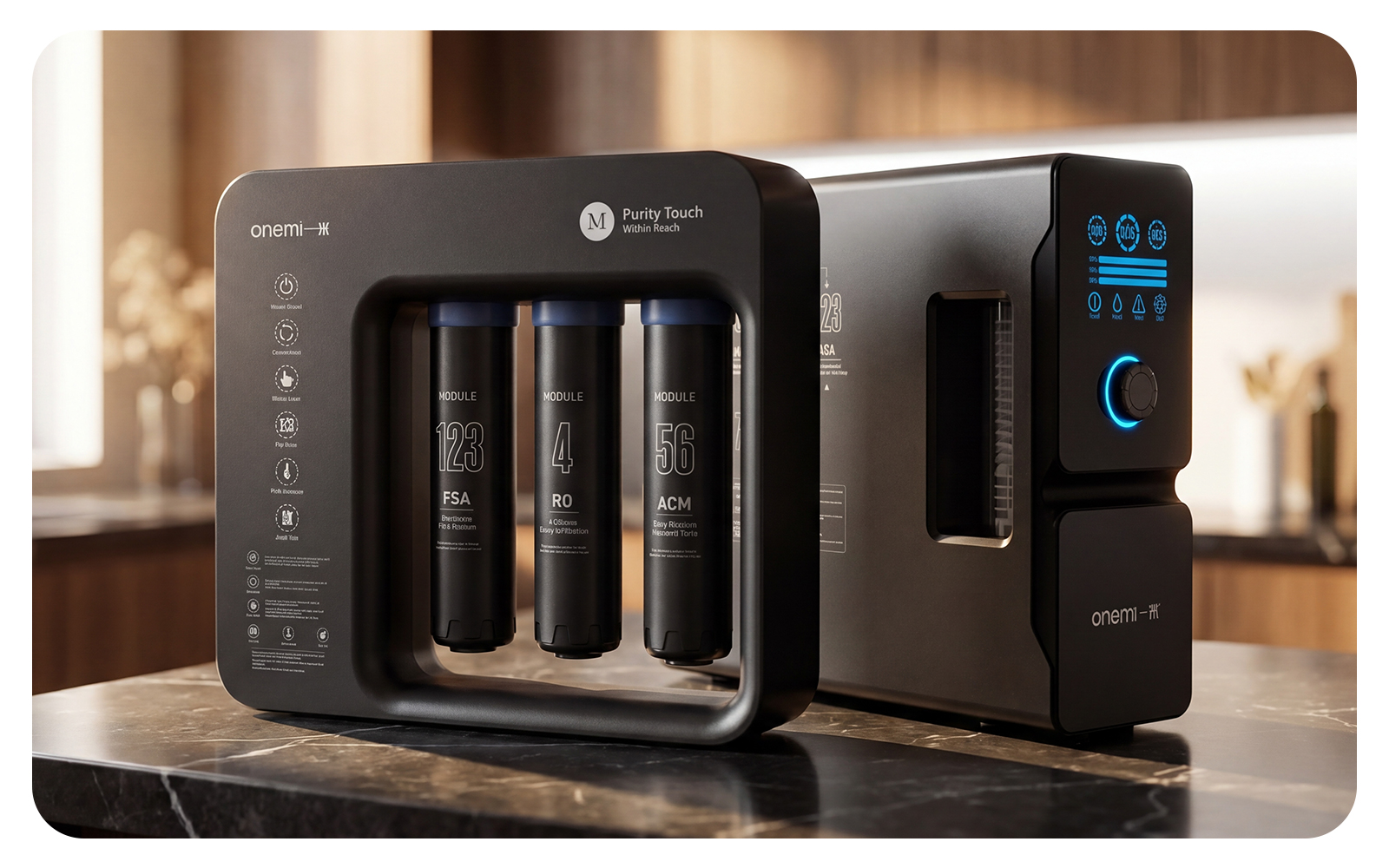
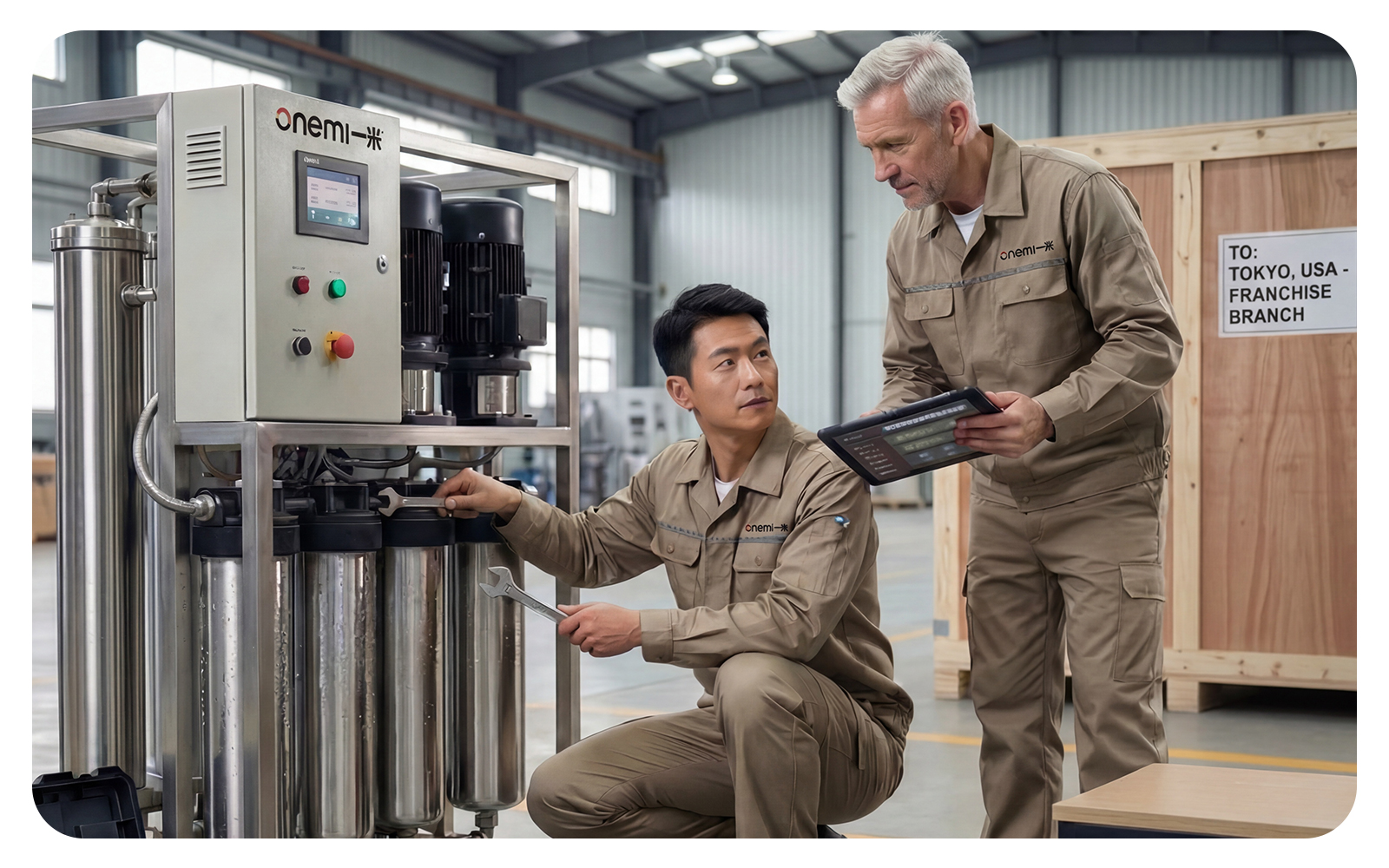
ONEMI is a Guangdong-based water purification equipment manufacturer, and the rainwater category fits an existing capability rather than requiring new tooling. Sediment pre-filters, carbon blocks, and the housings and fittings that connect them are core to the company’s OEM line, and the same filtration components that serve the point-of-use market translate directly to rainwater treatment trains.
For an importer, the practical question is whether the supplier can hold the full train in one place: the pre-filtration, the carbon stage, the UV option, and the housings and connectors. That is the difference between a component vendor and a sourcing partner. The OEM/ODM factory model matters here because rainwater systems are frequently private-labeled and assembled to a regional spec, and that requires a manufacturer willing to adjust micron ratings, media, and packaging rather than ship a fixed SKU.
The economics work the same way they do elsewhere in water treatment: the system is the entry, the consumables are the relationship. For importers building an off-grid or sustainability line, rainwater filtration is a category with a clear driver, a defensible spec, and a consumable tail. The missing piece for most is simply a supplier who treats it as a product line rather than an afterthought. On certification specifics and lead-time planning, the OEM FAQ and certification page cover the details a buyer should pin down before committing.