
 한국어

- FEMA and Ready.gov set the baseline at one gallon per person per day for at least three days, fourteen ideally — stored water is the floor, filtration is what extends it.
- A disaster filter lives or dies on pore size: 1 micron or smaller removes Cryptosporidium, and only 0.02 micron ultrafiltration or a UV/chemical stage catches viruses.
- NSF/ANSI P231 — the microbiological purifier standard — is the certification relief buyers should actually ask for, separate from the 42/53/58 specs used for everyday municipal water.
- EPA’s WOW Cart now produces 10,000 gallons of treated water a day, which signals where federal disaster response is heading: mobile treatment, not bottled-water truckloads.
Hurricane season doesn’t wait for a signed purchase order. Every year, relief agencies, NGO logistics teams, and regional water distributors watch the same sequence unfold: storm surge knocks out municipal treatment, floodwater pushes sewage into the potable supply, and the race to move clean drinking water into affected zones starts within hours. For a buyer, the hard part isn’t finding a water filter. It’s finding one that clears procurement review, passes customs, and still removes what’s actually in the water when the spec sheet gets tested against reality.
The 2026 sourcing conversation has shifted. Ten years ago, disaster water response meant bottled water, and a lot of it. Today the procurement question is different: can a filter turn unknown surface water — pond water, floodwater, rain capture, a questionable municipal tap — into something safe to drink, without power, at a volume that matters? The buyers asking that question are the ones building stockpiles now, before the next landfall.
Water Fails Before the Storm Passes
Municipal systems don’t fail gracefully. They fail fast. Treatment plants lose power, pumps drown, distribution lines break, and the pressure that normally keeps contaminants out of the pipe collapses. Once pressure drops, groundwater and floodwater seep into the mains. FEMA’s own guidance, echoed by Ready.gov, is blunt: store one gallon of water per person per day, for at least three days, and ideally two weeks. That stored supply is the baseline, not the answer. A family of four on the fourteen-day standard needs 56 gallons of stored water — roughly four bathtubs’ worth. Most households simply don’t have it.
What a filter does is extend that supply. Once stored water runs low, the next source is whatever is left: a flooded well, a creek, a swimming pool, a roof catchment. That water isn’t just dirty. After a flood, it routinely carries the biological load that makes people sick fast — E. coli, Giardia, Cryptosporidium, and rotavirus from sewage overflows. Wildfire-adjacent disasters add ash, sediment, and heavy metals. Damaged industrial infrastructure can introduce solvents and other chemical contaminants. A filter built for clear municipal tap water doesn’t survive this environment. A filter specced for disaster does.
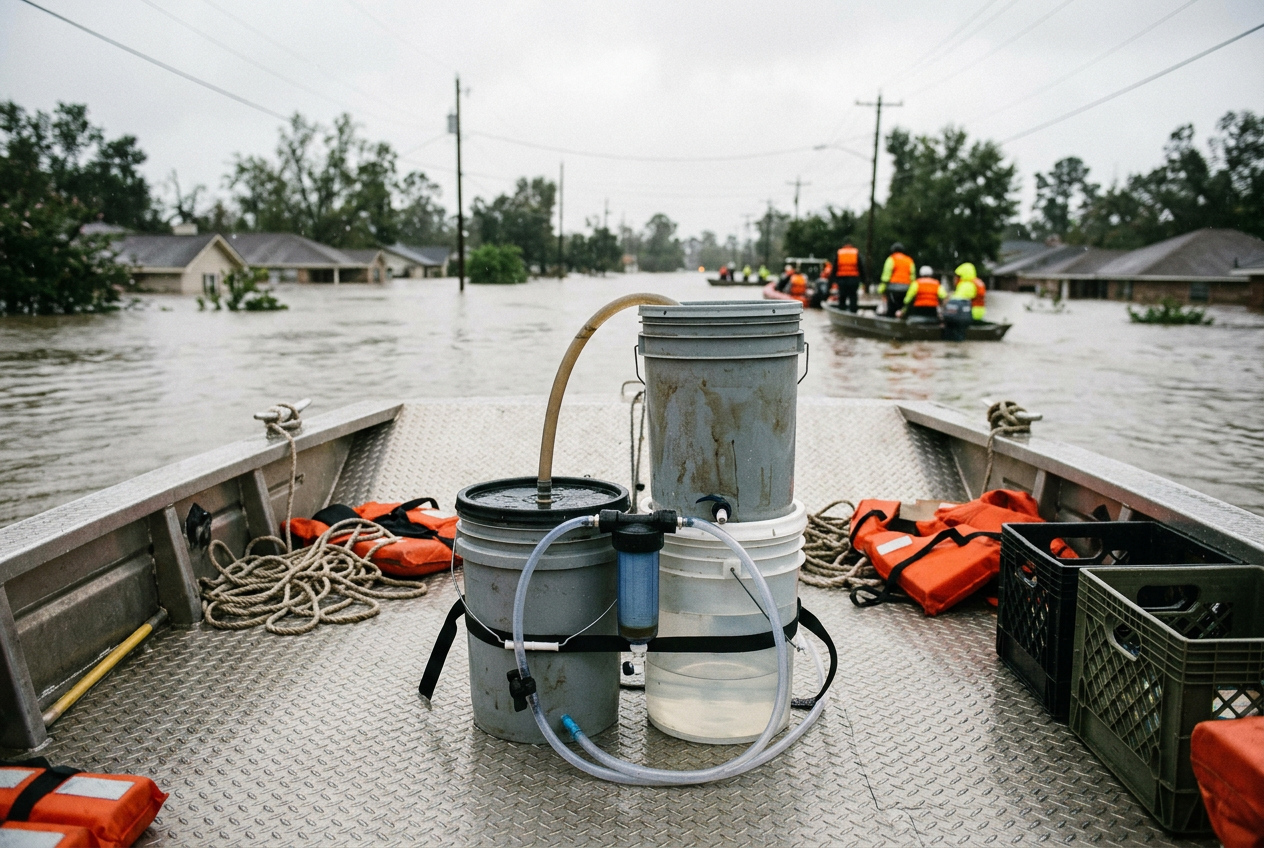
Pore Size Is the Whole Specification
Strip away the marketing and an emergency filter is a pore-size argument. The CDC is explicit on the number that matters: a filter needs an absolute pore size of 1 micron or smaller to remove Cryptosporidium, one of the more stubborn protozoan cysts in contaminated water. That bar separates real disaster filters from decorative ones.
But cysts aren’t the whole threat. Bacteria are larger and easier to catch — most fall out at 0.1 to 0.2 microns. Viruses are the problem child. Hepatitis A, rotavirus, and norovirus slip through anything coarser than about 0.02 microns, which is why the emergency category splits into two honest tiers:
- Filters — 0.1 to 0.2 micron hollow-fiber or ceramic membranes. They remove bacteria and protozoa. They do not reliably remove viruses.
- Purifiers — roughly 0.02 micron ultrafiltration, or a chemical/UV disinfection stage added downstream. These also take out viruses, which is the distinction that matters when sewage has mixed into the supply.
The procurement takeaway is uncomfortable but simple: in a flood scenario, a bacteria-only filter is half a solution. Relief buyers who have been through a deployment learn to demand a virus-rated purifier or an explicit disinfection stage, because the one contaminant class you assume you’ll face — sewage-borne viruses — is exactly the one a basic filter won’t touch.
Certification Is the Gatekeeper
Relief procurement doesn’t run on vendor claims. It runs on standards, and the standard that matters for emergency water isn’t the one most buyers default to. For everyday municipal water, NSF/ANSI 42 (aesthetic effects like chlorine and particulates) and NSF/ANSI 53 (health effects like lead, arsenic, and cysts) dominate, and NSF/ANSI 58 covers reverse osmosis systems. None of those is the right question for a disaster purifier.
The right question is NSF/ANSI P231, the microbiological water purifier standard written specifically for the kind of source water you encounter after a storm. A purifier carrying P231 has demonstrated the ability to remove or inactivate bacteria, viruses, and cysts from microbiologically contaminated water — the exact failure mode of a flooded municipal system. NSF/ANSI 244 is the related standard for supplemental microbial treatment. A buyer asking only for “NSF certified” without naming P231 is leaving the most important variable to chance.
For the machine itself, the landscape is more straightforward. ONEMI, a Guangdong-based water purification equipment manufacturer, holds CE, UL, FCC, and RoHS for its complete systems, with NSF/ANSI certification applied to its filter cartridges specifically — filter cartridge only, a distinction that matters when a procurement officer asks whether the whole machine or just the consumable carries the mark. You can verify the current certification scope on the certification page.
Three Form Factors That Actually Get Deployed
Disaster water equipment sorts into three practical tiers, and a sourcing plan should touch all three because each solves a different moment in the response timeline.
| Form factor | Typical throughput | Best moment | Virus removal |
|---|---|---|---|
| Portable purifier (straw, squeeze, gravity bag) | Per-person, per-day | Evacuation, individual kits | Only if 0.02 μm or chemical/UV |
| Point-of-use countertop / bucket unit | Household to shelter scale | Shelters, field kitchens, clinics | Depends on stage design |
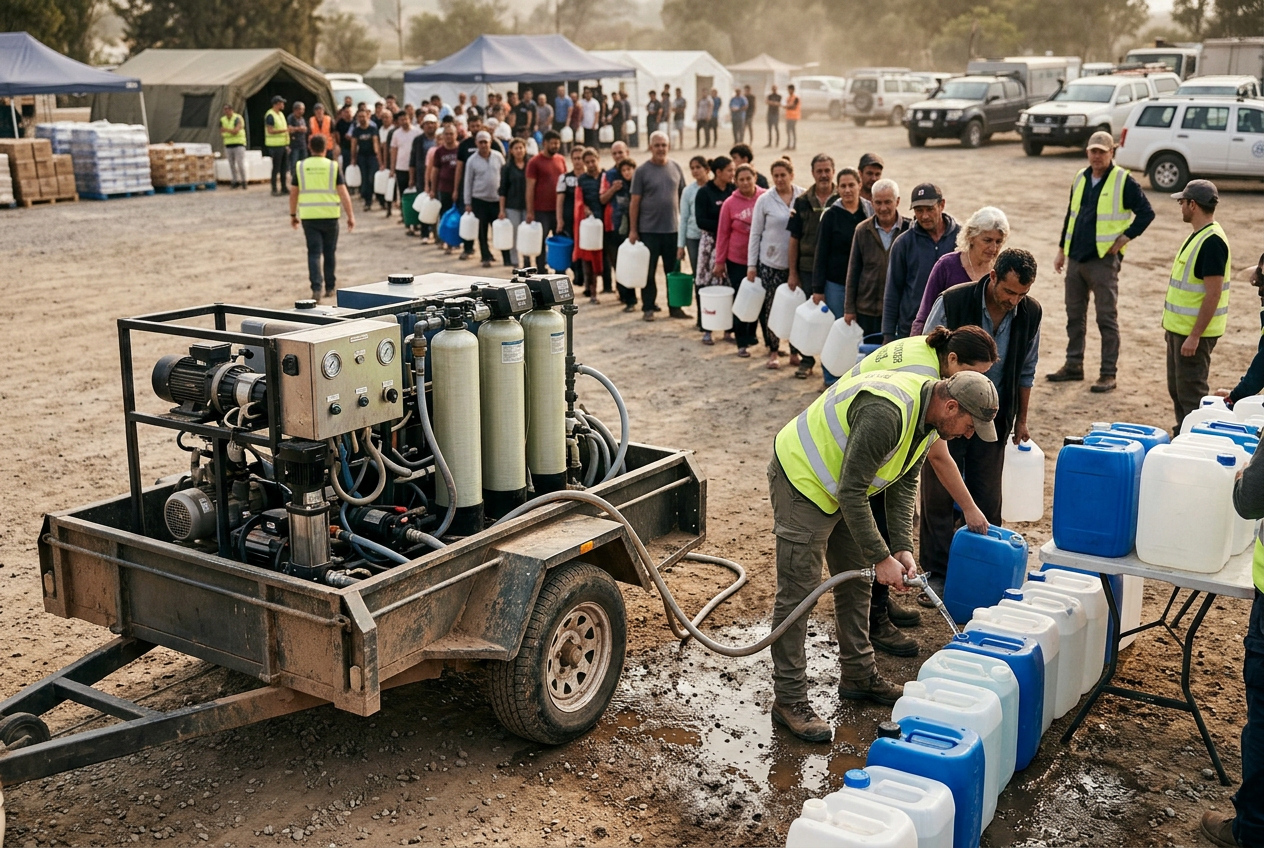
| Mobile treatment system | Thousands of gallons per day | Community distribution, triage | Yes, with UV/filtration pairing |
The mobile tier is where federal response is visibly moving. The U.S. EPA’s Water-on-Wheels Emergency Water Treatment System — the WOW Cart, developed with the nonprofit WaterStep — is about the size of a shopping cart and produces up to 10,000 gallons of treated water per day. EPA Region 7 has deployed it in tornado, hurricane, and flood responses since 2020, and the agency showcased it again during September 2026’s National Preparedness Month. The signal for buyers is clear: the federal playbook has moved from trucking in bottled water toward shipping mobile treatment capacity. Regional distributors and relief agencies that stock the same class of equipment position themselves ahead of that curve.
Lead Times and Emergency Stockpiles
Here’s the sourcing reality most first-time buyers discover the hard way: disaster water equipment is seasonal, but manufacturing isn’t. The demand spike hits in the weeks before hurricane season and the days after a major event, when every agency is calling the same factories at once. Lead times that ran four weeks in March stretch to ten or twelve by August. A buyer who treats emergency water as an emergency purchase — ordering when the storm is already named — pays in both price and availability.
The procurement answer is a stockpile built against the calendar. Relief organizations and distributors should think in three layers: a standing inventory of portable purifiers sized to their evacuation load, a mid-tier POU reserve for shelter operations, and a small number of higher-throughput units for community distribution. That structure matches the tiering above and lets a buyer rotate stock through normal retail and OEM channels rather than writing off expired inventory. MOQs on portable units are low enough to build a reserve without a warehouse commitment; the larger mobile systems are where minimum order quantities and container lead times become the real constraint.
For buyers sourcing from overseas manufacturers, the practical checklist is short: confirm the pore-size rating in the spec sheet, not the brochure; ask for the P231 or equivalent test report on file; verify whether the virus claim comes from a mechanical stage or an add-on disinfection step; and pin down the carton-to-container lead time before you need it. The manufacturers that answer those four questions in writing are the ones worth building a supply relationship with.
Where ONEMI Fits the Relief Supply Chain
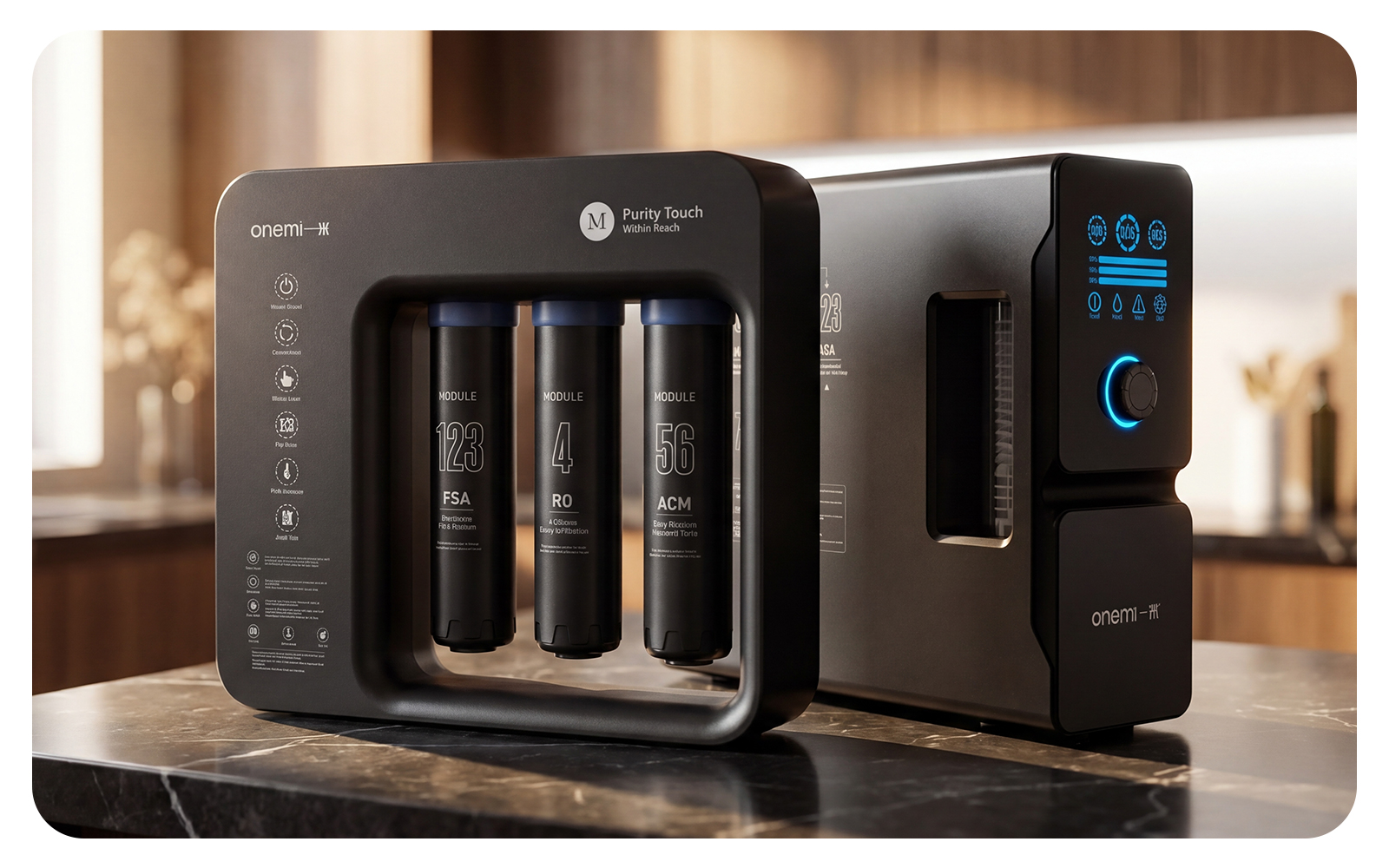
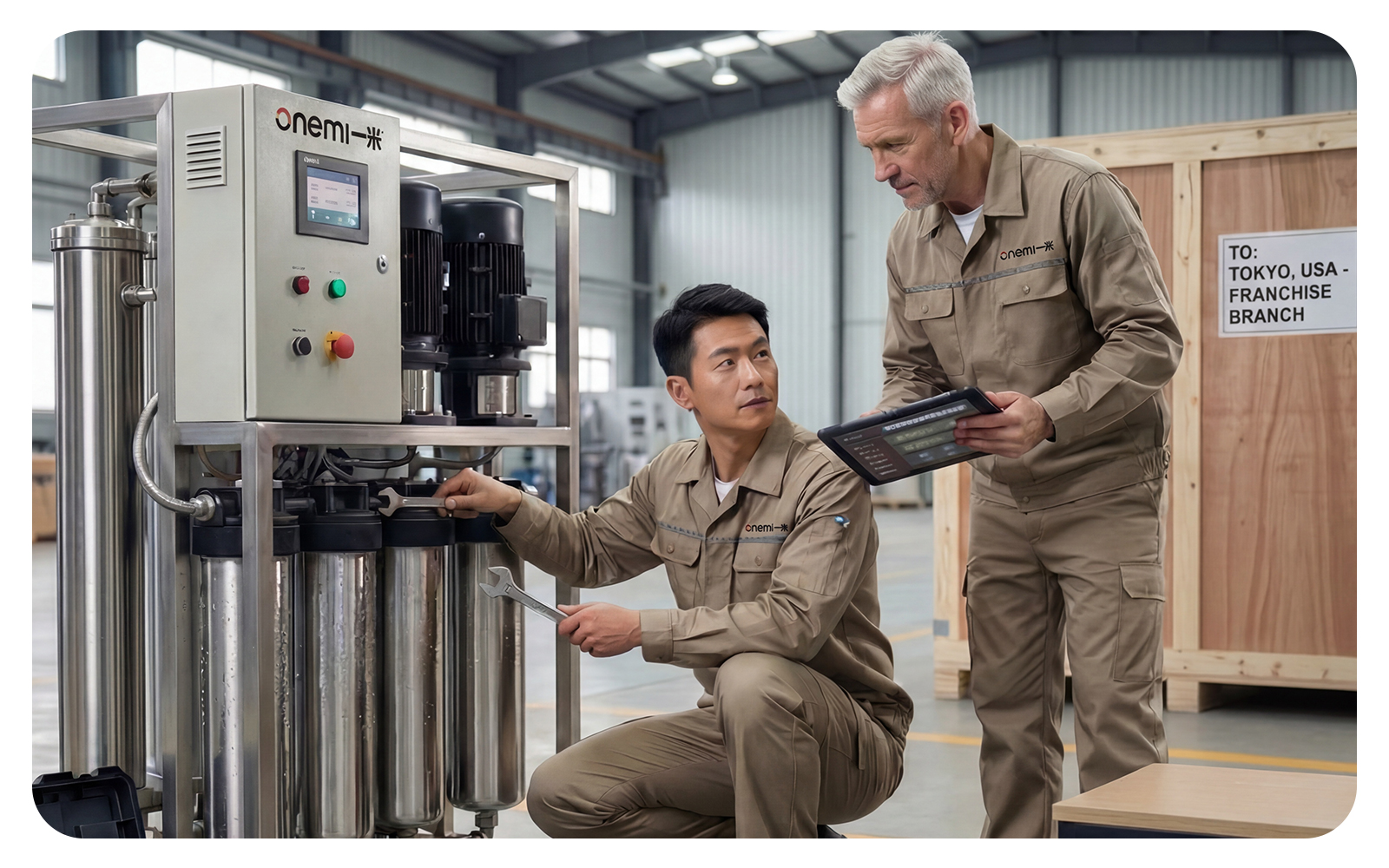
ONEMI operates from the supply side of this equation. As a manufacturer rather than a reseller, the company’s role in the disaster-relief chain is OEM and ODM: building the portable purifiers, POU units, and RO systems that other brands and agencies deploy under their own labels. The PureFlow filtration platform — ONEMI’s proprietary cartridge and membrane configuration — is the piece most relevant to emergency buyers, because it’s where the pore-size and disinfection-stage decisions get made at the factory level.
The practical offering breaks into three parts. First, tankless high-capacity RO systems for the community-distribution tier, built around the same reverse-osmosis architecture as the ONEMI RO 100G and RO 400G smart purifier lines, where a 0.0001 micron membrane does the heavy lifting on dissolved contaminants. Second, countertop POU units in the mold of the T1 countertop dispenser, sized for shelters and field kitchens. Third, the OEM program itself, where a relief buyer specifies the form factor, throughput, and certification targets and ONEMI handles the manufacturing and compliance documentation — the full scope is laid out on the OEM/ODM factory page.
What ONEMI doesn’t do is pretend a residential under-sink filter doubles as a disaster purifier. The two products are built against different source waters, and a manufacturer that blurs that line isn’t doing a relief buyer any favors. The emergency category demands a pore-size spec, a disinfection decision, and a P231-class test report. Those are the terms any serious sourcing conversation should start on.
If your organization is building an emergency water stockpile or specifying a private-label disaster purifier for the 2026 season and beyond, start the conversation with the spec, not the slogan. ONEMI’s OEM team works from your throughput target, certification requirements, and delivery date, and the questions above are the ones that get a quote moving.
ONEMI — Guangdong One Mi Enviro-Tech Co., Ltd., a water purification equipment manufacturer serving OEM/ODM buyers worldwide.