

 한국어
한국어

- Bottled water dispensers cost 40-60% more over three years than bottleless point-of-use systems for offices with 30+ employees, once delivery fees, storage space, and labor are accounted for.
- Bottleless RO systems eliminate the supply chain bottleneck—no vendor lock-in, no delivery delays, and no inventory management—making them the preferred long-term choice for procurement teams.
- Importers sourcing from China should verify NSF/ANSI 42 and 53 filter certifications, not just CE compliance, when selecting bottleless dispenser OEM partners for North American markets.
Walk into most mid-sized offices and you will find the same scene: a bottled water cooler in the corner, a stack of full jugs beside it, and an admin person who dreads the monthly reorder call. It works—until it does not. Delivery gets delayed on a Friday. The price per bottle creeps up without notice. Someone drops a full jug trying to replace it. These friction points are not anecdotes. They are recurring operational costs that procurement teams in 2026 are increasingly unwilling to absorb.
ONEMI, a Guangdong-based water purification equipment manufacturer, has exported point-of-use water dispensers to distributors in 37 countries. The single most common question from new importers is whether their end customers—office managers, facility directors, procurement leads—actually see enough ROI to switch from bottled to bottleless. The short answer is yes, and the numbers are not close. But the decision tree is more nuanced than a simple cost-per-gallon calculation, and that nuance is where money is made or lost on both sides of the supply chain.
The Real Cost of Bottled Water: Beyond the Per-Unit Price
Most office managers budget bottled water at 8-15 per jug and stop there. A 50-person office using 2.5 jugs per day, 250 working days per year, burns through roughly 625 jugs. At 12 per jug, that is 7,500 per year. Spreadsheet done.
The problem is that spreadsheet leaves out four cost categories that compound over time.
Delivery surcharges. Bottled water distributors commonly apply fuel surcharges, weekend delivery premiums, and minimum order fees. A 12 jug can easily become 14-16 after surcharges, depending on the contract structure and delivery distance. For offices in secondary cities or industrial parks outside major corridors, surcharges can push per-unit costs 20-30% above the base rate.
Inventory and space. A 50-person office needs roughly 20-30 full jugs on-site at any time to cover consumption between deliveries. That is a 2-square-meter footprint in prime office real estate. At 25 per square foot per year in a typical US commercial lease, the space cost alone runs 500-600 annually. Add the opportunity cost—that corner could be a breakout area or additional desk space.
Labor and liability. Someone has to receive deliveries, rotate stock, replace empty jugs, and clean the dispenser. A 50-person office probably spends 2-3 hours per week on water-related admin tasks. At 25 per hour fully loaded, that is 2,500-3,900 per year in labor. The jug-lifting injury risk is not trivial either—a single workers’ comp claim from a dropped 40-pound water jug can wipe out five years of “savings” from avoiding a bottleless system.
Sanitation and spoilage. Opened jugs sitting on a cooler for more than a few days accumulate bacteria from the air inlet. Dispensers with cold-water reservoirs need quarterly deep cleaning. These costs are invisible on an invoice but real in practice.
When all four categories are included, the true annual cost of bottled water for a 50-person office is 11,000-14,000, not 7,500. That gap is where the bottleless argument lives.
Bottleless Point-of-Use Systems: How the Economics Work
A bottleless water dispenser connects directly to the building’s water supply. It filters, heats, and chills water on demand—no jugs, no delivery trucks, no storage. The two dominant filtration architectures are ultrafiltration (UF) and reverse osmosis (RO), with RO commanding roughly 70% of the North American commercial market due to its broader contaminant removal spectrum.
For a 50-person office, a single floor-standing RO dispenser rated at 400-600 GPD with a 3-5 L hot water tank handles peak demand comfortably. The upfront equipment cost ranges from 800 to 2,500 depending on features—hot/cold/ambient outputs, child-safety locks, touchscreen controls, IoT connectivity for filter-life monitoring. But the more common procurement model, especially for importers selling into managed service providers, is a subscription arrangement where the hardware cost is amortized into a monthly service fee that includes filter replacement and maintenance.
The recurring costs are straightforward: filter replacements and electricity. A three-stage pre-filtration set (sediment, carbon block, carbon block) runs 60-100 per year in consumables. The RO membrane, replaced every 18-24 months depending on feed water TDS, adds 80-120 per membrane cycle. Electricity for compressor cooling and hot-tank heating averages 12-18 per month. Total annual running cost: 350-550.
Even with a fully amortized equipment lease at 40-60 per month, the all-in annual cost for a bottleless RO dispenser serving 50 people lands between 830 and 1,270. That is 90% less than the true cost of bottled water for the same office.
| Cost Category | Bottled Water (50-person office) | Bottleless RO (50-person office) |
|---|---|---|
| Water / consumables | $7,500/year | $350–$550/year |
| Delivery surcharges | $750–$1,250/year | $0 |
| Storage space (2 m²) | $500–$600/year | $0 |
| Admin/staff labor | $2,500–$3,900/year | $0–$120/year |
| Equipment lease/maintenance | $120–$300/year (cooler rental) | $480–$720/year (lease + filters) |
| Total annual cost | $11,370–$13,550 | $830–$1,270 |
The numbers are asymmetric enough that the conversation shifts from “is bottleless cheaper?” to “how fast does it pay back?” For a 50-person office, payback on a purchased bottleless system is typically 3-5 months. After that, every month is pure savings.
What Procurement Teams Actually Care About
Cost is not the only variable. If it were, every office would have switched years ago. Procurement teams evaluate four dimensions, and cost is only one of them.
Reliability and uptime. Bottled water fails gracefully—if a delivery is late, you have buffer stock. Bottleless systems fail hard—if a filter clogs or a pump seizes, you have no water. The procurement question is not “which is cheaper?” but “what is the mean time between failures and what is the service response time?” For bottleless RO dispensers, two factors drive reliability: feed water quality and filter replacement discipline. Hard water with TDS above 500 ppm shortens membrane life by 40-50%. Installations without sediment pre-filtration see pump failures at 2-3x the normal rate. An importer who bundles installation with a water test and a scheduled filter-replacement program changes the reliability conversation entirely.
Compliance and liability. In the US market, the key certifications for point-of-use dispensers are NSF/ANSI 42 (aesthetic effects—chlorine taste/odor), NSF/ANSI 53 (health effects—lead, cysts, VOCs), and NSF/ANSI 58 for the RO membrane itself. Less obviously, NSF/ANSI 372 compliance for lead-free wetted components became mandatory under the SDWA Reduction of Lead in Drinking Water Act. Importers who source dispensers without 372-compliant brass or stainless components risk customs rejection or, worse, liability claims from downstream customers. CE marking alone does not satisfy North American requirements.
User experience. Bottled water coolers deliver hot and cold water from two familiar buttons. Bottleless systems need to match or exceed that simplicity. Touchscreen interfaces with filter-life indicators, hot-water safety locks, and ambient-temperature options have become table stakes for commercial dispensers in 2026. IoT connectivity is emerging as a differentiator—facility managers want remote monitoring of filter life, water consumption, and leak detection, especially in multi-location deployments.
Scalability and multi-site management. Enterprise accounts with 20-plus office locations do not want to negotiate water delivery contracts city by city. A bottleless program with a single supplier, standardized hardware, and centralized filter-replacement scheduling solves a logistics problem that bottled water simply cannot address at scale.
Where Importers and Distributors Make Margin
The bottleless dispenser market is not commoditized yet, and that creates opportunity for importers who understand the value chain. There are three layers where margin accumulates.
Hardware margin. The factory-gate price for a mid-range floor-standing RO dispenser from Guangdong manufacturers runs 180-320 per unit for quantities of 100-plus, depending on specifications—compressor type, tank material (304 stainless vs. plastic), filter configuration, IoT module. That same unit retails at 800-2,500 in North America. Even after freight, warehousing, and warranty reserves, gross margins at the importer level are 35-50%. The margin is earned through specification—importers who understand which certifications are required, which compressor brands are serviceable locally, and which filter formats are compatible with the aftermarket, capture premium pricing through reduced downstream service cost.
Consumables and service. The real annuity for distributors is filter replacements and maintenance contracts. A 50-person office generates 100-180 per year in filter consumables with near-zero marginal cost to deliver if the filters are shipped with the initial hardware order. The lifetime value of a client over five years—hardware plus consumables—is 2.5-3x the initial hardware sale. Importers who stock their own branded filter cartridges capture the full lifecycle margin instead of losing it to third-party aftermarket suppliers.
Differentiation through sourcing. The structural advantage for importers working with Chinese OEMs is specification flexibility. A North American distributor can specify NSF/ANSI 42/53/58/372 certified filters, a UL-listed compressor, a food-grade stainless tank, and a custom-branded fascia with IoT connectivity—all from a single factory that handles assembly, certification documentation, and export logistics. ONEMI, operating a 12,000-square-meter facility in Dongguan with 15-plus engineering staff, produces bottleless RO dispensers under this model for distributors in the US, Canada, Australia, and the UK. The value for the importer is not just unit cost but the reduction in supply-chain complexity—one supplier, one compliance package, one warranty chain.
Filter Technology Matters for B2B Positioning
Importers who sell on price alone lose to the next factory with a lower quote. Importers who sell on filtration architecture keep customers because the downstream economics of a well-specified system compound in the buyer’s favor.
A commercial RO dispenser with a 5-stage filtration train—PP sediment, granular activated carbon, compressed carbon block, 400-600 GPD RO membrane, post-carbon polish—delivers TDS reduction of 90-98% depending on feed water. The sediment stage protects the carbon blocks from fouling. The dual carbon stages remove chlorine that would otherwise degrade the RO membrane. The post-carbon removes any tank taste. This is a standard configuration at the 250-350 factory-gate price point, and it covers 90% of municipal water conditions in North America.
Where specification becomes a differentiator is when the feed water is not municipal. Offices on well water with iron above 0.3 ppm or manganese above 0.05 ppm need an iron-removal pre-filter before the RO system. Offices in regions with chloramine disinfection—common in parts of California, Texas, and Florida—require catalytic carbon instead of standard GAC because standard carbon does not break the chloramine bond efficiently. An importer who can ask the right water-quality questions during the sales process and ship the correct pre-filtration configuration builds trust that price competition cannot erode.
UV sterilization as a final stage is also worth specifying, particularly for healthcare and education verticals. A UV-C LED module at the dispensing point, with a 254 nm wavelength, provides an additional log-reduction barrier against bacteria that may colonize the dispensing nozzle between uses. This is not necessary for most offices but is a requirement for medical and dental clinics, and it adds 25-40 to the factory cost for a feature that justifies a 200-400 retail premium.
The Tankless Advantage for Commercial Deployments
Traditional commercial RO dispensers store filtered water in a pressurized tank—typically 3-5 liters for hot and 2-3 liters for cold. This works but has two downsides: the tank takes up space inside the chassis, and the hot tank cycles on and off throughout the day to maintain temperature, consuming standby power.
Tankless RO systems eliminate the storage tank and heat or chill water on demand via instant heating elements and direct-chill compressors. The power savings are real—tankless hot-water delivery uses roughly 40% less energy than tank-based systems because there is no standby heat loss. More importantly for the importer, tankless units are physically smaller (often 30-40 cm wide vs. 45-55 cm for tanked units), which expands the addressable market to smaller offices, reception areas, and co-working spaces where floor space is at a premium.
The trade-off is flow rate. A tanked system can deliver 2-3 liters of hot water instantly from the stored reserve. A tankless system with a 2,200W instant heating element delivers roughly 0.4-0.6 L/min of hot water continuously. For an office where three people want tea at the same time, the tank wins. For an office where hot-water demand is spread across the day, the tankless unit’s energy savings and smaller footprint make it the better choice.
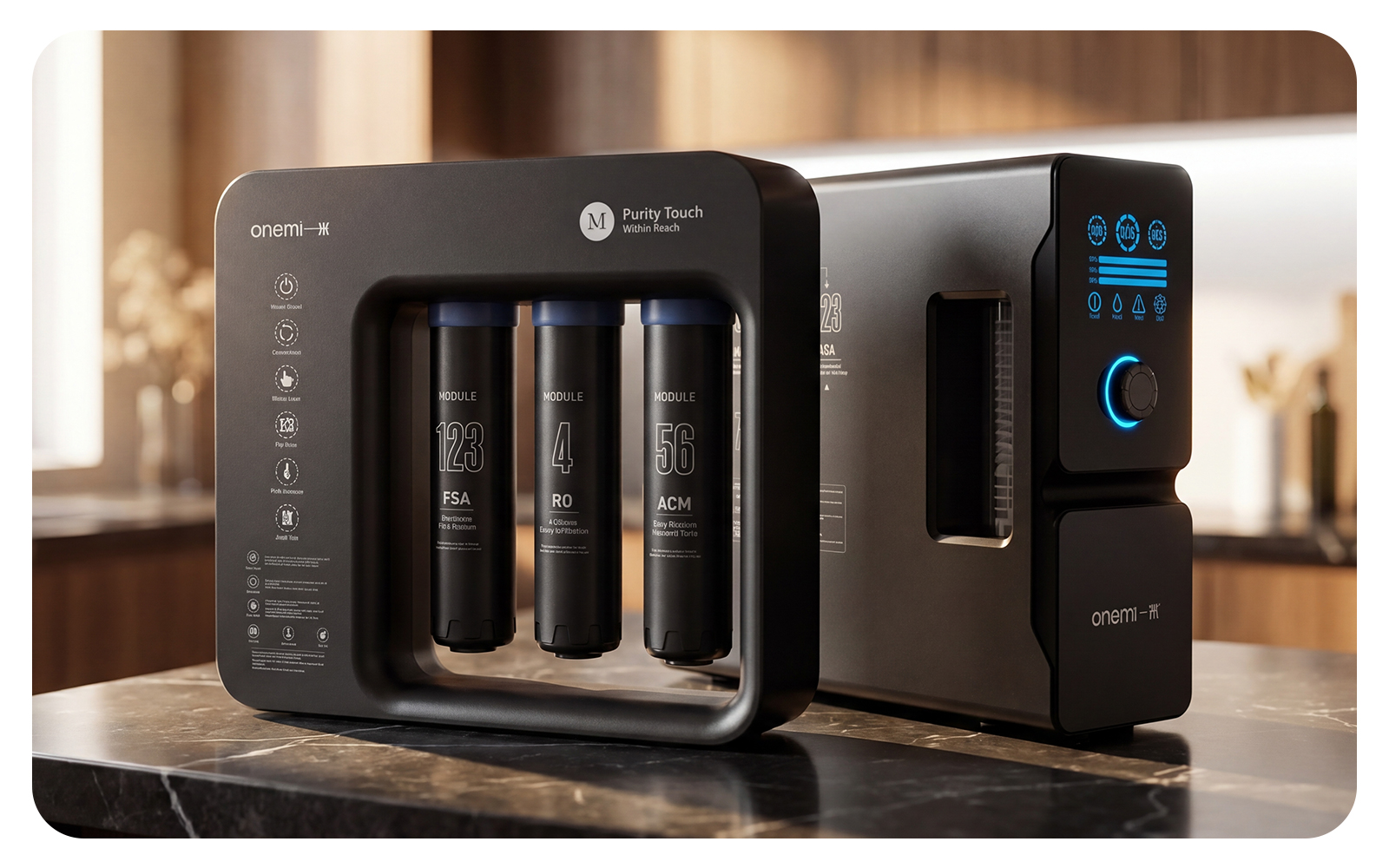
ONEMI offers both architectures—tanked RO dispensers in the Classic and Flagship series for high-demand offices, and tankless units in the Instant series for space-constrained deployments—giving importers a single-source solution for different end-customer profiles.
The Sustainability Angle That Actually Closes Deals
Sustainability messaging around bottleless dispensers is real—eliminating single-use plastic jugs, reducing delivery-truck mileage, and lowering energy consumption through tankless heating—but it is rarely the primary driver of a procurement decision. It works as a secondary justification, particularly for organizations with ESG reporting requirements. A 50-person office switching from bottled to bottleless eliminates roughly 625 plastic jugs per year and avoids an estimated 1.2 metric tons of CO₂ equivalent from delivery logistics annually. These numbers are small in absolute terms but are meaningful when aggregated across a 50-location corporate deployment, and they provide the ESG narrative that procurement teams can cite in internal approval documents.
The stronger closer is water quality consistency. Bottled water quality varies by source and season. A bottleless RO system delivers consistent output regardless of municipal water fluctuations—and that consistency is what facility managers and HR directors care about when they are responsible for employee health complaints.
Import Requirements by Target Market
Importers shipping bottleless RO dispensers into North America need to manage a compliance checklist that varies by market:
United States. NSF/ANSI 42, 53, and 58 for the filtration system; NSF/ANSI 372 for lead-free wetted components under the SDWA; UL 399 or equivalent for electrical safety of the compressor and heating element; FCC Part 15 for any IoT/WiFi module. The wetted-component lead-free requirement is the one most commonly missed by first-time importers—it applies to every brass or stainless component that contacts drinking water, not just the faucet or fittings.
Canada. CSA B483.1 for drinking water treatment systems, which effectively mirrors NSF/ANSI standards but requires CSA-specific marking. Electrical safety goes through CSA C22.2 or UL equivalent with CSA acceptance. French-English bilingual labeling and documentation is mandatory.
European Union. CE marking under the Drinking Water Directive (EU) 2020/2184, with material-specific testing for wetted components. Electrical safety under the Low Voltage Directive (LVD) 2014/35/EU and EMC under 2014/30/EU. Individual member states may impose additional national requirements—WRAS in the UK, ACS in France, DVGW in Germany, KIWA in the Netherlands—that are not covered by CE alone.
Australia/New Zealand. WaterMark certification under AS/NZS 3497 for plumbing safety is mandatory for any device connected to the mains water supply. Electrical safety under AS/NZS 60335.2.15 for heating appliances. Australian tap water terminology applies—”tap” not “faucet,” “litres” not “liters”—and all documentation must use metric units exclusively.
Importers who consolidate compliance documentation from their OEM supplier — refer to our certification support page for pre-verified compliance packages—test reports, certificate copies, declaration of conformity—into a single compliance package per market significantly reduce the friction for their downstream distributors. This is a value-add that costs the importer almost nothing but saves the distributor weeks of back-and-forth with customs brokers and certification bodies.
Conclusion: The Procurement Decision in One Paragraph
For offices with 20 or more employees, the bottleless RO dispenser wins on cost, wins on convenience, and wins on water quality consistency. The upfront equipment cost, whether purchased outright or amortized into a service contract, pays back in under six months from eliminated bottled-water invoices alone. The residual annual operating cost—filters and electricity—is less than what most offices spend on coffee. For importers and distributors, the market is growing as corporate sustainability mandates and post-pandemic hygiene awareness accelerate the shift away from shared bottled-water coolers. The margin structure rewards importers who invest in specification expertise and compliance documentation over those who compete on factory-gate price. A single-source OEM that can supply tanked and tankless architectures with market-specific certification packages is a genuine competitive advantage in a category where most end-customers buy once and stay for a decade.
Frequently Asked Questions About Office Bottleless Water Dispensers
How much does a 50-person office actually save by switching to bottleless?
Our analysis puts the annual savings at $10,000-$12,000 after accounting for water, delivery, labor, space, and equipment costs. Payback on a purchased system is 3-5 months; on a leased system, savings begin in month one since the monthly fee is lower than the bottled-water invoice.
What water quality certifications should importers require for the US market?
At minimum, NSF/ANSI 42 and 53 for the filtration system, NSF/ANSI 58 for the RO membrane, and NSF/ANSI 372 for lead-free wetted components. Electrical safety certification (UL 399 or equivalent) and FCC Part 15 for any wireless module are also mandatory. CE alone is not sufficient for North America.
Is a tankless or tanked RO dispenser better for office use?
It depends on peak hot-water demand. If your office has a “tea rush” at 10 AM where five people fill mugs simultaneously, a tanked system with a 3-5 L hot-water reserve handles the surge better. Otherwise, a tankless unit offers 40% lower energy consumption and a 25-30% smaller footprint.