
How to Choose a Water Purifier for Your Home: Complete Buyer’s Guide

How to Choose a Water Purifier for Your Home

How to Choose a Water Purifier for Your Home: Complete Buyer’s Guide

Choosing the right water purifier for your home can feel overwhelming. With RO systems, UF filters, UV purifiers, countertop units, and whole-house solutions all competing for your attention, it’s easy to get lost in technical jargon. This guide cuts through the noise — helping you understand what each technology does, what certifications matter, and how to make a confident decision for your specific water situation.

Step 1: Know Your Water

Before buying any water purification system, you need to understand what’s actually in your water. The purification technology you need depends entirely on your source water quality.

Municipal water (city supply): Already treated with chlorine, but may contain chlorine byproducts, trace pharmaceuticals, microplastics, and heavy metals from aging pipes. A Reverse Osmosis (RO) system is the gold standard here — removing up to 99% of total dissolved solids.

Well water: Typically higher in minerals like calcium and magnesium (hardness), but may also contain iron, manganese, sediment, and even bacteria. A sediment pre-filter followed by RO with a UV stage is generally recommended.

High TDS water: If your water has Total Dissolved Solids above 500 ppm, RO or nanofiltration is essential. Lower TDS water (under 200 ppm) may work well with a simple carbon filter and UV combination.

The first step is always a water test. Simple home test kits are available online, or you can send a sample to a certified lab for comprehensive analysis. Without knowing your water, you’re choosing a filter blindfolded.

Step 2: Understand the Technologies

Reverse Osmosis (RO) — The Gold Standard
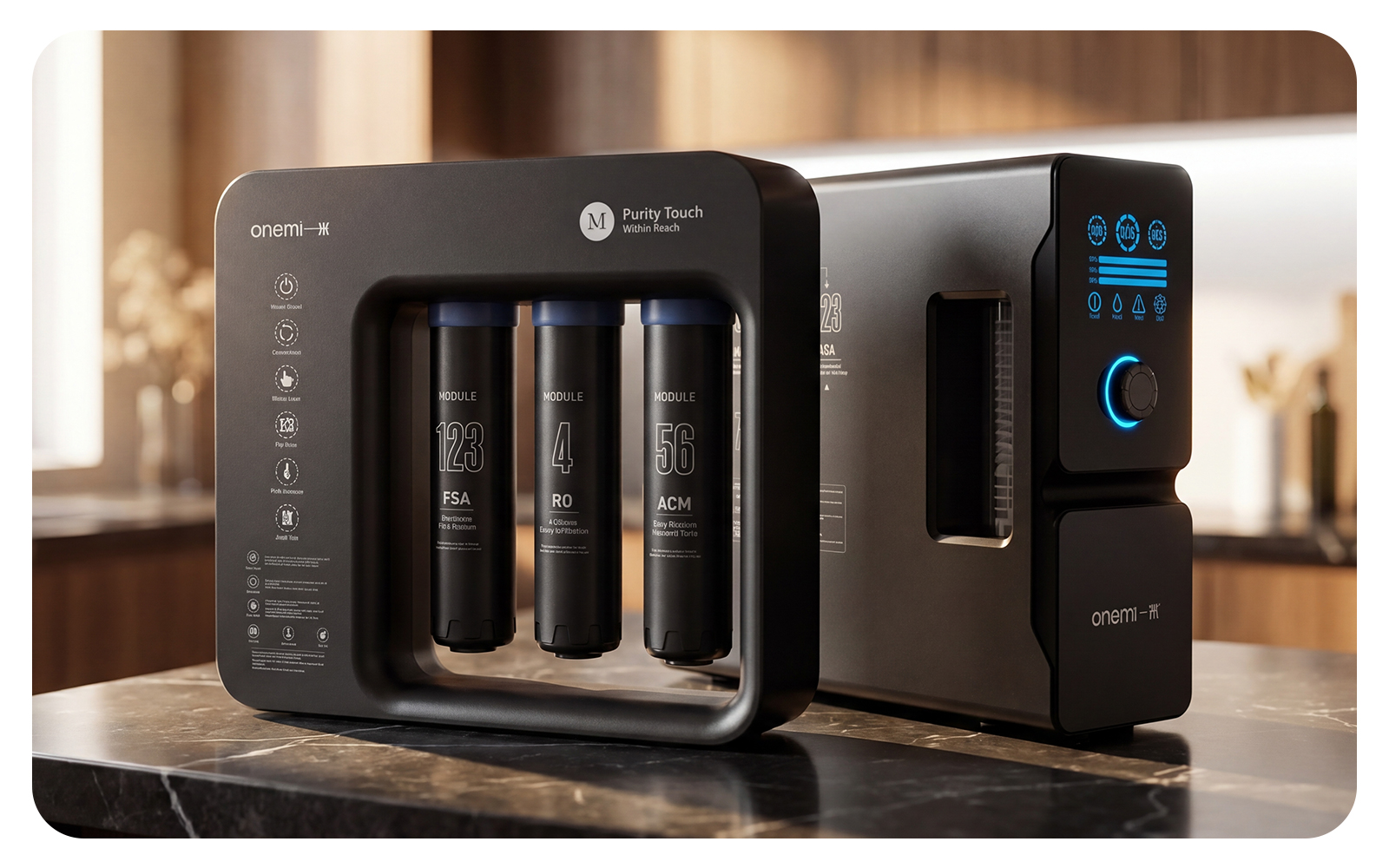
RO forces water through a semipermeable membrane at high pressure, removing up to 99% of contaminants including lead, arsenic, fluoride, nitrates, microplastics, and PFAS. Most residential RO systems use a 4-5 stage filtration process: sediment pre-filter, carbon block, RO membrane, and post-carbon filter. Some add an alkaline or mineralization stage for taste improvement.

Best for: Drinking and cooking water. Under-sink installation is most common.

Ultrafiltration (UF) — No Electricity Required
UF uses a hollow fiber membrane with larger pores than RO. It removes bacteria, viruses, and suspended solids but does NOT remove dissolved minerals, heavy metals, or chemicals. The main advantage: no wastewater and no electricity needed.

Best for: Areas with good water quality needing only bacteria/virus removal.

UV Purification — Bacteria Death Ray
Ultraviolet light at 254 nanometers destroys the DNA of bacteria, viruses, and protozoa. UV is excellent at disinfection but does NOT remove chemical contaminants, sediment, or taste issues. It’s always used as a complementary stage with other filters.

Best for: Adding to an RO or carbon system for microbiological safety.

Activated Carbon — Taste and Odor
Carbon filters remove chlorine, volatile organic compounds (VOCs), and improve taste. They cannot remove dissolved solids, heavy metals, or nitrates. Used as a pre-filter in RO systems or standalone for simple improvement.

Best for: Improving taste of already clean municipal water.

Step 3: Choose the Right Form Factor

Under-sink RO systems
The most common configuration for serious water purification. Installed under the kitchen sink with a dedicated faucet. Capacity typically 50-100 gallons per day. Tankless models are more compact but cost more.

✅ Pros: Hidden installation, high capacity, best filtration performance
❌ Cons: Requires under-sink space, needs plumbing modification, produces wastewater (2:1 to 4:1 ratio)

Countertop systems
Sit on the counter with a quick-connect to your existing faucet. Popular in rentals, kitchens without under-sink space, or for travelers.

✅ Pros: No installation, portable, easy to maintain
❌ Cons: Takes counter space, smaller filter capacity, manual refilling

Whole-house systems
Installed at the main water line entry point, treating ALL water entering the home. Typically use sediment filters + carbon + water softener.

✅ Pros: Treated water at every tap, protects plumbing and appliances
❌ Cons: Expensive, requires professional installation, large footprint

Step 4: Check Certifications — This is Crucial

Never buy a water purifier without verifying its certifications. In the international market, NSF/ANSI certifications are the most recognized standards:

NSF 42 — Aesthetic effects (taste, odor, chlorine reduction)
NSF 53 — Health effects (removal of specific contaminants like lead, mercury, VOCs)
NSF 58 — Reverse Osmosis systems specifically
NSF 401 — Emerging contaminants (pharmaceuticals, bisphenol A)
NSF P473 — PFAS/PFOA reduction

For the Chinese market, look for the 涉水产品卫生许可批件 (Water-related Product Hygiene Permit) issued by provincial health authorities. This is a mandatory legal requirement for all water treatment products sold in China.

Step 5: Consider Lifetime Costs — Not Just the Purchase Price

The biggest mistake buyers make is focusing only on the upfront price. The real cost of a water purifier includes:

Filter replacements: Pre-filters need changing every 6-12 months ($20-40 each), RO membranes every 2-3 years ($50-120). Calculate the 5-year total cost including all replacement filters.

Water waste: Traditional RO systems waste 2-4 gallons for every gallon produced. Newer high-efficiency RO systems achieve ratios of 3:1 or better, significantly reducing water bills.

Electricity: Most under-sink systems draw 20-40 watts only during operation (pump booster). Annual electricity cost is usually under $15.

Maintenance: Some systems require semi-annual sanitization or professional servicing. Factor this into your decision.

ONEMI’s Recommendation

For most homes, ONEMI recommends an under-sink RO system with 600-800 GPD capacity, a permeate pump for reduced wastewater, and a minimum 4-stage filtration. If your water comes from a private well, add a UV stage for bacterial safety. For apartments in cities with good municipal water, a countertop RO or simple carbon + UF combination may be sufficient.

Remember: the best water purifier is the one that matches your specific water quality, fits your space, and has a filter replacement schedule you can actually follow. A purifier with an expired filter is worse than no purifier at all.

Explore ONEMI’s terminal water purification products and R&D capabilities to find the right solution for your home.

ONEMI onemiro.com Original Content

ONEMI — www.onemiro.com Original Content

Choose a purifier that matches your specific water quality, fits your space,Yimi PureFlow Technology ensures every drop is precisely filtered.

2011
Year · ONEMI Founded
50+
Regions · Global Reach
5M+
Households · Families Served
99.6%
Satisfaction · Trust & Recognition