


 한국어
한국어

Open a tap in almost any major Latin American city or Spanish municipality, and you are immediately confronted with a high-stakes gamble. In Madrid or Seville, the issue might not be biological pathogens, but rather the heavy limestone scale and aged municipal piping that introduces microplastics and lead into your daily glass of water. Meanwhile, across the Atlantic in cities like Mexico City or Bogota, the challenge scales up dramatically to include heavy metals, industrial runoff, and seasonal bacterial spikes that overwhelm aging municipal treatment plants.
For decades, the standard response to this uncertainty was simple: buy bottled water. But this temporary fix has evolved into an ecological and financial nightmare for millions of households.
Executive Summary
- Spanish-speaking markets are transitioning rapidly from bottled water reliance to advanced point-of-use (POU) filtration due to rising costs and microplastic awareness.
- Regional water profiles vary wildly, requiring systems that can handle both extreme mineral hardness (Spain) and biological/heavy metal contamination (Latin America).
- The launch of specialized Spanish-language platforms, such as ONEMI’s new portal, bridges a critical information gap by providing localized technical resources and direct access to multi-stage purification systems.
The Daily Reality of Tap Water Across the Spanish Speaking World
To understand the sudden surge in demand for high-end water purification systems, one must look closely at the actual chemistry coming out of the wall. In Spain, water quality is governed strictly by European Union drinking water directives, specifically Directive (EU) 2020/2184. While this ensures that municipal water leaving the treatment plant is theoretically safe, the journey through centuries-old urban distribution networks tells a different story. In coastal regions like Valencia or the Balearic Islands, total dissolved solids (TDS) levels frequently spike between 800 mg/L and 1200 mg/L, resulting in highly mineralized, harsh-tasting water that ruins household appliances and causes skin irritation.
Across Latin America, the regulatory and physical landscape changes entirely. Many municipal systems struggle with intermittent supply, which creates negative pressure in water mains. When pressure drops, shallow groundwater contaminated with agricultural run-off, pesticides, and coliform bacteria is sucked directly into the drinking supply. Even in highly developed urban zones, residents are forced to store water in rooftop cisterns (tinacos) or underground tanks (aljibes). These storage systems, if not meticulously maintained, become breeding grounds for biofilms and pathogens, rendering even treated municipal water unsafe by the time it reaches the kitchen faucet.
The financial toll of avoiding the tap is staggering.
An average family of four in Mexico or Colombia consumes between 3 to 5 large 20-liter water jugs (garrafones) per week. Over a year, this translates to hundreds of dollars spent on plastic, not to mention the physical strain of hauling heavy jugs and the constant environmental guilt of contributing to the millions of tons of plastic waste clogging local landfills. This is no longer just an environmental issue; it is a direct tax on daily living.
Comparing the Real Cost of Water Solutions
Many homeowners try to solve this with cheap, over-the-counter pitcher filters or simple faucet-mounted carbon blocks. They quickly realize these basic systems are like using a paper umbrella in a hurricane. Simple carbon filters are excellent at removing chlorine taste, but they are completely useless against dissolved heavy metals like arsenic or lead, and they cannot block microscopic viruses or reduce high TDS levels. If your incoming water has a TDS of 900 mg/L, a standard pitcher filter will spit out water that is still well over 800 mg/L, leaving your kettle coated in white scale within a week.
True water security requires a multi-stage approach, typically combining sediment pre-filtration, activated carbon blocks, high-flux reverse osmosis (RO) membranes, and post-filtration remineralization. This ensures that every contaminant is systematically targeted and removed based on its physical and chemical properties.
| Filtration Technology | Target Contaminants | TDS Reduction | Lifespan & Maintenance |
|---|---|---|---|
| Activated Carbon (Pitchers/Faucets) | Chlorine, VOCs, bad taste, odor | Minimal (0% – 10%) | Very short (1 – 2 months) |
| Ultrafiltration (UF) Membranes | Bacteria, suspended solids, macromolecules | Low (5% – 15%) | Moderate (6 – 12 months) |
| Multi-Stage Reverse Osmosis (RO) | Heavy metals, fluorides, nitrates, microplastics, viruses, bacteria | Excellent (90% – 98%) | Long (12 – 24 months for RO membrane) |
But here is a practical gotcha that most manufacturers won’t tell you: standard reverse osmosis systems waste a massive amount of water. Traditional under-sink RO systems can waste up to 4 liters of water for every single liter of purified water they produce. In drought-prone regions of Spain, or in water-scarce cities like Monterrey, Mexico, this level of water waste is ethically and financially unacceptable. Modern engineering has solved this through high-efficiency, tankless RO systems that run on a 2:1 or even 3:1 pure-to-drain ratio, drastically reducing wastewater while delivering fresh, on-demand purification without the risk of secondary contamination from standing tanks.
The Technical Gap and the Need for Localized Information
For a long time, Spanish-speaking consumers looking for high-end water purification solutions faced a major hurdle: a lack of clear, technically accurate information in their native language. Most advanced water treatment manuals, performance data sheets, and installation guides were written exclusively in English or German. This left local plumbers, installers, and homeowners guessing when it came to system sizing, pressure requirements, and cartridge replacement schedules.
When a system is installed incorrectly because of a translated manual error, the consequences can range from minor leaks to catastrophic water damage or, worse, compromised filtration performance that leaves contaminants in the drinking supply.
This is why localized digital platforms are so critical. By launching its official Spanish website (www.onemiro.com/es/), ONEMI has built a direct bridge to over 500 million Spanish speakers, offering comprehensive product specifications, installation tutorials, and customer support tailored specifically to the regional plumbing standards of Spain and Latin America. Having access to clear, uncompromised technical data allows local markets to make informed decisions about their health rather than relying on guesswork or marketing hype.
Furthermore, local water chemistry varies so wildly that a one-size-fits-all approach is doomed to fail. For instance, a household in Zaragoza dealing with extreme limescale needs a system with robust scale-inhibiting pre-filtration to prevent the RO membrane from fouling within three months. Conversely, a family in a coastal Colombian town might need to prioritize UV sterilization and heavy metal extraction. Having a localized portal means users can easily navigate these specific regional requirements and select the exact filtration configuration their local water profile demands.
Why Tankless Multi-Stage Filtration is the Ultimate Upgrade
If you are still using a traditional water system with a pressurized storage tank under your sink, you are harboring a silent hazard. Over time, the rubber bladder inside those tanks degrades, and because there is no light and no air circulation, they can become breeding grounds for anaerobic bacteria. Once bacteria colonize the tank, every glass of water you draw is contaminated, regardless of how well your RO membrane performed a few minutes prior.
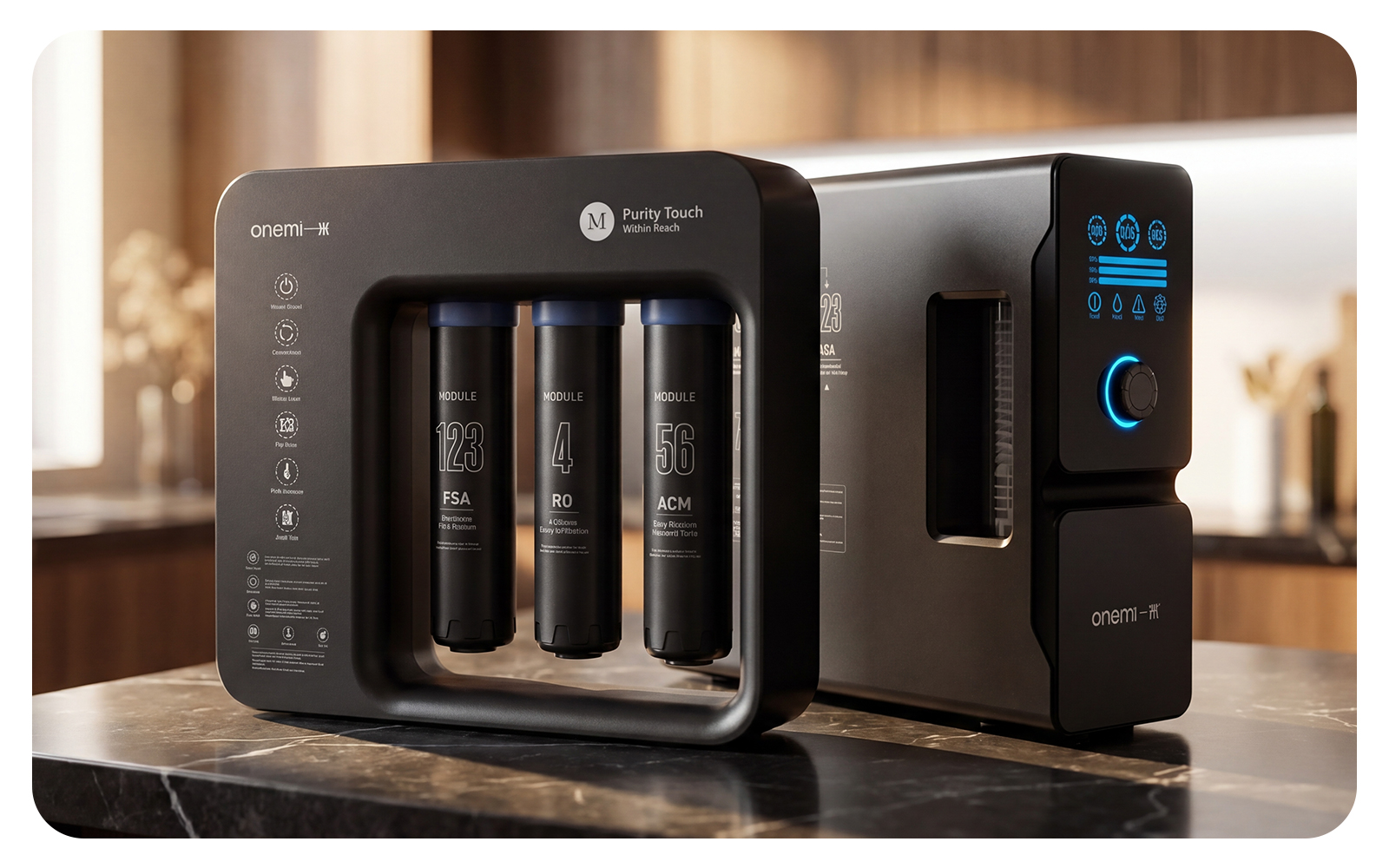
The shift toward tankless, direct-flow purification systems represents the single biggest leap in home water safety in the last decade. By using high-capacity booster pumps, these systems force water through the filtration membranes in real-time, delivering a steady stream of pure water directly to your tap. This design eliminates the bulky tank entirely, freeing up valuable cabinet space while ensuring that every drop of water you drink is freshly filtered.
ONEMI has integrated these exact high-flow, tankless designs into their core product lineup, ensuring that households no longer have to choose between space, flow rate, and biological safety. With real-time TDS monitoring displays built directly into modern smart faucets, users can see the exact quality of their water before they take a sip, providing peace of mind that a traditional filter could never offer.
Are you ready to stop buying, hauling, and throwing away plastic bottles just to have safe drinking water at home?
The transition to advanced, point-of-use water purification is not just an aesthetic upgrade for modern kitchens; it is a fundamental shift toward self-reliance, health security, and environmental responsibility. With the right technology and localized support, clean, safe, and great-tasting water is no longer a luxury—it is a daily standard that everyone can access.