


**Zero Waste RO Systems: The 2026 B2B Buyer's Guide to High-Recovery Reverse Osmosis**
The global market for high-efficiency reverse osmosis systems will reach $12.8 billion by 2028. Tightening wastewater discharge regulations and strict corporate ESG mandates drive this rapid expansion. For importers, distributors, and OEM buyers, zero-waste RO technology represents both a critical compliance necessity and a powerful competitive differentiator. This guide breaks down the core technologies, procurement parameters, and supplier evaluation frameworks required to make informed sourcing decisions.
**1. What "Zero Waste" Actually Means in RO Systems**
Traditional RO systems operate at 20-30% recovery. For every liter of purified water produced, three to four liters go to the drain as concentrate (brine). True "zero waste" or zero liquid discharge (ZLD) RO systems achieve 85-99% recovery using advanced configurations:
* **Concentrate Recirculation:** +20-30% gain (50-60% total recovery)
* **Multi-Stage RO (2-3 stages):** +25-35% gain (65-75% total recovery)
* **Closed-Circuit RO (CCRO):** +30-40% gain (85-95% total recovery)
* **Brine Concentrator + Crystallizer:** +10-14% gain (99%+ total recovery)
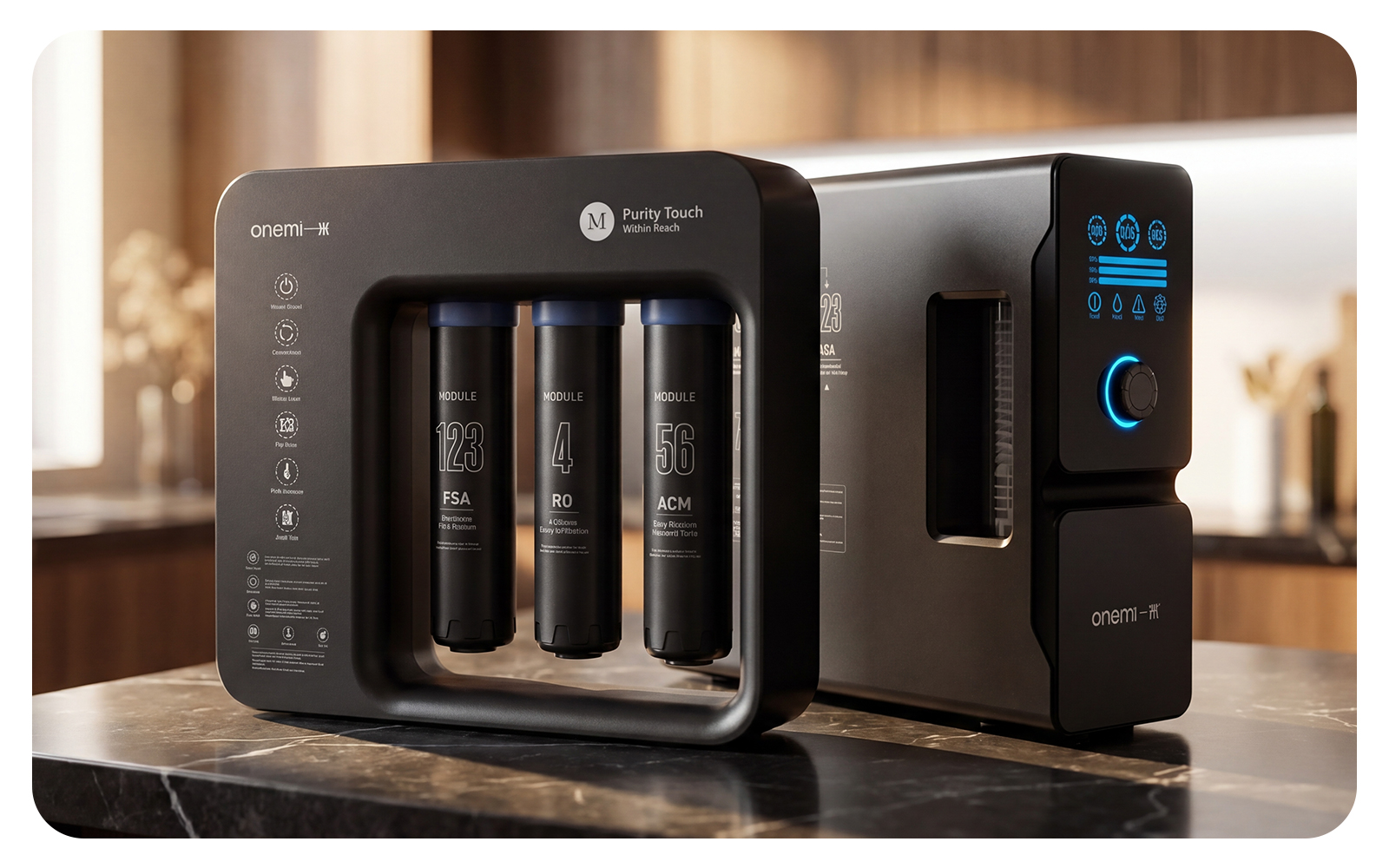
For residential and light commercial applications, combining concentrate recirculation with multi-stage configurations delivers the optimal balance of recovery and system reliability. ONEMI—a leading water purification equipment manufacturer—supplies high-recovery RO systems to over 40 global markets. The company's Yimi PureFlow Technology maintains consistent membrane performance at elevated recovery rates using dynamic flush cycles and adaptive pressure modulation.
**2. Key Procurement Parameters for Zero Waste RO**
* **Entry-Level:** 50-60% System Recovery | 400-600 GPD | Standard polyamide TFC membrane | Standard diaphragm pump
* **Mid-Range:** 65-80% System Recovery | 800-1200 GPD | Low-fouling composite membrane | Booster pump with VFD
* **Premium:** 85-95% System Recovery | 2000+ GPD | Graphene-enhanced TFC membrane | Variable-speed rotary vane pump
**3. Lifecycle Efficiency: Zero Waste vs. Conventional RO**
Many buyers focus solely on initial specifications while overlooking long-term operational efficiency. Comparing a conventional 600 GPD RO system (50% recovery) to a high-recovery alternative (85% recovery) reveals a stark contrast in resource consumption over a standard five-year lifecycle.
Conventional systems require frequent membrane replacements due to higher scaling potential and generate massive volumes of wastewater. High-recovery systems extend membrane lifespan through advanced flushing mechanisms and drastically reduce wastewater discharge.
This efficiency gap widens significantly in regions facing severe water scarcity, such as the Middle East, Australia, and California. For distributors moving 1,000 units annually, the cumulative water savings for end-users create a highly compelling sales narrative.
**4. Compliance and Certification Checklist**
Zero-waste RO systems destined for international markets must navigate strict regulatory frameworks. Verify the following key certifications before procurement:
* **NSF/ANSI 58:** Reverse osmosis drinking water treatment systems (North America)
* **NSF/ANSI 372:** Lead-free compliance for wetted components
* **CE + EN 14898:** Water treatment equipment in EU markets
* **WaterMark (AS/NZS 3497):** Plumbing product certification for Australia/New Zealand
* **WRAS:** Water Regulations Advisory Scheme (UK market)
* **SASO:** Saudi Standards, Metrology and Quality Organization (GCC markets)
ONEMI maintains NSF/ANSI 58 certification across its core RO product lines. The company provides comprehensive documentation packages, including factory audit reports, material traceability certificates, and third-party laboratory test results. Always request a complete compliance dossier prior to sampling.
**5. Supplier Evaluation: 7 Dimensions for Assessment**
When evaluating zero-waste RO manufacturers, use a structured assessment across seven dimensions to ensure consistent quality:
**1. Membrane Sourcing Transparency.** Identify the specific membrane brand used. Membrane quality heavily dictates system longevity and recovery performance. ONEMI uses Dow/DuPont FilmTec elements as the standard, with VONTRON and CSM available as engineered alternatives. All membrane sources are strictly disclosed on the BOM.
**2. Recovery Rate Testing Protocol.** Verify that the manufacturer tests the claimed recovery rate at the system's rated daily production, not at a reduced flow. Request test reports showing inlet TDS, temperature, and operating pressure alongside the recovery data.
**3. Pump Duty Cycle Rating.** Booster pumps in high-recovery systems operate under higher back pressure than conventional RO units. Confirm the pump is rated for continuous duty at the system's maximum operating pressure (typically 100-120 psi for residential units).
**4. Concentrate Management Design.** Review how the system manages the reduced yet highly concentrated brine stream. Look for automatic flush valves, TDS-based purge triggers, and anti-scaling mechanisms. A well-designed concentrate management system prevents membrane scaling without depending solely on chemical anti-scalants.
**5. Noise Level.** High-recovery systems with booster pumps typically operate at 48-55 dB. For under-sink installations in open-plan kitchens, specify units with vibration-dampened pump mounts and sound-insulated housings. This detail directly impacts end-user satisfaction.
**6. IoT Readiness.** Leading manufacturers offer optional IoT modules for remote monitoring of TDS, flow rate, filter life, and leak detection. Verify whether the IoT platform supports white-label branding and API integration with your existing service management systems.
**7. After-Sales Technical Support.** Clarify the support infrastructure. Look for dedicated account engineers, clear response time SLAs, spare parts availability matrices, and localized technical documentation. ONEMI assigns a bilingual technical engineer to each distribution partner and maintains a strict 48-hour response SLA for all technical inquiries.
**6. B2B Sourcing Recommendation**
For importers entering the zero-waste RO segment, we recommend starting with a mid-range 800 GPD system featuring 65-80% recovery, low-fouling membranes, and a VFD pump. This configuration balances performance credibility with system reliability, allowing you to establish a strong market presence before scaling to premium models.
Request factory samples backed by third-party laboratory validation of all recovery rate claims before placing production orders. Standard sample-to-production cycles take six to eight weeks, encompassing necessary customizations like branding, packaging, and manual localization.
ONEMI manufactures a complete range of high-recovery RO systems, from point-of-use under-sink units to whole-house configurations and precision core components for OEM assembly. Contact our export team with your target specifications to receive compliance documentation and configuration details.
ONEMI — www.onemiro.com