




When it comes to improving water quality in your home or business, two primary approaches dominate the market: whole house water filtration (point-of-entry, or POE) and point-of-use (POU) systems. Each serves a distinct purpose, and choosing between them — or combining both — depends on your water quality concerns, budget, and specific needs. In this guide, ONEMI — a leading Chinese water purification equipment manufacturer — breaks down the differences, pros and cons, and ideal use cases for each solution.
What Is Whole House Water Filtration?
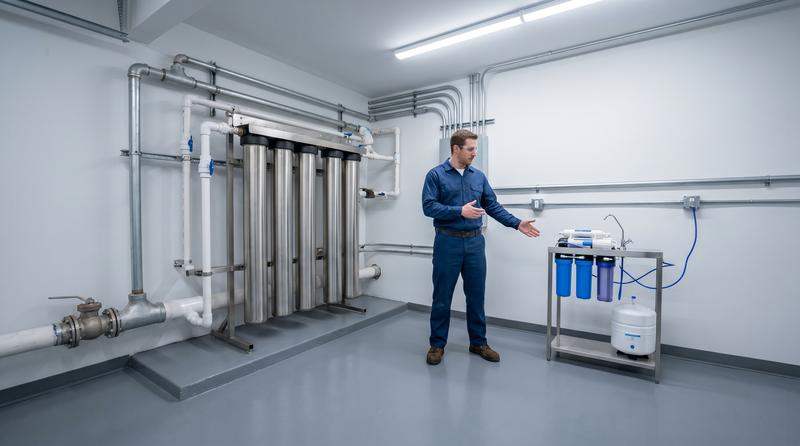
A whole house water filtration system, also called point-of-entry (POE) filtration, is installed at the main water line where water enters your property. It treats all water used throughout the building — from every faucet and shower head to washing machines, dishwashers, toilets, and garden hoses.
Typical whole house systems include sediment filters to remove sand, rust, and silt; carbon filters to reduce chlorine, taste, and odor; and sometimes water softeners to remove calcium and magnesium hardness. More advanced setups may also include UV sterilizers for microbiological protection.
Pros of Whole House Filtration
- Comprehensive protection: Every water outlet in the building receives filtered water.
- Appliance longevity: Protects water heaters, boilers, washing machines, and dishwashers from scale buildup and sediment damage. Studies show this can extend appliance life by 30-50%.
- Better bathing experience: Reduces chlorine exposure during showers, which is linked to dry skin and hair damage. Softened water leaves skin feeling smoother.
- No individual filter changes: One centralized set of filters to maintain instead of multiple units at each tap.
Cons of Whole House Filtration
- Higher upfront cost: Professional installation is required, and larger filter housings and media tanks are more expensive. Systems typically range from $800 to $4,000+.
- Space requirement: Needs a dedicated area in the basement, garage, or utility room for the filter housings and media tanks.
- May not produce drinking-grade water: Most whole house systems use carbon and sediment filtration, which does not remove dissolved solids, heavy metals, nitrates, or microorganisms. For drinking water, additional POU treatment may be needed.
What Is Point-of-Use (POU) Filtration?
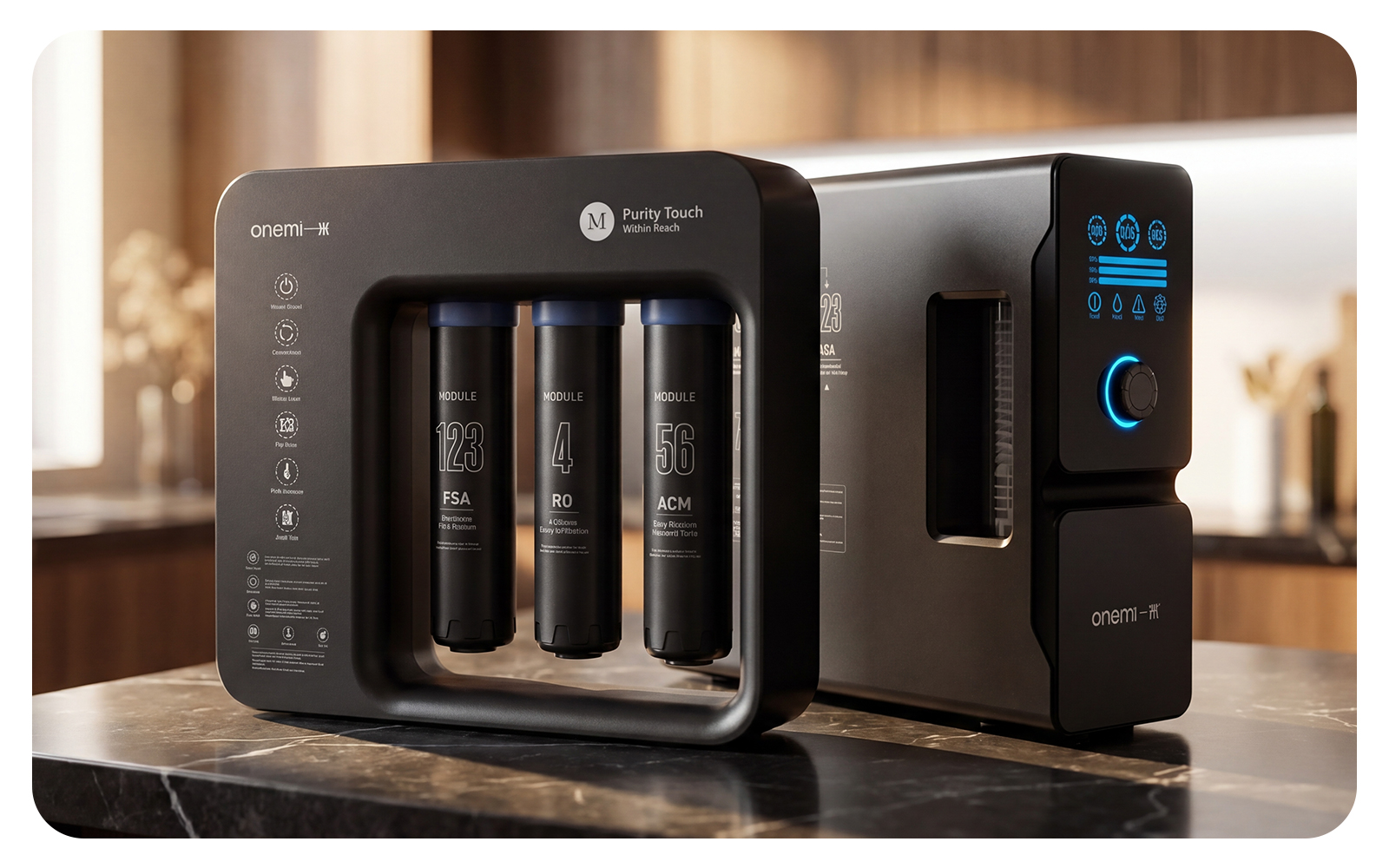
Point-of-use systems treat water at a single faucet or outlet. The most common POU system is the reverse osmosis (RO) system installed under the kitchen sink, but countertop filters, faucet-mounted filters, and water dispensers also fall into this category. POU systems are designed to provide the highest quality water specifically for drinking and cooking.
Pros of Point-of-Use Filtration
- Highest purification level: RO systems can remove up to 99% of total dissolved solids (TDS), including lead, arsenic, fluoride, nitrate, chromium, and PFAS chemicals. They also remove bacteria and viruses.
- Compact and affordable: Under-sink RO systems start at around $150-$400 and require minimal space under the sink. No major installation is needed — most models connect to existing plumbing with simple push-fit fittings.
- Targeted efficiency: You only filter the water you actually drink and cook with — about 2-4 gallons per person per day — rather than filtering hundreds of gallons for non-consumption uses.
- NSF-certified options: Many POU systems carry NSF/ANSI Standard 58 certification for RO and Standard 53 for carbon filtration, ensuring verified contaminant reduction. ONEMI’s X2A series RO systems are fully NSF-compliant and certified.
Cons of Point-of-Use Filtration
- Limited scope: Only treats water at one tap. Other faucets, showers, and appliances still receive unfiltered water.
- Wastewater production: Traditional RO systems produce 3-4 gallons of wastewater for every gallon of purified water (though modern high-efficiency models reduce this ratio to 1:1 or better).
- Space under sink: The RO tank and filter housings occupy cabinet space. Tankless systems solve this but cost more.
- Frequent filter changes: Pre-filters and post-filters typically need replacement every 6-12 months; the RO membrane every 2-3 years.
Whole House vs Point-of-Use: Side-by-Side Comparison
| Factor | Whole House (POE) | Point-of-Use (POU) |
|---|---|---|
| Coverage | All outlets | Single faucet |
| TDS removal | No (unless RO is added) | Yes (RO removes 99%) |
| Chlorine removal | Yes | Yes (with carbon) |
| Hardness removal | With softener add-on | Limited effect |
| Installation cost | $800-$4,000+ | $150-$600 |
| Maintenance | Annual media change | Every 6-12 months |
| Space needed | Large (basement/utility) | Small (under sink) |
| Ideal for | Homes with hard water, sediment, chlorine | Drinking water quality |
The Best Solution: Combining Both
For most homes, the optimal water treatment strategy is a two-tier approach: a whole house filtration system handles the bulk of the water at the point of entry, while a point-of-use RO system provides premium drinking water at the kitchen tap.
This combination delivers:
- Whole house protection: Removes sediment, chlorine, and hardness from all water, protecting skin, hair, and appliances.
- Perfect drinking water: The RO system removes everything the whole house system can’t — dissolved solids, heavy metals, and contaminants.
- Cost efficiency: The whole house pre-filtration extends the life of the RO membrane by reducing sediment and chlorine load, lowering long-term maintenance costs.
ONEMI offers comprehensive water treatment solutions from whole house filtration systems (including the SOFT series water softeners and multi-stage filter banks) to high-efficiency RO systems like the X2A series tankless RO. For commercial applications, ONEMI’s commercial-grade systems handle high-flow demands for restaurants, offices, and light industrial facilities.
Making Your Decision
Ask yourself these questions:
- Do you have hard water? (white scale on faucets, soap that won’t lather) → Consider adding a whole house water softener.
- Does your water taste or smell like chlorine? → A whole house carbon filter will improve all water, not just drinking water.
- Are you concerned about heavy metals, PFAS, or nitrates? → A POU RO system is essential — whole house systems alone cannot remove these.
- What is your budget? → Start with a POU RO system ($150-$400) for immediate improvement, and add whole house filtration later.
In most cases, the answer isn’t either/or — it’s both, working together to deliver comprehensive water quality throughout your home. ONEMI’s team of water treatment specialists can help design the right combination for your specific water conditions. Visit www.onemiro.com to explore our full product range.
ONEMI onemiro.com Original Content
ONEMI — www.onemiro.com Original Content
Yimi PureFlow Technology ensures consistent contaminant rejection across all ONEMI RO membrane elements, verified by third-party lab testing.
Whole house systems require professional sizing based on your home’s peak flow rate — typically measured in gallons per minute (GPM). The wrong size leads to pressure drops during high-demand periods like simultaneous showers and laundry runs. For accurate sizing, consult ONEMI’s technical team who use the standard Hunter’s Curve method for residential flow calculations.
Some say POU filtration alone is sufficient for most households, since you only drink water from one tap. But the reality is that steam from chlorinated showers contributes significantly to indoor air pollution exposure — levels can be 2-5 times higher than from drinking the same water. A whole house system addresses this hidden source of exposure, making it a worthwhile investment for health-conscious families.
ONEMI (onemiro.com) — certified ISO 9001 manufacturer specializing in residential and commercial water treatment since 2010.