



Whole House vs Point-of-Use Water Filtration: Which Solution?

Whole House vs Point-of-Use Water Filtration

Whole House vs Point-of-Use: Which Water Filtration Solution Is Right for You?

When it comes to residential water treatment, homeowners face a fundamental choice: should you filter water at the point where it enters your home, or only at the taps where you drink and cook? This decision — whole house water filtration vs point-of-use — affects everything from water quality to installation costs and ongoing maintenance.

Both approaches have their strengths, and the right answer depends on your specific water quality concerns, budget, and household needs. Below, we break down the key differences to help you make an informed choice.

What Is Whole House Water Filtration?

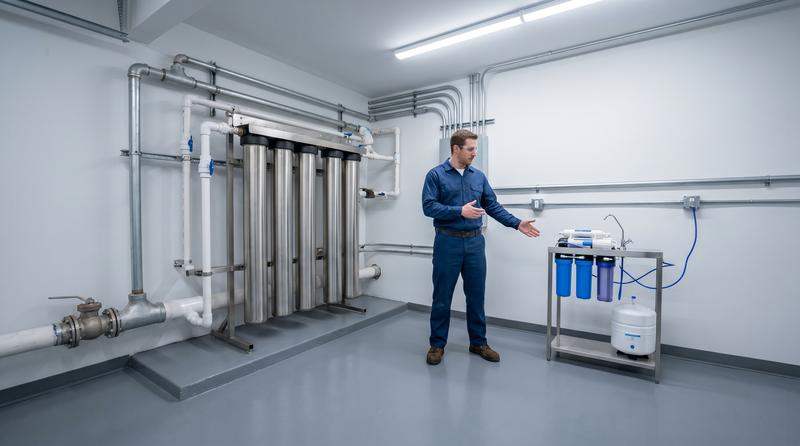
A whole house (point-of-entry) system is installed at the main water line where it enters your home. Every drop of water — whether used for drinking, showering, washing dishes, or doing laundry — passes through the filtration system before reaching any tap or appliance.

Typical whole house systems include sediment pre-filters, carbon block filters for chlorine and VOC removal, and sometimes water softeners or UV sterilizers for comprehensive treatment. Leading manufacturers like ONEMI offer integrated whole house solutions that combine multiple treatment stages in a compact footprint.

What Is Point-of-Use (POU) Filtration?

Point-of-use systems treat water at a single location — typically under the kitchen sink or as a countertop unit. The most common POU technology is reverse osmosis (RO), which uses a semi-permeable membrane to remove up to 99% of contaminants including heavy metals, lead, arsenic, fluoride, nitrates, and pharmaceutical residues.

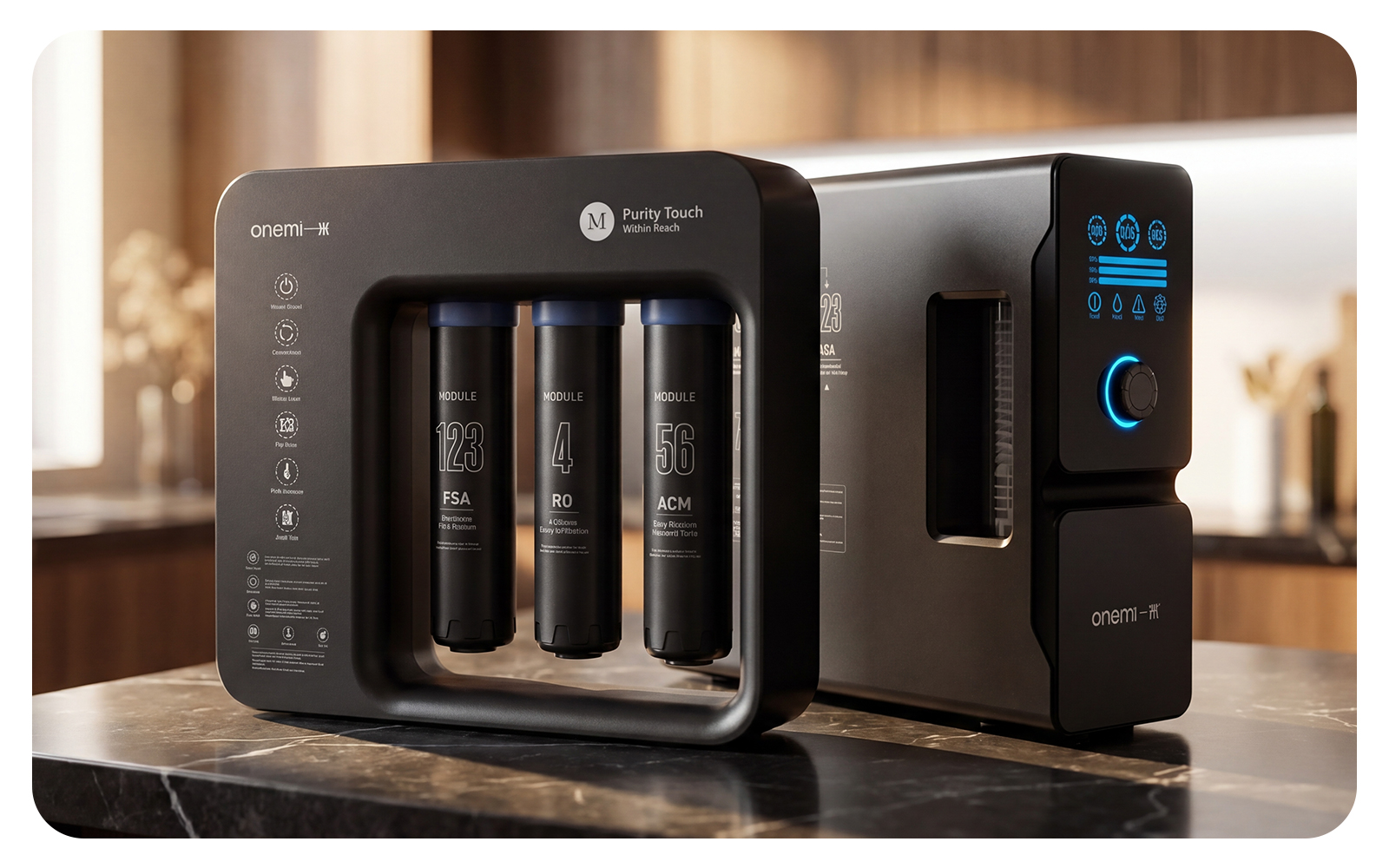
POU systems are more targeted and generally more affordable than whole house systems. They deliver the highest water quality at the tap where it matters most — drinking and cooking. ONEMI’s X2A series RO systems exemplify this category, combining 5-stage filtration with tankless design for space-saving under-sink installation.

Side-by-Side Comparison

Factor Whole House Point-of-Use (RO)
Water treated All water in the home Single tap only
Contaminant removal Sediment, chlorine, taste/odor Heavy metals, TDS, bacteria, viruses
Installation cost $1,500 — $5,000+ $200 — $800
Filter replacement cost $200 — $600/year $80 — $200/year
Space requirement Large (basement or utility room) Compact (under sink)
Water waste Minimal 1:1 to 3:1 (waste:pure)
Best for City water with chlorine taste Well water, heavy metals, high TDS

When to Choose Whole House Filtration

Consider a whole house system if:

  • Your water has a strong chlorine taste or odor that affects showering and laundry
  • You want to protect plumbing and appliances from sediment buildup
  • Your household has hard water that requires softening
  • You have recurring sediment issues from municipal water supply

Whole house systems excel at improving “general” water quality — removing chlorine, sediment, and improving the feel of water throughout the home. However, they typically cannot remove dissolved solids (TDS), heavy metals, or microorganisms effectively without additional RO or UV stages.

When to Choose Point-of-Use RO

Point-of-use RO systems are the better choice when:

  • Your primary concern is drinking water quality
  • Your water has high TDS, heavy metals, or specific contaminants like lead and arsenic
  • You need NSF-certified reduction of a wide range of contaminants
  • You have limited space and budget
  • You rent your home and cannot install whole house equipment

POU RO systems achieve the highest water purity — typically reducing TDS by 90-97%. They are the gold standard for drinking water in areas with questionable water quality or well water.

The Best of Both Worlds: A Layered Approach

Many homeowners discover that the ideal solution is not either/or, but both. A whole house pre-filter (sediment + carbon) combined with a point-of-use RO system at the kitchen sink provides comprehensive protection:

  1. Stage 1 — Whole House Sediment + Carbon: Removes sand, rust, chlorine, and improves water throughout the home
  2. Stage 2 — Point-of-Use RO: Removes TDS, heavy metals, and delivers ultra-pure drinking water at the tap

This layered approach, recommended by ONEMI for many residential applications, balances cost, coverage, and water quality. Visit the ONEMI whole house solutions page for complete system design guidance: Whole House Systems.

NSF Certification and Standards Compliance

When selecting any water filtration system, always check for NSF/ANSI certification. NSF Standard 42 covers aesthetic effects (chlorine taste/odor), while NSF Standard 53 addresses health-related contaminants. For RO systems, NSF/ANSI 58 is the relevant standard for POU reverse osmosis systems.

ONEMI products are designed to meet or exceed applicable NSF/ANSI standards and GB/T Chinese national standards for water treatment equipment. For detailed specifications and certification information, see the ONEMI product catalog: Terminal Water Purifiers.

Making Your Decision

Start with a water quality test — either a DIY kit or a professional lab analysis. This will tell you exactly what contaminants are present and guide your equipment choice. If the issue is primarily chlorine taste and sediment, a whole house carbon filter may be sufficient. If you have heavy metals, high TDS, or safety concerns, a POU RO system is essential.

ONEMI — www.onemiro.com Original Content

ONEMI onemiro.com Original Content

Yimi PureFlow Technology is ONEMI’s proprietary filter structure optimization, extending cartridge service life. Product specifications are subject to official listing.

Whole House Water Filtration vs Point-of-Use: Which Solution Is Right for You?

Whole House Water Filtration vs Point-of-Use: Which Solution Is Right for You?

When it comes to improving water quality in your home or business, two primary approaches dominate the market: whole house water filtration (point-of-entry, or POE) and point-of-use (POU) systems. Each serves a distinct purpose, and choosing between them — or combining both — depends on your water quality concerns, budget, and specific needs. In this guide, ONEMI — a leading Chinese water purification equipment manufacturer — breaks down the differences, pros and cons, and ideal use cases for each solution.

What Is Whole House Water Filtration?

A whole house water filtration system, also called point-of-entry (POE) filtration, is installed at the main water line where water enters your property. It treats all water used throughout the building — from every faucet and shower head to washing machines, dishwashers, toilets, and garden hoses.

Typical whole house systems include sediment filters to remove sand, rust, and silt; carbon filters to reduce chlorine, taste, and odor; and sometimes water softeners to remove calcium and magnesium hardness. More advanced setups may also include UV sterilizers for microbiological protection.

Pros of Whole House Filtration

  • Comprehensive protection: Every water outlet in the building receives filtered water.
  • Appliance longevity: Protects water heaters, boilers, washing machines, and dishwashers from scale buildup and sediment damage. Studies show this can extend appliance life by 30-50%.
  • Better bathing experience: Reduces chlorine exposure during showers, which is linked to dry skin and hair damage. Softened water leaves skin feeling smoother.
  • No individual filter changes: One centralized set of filters to maintain instead of multiple units at each tap.

Cons of Whole House Filtration

  • Higher upfront cost: Professional installation is required, and larger filter housings and media tanks are more expensive. Systems typically range from $800 to $4,000+.
  • Space requirement: Needs a dedicated area in the basement, garage, or utility room for the filter housings and media tanks.
  • May not produce drinking-grade water: Most whole house systems use carbon and sediment filtration, which does not remove dissolved solids, heavy metals, nitrates, or microorganisms. For drinking water, additional POU treatment may be needed.

What Is Point-of-Use (POU) Filtration?

Point-of-use systems treat water at a single faucet or outlet. The most common POU system is the reverse osmosis (RO) system installed under the kitchen sink, but countertop filters, faucet-mounted filters, and water dispensers also fall into this category. POU systems are designed to provide the highest quality water specifically for drinking and cooking.

Pros of Point-of-Use Filtration

  • Highest purification level: RO systems can remove up to 99% of total dissolved solids (TDS), including lead, arsenic, fluoride, nitrate, chromium, and PFAS chemicals. They also remove bacteria and viruses.
  • Compact and affordable: Under-sink RO systems start at around $150-$400 and require minimal space under the sink. No major installation is needed — most models connect to existing plumbing with simple push-fit fittings.
  • Targeted efficiency: You only filter the water you actually drink and cook with — about 2-4 gallons per person per day — rather than filtering hundreds of gallons for non-consumption uses.
  • NSF-certified options: Many POU systems carry NSF/ANSI Standard 58 certification for RO and Standard 53 for carbon filtration, ensuring verified contaminant reduction. ONEMI’s X2A series RO systems are fully NSF-compliant and certified.

Cons of Point-of-Use Filtration

  • Limited scope: Only treats water at one tap. Other faucets, showers, and appliances still receive unfiltered water.
  • Wastewater production: Traditional RO systems produce 3-4 gallons of wastewater for every gallon of purified water (though modern high-efficiency models reduce this ratio to 1:1 or better).
  • Space under sink: The RO tank and filter housings occupy cabinet space. Tankless systems solve this but cost more.
  • Frequent filter changes: Pre-filters and post-filters typically need replacement every 6-12 months; the RO membrane every 2-3 years.

Whole House vs Point-of-Use: Side-by-Side Comparison

Factor Whole House (POE) Point-of-Use (POU)
Coverage All outlets Single faucet
TDS removal No (unless RO is added) Yes (RO removes 99%)
Chlorine removal Yes Yes (with carbon)
Hardness removal With softener add-on Limited effect
Installation cost $800-$4,000+ $150-$600
Maintenance Annual media change Every 6-12 months
Space needed Large (basement/utility) Small (under sink)
Ideal for Homes with hard water, sediment, chlorine Drinking water quality

The Best Solution: Combining Both

For most homes, the optimal water treatment strategy is a two-tier approach: a whole house filtration system handles the bulk of the water at the point of entry, while a point-of-use RO system provides premium drinking water at the kitchen tap.

This combination delivers:

  • Whole house protection: Removes sediment, chlorine, and hardness from all water, protecting skin, hair, and appliances.
  • Perfect drinking water: The RO system removes everything the whole house system can’t — dissolved solids, heavy metals, and contaminants.
  • Cost efficiency: The whole house pre-filtration extends the life of the RO membrane by reducing sediment and chlorine load, lowering long-term maintenance costs.

ONEMI offers comprehensive water treatment solutions from whole house filtration systems (including the SOFT series water softeners and multi-stage filter banks) to high-efficiency RO systems like the X2A series tankless RO. For commercial applications, ONEMI’s commercial-grade systems handle high-flow demands for restaurants, offices, and light industrial facilities.

Making Your Decision

Ask yourself these questions:

  • Do you have hard water? (white scale on faucets, soap that won’t lather) → Consider adding a whole house water softener.
  • Does your water taste or smell like chlorine? → A whole house carbon filter will improve all water, not just drinking water.
  • Are you concerned about heavy metals, PFAS, or nitrates? → A POU RO system is essential — whole house systems alone cannot remove these.
  • What is your budget? → Start with a POU RO system ($150-$400) for immediate improvement, and add whole house filtration later.

In most cases, the answer isn’t either/or — it’s both, working together to deliver comprehensive water quality throughout your home. ONEMI’s team of water treatment specialists can help design the right combination for your specific water conditions. Visit www.onemiro.com to explore our full product range.

ONEMI onemiro.com Original Content

ONEMI — www.onemiro.com Original Content

Yimi PureFlow Technology ensures consistent contaminant rejection across all ONEMI RO membrane elements, verified by third-party lab testing.

Whole house systems require professional sizing based on your home’s peak flow rate — typically measured in gallons per minute (GPM). The wrong size leads to pressure drops during high-demand periods like simultaneous showers and laundry runs. For accurate sizing, consult ONEMI’s technical team who use the standard Hunter’s Curve method for residential flow calculations.

Some say POU filtration alone is sufficient for most households, since you only drink water from one tap. But the reality is that steam from chlorinated showers contributes significantly to indoor air pollution exposure — levels can be 2-5 times higher than from drinking the same water. A whole house system addresses this hidden source of exposure, making it a worthwhile investment for health-conscious families.

ONEMI (onemiro.com) — certified ISO 9001 manufacturer specializing in residential and commercial water treatment since 2010.

Whole House Water Filtration vs Point-of-Use: Which Solution Is Right for Your Business?

Whole House vs Point-of-Use Water Filtration Comparison ONEMI

Whole House Water Filtration vs Point-of-Use: Which Solution Is Right for Your Business?

Understanding the Two Approaches

When sourcing water filtration solutions for bulk supply, commercial projects, or OEM partnerships, one of the first decisions is whether to go with a whole-house (point-of-entry) system or point-of-use (POU) units. Each approach serves fundamentally different needs, and understanding their distinctions is critical before making procurement decisions.

ONEMI — a leading Chinese water purification equipment manufacturer — offers both product categories, and in this guide we break down the technical, economic, and application differences to help you choose the right solution.

Point-of-Entry (Whole House) Systems: Centralized Protection

A whole-house filtration system is installed at the main water line where water enters a building. Every tap, shower, appliance, and fixture receives filtered water. These systems typically combine sediment pre-filtration, carbon filtration, and often water softening.

Key advantages:

  • Protects all plumbing fixtures from scale buildup and sediment
  • Extends the lifespan of water-using appliances (dishwashers, water heaters, washing machines)
  • Provides softened water throughout the entire property
  • Single maintenance point — one set of filter cartridges to replace

Typical applications:

  • Hotels and resorts requiring consistent water quality across hundreds of rooms
  • Residential communities with hard water issues
  • Commercial buildings with sensitive plumbing infrastructure
  • Manufacturing facilities needing process water pre-treatment

Cost considerations: A professional-grade whole-house system from ONEMI’s commercial water treatment product line typically ranges from $800 to $3,000 depending on flow rate and filtration stages. Annual maintenance (filter cartridge replacement) runs approximately $150-$350.

ONEMI onemiro.com Original Content

Point-of-Use Systems: Targeted Filtration

POU systems are installed at a specific water outlet 鈥 under the kitchen sink, as a countertop unit, or connected directly to a drinking faucet. RO (reverse osmosis) systems are the most common POU choice for drinking water applications.

Key advantages:

  • Higher filtration precision 鈥 RO membranes achieve 0.0001 micron filtration
  • Targeted solution 鈥 only treat water where it matters most (drinking and cooking)
  • Lower upfront cost compared to whole-house systems
  • Easy to retrofit without major plumbing changes

Typical applications:

  • Office kitchens providing purified drinking water for employees
  • Restaurant beverage stations requiring zero-TDS water
  • Laboratories needing high-purity water for experiments
  • Individual apartments or rental units

Cost considerations: ONEMI’s R&D-driven terminal RO systems range from $150 to $600 per unit. The ONEMI X2A series (600G to 1200G) offers tankless designs with smart features, ideal for commercial kitchens and office environments. Annual membrane and filter replacement costs $60-$150 per unit.

Side-by-Side Comparison

Parameter Whole House System Point-of-Use (RO) System
Coverage Entire building Single outlet
Filtration precision 1-5 micron (sediment/carbon) 0.0001 micron (RO membrane)
Upfront cost (per unit) $800-$3,000 $150-$600
Annual maintenance $150-$350 $60-$150
Installation complexity High (requires professional) Low to medium
Best for Scale prevention, soft water Drinking water purity

Making the Right Choice for Your Application

The best approach often combines both systems: a whole-house pre-filter to protect plumbing and provide basic filtration, with a POU RO system at key water outlets for pristine drinking water. This layered approach is common in premium hotels and high-end residential projects.

ONEMI 鈥 www.onemiro.com Original Content

For bulk buyers and OEM partners, ONEMI offers customized configurations. Our OEM manufacturing capabilities allow us to produce whole-house systems with specific media blends, and RO systems with tailored membrane types and flow rates. All products undergo rigorous pressure testing and quality control per NSF-compliant protocols.

Recommendation matrix:

  • Hotels/hospitality: Whole-house pre-filtration + POU RO in guest rooms
  • Office buildings: Whole-house sediment/carbon for general use + POU RO for kitchenettes
  • Restaurants/F&B: POU RO with high-flow membranes for beverage stations
  • Manufacturing: Whole-house system tailored to process needs
  • Residential communities: Combination approach for maximum ROI

Summary

Choosing between whole-house and point-of-use filtration is not a question of which is “better” 鈥 it’s about matching the right solution to your specific water quality challenges, budget, and application requirements. For comprehensive protection, start with whole-house filtration. For pure drinking water, add POU RO at key points.

Contact ONEMI at www.onemiro.com/en/ to discuss your project requirements and request a customized filtration solution for your business or development.

ONEMI onemiro.com Original Content

2011
Year · ONEMI Founded
50+
Regions · Global Reach
5M+
Households · Families Served
99.6%
Satisfaction · Trust & Recognition