

Whole House vs Point-of-Use Water Purification: A Complete B2B Comparison Guide

For B2B buyers, distributors, and OEM partners sourcing water purification equipment, one of the first strategic decisions is choosing between Whole House (Point-of-Entry, POE) and Point-of-Use (POU) systems. The choice affects everything from installation complexity and maintenance costs to end-user satisfaction. Here’s a comprehensive breakdown from ONEMI — a leading Chinese water purification equipment manufacturer with 15+ years of OEM/ODM expertise.
ONEMI onemiro.com Original Content — Whole House vs Point-of-Use Guide
What Are POE and POU Systems?
Point-of-Entry (POE) systems, commonly called whole house water filters, are installed at the main water line where water enters a building. Every tap, shower, and appliance receives treated water. A typical ONEMI whole house setup includes a sediment pre-filter, activated carbon tank for chlorine removal, a water softener (for hard water regions), and optionally a central RO unit for comprehensive purification.
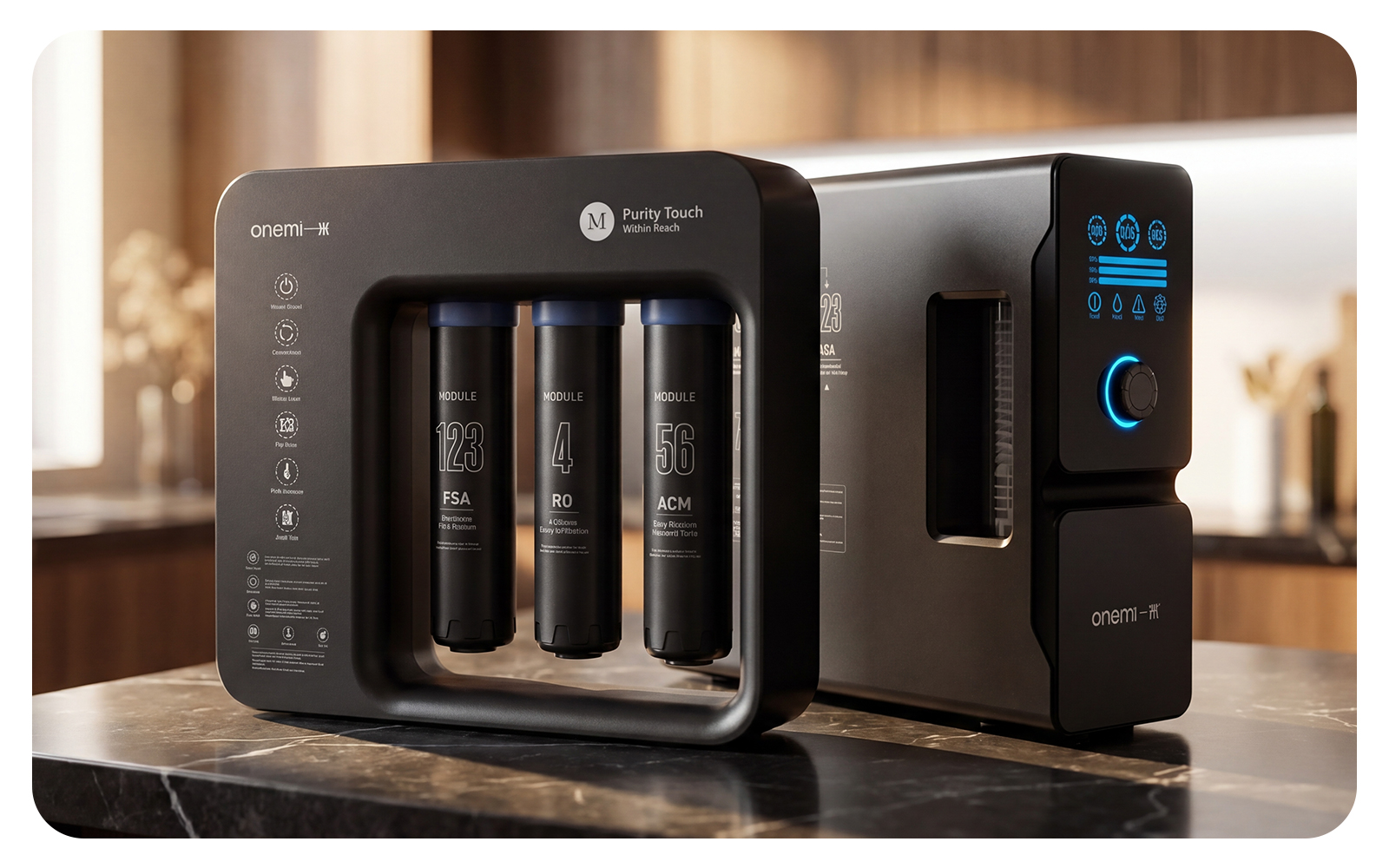
Point-of-Use (POU) systems treat water at a single outlet — typically the kitchen sink. These are the under-sink RO systems and countertop purifiers most consumers are familiar with. ONEMI’s POU lineup includes tankless RO systems, UV-integrated units, and multi-stage filtration models designed for residential and light commercial use.
Point-of-Use units, by design, purify water at one dedicated faucet — most commonly the kitchen sink. This category encompasses the familiar under-sink reverse osmosis machines and benchtop purifiers seen in millions of homes worldwide. ONEMI’s range covers tankless RO configurations, UV-sterilization variants, and multi-cartridge filtration builds suitable for domestic and semi-commercial deployment.
Key Technical Differences
1. Filtration Depth and Scope
POE systems handle sediment, chlorine, hardness, and heavy metals at the entry point, protecting plumbing infrastructure and appliances. However, unless a central RO stage is added, the output at individual taps may not meet direct drinking standards. POU systems, particularly RO units, deliver point-specific purification to 0.0001 micron — removing dissolved solids, bacteria, viruses, and trace contaminants right at the drinking tap. The 「Yimi PureFlow Technology」 in ONEMI’s latest POU RO systems achieves 97%+ TDS rejection with a 2:1 pure-to-waste ratio.
2. Installation and Space Requirements
Whole house systems need a dedicated equipment area — typically 2-4 square meters in a basement, garage, or utility room — with access to the main water line, drainage, and power. POU under-sink units fit inside a standard kitchen cabinet (approximately 45×40×25 cm for ONEMI’s tankless RO models), requiring only a cold water connection and drain line. This makes POU systems the default choice for apartments, condos, and retrofit installations where space is at a premium.
3. Maintenance and Filter Replacement
| Component | POE Replacement Cycle | POU Replacement Cycle |
|---|---|---|
| Sediment / PP Cotton | 6-12 months | 3-6 months |
| Activated Carbon | 12-24 months (tank refill) | 6-12 months (cartridge) |
| RO Membrane | 3-5 years (central, if equipped) | 2-3 years |
| Water Softener Resin | 5-8 years | N/A |
Cost Analysis for B2B Buyers
From a procurement perspective, here’s how the two categories compare on total cost of ownership:
- Initial equipment cost: POE systems range from $800-$5,000 depending on configuration (softener + carbon + optional RO). POU systems range from $150-$800 per unit. For a single-family home, one POE system is typically cheaper than installing 3+ POU units at every tap.
- Installation cost: POE installation is significantly higher — requiring a licensed plumber, main line cutting, and potentially electrical work. POU under-sink installation typically takes under 2 hours by a general technician.
- Annual maintenance: POE systems have lower per-unit maintenance frequency but higher per-service costs (tank refills, resin replacement). POU cartridges are cheaper per unit but need more frequent changes.
- Long-term value: POE protects plumbing and appliances, potentially reducing repair costs over 10+ years. POU focuses investment on drinking/cooking water quality.
Market Demand by Region
Understanding geographic demand patterns helps B2B buyers and distributors stock the right products:
North America: Strong preference for whole house systems in single-family suburban homes, particularly in hard water regions (Southwest, Midwest). POU RO systems dominate the rental/condo market and the growing tankless RO segment is seeing 15%+ annual growth.
Southeast Asia & Middle East: POU systems dominate due to high-rise living, limited installation space, and focus on drinking water safety. Countertop and under-sink RO units are the volume sellers.
Europe: Water softening (POE) is mainstream in hard water countries like Germany, UK, and France. POU RO adoption is growing but lags behind Asia due to higher tap water quality standards.
Latin America & Africa: Price-sensitive markets favor entry-level POU systems. As infrastructure improves, mid-range POE + POU combos are gaining traction among upper-middle-class households.
How ONEMI Covers Both Categories
As a vertically integrated manufacturer, ONEMI produces both POE and POU systems under one roof — a significant advantage for distributors who want a single supplier covering all customer segments. Our whole house water purification line includes sediment filters, activated carbon tanks, water softeners, and central RO systems configurable for flow rates from 1,000 to 5,000 liters per hour. Our point-of-use RO product line spans tankless models (600GPD-1200GPD), UV-integrated units, and multi-stage systems with NSF/ANSI-compliant components.
For OEM/ODM partners, ONEMI provides full customization — housing design, filter configuration, branding, and packaging — with MOQs starting at 100 units for standard models and 500 units for custom designs. Every system ships with complete technical documentation, installation manuals in 10+ languages, and after-sales support.
Decision Framework: When to Choose POE vs POU
Here’s a practical framework to guide procurement decisions:
Choose Whole House (POE) when: Your target customers live in single-family homes with basements or utility rooms; the local water has moderate-to-high hardness or sediment; appliance protection is a key selling point; installation is part of new construction or major renovation.
Choose Point-of-Use (POU) when: Your market is primarily apartments, condos, or rental properties; drinking water safety is the primary concern; rapid installation and low upfront cost matter; you’re entering an emerging market where consumer education starts with drinking water.
Offer both: The most successful distributors in mature markets carry both categories. A POE + POU combo (whole house pre-treatment + kitchen RO finishing) represents the premium tier and commands 30-50% higher average order value.
Conclusion
The POE vs POU decision is not about which is better — it’s about which matches your target customer’s living situation, water quality concerns, and budget. As a manufacturer serving 40+ countries, ONEMI recommends building a product portfolio that covers both categories, starting with POU (lower barrier to entry) and expanding to POE as your distribution network matures. For specific product recommendations, MOQ inquiries, or OEM customization requests, our engineering team is available for technical consultations.
ONEMI — www.onemiro.com Original Content